Thank you for visiting SNEWPapers!
Sign up free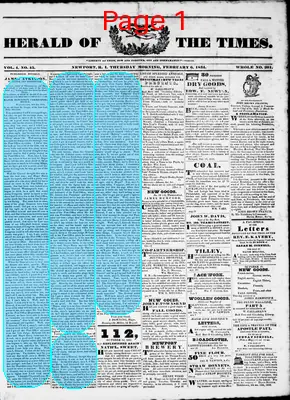
Letter to Editor
February 6, 1834
Herald Of The Times
Newport, Newport County, Rhode Island
What is this article about?
Satirical correspondence from 'Major Downing' to Mr. Dwight, detailing fictional discussions with President Jackson on the U.S. Post Office's financial deficits under Postmaster Barry, attributing issues to borrowing, bank deposits, and the costs of 'Glory' and 'Reform' in the Jackson administration.
Clipping
OCR Quality
95%
Excellent
Full Text
JAMES ATKINSON,
PUBLISHER AND PROPRIETOR.
OFFICE, corner of Thames-street and Sherman's wharf, a few doors south of the Brick-market. Entrance first door down the wharf.
Terms
$2 in advance, or $2.25 at the end of the year.
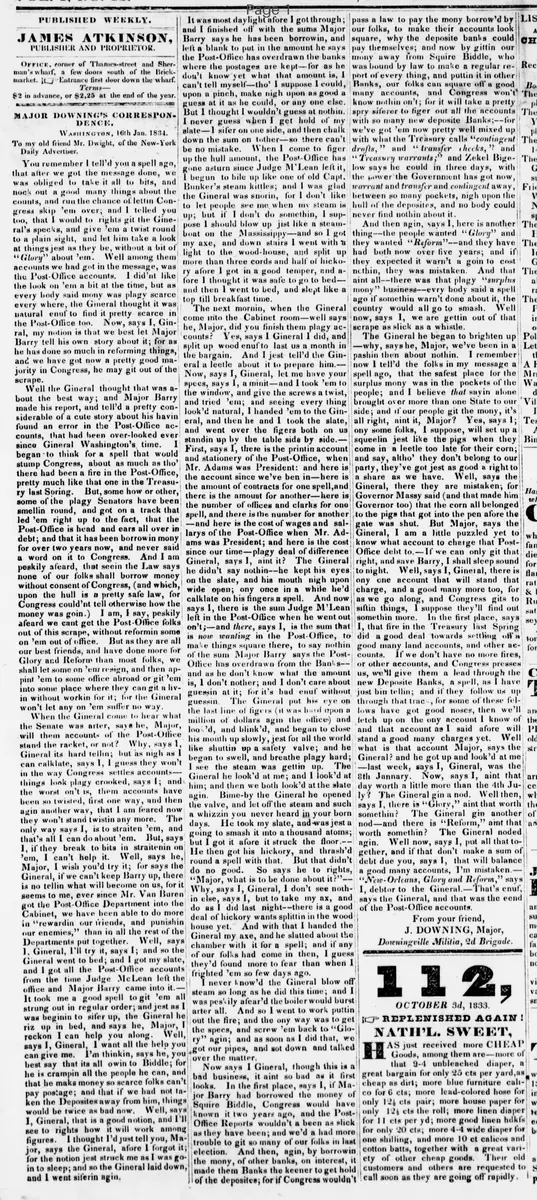
MAJOR DOWNING'S CORRESPONDENCE.
Washington, 16th Jan. 1834.
To my old friend Mr. Dwight, of the New-York Daily Advertiser.
You remember I tell'd you a spell ago that after we got the message done, we was obliged to take it all to bits, and nock out a good many things about the counts, and run the chance of lettin Congress skip 'em over; and I telled you too, that I would to rights git the General's specks, and give 'em a twist round to a plain sight, and let him take a look at things jest as they be, without a bit of "Glory" about 'em. Well among them accounts we had got in the message, was the Post-Office accounts. I did'nt like the look on 'em a bit at the time, but as every body said mony was plagy scarce every where, the General thought it was natural enuf to find it pretty scarce in the Post-Office too. Now, says I, General, my notion is that we best let Major Barry tell his own story about it; for as he has done so much in reforming things, and we have got now a pretty good majority in Congress, he may git out of the scrape.
Well the General thought that was about the best way; and Major Barry made his report, and tell'd a pretty considerable of a cute story about his havin found an error in the Post-Office accounts, that had been over-looked ever since General Washington's time. I began to think for a spell that would stump Congress, about as much as tho' there had been a fire in the Post-Office, pretty much like that one in the Treasury last Spring. But, some how or other, some of the plagy Senators have been smellin round, and got on a track that led 'em right up to the fact, that the Post-Office is head and ears all over in debt; and that it has been borrowin mony for over two years now, and never said a word on it to Congress. And I am peskily afeard, that seein the Law says none of our folks shall borrow money without consent of Congress, (and which upon the hull is a pretty safe law, for Congress couldn't tell otherwise how the money was goin.) I am, I say, peskily afeard we cant get the Post-Office folks out of this scrape, without reformin some on 'em out of office. But as they are all our best friends, and have done more for Glory and Reform than most folks, we shall let some on 'em resign, and then appoint 'em to some office abroad or git 'em into some place where they can git a livin without workin for it; for the General won't let any on 'em suffer no way.
When the General come to hear what the Senate was arter, says he, Major, will them accounts of the Post-Office stand the racket, or not? Why, says I, General its hard tellin; but as nigh as I can calklate, says I, I guess they won't in the way Congress settles accounts-- things look plagy crooked, says I; and the worst on't is, them accounts have been so twisted, first one way, and then agin another way, that I am feared now they won't stand twistin any more. The only way says I, is to straiten 'em, and that's all I can do about 'em. But, says I, if they break to bits in straitenin on 'em, I can't help it. Well, says he, Major, I wish you'd try it; for says the General, if we can't keep Barry up, there is no tellin what will become on us, for it seems to me, ever since Mr. Van Buren got the Post-Office Department into the Cabinet, we have been able to do more in "rewardin our friends, and punishin our enemies," than in all the rest of the Departments put together. Well, says I, General, I'll try it, says I; and so the General went to bed; and I got my slate, and I got all the Post-Office accounts from the time Judge McLean left the office and Major Barry came into it.
It took me a good spell to git 'em all strung out in regular order; and jest as I was beginin to sifer up, the General he riz up in bed, and says he, Major, I reckon I can help you along. Well, says I, General, I want all the help you can give me. I'm thinkin, says he, you best say that its all owin to Biddle; for he is crampin all the people he can, and that he makes money so scarce folks can't pay postage; and that if we had not taken the Deposites away from him, things would be twice as bad now. Well, says I, General, that is a good notion, and I'll see to rights how it will work among figures. I thought I'd just tell you, Major, says the General, afore I forgot it; for the notion jest struck me as I was goin to sleep; and so the General laid down, and I went siferin agin,
It was most daylight afore I got through; and I finished off with the sums Major Barry says he has been borrowin, and left a blank to put in the amount he says the Post-Office has overdrawn the banks where the postages are kept--for as he don't know yet what that amount is, I can't tell myself--tho' I suppose I could, upon a pinch, make nigh upon as good a guess at it as he could, or any one else. But I thought I wouldn't guess at nothin. I never guess when I get hold of my slate--I sifer on one side, and then chalk down the sum on tother--so there can't be no mistake. When I come to figer up the hull amount, the Post-Office has gone asturn since Judge M'Lean left it, I begun to bile up like one of old Capt. Bunker's steam kittles; and I was glad the General was snorin, for I don't like to let people see me when my steam is up; but if I don't do somethin, I suppose I should blow up jist like a steamboat on the Mississippy--and so I got my axe, and down stairs I went with a light to the wood-house, and split up more than three cords and half of hickory afore I got in a good temper, and afore I thought it was safe to go to bed-- and then I went to bed, and slept like a top till breakfast time.
The next mornin, when the General come into the Cabinet room--well says he, Major, did you finish them plagy accounts? Yes, says I General I did, and split up wood enuf to last us a month in the bargain. And I jest tell'd the General a leetle about it to prepare him.-- Now, says I, General, let me have your specs, says I, a minit--and I took 'em to the window, and give the screws a twist. and tried 'em; and seeing every thing look'd natural, I handed 'em to the General, and then he and I took the slate, and went over the figers both on us standin up by the table side by side.-- First, says I, there is the printin account and stationery of the Post-Office, when Mr. Adams was President: and here is the account since we've ben in--here is the amount of contracts for one spell, and there is the amount for another--here is the number of offices and clarks for one spell, and there is the number for another and here is the cost of wages and salaries of the Post-Office when Mr. Adams was President; and here is the cost since our time--plagy deal of difference General, says I, aint it? The General he didn't say nothin--he kept his eyes on the slate, and his mouth nigh upon wide open; ony once in a while he'd calklate on his fingers a spell. And now says I, there is the sum Judge M'Lean left in the Post-Office when he went out on't;--and there, says I, is the sum that is now wanting in the Post-Office, to make things square there, to say nothin of the sum Major Barry says the Post-Office has overdrawn from the Banks-- and as he don't know what the amount is, I don't nother; and I don't care about guessin at it; for it's bad enuf without guessin. The General put his eye on the last line of figers (it was hard upon a million of dollars agin the office) and look'd, and blink'd, and began to close his mouth up slowly, jest for all the world like shuttin up a safety valve; and he began to swell, and breathe plagy hard; I see the steam was gettin up. The General he look'd at me; and I look'd at him; and then we both look'd at the slate agin. Bime-by the General he opened the valve, and let off the steam and such a whizzin you never heard in your born days. He took my slate, and was jest a going to smash it into a thousand atoms; but I got it afore it struck the floor.-- He then got his hickory, and thrash'd round a spell with that. "But that didn't do no good. So says he to rights, "Major, what is to be done about it?"-- Why, says I, General, I don't see nothin else, says I, but to take my ax, and do as I did last night--there is a good deal of hickory wants splittin in the wood house yet. And with that I handed the General my axe, and he slatted about the chamber with it for a spell; and if any of our folks had come in then, I guess they'd found more to fear than when I frighted 'em so few days ago.
I never know'd the General blow off steam so long as he did this time; and I was peskily afear'd the boiler would burst arter all. And so I went to work puttin out the fire; and the ony way was to get the specs, and screw 'em back to "Glory" agin; and as soon as I did that, we got our pipes, and sot down and talked over the matter.
Now says I General, though this is a bad business, it aint so bad as it first looks. In the first place, says I, if Major Barry had borrowed the money of Squire Biddle, Congress would have known it two years ago, and the Post-Office Reports wouldn't a been as slick as they have been; and we'd a had more trouble to git so many of our folks in last election. And then, agin, by borrowin the mony, of other banks, on interest, it made them Banks the keener to get hold of the deposites; for if Congress wouldn't pass a law to pay the mony borrow'd by our folks, to make their accounts look square, why the deposite banks could pay themselves; and now by gittin our mony away from Squire Biddle, who was bound by law to make a regular report of every thing, and puttin it in other Banks, our folks can square off a good many accounts, and Congress won't know nothin on't; for it will take a pretty spry siferer to figer out all the accounts with so many new deposite Banks;--for we've got 'em now pretty well mixed up with what the Treasury calls "contingent drafts," and "transfer checks," and "Treasury warrants;" and Zekel Bigelow says he could in three days, with the power the Government has got now, warrant and transfer and contingent away, between so many pockets, nigh upon the hull of the deposites, and no body could never find nothin about it.
And then agin, says I, here is another thing--the people wanted "Glory" and they wanted "Reform"--and they have had both now over five years; and if they expected it warn't a goin to cost nothin, they was mistaken. And that aint all--there was that plagy "surplus mony" business--evry body said a spell ago if somnethin warn't done about it, the country would all go to smash. Well now, says I, we are gettin out of that scrape as slick as a whistle.
The General he began to brighten up --why, says he, Major, we've been in a pashin then about nothin. I remember now I tell'd the folks in my message a spell ago, that the safest place for the surplus mony was in the pockets of the people; and I believe that sayin alone brought over more than one State to our side; and if our people git the mony, it's all right, aint it, Major? Yes, says I; ony some folks, I suppose, will set up a squeelin jest like the pigs when they come in a leetle too late for their corn; and say, altho' they don't belong to our party, they've got jest as good a right to a share as we have. Well, says the General, there they are mistaken; for Governor Massy said (and that made him Governor too) that the corn all belonged to the pigs that got into the pen afore the gate was shut. But Major, says the General, I am a little puzzled yet to know what account to charge that Post-Office debt to.--If we can only git that right, and save Barry, I shall sleep sound to night. Well, says I, General, there is ony one account that will stand that charge, and a good many more too, for as we go along, and Congress gits to siftin things, I suppose they'll find out somethin more. In the first place, says I, that fire in the Treasury last Spring did a good deal towards settling of a good many land accounts, and other accounts. If we don't have no more fires, or other accidents, and Congress presses us, we'll give them a lead through the new Deposite Banks, a spell, as I have just bin tellin; and if they follow us up through that track, for some of these fell- ows have got good noses, then we'll fetch up on the ony account I know of and that account as I said afore will stand a good many charges yet. Well what is that account Major, says the General? and he got up and look'd at me last week, says I, General, was the 8th January. Now, says I, aint that day worth a little more than the 4th July? The General gin a nod. Well then, says I, there is "Glory," aint that worth somethin? The General gin another nod--and there is "Reform," aint that worth somethin? The General noded agin. Well now, says I, put all that together, and if that don't make a sum of debt due you, says I, that will balance a good many accounts, I'm mistaken.-- "New-Orleans, Glory and Reform," says I, debtor to the General.--That's enuf, says the General, and that was the end of the Post-Office accounts.
PUBLISHER AND PROPRIETOR.
OFFICE, corner of Thames-street and Sherman's wharf, a few doors south of the Brick-market. Entrance first door down the wharf.
Terms
$2 in advance, or $2.25 at the end of the year.
MAJOR DOWNING'S CORRESPONDENCE.
Washington, 16th Jan. 1834.
To my old friend Mr. Dwight, of the New-York Daily Advertiser.
You remember I tell'd you a spell ago that after we got the message done, we was obliged to take it all to bits, and nock out a good many things about the counts, and run the chance of lettin Congress skip 'em over; and I telled you too, that I would to rights git the General's specks, and give 'em a twist round to a plain sight, and let him take a look at things jest as they be, without a bit of "Glory" about 'em. Well among them accounts we had got in the message, was the Post-Office accounts. I did'nt like the look on 'em a bit at the time, but as every body said mony was plagy scarce every where, the General thought it was natural enuf to find it pretty scarce in the Post-Office too. Now, says I, General, my notion is that we best let Major Barry tell his own story about it; for as he has done so much in reforming things, and we have got now a pretty good majority in Congress, he may git out of the scrape.
Well the General thought that was about the best way; and Major Barry made his report, and tell'd a pretty considerable of a cute story about his havin found an error in the Post-Office accounts, that had been over-looked ever since General Washington's time. I began to think for a spell that would stump Congress, about as much as tho' there had been a fire in the Post-Office, pretty much like that one in the Treasury last Spring. But, some how or other, some of the plagy Senators have been smellin round, and got on a track that led 'em right up to the fact, that the Post-Office is head and ears all over in debt; and that it has been borrowin mony for over two years now, and never said a word on it to Congress. And I am peskily afeard, that seein the Law says none of our folks shall borrow money without consent of Congress, (and which upon the hull is a pretty safe law, for Congress couldn't tell otherwise how the money was goin.) I am, I say, peskily afeard we cant get the Post-Office folks out of this scrape, without reformin some on 'em out of office. But as they are all our best friends, and have done more for Glory and Reform than most folks, we shall let some on 'em resign, and then appoint 'em to some office abroad or git 'em into some place where they can git a livin without workin for it; for the General won't let any on 'em suffer no way.
When the General come to hear what the Senate was arter, says he, Major, will them accounts of the Post-Office stand the racket, or not? Why, says I, General its hard tellin; but as nigh as I can calklate, says I, I guess they won't in the way Congress settles accounts-- things look plagy crooked, says I; and the worst on't is, them accounts have been so twisted, first one way, and then agin another way, that I am feared now they won't stand twistin any more. The only way says I, is to straiten 'em, and that's all I can do about 'em. But, says I, if they break to bits in straitenin on 'em, I can't help it. Well, says he, Major, I wish you'd try it; for says the General, if we can't keep Barry up, there is no tellin what will become on us, for it seems to me, ever since Mr. Van Buren got the Post-Office Department into the Cabinet, we have been able to do more in "rewardin our friends, and punishin our enemies," than in all the rest of the Departments put together. Well, says I, General, I'll try it, says I; and so the General went to bed; and I got my slate, and I got all the Post-Office accounts from the time Judge McLean left the office and Major Barry came into it.
It took me a good spell to git 'em all strung out in regular order; and jest as I was beginin to sifer up, the General he riz up in bed, and says he, Major, I reckon I can help you along. Well, says I, General, I want all the help you can give me. I'm thinkin, says he, you best say that its all owin to Biddle; for he is crampin all the people he can, and that he makes money so scarce folks can't pay postage; and that if we had not taken the Deposites away from him, things would be twice as bad now. Well, says I, General, that is a good notion, and I'll see to rights how it will work among figures. I thought I'd just tell you, Major, says the General, afore I forgot it; for the notion jest struck me as I was goin to sleep; and so the General laid down, and I went siferin agin,
It was most daylight afore I got through; and I finished off with the sums Major Barry says he has been borrowin, and left a blank to put in the amount he says the Post-Office has overdrawn the banks where the postages are kept--for as he don't know yet what that amount is, I can't tell myself--tho' I suppose I could, upon a pinch, make nigh upon as good a guess at it as he could, or any one else. But I thought I wouldn't guess at nothin. I never guess when I get hold of my slate--I sifer on one side, and then chalk down the sum on tother--so there can't be no mistake. When I come to figer up the hull amount, the Post-Office has gone asturn since Judge M'Lean left it, I begun to bile up like one of old Capt. Bunker's steam kittles; and I was glad the General was snorin, for I don't like to let people see me when my steam is up; but if I don't do somethin, I suppose I should blow up jist like a steamboat on the Mississippy--and so I got my axe, and down stairs I went with a light to the wood-house, and split up more than three cords and half of hickory afore I got in a good temper, and afore I thought it was safe to go to bed-- and then I went to bed, and slept like a top till breakfast time.
The next mornin, when the General come into the Cabinet room--well says he, Major, did you finish them plagy accounts? Yes, says I General I did, and split up wood enuf to last us a month in the bargain. And I jest tell'd the General a leetle about it to prepare him.-- Now, says I, General, let me have your specs, says I, a minit--and I took 'em to the window, and give the screws a twist. and tried 'em; and seeing every thing look'd natural, I handed 'em to the General, and then he and I took the slate, and went over the figers both on us standin up by the table side by side.-- First, says I, there is the printin account and stationery of the Post-Office, when Mr. Adams was President: and here is the account since we've ben in--here is the amount of contracts for one spell, and there is the amount for another--here is the number of offices and clarks for one spell, and there is the number for another and here is the cost of wages and salaries of the Post-Office when Mr. Adams was President; and here is the cost since our time--plagy deal of difference General, says I, aint it? The General he didn't say nothin--he kept his eyes on the slate, and his mouth nigh upon wide open; ony once in a while he'd calklate on his fingers a spell. And now says I, there is the sum Judge M'Lean left in the Post-Office when he went out on't;--and there, says I, is the sum that is now wanting in the Post-Office, to make things square there, to say nothin of the sum Major Barry says the Post-Office has overdrawn from the Banks-- and as he don't know what the amount is, I don't nother; and I don't care about guessin at it; for it's bad enuf without guessin. The General put his eye on the last line of figers (it was hard upon a million of dollars agin the office) and look'd, and blink'd, and began to close his mouth up slowly, jest for all the world like shuttin up a safety valve; and he began to swell, and breathe plagy hard; I see the steam was gettin up. The General he look'd at me; and I look'd at him; and then we both look'd at the slate agin. Bime-by the General he opened the valve, and let off the steam and such a whizzin you never heard in your born days. He took my slate, and was jest a going to smash it into a thousand atoms; but I got it afore it struck the floor.-- He then got his hickory, and thrash'd round a spell with that. "But that didn't do no good. So says he to rights, "Major, what is to be done about it?"-- Why, says I, General, I don't see nothin else, says I, but to take my ax, and do as I did last night--there is a good deal of hickory wants splittin in the wood house yet. And with that I handed the General my axe, and he slatted about the chamber with it for a spell; and if any of our folks had come in then, I guess they'd found more to fear than when I frighted 'em so few days ago.
I never know'd the General blow off steam so long as he did this time; and I was peskily afear'd the boiler would burst arter all. And so I went to work puttin out the fire; and the ony way was to get the specs, and screw 'em back to "Glory" agin; and as soon as I did that, we got our pipes, and sot down and talked over the matter.
Now says I General, though this is a bad business, it aint so bad as it first looks. In the first place, says I, if Major Barry had borrowed the money of Squire Biddle, Congress would have known it two years ago, and the Post-Office Reports wouldn't a been as slick as they have been; and we'd a had more trouble to git so many of our folks in last election. And then, agin, by borrowin the mony, of other banks, on interest, it made them Banks the keener to get hold of the deposites; for if Congress wouldn't pass a law to pay the mony borrow'd by our folks, to make their accounts look square, why the deposite banks could pay themselves; and now by gittin our mony away from Squire Biddle, who was bound by law to make a regular report of every thing, and puttin it in other Banks, our folks can square off a good many accounts, and Congress won't know nothin on't; for it will take a pretty spry siferer to figer out all the accounts with so many new deposite Banks;--for we've got 'em now pretty well mixed up with what the Treasury calls "contingent drafts," and "transfer checks," and "Treasury warrants;" and Zekel Bigelow says he could in three days, with the power the Government has got now, warrant and transfer and contingent away, between so many pockets, nigh upon the hull of the deposites, and no body could never find nothin about it.
And then agin, says I, here is another thing--the people wanted "Glory" and they wanted "Reform"--and they have had both now over five years; and if they expected it warn't a goin to cost nothin, they was mistaken. And that aint all--there was that plagy "surplus mony" business--evry body said a spell ago if somnethin warn't done about it, the country would all go to smash. Well now, says I, we are gettin out of that scrape as slick as a whistle.
The General he began to brighten up --why, says he, Major, we've been in a pashin then about nothin. I remember now I tell'd the folks in my message a spell ago, that the safest place for the surplus mony was in the pockets of the people; and I believe that sayin alone brought over more than one State to our side; and if our people git the mony, it's all right, aint it, Major? Yes, says I; ony some folks, I suppose, will set up a squeelin jest like the pigs when they come in a leetle too late for their corn; and say, altho' they don't belong to our party, they've got jest as good a right to a share as we have. Well, says the General, there they are mistaken; for Governor Massy said (and that made him Governor too) that the corn all belonged to the pigs that got into the pen afore the gate was shut. But Major, says the General, I am a little puzzled yet to know what account to charge that Post-Office debt to.--If we can only git that right, and save Barry, I shall sleep sound to night. Well, says I, General, there is ony one account that will stand that charge, and a good many more too, for as we go along, and Congress gits to siftin things, I suppose they'll find out somethin more. In the first place, says I, that fire in the Treasury last Spring did a good deal towards settling of a good many land accounts, and other accounts. If we don't have no more fires, or other accidents, and Congress presses us, we'll give them a lead through the new Deposite Banks, a spell, as I have just bin tellin; and if they follow us up through that track, for some of these fell- ows have got good noses, then we'll fetch up on the ony account I know of and that account as I said afore will stand a good many charges yet. Well what is that account Major, says the General? and he got up and look'd at me last week, says I, General, was the 8th January. Now, says I, aint that day worth a little more than the 4th July? The General gin a nod. Well then, says I, there is "Glory," aint that worth somethin? The General gin another nod--and there is "Reform," aint that worth somethin? The General noded agin. Well now, says I, put all that together, and if that don't make a sum of debt due you, says I, that will balance a good many accounts, I'm mistaken.-- "New-Orleans, Glory and Reform," says I, debtor to the General.--That's enuf, says the General, and that was the end of the Post-Office accounts.
What sub-type of article is it?
Satirical
Comedic
Political
What themes does it cover?
Politics
Economic Policy
What keywords are associated?
Post Office Deficit
Jackson Administration
Political Satire
Bank Deposits
Glory And Reform
Major Barry
Congressional Scrutiny
What entities or persons were involved?
Major Downing
Mr. Dwight, Of The New York Daily Advertiser
Letter to Editor Details
Author
Major Downing
Recipient
Mr. Dwight, Of The New York Daily Advertiser
Main Argument
the post office deficit under major barry is a result of secret borrowings and political maneuvers to reward friends and punish enemies, but can be justified as the cost of 'glory' and 'reform' achieved during the jackson administration.
Notable Details
Fictional Dialogue With 'The General' (Jackson)
References To Postmaster Barry's Report
Blame On Biddle And Bank Deposits
Analogy To Steam Engine For Anger
Attribution Of Debt To 'New Orleans, Glory And Reform'