Thank you for visiting SNEWPapers!
Sign up free
Editorial
April 26, 1856
Montgomery County Sentinel
Rockville, Gaithersburg, Montgomery County, Maryland
What is this article about?
An editorial critiques the classical focus of American colleges, advocating for inclusion of modern languages and sciences to better prepare students for practical life, referencing Agesilaus and philosophers like Locke, while noting resistance from parents and traditional educators.
Clipping
OCR Quality
98%
Excellent
Full Text
A Word Upon Education.
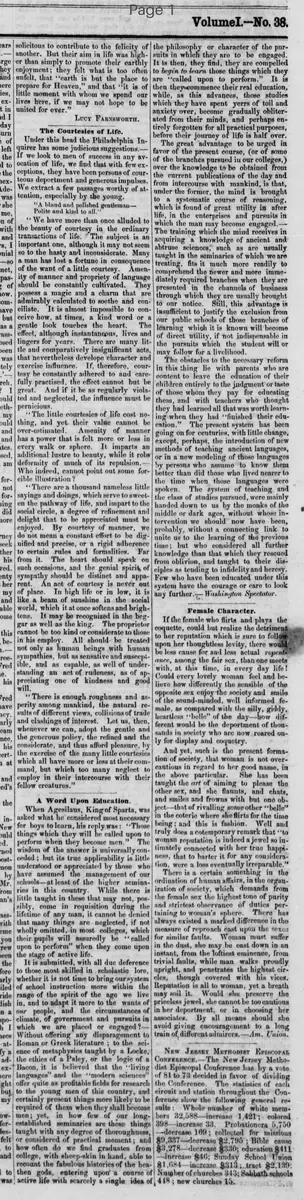
When Agesilaus, King of Sparta, was asked what he considered most necessary for boys to learn, his reply was: "Those things which they will be called upon to perform when they become men." The wisdom of the answer is universally conceded; but its true applicability is little understood or appreciated by those who have assumed the management of our schools—at least of the higher seminaries in this country. While there is little taught in these that may not, possibly, come in requisition during the lifetime of any man, it cannot be denied that many things are neglected, if not wholly omitted, in most colleges, which their pupils will assuredly be "called upon to perform" when they come upon the stage of active life.
It is submitted, with all due deference to those most skilled in scholastic lore, whether it is not time to bring our system of school instruction more within the range of the spirit of the age we live in, and to adapt it more to the wants of our people, and the circumstances of climate, of government and pursuits in which we are placed or engaged?—
Without offering any disparagement to Roman or Greek literature; to the science of metaphysics taught by a Locke, the ethics of a Paley, or the logic of a Bacon, it is believed that the "living languages" and the "modern sciences" offer quite as profitable fields for research to the young men of this country, and certainly present things more likely to be required of them when they shall become men; yet, in how few of our long-established seminaries are these things taught with any degree of thoroughness, or considered of practical moment; and how often do we find graduates from college, with sheep-skin in hand, able to recount the fabulous histories of the heathen gods, entering upon a course of active life with scarcely a single idea of the philosophy or character of the pursuits in which they are to be engaged.
It is then, they find, they are compelled to begin to learn those things which they are "called upon to perform." It is then they commence their real education, while, as this advances, those studies which they have spent years of toil and anxiety over, become gradually obliterated from their minds, and perhaps entirely forgotten for all practical purposes, before their journey of life is half over.
The great advantage to be urged in favor of the present course, (or of some of the branches pursued in our colleges,) over the knowledge to be obtained from the current publications of the day and from intercourse with mankind, is that, under the former, the mind is brought to a systematic course of reasoning, which is found of great utility in after life, in the enterprises and pursuits in which the man may become engaged.— The training which the mind receives in acquiring a knowledge of ancient and abstruse sciences, such as are usually taught in the seminaries of which we are treating, fits it much more readily to comprehend the newer and more immediately required branches when they are presented in the channels of business through which they are usually brought to our notice. Still, this advantage is insufficient to justify the exclusion from our public schools of those branches of learning which it is known will become of direct utility, if not indispensable in the pursuits which the student will or may follow for a livelihood.
The obstacles to the necessary reform in this thing lie with parents who are content to leave the education of their children entirely to the judgment or taste of those whom they pay for educating them, and with teachers who thought they had learned all that was worth learning when they had "finished their education." The present system has been going on for centuries, with little change, except, perhaps, the introduction of new methods of teaching ancient languages, or in a new modeling of those languages by persons who assume to know them better than did those who lived nearer to the time when those languages were spoken. The system of teaching and the class of studies pursued, were mainly handed down to us by the monks of the middle or dark ages, without whose intervention we should now have been, probably, without a connecting link to unite us to the learning of the previous time; but who considered all further knowledge than that which they rescued from oblivion, and taught to their disciples as tending to infidelity and heresy.
Few who have been educated under this system have the courage or care to look any further.—Washington Spectator.
When Agesilaus, King of Sparta, was asked what he considered most necessary for boys to learn, his reply was: "Those things which they will be called upon to perform when they become men." The wisdom of the answer is universally conceded; but its true applicability is little understood or appreciated by those who have assumed the management of our schools—at least of the higher seminaries in this country. While there is little taught in these that may not, possibly, come in requisition during the lifetime of any man, it cannot be denied that many things are neglected, if not wholly omitted, in most colleges, which their pupils will assuredly be "called upon to perform" when they come upon the stage of active life.
It is submitted, with all due deference to those most skilled in scholastic lore, whether it is not time to bring our system of school instruction more within the range of the spirit of the age we live in, and to adapt it more to the wants of our people, and the circumstances of climate, of government and pursuits in which we are placed or engaged?—
Without offering any disparagement to Roman or Greek literature; to the science of metaphysics taught by a Locke, the ethics of a Paley, or the logic of a Bacon, it is believed that the "living languages" and the "modern sciences" offer quite as profitable fields for research to the young men of this country, and certainly present things more likely to be required of them when they shall become men; yet, in how few of our long-established seminaries are these things taught with any degree of thoroughness, or considered of practical moment; and how often do we find graduates from college, with sheep-skin in hand, able to recount the fabulous histories of the heathen gods, entering upon a course of active life with scarcely a single idea of the philosophy or character of the pursuits in which they are to be engaged.
It is then, they find, they are compelled to begin to learn those things which they are "called upon to perform." It is then they commence their real education, while, as this advances, those studies which they have spent years of toil and anxiety over, become gradually obliterated from their minds, and perhaps entirely forgotten for all practical purposes, before their journey of life is half over.
The great advantage to be urged in favor of the present course, (or of some of the branches pursued in our colleges,) over the knowledge to be obtained from the current publications of the day and from intercourse with mankind, is that, under the former, the mind is brought to a systematic course of reasoning, which is found of great utility in after life, in the enterprises and pursuits in which the man may become engaged.— The training which the mind receives in acquiring a knowledge of ancient and abstruse sciences, such as are usually taught in the seminaries of which we are treating, fits it much more readily to comprehend the newer and more immediately required branches when they are presented in the channels of business through which they are usually brought to our notice. Still, this advantage is insufficient to justify the exclusion from our public schools of those branches of learning which it is known will become of direct utility, if not indispensable in the pursuits which the student will or may follow for a livelihood.
The obstacles to the necessary reform in this thing lie with parents who are content to leave the education of their children entirely to the judgment or taste of those whom they pay for educating them, and with teachers who thought they had learned all that was worth learning when they had "finished their education." The present system has been going on for centuries, with little change, except, perhaps, the introduction of new methods of teaching ancient languages, or in a new modeling of those languages by persons who assume to know them better than did those who lived nearer to the time when those languages were spoken. The system of teaching and the class of studies pursued, were mainly handed down to us by the monks of the middle or dark ages, without whose intervention we should now have been, probably, without a connecting link to unite us to the learning of the previous time; but who considered all further knowledge than that which they rescued from oblivion, and taught to their disciples as tending to infidelity and heresy.
Few who have been educated under this system have the courage or care to look any further.—Washington Spectator.
What sub-type of article is it?
Education
Social Reform
What keywords are associated?
Education Reform
College Curriculum
Modern Sciences
Ancient Languages
Practical Learning
Classical Education
School Instruction
What entities or persons were involved?
Agesilaus
Locke
Paley
Bacon
Washington Spectator
Editorial Details
Primary Topic
Reform Of College Education To Emphasize Practical Modern Subjects
Stance / Tone
Critical Of Classical Curriculum, Advocating Practical Reform
Key Figures
Agesilaus
Locke
Paley
Bacon
Washington Spectator
Key Arguments
Current College Curricula Neglect Practical Skills Needed In Adult Life
Modern Languages And Sciences Are More Relevant Than Ancient Classics
Graduates Often Forget Classical Studies And Must Learn Practical Knowledge Later
Systematic Reasoning From Classics Aids But Does Not Justify Excluding Modern Subjects
Reform Hindered By Parents And Traditional Teachers