Thank you for visiting SNEWPapers!
Sign up free
Griggs Courier
Cooperstown, Griggs County, North Dakota
What is this article about?
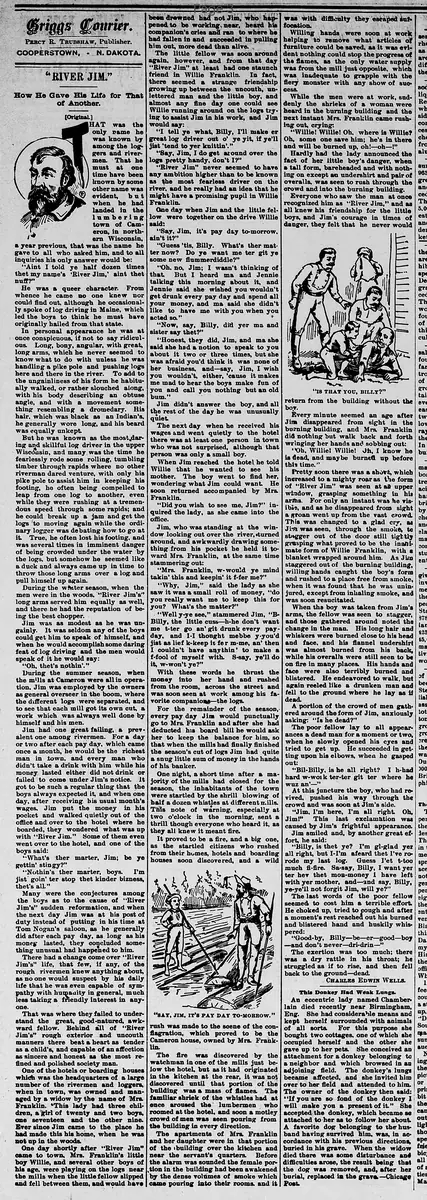
In Cameron, Wisconsin, rough riverman River Jim bonds with widow's son Willie, quits boozing after saving the boy from drowning, and perishes heroically rescuing him from a boarding house blaze, leaving his savings to the family.
Merged-components note: Images are illustrations integrated into the 'RIVER JIM.' story based on sequential reading order and spatial proximity; resulting label is story as dominant content.
Clipping
OCR Quality
Full Text
How He Gave His Life for That of Another.
[Original.]
That was the only name he was known by among the loggers and rivermen. That he must at one time have been known by some other name was evident, but when he had landed in the lumbering town of Cameron, in northern Wisconsin, a year previous, that was the name he gave to all who asked him, and to all inquiries his only answer would be:
"Ain't I told ye half a dozen times thet my name's 'River Jim,' ain't thet nuff?"
He was a queer character. From whence he came no one knew nor could find out, although he occasionally spoke of log driving in Maine, which led the boys to think he must have originally hailed from that state.
In personal appearance he was at once conspicuous, if not to say ridiculous. Long, bony, angular, with great, long arms, which he never seemed to know what to do with unless he was handling a pike pole and pushing logs here and there in the river. To add to the ungainliness of his form he habitually walked, or rather slouched along, with his body describing an obtuse angle, and with a movement something resembling a dromedary. His hair, which was black as an Indian's, he generally wore long, and his beard was equally unkempt.
But he was known as the most daring and skillful log driver in the upper Wisconsin, and many was the time he fearlessly rode some rolling, tumbling timber through rapids where no other riverman dared venture, with only his pike pole to assist him in keeping his footing, he often being compelled to leap from one log to another, even while they were rushing at a tremendous speed through some rapids; and he could break up a jam and get the logs to moving again while the ordinary logger was debating how to go at it. True, he often lost his footing, and was several times in imminent danger of being crowded under the water by the logs, but somehow he seemed like a duck and always came up in time to throw those long arms over a log and pull himself up again.
During the winter season, when the men were in the woods, "River Jim's" long arms served him equally as well, and there he had the reputation of being the best chopper.
Jim was as modest as he was ungainly. It was seldom any of the boys could get him to speak of himself, and when he would accomplish some daring feat of log driving and the men would speak of it he would say:
"Oh, thet's nothin'."
During the summer season, when the mills at Cameron were all in operation, Jim was employed by the owners as general overseer in the boom, where the different logs were separated, and to see that each mill got its own cut, a work which was always well done by himself and his men.
Jim had one great failing, a prevalent one among rivermen. For a day or two after each pay day, which came once a month, he would be the richest man in town, and every man who didn't take a drink with him while his money lasted either did not drink or failed to come under Jim's notice. It got to be such a regular thing that the boys always expected it, and when one day, after receiving his usual month's wages, Jim put the money in his pocket and walked quietly out of the office and over to the hotel where he boarded, they wondered what was up with "River Jim." Some of them even went over to the hotel, and one of the boys said:
"What's ther matter, Jim; be yo gettin' stingy?"
"Nothin's ther matter, boys. I'm jist goin' ter stop thet kinder bizness, thet's all."
Many were the conjectures among the boys as to the cause of "River Jim's" sudden reformation, and when the next day Jim was at his post of duty instead of putting in his time at Tom Nogans's saloon, as he generally did after each pay day, as long as his money lasted, they concluded something unusual had happened to him.
There had a change come over "River Jim's" life, that few, if any, of the rough rivermen knew anything about, as no one would suspect by his daily life that he was even capable of sympathy with humanity in general, much less taking a friendly interest in anyone.
That was where they failed to understand the great, good-natured, awkward fellow. Behind all of "River Jim's" rough exterior and uncouth manners there beat a heart as tender as a child's, and capable of an affection as sincere and honest as the most refined and polished society man.
One of the hotels or boarding houses which was the headquarters of a large number of the rivermen and loggers, when in town, was owned and managed by a widow by the name of Mrs. Franklin. This lady had three children, a girl of twenty and two boys, one seventeen and the other nine.
Ever since Jim came to the place he had made this his home, when he was not up in the woods.
One day shortly after "River Jim" came to town, Mrs. Franklin's little boy Willie, and several other boys of his age, were playing on the logs near the mills when the little fellow slipped and fell between them, and would have been drowned had not Jim, who happened to be working near, heard the companion's cries and ran to where he had fallen in and succeeded in pulling him out, more dead than alive.
The little fellow was soon around again, however, and from that day "River Jim" at least had one staunch friend in Willie Franklin. In fact, there seemed a strange friendship growing up between the uncouth, unlettered man and the little boy, and almost any fine day one could see Willie running around on the logs trying to assist Jim in his work, and Jim would say:
"I tell ye what, Billy, I'll make er great log driver out o' ye yit, if ye'll jist 'tend to yer knittin'."
"Say, Jim, I do get around over the logs protty handy, don't I?"
"River Jim" never seemed to have any ambition higher than to be known as the most fearless driver on the river, and he really had an idea that he might have a promising pupil in Willie Franklin.
One day when Jim and the little fellow were together on the drive Willie said:
"Say, Jim, it's pay day to-morrow, ain't it?"
"Guess 'tis, Billy. What's ther matter now? Do yo want me ter git ye some new fiummerdiddle?"
"Oh, no, Jim; I wasn't thinking of that. But I heard ma and Jennie talking this morning about it, and Jennie said she wished you wouldn't get drunk every pay day and spend all your money, and ma said she didn't like to have me with you when you acted so."
"Now, say, Billy, did yer ma and sister say thet?"
"Honest, they did, Jim, and ma sho said sho had a notion to speak to you about it two or three times, but she was afraid you'd think it was none of her business, and—say, Jim, I wish you wouldn't, either, 'cause it makes me mad to hear the boys make fun o' you and call you nothing but an old bum."
Jim didn't answer the boy, and all the rest of the day he was unusually quiet.
The next day when he received his wages and went quietly to the hotel there was at least one person in town who was not surprised, although that person was only a small boy.
When Jim reached the hotel he told Willie that he wanted to see his mother. The boy went to find her, wondering what Jim could want. He soon returned accompanied by Mrs. Franklin.
"Did you wish to see me, Jim?" inquired the lady, as she came into the office.
Jim, who was standing at the window looking out over the river, turned around, and awkwardly drawing something from his pocket he held it toward Mrs. Franklin, at the same time stammering out:
"Mrs. Franklin, w-would ye mind takin' this and keepin' it f-fer me?"
"Why, Jim," said the lady as she saw it was a small roll of money, "do you really want me to keep this for you? What's the matter?"
"Welly—ye see," stammered Jim, "B-Billy, the little cuss—h—he don't want me t-ter go an' git drunk every pay-day, and I—I thonght mebbe y—you'd jist as lief k-keep it fer m-me, an' then I couldn't have anythin' to make a f-fool of myself with. S-say, ye'll do it, w-won't ye?"
With these words he thrust the money into her hand and rushed from the room, across the street and was soon seen at work among his favorite companions—the logs.
For the remainder of the season, every pay day Jim would punctually go to Mrs. Franklin and after she had deducted his board bill he would ask her to keep the balance for him, so that when the mills had finally finished the season's cut of logs Jim had quite a snug little sum of money in the hands of his banker.
One night, a short time after a majority of the mills had closed for the season, the inhabitants of the town were startled by the shrill blowing of half a dozen whistles at different mills. This note of warning, especially at two o'clock in the morning, sent a thrill through everyone who heard it, as they all knew it meant fire.
It proved to be a fire, and a big one, as the startled citizens who rushed from their homes, hotels and boarding houses soon discovered, and a wild rush was made to the scene of the conflagration, which proved to be the Cameron house, owned by Mrs. Franklin.
The fire was discovered by the watchman in one of the mills just below the hotel, but as it had originated in the kitchen at the rear, it was not discovered until that portion of the building was a mass of flames. The familiar shriek of the whistles had at once aroused the lumbermen who roomed at the hotel, and soon a motley crowd of men was seen pouring from the building in every direction.
The apartments of Mrs. Franklin and her daughter were in that portion of the building over the kitchen and near the servant's quarters. Before the alarm was sounded the female portion in the building had been awakened by the dense volumes of smoke which came pouring into their rooms, and it was with difficulty they escaped suffocation.
Willing hands were soon at work helping to remove what articles of furniture could be saved, as it was evident nothing could stop the progress of the flames, as the only water supply was from the mill just opposite, which was inadequate to grapple with the fiery monster with any show of success.
While the men were at work, suddenly the shrieks of a woman were heard in the burning building and the next instant Mrs. Franklin came rushing out crying:
"Willie! Willie! Oh, where is Willie? Oh, some one save him; he's in there and will be burned up, oh! oh—!"
Hardly had the lady announced the fact of her little boy's danger, when a tall form, bareheaded and with nothing on except an undershirt and pair of overalls, was seen to rush through the crowd and into the burning building.
Everyone who saw the man at once recognized him as "River Jim," and as all knew his friendship for the little boy, and Jim's courage in times of danger, they felt that he never would return from the building without the boy.
Every minute seemed an age after Jim disappeared from sight in the burning building, and Mrs. Franklin did nothing but walk back and forth wringing her hands and sobbing out:
"Oh, Willie! Willie! Oh, I know he is dead, and maybe burned up before this time."
Pretty soon there was a shout, which increased to a mighty roar as the form of "River Jim" was seen at an upper window, grasping something in his arms. For only an instant was he visible, and as he disappeared from sight a groan went up from the vast crowd.
This was changed to a glad cry, as Jim was seen, through the smoke, to stagger out of the door still tightly grasping what proved to be the inanimate form of Willie Franklin, with blanket wrapped around him. As Jim staggered out of the burning building, willing hands caught the boy's form and rushed to a place free from smoke, when it was found that he was uninjured, except from inhaling smoke, and was soon resuscitated.
When the boy was taken from Jim's arms, the fellow was seen to stagger, and those gathered around noted the change in the man. His long hair and whiskers were burned close to his head and face, and his flannel undershirt was almost burned from his back, while his overalls were still seen to be on fire in many places. His hands and face were also terribly burned and blistered. He endeavored to walk, but again reeled like a drunken man and fell to the ground where he lay as if dead.
A portion of the crowd of men gathered around the form of Jim, anxiously asking: "Is he dead?"
The poor fellow lay to all appearances a dead man for a moment or two, when he slowly opened his eyes and tried to get up. He succeeded in getting upon his elbows, when he gasped out:
"Bil—Billy, is he all right? I h—had hard w—woik ter—ter git ter where he wuz an'—"
At this juncture the boy, who had revived, pushed his way through the crowd and was soon at Jim's side.
"Jim, I'm here, I'm all right. Oh, Jim!" This last exclamation was caused by Jim's frightful appearance.
Jim smiled and, by another great effort, he said:
"Billy, is thet ye? I'm gl—glad yer all right, but I—I'm afeard thet Ive ro—rode my last log. Guess Iet t—too much fi—fire. Sa—say, Billy, I want yer ter hev thet mon—money I have left with yer mother, and—and say, Billy, ye—ye'll not forgit Jim, will ye?"
The last words of the poor fellow seemed to cost him a terrible effort. He choked up, tried to cough and after a moment's rest reached out his burned and blistered hand and huskily whispered:
"Good-by, Billy—be—er good boy —and don't never—dri—drin—"
The exertion was too much; there was a dry rattle in his throat; he struggled as if to rise, and then fell back to the ground—dead.
Charles Edwin Wells.
What sub-type of article is it?
What themes does it cover?
What keywords are associated?
What entities or persons were involved?
Where did it happen?
Story Details
Key Persons
Location
Cameron, Northern Wisconsin
Story Details
River Jim, a skilled but ungainly log driver, befriends young Willie Franklin after saving him from drowning, reforms his drinking habit at Willie's request by entrusting his money to Willie's mother, and ultimately dies from severe burns after rescuing Willie from a fire that destroys their boarding house.