Thank you for visiting SNEWPapers!
Sign up free
Literary
July 8, 1858
The Potter Journal
Coudersport, Potter County, Pennsylvania
What is this article about?
Essay by J.W. Bird advocating questioning over telling in teaching to cultivate active, self-acting minds in students. Presented to Potter County Teachers' Association at Oswayo Village on May 28, 1858.
Clipping
OCR Quality
95%
Excellent
Full Text
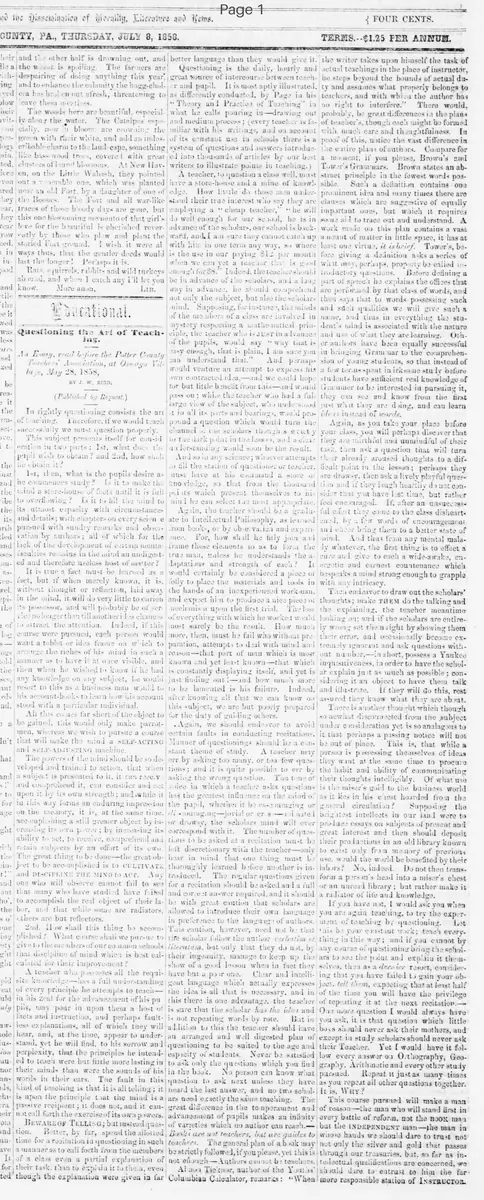
Educational.
Questioning the Art of Teaching.
An Essay, read before the Potter County
Teachers' Association, at Oswayo Village,
May 28, 1858,
BY J. W. BIRD.
(Published by Request.)
In rightly questioning consists the art
of teaching. Therefore, if we would teach
successfully we must question properly.
This subject presents itself for considera-
tion in two parts: 1st, what does the
pupil wish to obtain? and 2nd, how shall
he obtain it?
1st, then, what is the pupil's desire as-
he commences study? Is it to make the
mind a store-house of facts until it is full
to overflowing? Is it to fill the mind to
its utmost capacity with circumstances
and details; with chapters on every science
pursued with sundry remarks and obser-
vation by authors; all of which for the
lack of the development of certain mental
faculties remains in the mind an undigested
and therefore useless host of matter?
It is true a fact must be learned as a
fact, but if when merely known, it is,
without thought or reflection, laid away
in the mind, it will do very little to enrich
its possessor, and will probably be of ser-
vice no longer than till another chance
attracts the attention. Indeed, if this
course were pursued, each person would
want a tablet or idea frame on which to
arrange the riches of his mind in such a
manner as to have it at once visible, and
then when he wished to know if he had
any knowledge on any subject, he would
resort to this as a business man would to
his account-books to learn how his account
stood with a particular individual.
All this comes far short of the object to
be gained, this would only make parrot-
men, whereas we wish to pursue a course
that will make the mind a SELF-ACTING
and SELF-ADJUSTING machine.
The powers of the mind should be so de-
veloped and trained to action, that when
a subject is presented to it, it can receive
and comprehend it, can consider and act
upon it by its own strength; and--while it
in this way forms an enduring impression
on the memory, it is, at the same time,
accomplishing a still greater object by in-
creasing its own powers; by increasing its
ability to act, to receive, comprehend and
retain subjects by an effort of its own.
The great thing to be done--the great ob-
ject to be accomplished is to CULTIVATE
AND DISCIPLINE THE MIND TO ACT. Any
one who will observe cannot fail to see
that many who have studied have failed
to accomplish the real object of their la-
bor, and that while some are radiators,
others are but reflectors.
2nd. How shall this thing be accom-
plished? What course shall we pursue to
give to the members of our common schools
that disciplining of mind which is best cal-
culated for their improvement?
A teacher who possesses all the requi-
site knowledge--has a full understanding
of every principle he attempts to teach--
in his zeal for the advancement of his pu-
pils, may pour in upon them a host of
facts and instruction, and perhaps fault-
less explanations, all of which they will
hear, and, at the time, appear to under-
stand, yet he will find, to his sorrow and
perplexity, that the principles he intend-
ed to teach were but little more lasting in
their minds than were the sounds of his
words in their ears. The fault in this
kind of teaching is that it is all telling; it
is upon the principle that the mind is a
passive recipient; it does not, and it can-
not call forth the exercise of its own powers.
BEWARE OF TELLING; but instead question.
Better, by far, spend the allotted
time for a recitation in questioning in such
a manner as to call forth from the members
of a class even a partial explanation of
their task, than to explain it to them, even
though the explanation were given in far
better language than they would give it.
Questioning is the daily, hourly and
great source of intercourse between teach-
er and pupil. It is most aptly illustrated,
as differently conducted, by Page in his
"Theory and Practice of Teaching" in
what he calls pouring in--drawing out
and medium process; (every teacher is fa-
miliar with his writings, and on account
of its constant use in schools there is a
system of questions and answers introduc-
ed into thousands of articles by our best
writers to illustrate points in teaching.)
A teacher, to question a class well, must
have a store-house and a mine of knowl-
edge. How little do those men under-
stand their true interest who say they are
employing a "cheap teacher." "he will
do well enough for our school, he is in
advance of the scholars, our school is back-
ward, and I am sure they cannot catch up
with him in one term any way, so where
is the use in our paying $15 per month
when we can get a teacher that is good
enough for $10." Indeed, the teacher should
be in advance of the scholars, and a long
way in advance. He should comprehend
not only the subject, but also the scholars'
mind. Supposing, for instance, the minds
of the members of a class are involved in
mystery respecting a mathematical prin-
ciple, the teacher who is just in advance
of the pupils, would say "why that is
easy enough, that is plain, I am sure you
can understand that." And perhaps
would venture an attempt to express his
own contracted idea,--and we could hope
for but little benefit from this--and would
pass on; while the teacher who had a full
large view of the subject, who understood
it in all its parts and bearings, would pro-
pound a question which would turn the
channel of the scholars' thoughts directly
to the dark point in the lesson, and a clear
understanding would soon be the result.
And so in any science; whoever attempts
to fill the station of questioner or teacher,
must have at his command a store of
knowledge, so that from the thousand
points which present themselves to his
mind he can select the most appropriate.
Again, the teacher should be a gradu-
ate in Intellectual Philosophy, as learned
from books, or by observation and expe-
rience. For, how shall he fitly join and
frame these elements so as to form the
true man, unless he understands the a-
daptations and strength of each? It
would certainly be considered a piece of
folly to place the materials and tools in
the hands of an inexperienced workman,
and expect him to produce a nice piece of
mechanism upon the first trial. The loss
of everything with which he worked would
not surely be the result. How much
more, then, must he fail who without pre-
paration, attempts to deal with mind and
reason--that part of man which is most
known and yet least known--that which
is constantly displaying itself, and yet is
just finding out:--and how much more
to be lamented is his failure. Indeed,
after knowing all that we can know of
this subject, we are but poorly prepared
for the duty of guiding others.
Again, we should endeavor to avoid
certain faults in conducting recitations.
Manner of questioning should be a con-
stant theme of study. A teacher may
err by asking too many, or too few ques-
tions; and it is quite possible to err by
asking the wrong question. The tone of
voice in which a teacher asks questions
has the greatest influence on the mind of
the pupil, whether it be encouraging or
discouraging--jovial or cross--or
spirited
or drowsy, the scholars' mind will ever
correspond with it. The number of ques-
tions to be asked at a recitation must be
left discretionary with the teacher--only
bear in mind that one thing must be
thoroughly learned before another is in-
troduced. The regular questions given
for a recitation should be asked and a full
and correct answer required, and it should
be with great caution that scholars are
allowed to introduce their own language
in preference to the language of authors.
This caution, however, need not be that
the scholar follow the author verbatim et
literatim, but only that they do not, by
their ingenuity, manage to keep up the
show of a good lesson when in fact they
have but a poor one. Clear and intelli-
gent language which actually expresses
the idea is all that is necessary, and in
this there is one advantage, the teacher
is sure that the scholar has the idea and
is not repeating words by rote. But in
addition to this the teacher should have
an arranged and well digested plan of
questioning to be suited to the age and
capacity of students. Never be satisfied
to ask only the questions which you find
in the book. No person can know what
question to ask next unless they have
heard the last answer, and no two schol-
ars need exactly the same teaching. The
great difference in the temperament and
advancement of pupils makes an infinity
of varieties which no author can reach.--
Books are but teachers, but are guides to
teachers. The general plan of a book may
be strictly followed, if you please, yet this is
not enough--Authors cannot be teachers.
As Prof. Ticknor, author of the Youth's
Columbian Calculator, remarks: "When
the writer takes upon himself the task of
actual teaching in the place of instructor,
he steps beyond the bounds of actual du-
ty and assumes what properly belongs to
teachers, and with which the author has
no right to interfere." There would,
probably, be great differences in the plans
of teachers, though each might be formed
with much care and thoughtfulness. In
proof of this, notice the vast difference in
the entire plans of authors. Compare for
a moment, if you please, Brown's and
Tower's Grammars. Brown states an ab-
stract principle in the fewest words pos-
sible. Such a definition contains one
prominent idea and many times there are
clauses which are suggestive of equally
important ones, but which it requires
some skill to trace out and understand. A
work made on this plan contains a vast
amount of matter in little space, it has at
least one virtue, it is brief. Tower's, be-
fore giving a definition asks a series of
what may, perhaps, properly be called in-
troductory questions. Before defining a
part of speech he explains the offices that
are performed by that class of words, and
then says that to words possessing such
and such qualities we will give such a
name, and thus in everything the stu-
dent's mind is associated with the nature
and use of what they are learning. Oth-
er authors have been equally successful
in bringing Grammar to the comprehen-
sion of young students, so that instead of
a few terms spent in irksome study before
students have sufficient real knowledge of
Grammar to be interested in pursuing it,
they can see and know from the first
just what they are doing, and can learn
ideas instead of words.
Again, as you take your place before
your class, you will perhaps discover that
they are mirthful and unmindful of their
task, then ask a question that will turn
their already aroused thoughts to a dif-
ficult point in the lesson; perhaps they
are drowsy, then ask a lively playful ques-
tion and if they laugh heartily do not con-
sider that you have lost time, but rather
feel encouraged. If, after an unsuccess-
ful effort they come to the class disheart-
ened, by a few words of encouragement
and cheer bring them to a better state of
mind. And thus from any mental malady
whatever, the first thing is to effect a
cure and give to each a wide-awake, en-
ergetic and earnest countenance which
bespeaks a mind strong enough to grapple
with any intricacy.
Then endeavor to draw out the scholars'
thoughts; make THEM do the talking and
the explaining, the teacher meantime
looking on; and if the scholars are entire-
ly wrong set them right by showing them
their error, and occasionally become ex-
tremely ignorant and ask questions with-
out number,--in short, possess a Yankee
inquisitiveness, in order to have the schol-
ar explain just as much as possible: con-
sidering it an object to have them talk
and illustrate. If they will do this, rest
assured they know what they are about.
There is another thought which though
somewhat disconnected from the subject
under consideration yet is so analogous to
it that perhaps a passing notice will not
be out of place. This is, that while a
person is possessing themselves of ideas
they want at the same time to procure
the habit and ability of communicating
their thoughts intelligibly. Of what use
is the miser's gold to the business world
as it lies in his chest hoarded from the
general circulation? Supposing the
brightest intellects in our land were to
produce essays on subjects of present and
great interest and then should deposit
their productions in an old library known
to exist only from memory of previous
use, would the world be benefited by their
labors? No, indeed. Do not then trans-
form a person's head into a miser's chest
or an unread library; but rather make it
a radiator of life and knowledge.
If you have not, I would ask you when
you are again teaching, to try the exper-
iment of teaching by questioning. Let
this be your constant work; teach every-
thing in this way; and if you cannot by
any course of questioning bring the schol-
ars to see the point and explain it them-
themselves, then as a last resort, con-
sidering that you have failed to gain your ob-
ject, tell them, expecting that at least half
of the time you will have the privilege
of repeating it at the next recitation.--
One more question I would always have
you ask, it is that question which little
boys should never ask their mothers, and
except in study scholars should never ask
their Teacher. Yet I would have it fol-
low every answer on Orthography, Geo-
graphy, Arithmetic and every other study
pursued. Repeat it just as many times
as you repeat all other questions together.
It is, WHY?
This course pursued will make a man
of reason--the man who will stand first in
every battle of reform, not the Book man
but the INDEPENDENT man--the man in
whose hands we should dare to trust not
only the silver and gold that passes
through our treasuries, but, so far as in-
intellectual qualifications are concerned, we
should dare to entrust to him the far
more responsible station of Instructor.
FOUR CENTS.
TERMS.--$1.25 PER ANNUM.
Questioning the Art of Teaching.
An Essay, read before the Potter County
Teachers' Association, at Oswayo Village,
May 28, 1858,
BY J. W. BIRD.
(Published by Request.)
In rightly questioning consists the art
of teaching. Therefore, if we would teach
successfully we must question properly.
This subject presents itself for considera-
tion in two parts: 1st, what does the
pupil wish to obtain? and 2nd, how shall
he obtain it?
1st, then, what is the pupil's desire as-
he commences study? Is it to make the
mind a store-house of facts until it is full
to overflowing? Is it to fill the mind to
its utmost capacity with circumstances
and details; with chapters on every science
pursued with sundry remarks and obser-
vation by authors; all of which for the
lack of the development of certain mental
faculties remains in the mind an undigested
and therefore useless host of matter?
It is true a fact must be learned as a
fact, but if when merely known, it is,
without thought or reflection, laid away
in the mind, it will do very little to enrich
its possessor, and will probably be of ser-
vice no longer than till another chance
attracts the attention. Indeed, if this
course were pursued, each person would
want a tablet or idea frame on which to
arrange the riches of his mind in such a
manner as to have it at once visible, and
then when he wished to know if he had
any knowledge on any subject, he would
resort to this as a business man would to
his account-books to learn how his account
stood with a particular individual.
All this comes far short of the object to
be gained, this would only make parrot-
men, whereas we wish to pursue a course
that will make the mind a SELF-ACTING
and SELF-ADJUSTING machine.
The powers of the mind should be so de-
veloped and trained to action, that when
a subject is presented to it, it can receive
and comprehend it, can consider and act
upon it by its own strength; and--while it
in this way forms an enduring impression
on the memory, it is, at the same time,
accomplishing a still greater object by in-
creasing its own powers; by increasing its
ability to act, to receive, comprehend and
retain subjects by an effort of its own.
The great thing to be done--the great ob-
ject to be accomplished is to CULTIVATE
AND DISCIPLINE THE MIND TO ACT. Any
one who will observe cannot fail to see
that many who have studied have failed
to accomplish the real object of their la-
bor, and that while some are radiators,
others are but reflectors.
2nd. How shall this thing be accom-
plished? What course shall we pursue to
give to the members of our common schools
that disciplining of mind which is best cal-
culated for their improvement?
A teacher who possesses all the requi-
site knowledge--has a full understanding
of every principle he attempts to teach--
in his zeal for the advancement of his pu-
pils, may pour in upon them a host of
facts and instruction, and perhaps fault-
less explanations, all of which they will
hear, and, at the time, appear to under-
stand, yet he will find, to his sorrow and
perplexity, that the principles he intend-
ed to teach were but little more lasting in
their minds than were the sounds of his
words in their ears. The fault in this
kind of teaching is that it is all telling; it
is upon the principle that the mind is a
passive recipient; it does not, and it can-
not call forth the exercise of its own powers.
BEWARE OF TELLING; but instead question.
Better, by far, spend the allotted
time for a recitation in questioning in such
a manner as to call forth from the members
of a class even a partial explanation of
their task, than to explain it to them, even
though the explanation were given in far
better language than they would give it.
Questioning is the daily, hourly and
great source of intercourse between teach-
er and pupil. It is most aptly illustrated,
as differently conducted, by Page in his
"Theory and Practice of Teaching" in
what he calls pouring in--drawing out
and medium process; (every teacher is fa-
miliar with his writings, and on account
of its constant use in schools there is a
system of questions and answers introduc-
ed into thousands of articles by our best
writers to illustrate points in teaching.)
A teacher, to question a class well, must
have a store-house and a mine of knowl-
edge. How little do those men under-
stand their true interest who say they are
employing a "cheap teacher." "he will
do well enough for our school, he is in
advance of the scholars, our school is back-
ward, and I am sure they cannot catch up
with him in one term any way, so where
is the use in our paying $15 per month
when we can get a teacher that is good
enough for $10." Indeed, the teacher should
be in advance of the scholars, and a long
way in advance. He should comprehend
not only the subject, but also the scholars'
mind. Supposing, for instance, the minds
of the members of a class are involved in
mystery respecting a mathematical prin-
ciple, the teacher who is just in advance
of the pupils, would say "why that is
easy enough, that is plain, I am sure you
can understand that." And perhaps
would venture an attempt to express his
own contracted idea,--and we could hope
for but little benefit from this--and would
pass on; while the teacher who had a full
large view of the subject, who understood
it in all its parts and bearings, would pro-
pound a question which would turn the
channel of the scholars' thoughts directly
to the dark point in the lesson, and a clear
understanding would soon be the result.
And so in any science; whoever attempts
to fill the station of questioner or teacher,
must have at his command a store of
knowledge, so that from the thousand
points which present themselves to his
mind he can select the most appropriate.
Again, the teacher should be a gradu-
ate in Intellectual Philosophy, as learned
from books, or by observation and expe-
rience. For, how shall he fitly join and
frame these elements so as to form the
true man, unless he understands the a-
daptations and strength of each? It
would certainly be considered a piece of
folly to place the materials and tools in
the hands of an inexperienced workman,
and expect him to produce a nice piece of
mechanism upon the first trial. The loss
of everything with which he worked would
not surely be the result. How much
more, then, must he fail who without pre-
paration, attempts to deal with mind and
reason--that part of man which is most
known and yet least known--that which
is constantly displaying itself, and yet is
just finding out:--and how much more
to be lamented is his failure. Indeed,
after knowing all that we can know of
this subject, we are but poorly prepared
for the duty of guiding others.
Again, we should endeavor to avoid
certain faults in conducting recitations.
Manner of questioning should be a con-
stant theme of study. A teacher may
err by asking too many, or too few ques-
tions; and it is quite possible to err by
asking the wrong question. The tone of
voice in which a teacher asks questions
has the greatest influence on the mind of
the pupil, whether it be encouraging or
discouraging--jovial or cross--or
spirited
or drowsy, the scholars' mind will ever
correspond with it. The number of ques-
tions to be asked at a recitation must be
left discretionary with the teacher--only
bear in mind that one thing must be
thoroughly learned before another is in-
troduced. The regular questions given
for a recitation should be asked and a full
and correct answer required, and it should
be with great caution that scholars are
allowed to introduce their own language
in preference to the language of authors.
This caution, however, need not be that
the scholar follow the author verbatim et
literatim, but only that they do not, by
their ingenuity, manage to keep up the
show of a good lesson when in fact they
have but a poor one. Clear and intelli-
gent language which actually expresses
the idea is all that is necessary, and in
this there is one advantage, the teacher
is sure that the scholar has the idea and
is not repeating words by rote. But in
addition to this the teacher should have
an arranged and well digested plan of
questioning to be suited to the age and
capacity of students. Never be satisfied
to ask only the questions which you find
in the book. No person can know what
question to ask next unless they have
heard the last answer, and no two schol-
ars need exactly the same teaching. The
great difference in the temperament and
advancement of pupils makes an infinity
of varieties which no author can reach.--
Books are but teachers, but are guides to
teachers. The general plan of a book may
be strictly followed, if you please, yet this is
not enough--Authors cannot be teachers.
As Prof. Ticknor, author of the Youth's
Columbian Calculator, remarks: "When
the writer takes upon himself the task of
actual teaching in the place of instructor,
he steps beyond the bounds of actual du-
ty and assumes what properly belongs to
teachers, and with which the author has
no right to interfere." There would,
probably, be great differences in the plans
of teachers, though each might be formed
with much care and thoughtfulness. In
proof of this, notice the vast difference in
the entire plans of authors. Compare for
a moment, if you please, Brown's and
Tower's Grammars. Brown states an ab-
stract principle in the fewest words pos-
sible. Such a definition contains one
prominent idea and many times there are
clauses which are suggestive of equally
important ones, but which it requires
some skill to trace out and understand. A
work made on this plan contains a vast
amount of matter in little space, it has at
least one virtue, it is brief. Tower's, be-
fore giving a definition asks a series of
what may, perhaps, properly be called in-
troductory questions. Before defining a
part of speech he explains the offices that
are performed by that class of words, and
then says that to words possessing such
and such qualities we will give such a
name, and thus in everything the stu-
dent's mind is associated with the nature
and use of what they are learning. Oth-
er authors have been equally successful
in bringing Grammar to the comprehen-
sion of young students, so that instead of
a few terms spent in irksome study before
students have sufficient real knowledge of
Grammar to be interested in pursuing it,
they can see and know from the first
just what they are doing, and can learn
ideas instead of words.
Again, as you take your place before
your class, you will perhaps discover that
they are mirthful and unmindful of their
task, then ask a question that will turn
their already aroused thoughts to a dif-
ficult point in the lesson; perhaps they
are drowsy, then ask a lively playful ques-
tion and if they laugh heartily do not con-
sider that you have lost time, but rather
feel encouraged. If, after an unsuccess-
ful effort they come to the class disheart-
ened, by a few words of encouragement
and cheer bring them to a better state of
mind. And thus from any mental malady
whatever, the first thing is to effect a
cure and give to each a wide-awake, en-
ergetic and earnest countenance which
bespeaks a mind strong enough to grapple
with any intricacy.
Then endeavor to draw out the scholars'
thoughts; make THEM do the talking and
the explaining, the teacher meantime
looking on; and if the scholars are entire-
ly wrong set them right by showing them
their error, and occasionally become ex-
tremely ignorant and ask questions with-
out number,--in short, possess a Yankee
inquisitiveness, in order to have the schol-
ar explain just as much as possible: con-
sidering it an object to have them talk
and illustrate. If they will do this, rest
assured they know what they are about.
There is another thought which though
somewhat disconnected from the subject
under consideration yet is so analogous to
it that perhaps a passing notice will not
be out of place. This is, that while a
person is possessing themselves of ideas
they want at the same time to procure
the habit and ability of communicating
their thoughts intelligibly. Of what use
is the miser's gold to the business world
as it lies in his chest hoarded from the
general circulation? Supposing the
brightest intellects in our land were to
produce essays on subjects of present and
great interest and then should deposit
their productions in an old library known
to exist only from memory of previous
use, would the world be benefited by their
labors? No, indeed. Do not then trans-
form a person's head into a miser's chest
or an unread library; but rather make it
a radiator of life and knowledge.
If you have not, I would ask you when
you are again teaching, to try the exper-
iment of teaching by questioning. Let
this be your constant work; teach every-
thing in this way; and if you cannot by
any course of questioning bring the schol-
ars to see the point and explain it them-
themselves, then as a last resort, con-
sidering that you have failed to gain your ob-
ject, tell them, expecting that at least half
of the time you will have the privilege
of repeating it at the next recitation.--
One more question I would always have
you ask, it is that question which little
boys should never ask their mothers, and
except in study scholars should never ask
their Teacher. Yet I would have it fol-
low every answer on Orthography, Geo-
graphy, Arithmetic and every other study
pursued. Repeat it just as many times
as you repeat all other questions together.
It is, WHY?
This course pursued will make a man
of reason--the man who will stand first in
every battle of reform, not the Book man
but the INDEPENDENT man--the man in
whose hands we should dare to trust not
only the silver and gold that passes
through our treasuries, but, so far as in-
intellectual qualifications are concerned, we
should dare to entrust to him the far
more responsible station of Instructor.
FOUR CENTS.
TERMS.--$1.25 PER ANNUM.
What sub-type of article is it?
Essay
What keywords are associated?
Teaching
Questioning
Education
Mind Discipline
Pedagogy
Intellectual Growth
What entities or persons were involved?
By J. W. Bird
Literary Details
Title
Questioning The Art Of Teaching
Author
By J. W. Bird
Subject
An Essay, Read Before The Potter County Teachers' Association, At Oswayo Village, May 28, 1858
Key Lines
In Rightly Questioning Consists The Art Of Teaching. Therefore, If We Would Teach Successfully We Must Question Properly.
Beware Of Telling; But Instead Question.
The Great Thing To Be Done The Great Object To Be Accomplished Is To Cultivate And Discipline The Mind To Act.
It Is, Why?
This Course Pursued Will Make A Man Of Reason The Man Who Will Stand First In Every Battle Of Reform, Not The Book Man But The Independent Man