Thank you for visiting SNEWPapers!
Sign up free
Kentucky Gazette
Lexington, Fayette County, Kentucky
What is this article about?
Correspondence between Generals Andrew Jackson and Winfield Scott from October 1817 to January 1818, debating a controversial military order issued by Jackson in April 1817, an anonymous letter accusing Scott of slander, chain of command issues, and personal honor. Scott declines an implied challenge on patriotic and religious grounds.
Merged-components note: Publication of correspondence between Generals Jackson and Scott, continued across pages 2 and 3 as a single coherent domestic news item.
Clippings
1 of 2
OCR Quality
Full Text
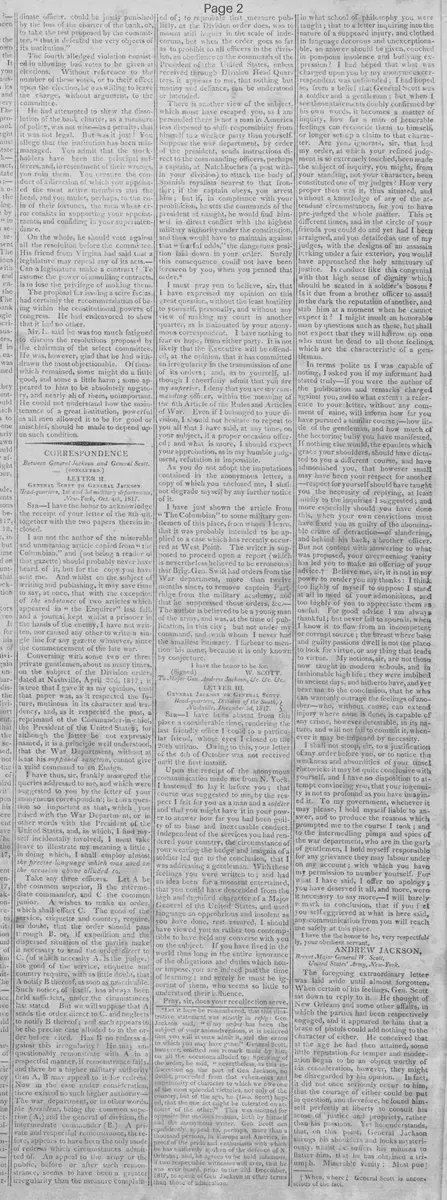
Between General Jackson and General Scott.
(CONCLUDED.)
LETTER II.
General Scott to General Jackson.
Head-quarters, 1st and 2d military departments,
New-York, Oct. 4th, 1817.
Sir—I have the honor to acknowledge the receipt of your letter of the 8th ult. together with the two papers therein inclosed.
I am not the author of the miserable and unmeaning article copied from "the Columbian," and (not being a reader of that gazette) should probably never have heard of it, but for the copy you have sent me. And whilst on the subject of writing and publishing, it may save time to say, at once, that with the exception of the substance of two articles which appeared in "the Enquirer" last fall, and a journal kept whilst a prisoner in the hands of the enemy, I have not written, nor caused any other to write a single line for any gazette whatever, since the commencement of the late war.
Conversing with some two or three private gentlemen, about as many times, on the subject of the Division order, dated at Nashville, April 22d, 1817: it is true that I gave it as my opinion, that that paper was, as it respected the future, mutinous in its character and tendency, and, as it respected the past, a reprimand of the Commander-in-chief, the President of the United States; for although the latter be not expressly named, it is a principle well understood, that the War Department, without at least his supposed sanction, cannot give a valid command to an Ensign.
I have thus, sir, frankly answered the queries addressed to me, and which were suggested to you by the letter of your anonymous correspondent: but on a question so important as that, which you raised with the War Department, or in other words with the President of the United States, and, in which, I find myself incidentally involved, I must take leave to illustrate my meaning a little; in doing which, I shall employ almost the precise language which was used on the occasion above alluded to.
Take any three officers. Let A be the common superior, B the intermediate commander, and C the common junior. A wishes to make an order, which shall effect C. The good of the service, etiquette and country, require, no doubt, that the order should pass through B. or, if expedition and the dispersed situation of the parties make it necessary to send the order direct to C. (of which necessity A. is the judge,) the good of the service, etiquette and country require, with as little doubt, that A notify B thereof, as soon as practicable. Such notice, of itself, has always been held sufficient, under the circumstances last stated But we will suppose that A sends the order direct to C. and neglects to notify B thereof; and such appears to be the precise case alluded to in the order before cited. Has B no redress against this irregularity? He may unquestionably remonstrate with A in a respectful manner, if remonstrance fails, and there be a higher military authority than A, B may appeal to it for redress.
Now in the case under consideration there existed no such higher authority—The war department, or in other words, the President, being the common superior (A,) and the general of division, the intermediate commander (B.) A private and respectful remonstrance, therefore, appears to have been the only mode of redress which circumstances admitted of. An appeal to the army or the public, before or after such remonstrance, seems to have been a greater irregularity than the measure complained of; to reprobate that measure publicly, as the Division order does, was to mount still higher in the scale of indecorum, but when the order goes so far as to prohibit to all officers in the division, an obedience to the commands of the President of the United States, unless received through Division Head Quarters, it appears to me, that nothing but mutiny and defiance, can be understood or intended.
There is another view of the subject, which must have escaped you, as I am persuaded there is not a man in America less disposed to shift responsibility from himself to a weaker party than yourself. Suppose the war department, by order of the president, sends instructions direct to the commanding officers, perhaps a captain, at Natchitoches (a post within your division) to attack the body of Spanish royalists nearest to that frontier; if the captain obeys, you arrest him; but if, in compliance with your prohibition, he sets the commands of the president at naught, he would find himself in direct conflict with the highest military authority under the constitution, and thus would have to maintain against that "fearful odds," the dangerous position laid down in your order. Surely this consequence could not have been foreseen by you, when you penned that order.*
I must pray you to believe, sir, that I have expressed my opinion on this great question, without the least hostility to yourself, personally, and without any view of making my court in another quarter, as is insinuated by your anonymous correspondent. I have nothing to fear or hope, from either party. It is not likely that the Executive will be offended, at the opinion, that it has committed an irregularity in the transmission of one of its orders; and, as to yourself, although I cheerfully admit that you are my superior, I deny that you are my commanding officer, within the meaning of the 6th Article of the Rules and Articles of War. Even if I belonged to your division, I should not hesitate to repeat to you all that I have said, at any time, on your subject, if a proper occasion offered; and what is more, I should expect your approbation, as in my humble judgment, refutation is impossible.
As you do not adopt the imputations contained in the anonymous letter, a copy of which you enclosed me, I shall not degrade myself by any further notice of it.
I have just shown the article from "The Columbian" to some military gentlemen of this place, from whom I learn, that it was probably intended to be applied to a case which has recently occurred at West Point. The writer is supposed to proceed upon a report (which is nevertheless believed to be erroneous) that Brig. Gen. Swift had orders from the War department, more than twelve months since, to remove captain Partridge from the military academy, and that he suppressed those orders, &c.—The author is believed to be a young man of the army, and was, at the time of publication, in this city; but not under my command, and with whom I never had the smallest intimacy. I forbear to mention his name, because it is only known by conjecture.
I have the honor to be &c.
(Signed) W. SCOTT.
To Major Gen. Andrew Jackson, &c. &c. &c.
LETTER III.
General Jackson to General Scott
Head-quarters, Division of the South,
Nashville, December 3d, 1817.
Sir—I have been absent from this place a considerable time, rendering the last friendly office I could to a particular friend, whose eyes I closed on the 20th ultimo. Owing to this, your letter of the 4th of October was not received until the first instant.
Upon the receipt of the anonymous communication made me from N. York, I hastened to lay it before you; that course was suggested to me, by the respect I felt for you as a man and a soldier and that you might have it in your power to answer how far you had been guilty of so base and inexcusable conduct. Independent of the services you had rendered your country, the circumstance of your wearing the badge and insignia of a soldier led me to the conclusion, that I was addressing a gentleman. With these feelings you were written to; and had an idea been for a moment entertained, that you could have descended from the high and dignified character of a Major General of the United States, and used language so opprobrious and insolent as you have done, rest assured, I should have viewed you as rather too contemptible to have held any converse with you on the subject. If you have lived in the world thus long in the entire ignorance of the obligations and duties which honor impose, you are indeed past the time of learning; and surely he must be ignorant of them, who seems so little to understand their influence.
Pray, sir, does your recollection serve, in what school of philosophy you were taught; that to a letter inquiring into the nature of a supposed injury, and clothed in language decorous and unexceptionable, an answer should be given, couched in pompous insolence and bullying expression? I had hoped that what was charged upon you by my anonymous correspondent was unfounded; I had hoped so, from a belief that General Scott was a soldier and a gentleman: but when I see those statements doubly confirmed by his own words, it becomes a matter of inquiry, how far a man of honorable feelings can reconcile them to himself or longer set up a claim to that character. Are you, ignorant, sir, that had my order, at which your refined judgment is so extremely touched, been made the subject of inquiry, you might, from your standing, not your character, been constituted one of my judges? How very proper then was it, thus situated, and without a knowledge of any of the attendant circumstances, for you to have pre-judged the whole matter. This at different times, and in the circle of your friends you could do and yet had I been arraigned, and you detailed as one of my judges, with the designs of an assassin lurking under a fair exterior, you would have approached the holy sanctuary of justice. Is conduct like this congenial with that high sense of dignity which should be seated in a soldier's bosom? Is it due from a brother officer to assail in the dark the reputation of another, and stab him at a moment when he cannot expect it? I might insult an honorable man by questions such as these, but shall not expect that they will harrow up one who must be dead to all those feelings which are the characteristic of a gentleman.
In terms polite as I was capable of noting, I asked you if my informant had stated truly—if you were the author of the publication and remarks charged against you, and to what extent: a reference to your letter, without any comment of mine, will inform how far you have pursued a similar course; how little of the gentleman, and how much of the hectoring bully you have manifested. If nothing else would, the epaulets which grace your shoulders, should have dictated to you a different course, and have admonished you, that however small may have been your respect for another—respect for yourself should have taught you the necessity of replying, at least mildly to the inquiries I suggested; and more especially should you have done this, when your own convictions must have fixed you as guilty of the abominable crime of detraction—of slandering, and behind his back, a brother officer.
But not content with answering to what was proposed, your overweening vanity has led you to make an offering of your advice. Believe me, sir, it is not in my power to render you my thanks: I think too lightly of myself to suppose I stand at all in need of your admonitions, and too highly of you to appreciate them as useful. For good advice I am always thankful; but never fail to spurn it, when I know it to flow from an incompetent or corrupt source; the breast where base and guilty passions dwell is not the place to look for virtue, or any thing that leads to virtue. My notions, sir, are not those now taught in modern schools, and in fashionable high life; they were imbibed in ancient days, and hitherto have, and yet bear me to the conclusion, that he who can wantonly outrage the feelings of another—who, without cause, can extend injury where none is done, is capable of any crime, however detestable, in its nature, and will not fail to commit it, whenever it may be imposed by necessity.
I shall not stoop, sir, to a justification of my order before you, or to notice the weakness and absurdities of your tinsel rhetorick: it may be quite conclusive with yourself, and I have no disposition to attempt convincing you, that your ingenuity is not as profound as you have imagined it. To my government, whenever it may please, I hold myself liable to answer, and to produce the reasons which prompted me to the course I took: and to the intermedling pimps and spies of the war department, who are in the garb of gentlemen, I hold myself responsible for any grievance they may labour under on my account; with which you have my permission to number yourself. For what I have said, I offer no apology; you have deserved it all, and more, were it necessary to say more,—I will barely remark in conclusion, that if you feel yourself aggrieved at what is here said, any communication from you will reach me safely at this place.
I have the honor to be, very respectfully, your obedient servant,
ANDREW JACKSON,
Brevet Major General W. Scott,
United States Army, New-York.
The foregoing extraordinary letter was laid aside until almost forgotten. When certain of his feelings, Gen. Scott sat down to reply to it. He thought of New Orleans and some other affairs, in which the parties had been respectively engaged, and it appeared to him that a brace of pistols could add nothing to the character of either. He conceived that at the age he had then attained, some little reputation for temper and moderation began to be an object worthy of his consideration, however, they might be disregarded by his opponent. In fact, it did not once seriously occur to him, that the courage of either could be put in question, and therefore, he found himself perfectly at liberty to consult his sense of justice and propriety, rather than his passions. Yet he understands, that, on this point, General Jackson shrugs his shoulders and looks mysteriously, whilst he suffers his minions to flatter him, that he has obtained a triumph. Miserable vanity! Most puerile triumph! When, where? General Scott is unconscious of the fact.
Let it here be remembered, that this illustrative statement was strictly in reply: Gen Jackson said, "if my order has been the subject of your animadversions, it is believed that you will at once admit it, and the extent to which you may have gone." General Scott, however, omitted one remark made by him, on all the occasions alluded to: Speaking of the order, he said, "nevertheless, as this indiscretion on the part of Gen Jackson, no doubt, proceeded from that vehemence and impetuosity of character to which we owe one of the most splendid victories, not only of the country, but of the age, he (Gen. Scott) hoped, that the one act might be tolerated on account of the other." This was omitted for opposite but obvious reasons, both by himself and the anonymous writer. Gen Scott can confidently appeal to, perhaps, more than a thousand persons, in Europe and America, in proof of the pride and enthusiasm with which he has uniformly spoken of the defence of New Orleans; and, he agrees to be held infamous, if two respectable witnesses will aver, that he was ever heard, prior to the 22d December, 1817, to speak of Gen Jackson in other terms than those of admiration.
rile and unworthy conceit! A triumph over the fears of Gen. Scott! The letter does not doubt the courage of Gen. Jackson; yet he might enumerate several affairs, in any one of which, he was, probably, exposed to greater personal danger than General Jackson has encountered in his whole military career. And here 'let him not "be called a fool for boasting; for he may say with one of the greatest of men, "mine enemy has forced me to it." But is it a boast in an American, to assert his indifference of personal danger? General Scott has commanded some thousands of his countrymen at different times, and does not remember three individuals among them, who were deficient in that almost universal attribute. But the foregoing letter has been represented as a challenge, and the reply to it a non acceptance-on the ground of religious scruples. The double falsehood will not escape the reader, although it be true, that general Scott, in a playful humour, chose to treat the letter as a challenge. And as to the other point, however repugnant to his principles, it may be, "to do a contrived murder," either under forms, or in violation of them, or by his own voluntary seeking, Gen. Scott, whenever he shall think it necessary, will be as free to defend his reputation against calumny, as he would be to slay a robber who should attempt his life on the highway. He knows of no code of morals which would disarm him in either case, nor does the promise in the following letter; for as that was made without consideration, so may it be withdrawn without explanation or apology.
LETTER IV.
General Scott To General Jackson.
Head-quarters, 1st and 3d Military Departments,
New-York, January 2d, 1818.
Sir-Your letter of the 3d ult. was handed me about the 22d, and has not been read, I might say thought of, since. These circumstances will show that it is my wish to reply to you dispassionately. I regret that I cannot accept the challenge you offer me. Perhaps I may be restrained from wishing to level a pistol at the breast of a fellow being, in private combat, by a sense of religion : but lest this motive should excite the ridicule of gentlemen of liberal habits of thinking and acting, I beg leave to add, that I decline the honour of your invitation from patriotick scruples. My ambition is not that of Erostratus. I should think it would be easy for you to console yourself under this refusal, by the application of a few epithets, as coward, &c. to the object of your resentment, and I here promise to leave you until the next war, to persuade yourself of their truth. Your famous order bears date the 22d April, 1817. At intervals of three or four months thereafter-that, when it had been officially published to the troops of your division, and printed in almost every paper in the Union-as if to challenge discussion-I found myself in company where it was the subject of conversation. Not being under your command, I was as free to give my opinion on that publick act as any one else; for, I presume, you will not assert, that where an officer is not expressly restrained by the military code, he has not all the rights of any other citizen. For this fair expression of opinion, on a principle as universal as the profession of arms-and which opinion I, afterwards, at your instance, stated to you, in all its detail, you are pleased to charge me with having slandered you behind your back! an accusation, which I consider the more amusing, as I never had the honour of being in your presence in all my life! I can assure you, sir, that nothing but my great respect for your superior age and services prevents me from indulging, also, in a little bitter pleasantry on this point. It seems that you are under the further impression that if you had been brought to trial, for publishing the order, (an idea that I never heard any other suggest) and I appointed one of your judges, that, assassin-like, I should have approached the holy sanctuary of justice, &c. such is, I think, your language. Now, like you (without believing one word of it) it would be as easy for me manually) to retort all this abuse, as it was for you to originate it ; but I must inform you, sir, that however much I may desire to emulate certain portions of your history, I am not at all inclined to follow the pernicious example that your letter furnishes. You complain of harshness on my part. My letter to which yours is a reply, is, doubtless, somewhat bold in its character, but, believing that in an affair with you, it was only necessary to have right on one's side, in order to obtain approbation, I had no other care in its composition, than to avoid every thing personally offensive, as far as the truth, and a fair discussion of the subject would permit : and I still rest persuaded, that the fact corresponds with my intention. It is true, that I spoke of you, and treated you, as a MAN, without the petty qualifications of common usage; because, in addressing you, they were then considered as so many diminutives; but I am now to apprehend that universal success and applause have somewhat spoiled you; and that I shall ultimately be obliged to fall into the common place habits observed in respect to common place people, and consider you as nothing more than a gentleman. Permit me to request I think I have a right to demand-a sight of the original anonymous letter which has given rise to this discussion. If I mistake not, your correspondent is a greater personage than you, perhaps, imagine : nay so high, that he has once essayed to sit himself above the highest in our political sphere. The letter shall be returned as soon as the hand is compared with that of a certain agent of the personage alluded to.
I cannot close this letter without expressing a belief, that on the return of your wonted magnanimity, I shall be requested to burn the one which has elicited it, by way of apology for the injury it does me. Accordingly, it has been seen, as yet, by but one individual (of my staff) and shall be held in reserve, until a certain time has elapsed-attending that just expectation. In the mean time. I shall have the honor to remain, sir,
Very respectfully,
Your most obedient servant,
(Signed)
W. SCOTT.
To Major General Andrew Jackson.
No reply has ever been given to the foregoing, and of course General Scott has never seen the original anonymous letter. His suspicions and the whole correspondence were fully communicated, in Jan. 1818, to a particular friend of Governor Clinton, who was perfectly at liberty to give notice thereof to that personage. Whether he did so or not, gen. Scott is not informed. A copy of the correspondence itself would have been sent to Mr. Clinton, but for the prohibitory regulation above cited, and which came out before gen. Jackson had had time to reply to the letter, if he had been so disposed. Gen. Scott, until his opponent has set him the example (a precedent not disapproved by the War Department) supposed that the first sentence of the regulation "all publications &c." interdicted manuscript copies as well as others. Until then a distinction of this sort appeared to him absurd : for how easy would it be for any of the numerous persons to whom gen. Jackson has delivered copies, or rather parts of the correspondence, to print them. The moment they passed out of his hands they ceased to be under his control. After all, it is possible, that the suspicions above expressed are unjust, as it respects one individual; although there is not room to doubt, that the anonymous letter was written to serve the views of Mr. Clinton, and that those views have been effected, at least so far as they respect gen. Jackson. Should gen. Scott ever discover or find cause to believe, that Mr. Clinton neither wrote nor dictated the anonymous letter, there is no apology which one gentleman may prescribe to another; that shall not be promptly and cheerfully rendered. And here, gen. Scott must, in candour, state that some time during the summer or fall of 1818, when a threat of general Jackson's (that he meant to visit N. York for the purpose of "calling out" gen. Scott-published in a Georgia paper, on information derived, as was said, from an officer direct from Florida) was mentioned in the hearing of Mr. Clinton, the latter replied-"General Jackson would have enough to do, if he undertook to fight every body who thinks with gen. Scott. on the subject of the famous order"- intimating thereby, that he (Mr. Clinton) was still one of those persons. General Scott's informant, who had previously heard of the suspicion entertained in respect to the anonymous letter, was certainly impressed, in that incidental conversation, with the idea, that Mr. Clinton had no agency in dictating the letter. Gen. Scott would be very well content to yield himself to the same belief.
What sub-type of article is it?
What keywords are associated?
What entities or persons were involved?
Domestic News Details
Event Date
October 4, 1817 To January 2, 1818
Key Persons
Outcome
no further reply from jackson; scott's suspicions about the anonymous letter's origin involving clinton unconfirmed; correspondence concluded without resolution or duel.
Event Details
Exchange of letters between Generals Jackson and Scott initiated by Jackson's inquiry into an anonymous letter accusing Scott of authoring critical articles against Jackson's April 22, 1817 Division order requiring all commands to pass through headquarters. Scott defends his opinions on the order's mutinous nature and chain of command violations, denies authorship, and critiques Jackson's response as insolent. Jackson accuses Scott of slander and bullying. Scott declines an implied challenge citing religious and patriotic reasons, requests the original anonymous letter, and expresses belief in future apology from Jackson.