Thank you for visiting SNEWPapers!
Sign up free
Story
December 26, 1864
Delaware State Journal And Statesman
Wilmington, New Castle County, Delaware
What is this article about?
A correspondent describes the process of drilling an oil well in Pennsylvania's oil regions, detailing the erection of a derrick, use of steam engine, drilling through rock strata, and pumping or flowing extraction methods, with an example from Watson's Flat reaching 300 feet.
Clipping
OCR Quality
98%
Excellent
Full Text
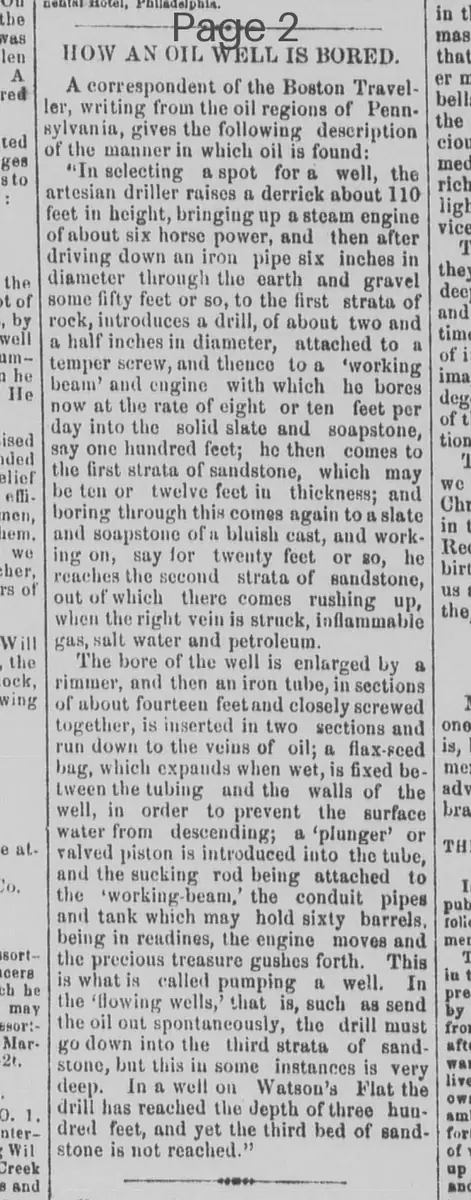
HOW AN OIL WELL IS BORED.
A correspondent of the Boston Traveller, writing from the oil regions of Pennsylvania, gives the following description of the manner in which oil is found: "In selecting a spot for a well, the artesian driller raises a derrick about 110 feet in height, bringing up a steam engine of about six horse power, and then after driving down an iron pipe six inches in diameter through the earth and gravel some fifty feet or so, to the first strata of rock, introduces a drill, of about two and a half inches in diameter, attached to a temper screw, and thence to a 'working beam' and engine with which he bores now at the rate of eight or ten feet per day into the solid slate and soapstone, say one hundred feet; he then comes to the first strata of sandstone, which may be ten or twelve feet in thickness; and boring through this comes again to a slate and soapstone of a bluish cast, and working on, say for twenty feet or so, he reaches the second strata of sandstone, out of which there comes rushing up, when the right vein is struck, inflammable gas, salt water and petroleum. The bore of the well is enlarged by a rimmer. and then an iron tube, in sections of about fourteen feet and closely screwed together, is inserted in two sections and run down to the veins of oil; a flax-seed bag, which expands when wet, is fixed between the tubing and the walls of the well, in order to prevent the surface water from descending; a 'plunger' or valved piston is introduced into the tube, and the sucking rod being attached to the 'working-beam,' the conduit pipes and tank which may hold sixty barrels, being in readiness, the engine moves and the precious treasure gushes forth. This is what is called pumping a well. In the 'flowing wells,' that is, such as send the oil out spontaneously, the drill must go down into the third strata of sand. stone, but this in some instances is very deep. In a well on Watson's Flat the drill has reached the depth of three hundred feet, and yet the third bed of sand. stone is not reached."
A correspondent of the Boston Traveller, writing from the oil regions of Pennsylvania, gives the following description of the manner in which oil is found: "In selecting a spot for a well, the artesian driller raises a derrick about 110 feet in height, bringing up a steam engine of about six horse power, and then after driving down an iron pipe six inches in diameter through the earth and gravel some fifty feet or so, to the first strata of rock, introduces a drill, of about two and a half inches in diameter, attached to a temper screw, and thence to a 'working beam' and engine with which he bores now at the rate of eight or ten feet per day into the solid slate and soapstone, say one hundred feet; he then comes to the first strata of sandstone, which may be ten or twelve feet in thickness; and boring through this comes again to a slate and soapstone of a bluish cast, and working on, say for twenty feet or so, he reaches the second strata of sandstone, out of which there comes rushing up, when the right vein is struck, inflammable gas, salt water and petroleum. The bore of the well is enlarged by a rimmer. and then an iron tube, in sections of about fourteen feet and closely screwed together, is inserted in two sections and run down to the veins of oil; a flax-seed bag, which expands when wet, is fixed between the tubing and the walls of the well, in order to prevent the surface water from descending; a 'plunger' or valved piston is introduced into the tube, and the sucking rod being attached to the 'working-beam,' the conduit pipes and tank which may hold sixty barrels, being in readiness, the engine moves and the precious treasure gushes forth. This is what is called pumping a well. In the 'flowing wells,' that is, such as send the oil out spontaneously, the drill must go down into the third strata of sand. stone, but this in some instances is very deep. In a well on Watson's Flat the drill has reached the depth of three hundred feet, and yet the third bed of sand. stone is not reached."
What sub-type of article is it?
Technical Description
Industrial Process
What themes does it cover?
Exploration
What keywords are associated?
Oil Well Boring
Drilling Process
Pennsylvania Oil Regions
Petroleum Extraction
Sandstone Strata
Pumping Well
Flowing Well
What entities or persons were involved?
Correspondent Of The Boston Traveller
Where did it happen?
Oil Regions Of Pennsylvania, Watson's Flat
Story Details
Key Persons
Correspondent Of The Boston Traveller
Location
Oil Regions Of Pennsylvania, Watson's Flat
Story Details
Detailed process of selecting a spot, raising derrick, driving pipe, drilling through strata of rock, slate, soapstone, and sandstone to reach oil, gas, and water; enlarging bore, inserting tubing, using flax-seed bag, plunger, and pumping; flowing wells require deeper drilling to third sandstone stratum.