Thank you for visiting SNEWPapers!
Sign up free
Editorial
May 21, 1891
Fergus County Argus
Lewistown, Fergus County, Montana
What is this article about?
An editorial praising American protectionist policies for iron and steel production, quoting British figures like Sir James Kitson and the Fair Trade League to argue against free trade, emphasizing legislation for producers over consumers, and citing Adam Smith and Dr. Johnson on high prices and plenty as prosperity.
Clipping
OCR Quality
95%
Excellent
Full Text
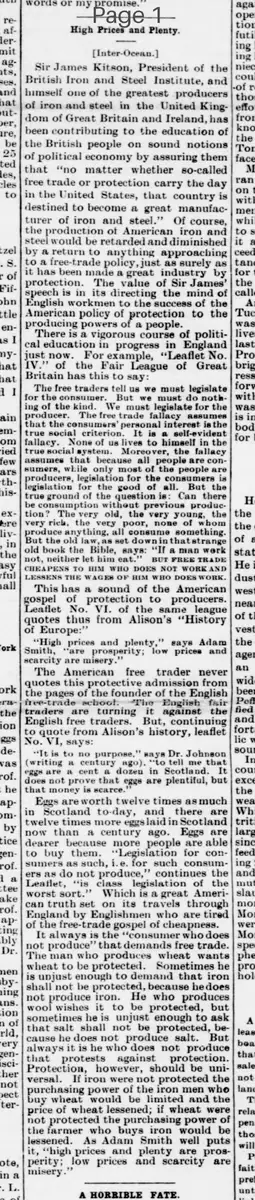
High Prices and Plenty.
[Inter-Ocean.]
Sir James Kitson, President of the
British Iron and Steel Institute, and
himself one of the greatest producers
of iron and steel in the United Kingdom
of Great Britain and Ireland, has
been contributing to the education of
the British people on sound notions
of political economy by assuring them
that "no matter whether so-called
free trade or protection carry the day
in the United States, that country is
destined to become a great manufac-
turer of iron and steel." Of course,
the production of American iron and
steel would be retarded and diminished
by a return to anything approaching
to a free-trade policy, just as surely as
it has been made a great industry by
protection. The value of Sir James'
speech is in its directing the mind of
English workmen to the success of the
American policy of protection to the
producing powers of a people.
There is a vigorous course of politi-
cal education in progress in England
just now. For example. "Leaflet No.
IV." of the Fair Trade League of Great
Britain has this to say:
The free traders tell us we must legislate
for the consumer. But we must do noth-
ing of the kind. We must legislate for the
producer. The free trade fallacy assumes
that the consumers' personal interest is the
true social criterion. It is a self-evident
fallacy. None of us lives to himself in the
true social system. Moreover, the fallacy
assumes that because all people are con-
sumers, while only most of the people are
producers. legislation for the consumers is
legislation for the good of all. But the
true ground of the question is: Can there
be consumption without previous produc-
tion? The very old, the very young, the
very rich, the very poor, none of whom
produce anything. all consume something.
But the old law, as set down in that strange
old book the Bible. says: "If a man work
not, neither let him eat."
BUT FREE TRADE
CHEAPENS TO HIM WHO DOES NOT WORK AND
LESSENS THE WAGES OF HIM WHO DOES WORK.
This has a sound of the American
gospel of protection to producers.
Leaflet No. VI. of the same league
quotes thus from Alison's "History
of Europe:"
"High prices and plenty," says Adam
Smith,
"are prosperity; low prices and
scarcity are misery.
The American
free trader never
quotes this protective admission from
the pages of the founder of the English
free-trade school.
The English fair
traders are turning it against the
English free traders. But, continuing
to quote from Alison's history, leaflet
No. VI, says:
"It is to no purpose." says Dr. Johnson
(writing a century ago), "to tell me that
eggs are a cent a dozen in Scotland. It
does not prove that eggs are plentiful, but
that money is scarce.
Eggs are worth twelve times as much
in Scotland to-day, and there are
twelve times more eggs laid in Scotland
now than a century ago. Eggs are
dearer because more people are able
to buy them. "Legislation for con-
sumers as such, i.e. for such consum-
ers as do not produce," continues the
Leaflet, "is class legislation of the
worst sort." Which is a great Ameri-
can truth set on its travels through
England by Englishmen who are tired
of the free-trade gospel of cheapness.
It always is the "consumer who does
not produce" that demands free trade.
The man who produces wheat wants
wheat to be protected. Sometimes he
is unjust enough to demand that iron
shall not be protected, because he does
not produce iron. He who produces
wool wishes it to be protected, but
sometimes he is unjust enough to ask
that salt shall not be protected, be-
cause he does not produce salt. But
always it is he who does not produce
that protests against protection.
Protection, however, should be uni-
versal. If iron were not protected the
purchasing power of the iron men who
buy wheat would be limited and the
price of wheat lessened; if wheat were
not protected the purchasing power of
the farmer who buys iron would be
lessened. As Adam Smith well puts
it, "high prices and plenty are pros-
perity; low prices and scarcity are
misery.
[Inter-Ocean.]
Sir James Kitson, President of the
British Iron and Steel Institute, and
himself one of the greatest producers
of iron and steel in the United Kingdom
of Great Britain and Ireland, has
been contributing to the education of
the British people on sound notions
of political economy by assuring them
that "no matter whether so-called
free trade or protection carry the day
in the United States, that country is
destined to become a great manufac-
turer of iron and steel." Of course,
the production of American iron and
steel would be retarded and diminished
by a return to anything approaching
to a free-trade policy, just as surely as
it has been made a great industry by
protection. The value of Sir James'
speech is in its directing the mind of
English workmen to the success of the
American policy of protection to the
producing powers of a people.
There is a vigorous course of politi-
cal education in progress in England
just now. For example. "Leaflet No.
IV." of the Fair Trade League of Great
Britain has this to say:
The free traders tell us we must legislate
for the consumer. But we must do noth-
ing of the kind. We must legislate for the
producer. The free trade fallacy assumes
that the consumers' personal interest is the
true social criterion. It is a self-evident
fallacy. None of us lives to himself in the
true social system. Moreover, the fallacy
assumes that because all people are con-
sumers, while only most of the people are
producers. legislation for the consumers is
legislation for the good of all. But the
true ground of the question is: Can there
be consumption without previous produc-
tion? The very old, the very young, the
very rich, the very poor, none of whom
produce anything. all consume something.
But the old law, as set down in that strange
old book the Bible. says: "If a man work
not, neither let him eat."
BUT FREE TRADE
CHEAPENS TO HIM WHO DOES NOT WORK AND
LESSENS THE WAGES OF HIM WHO DOES WORK.
This has a sound of the American
gospel of protection to producers.
Leaflet No. VI. of the same league
quotes thus from Alison's "History
of Europe:"
"High prices and plenty," says Adam
Smith,
"are prosperity; low prices and
scarcity are misery.
The American
free trader never
quotes this protective admission from
the pages of the founder of the English
free-trade school.
The English fair
traders are turning it against the
English free traders. But, continuing
to quote from Alison's history, leaflet
No. VI, says:
"It is to no purpose." says Dr. Johnson
(writing a century ago), "to tell me that
eggs are a cent a dozen in Scotland. It
does not prove that eggs are plentiful, but
that money is scarce.
Eggs are worth twelve times as much
in Scotland to-day, and there are
twelve times more eggs laid in Scotland
now than a century ago. Eggs are
dearer because more people are able
to buy them. "Legislation for con-
sumers as such, i.e. for such consum-
ers as do not produce," continues the
Leaflet, "is class legislation of the
worst sort." Which is a great Ameri-
can truth set on its travels through
England by Englishmen who are tired
of the free-trade gospel of cheapness.
It always is the "consumer who does
not produce" that demands free trade.
The man who produces wheat wants
wheat to be protected. Sometimes he
is unjust enough to demand that iron
shall not be protected, because he does
not produce iron. He who produces
wool wishes it to be protected, but
sometimes he is unjust enough to ask
that salt shall not be protected, be-
cause he does not produce salt. But
always it is he who does not produce
that protests against protection.
Protection, however, should be uni-
versal. If iron were not protected the
purchasing power of the iron men who
buy wheat would be limited and the
price of wheat lessened; if wheat were
not protected the purchasing power of
the farmer who buys iron would be
lessened. As Adam Smith well puts
it, "high prices and plenty are pros-
perity; low prices and scarcity are
misery.
What sub-type of article is it?
Economic Policy
Trade Or Commerce
What keywords are associated?
Protectionism
Free Trade
Producers
Consumers
High Prices
Plenty
Iron And Steel
Political Economy
What entities or persons were involved?
Sir James Kitson
British Iron And Steel Institute
Fair Trade League Of Great Britain
Adam Smith
Alison
Dr. Johnson
Editorial Details
Primary Topic
Advocacy For Protectionism Over Free Trade
Stance / Tone
Strongly Pro Protectionist, Anti Free Trade
Key Figures
Sir James Kitson
British Iron And Steel Institute
Fair Trade League Of Great Britain
Adam Smith
Alison
Dr. Johnson
Key Arguments
American Iron And Steel Industry Succeeds Due To Protection, Would Diminish Under Free Trade
Legislate For Producers, Not Consumers; Consumption Requires Prior Production
Free Trade Cheapens Goods For Non Workers And Lowers Wages For Workers
"High Prices And Plenty" Are Prosperity, As Per Adam Smith
Low Prices Indicate Scarcity Or Scarce Money, Not Plenty
Protection Should Be Universal To Maintain Purchasing Power Across Industries