Thank you for visiting SNEWPapers!
Sign up free
Letter to Editor
December 10, 1802
The National Intelligencer And Washington Advertiser
Washington, District Of Columbia
What is this article about?
Edmund Pendleton's 1802 letter to the Richmond Examiner defends the constitutionality of Congress repealing the Judiciary Act of 1801, arguing it relieves unnecessary judicial expenses without violating judicial independence, rooted in the elective principles of representative democracy.
Clipping
OCR Quality
95%
Excellent
Full Text
From the Richmond Examiner
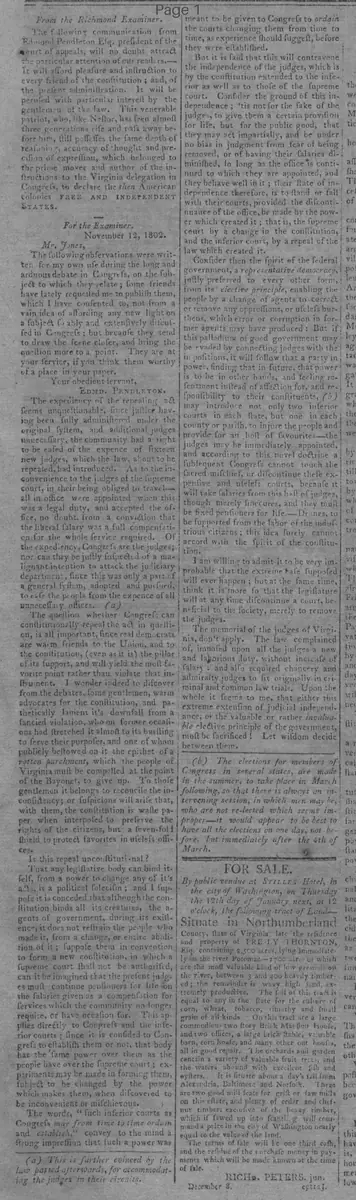
The following communication from Edmund Pendleton, Esq. president of the court of appeals, will no doubt attract the particular attention of our readers. It will afford pleasure and instruction to every friend of the constitution: and, of the present administration, it will be perused with particular interest by the gentlemen of the law. This venerable patriot, who, like Nestor, has seen almost three generations rise and pass away before him, still possesses the same depth of reasoning, accuracy of thought and precision of expression, which belonged to the prime mover and author of the instructions to the Virginia delegation in Congress, to declare the then American COLONIES FREE AND INDEPENDENT STATES.
For the Examiner.
November 12, 1802.
Mr. Jones,
The following observations were written for my own use during the long and arduous debate in Congress, on the subject to which they relate; some friends have lately requested me to publish them, which I have consented to, not from a vain idea of affording any new light on a subject so ably and extensively discussed in Congress; but because they tend to draw the scene closer, and bring the question more to a point. They are at your service, if you think them worthy of a place in your paper.
Your obedient servant,
EDMD. PENDLETON.
The expediency of the repealing act seems unquestionable, since justice having been fully administered under the original system, and additional judges unnecessary, the community had a right to be eased of the expense of sixteen new judges, which the law, about to be repealed, had introduced. As to the inconvenience to the judges of the supreme court, in their being obliged to travel--- all in office were appointed when this was a legal duty, and accepted the office, no doubt, from a conviction that the liberal salary was a full compensation for the whole service required. Of the expediency, Congress are the judges; nor can they be justly suspected of a malignant intention to attack the judiciary department, since this was only a part of a general system, adopted and pursued, to relieve the people from the expense of all unnecessary offices. (a)
The question whether Congress can constitutionally repeal the act in question, is all important, since real democrats are warm friends to the Union, and to the constitution, (even as it is) the pillar of its support, and will yield the most favorite point rather than violate that instrument. I wonder indeed to discover from the debates, some gentlemen, warm advocates for the constitution, and pathetically lament its downfall from a fancied violation, who on former occasions had stretched it almost to its bursting to serve their purposes, and one of whom publicly bestowed on it the epithet of a rotten parchment, which the people of Virginia must be compelled at the point of the bayonet, to give up. To those gentlemen it belongs to reconcile the inconsistency; or suspicions will arise that, with them, the constitution is waste paper when interposed to preserve the rights of the citizens, but a seven-fold shield to protect favorites in useless office.
Is this repeal unconstitutional?
That any legislative body can bind itself, from a power to change any of its acts, is a political solecism; and I suppose it is conceded that although the constitution binds all its creatures, the agents of government, during its existence, it does not restrain the people who made it, from a change, or entire abolition of it; suppose them in convention to form a new constitution, in which a supreme court shall not be authorized. Can it be imagined that the present judges must continue pensioners for life on the salaries given as a compensation for services which the community no longer require, or have occasion for. This applies directly to Congress and the inferior courts; since it is confided to Congress to establish them or not, that body has the same power over them as the people have over the supreme court; experiments may be made in forming them, subject to be changed by the power which makes them, when discovered to be inconvenient or mischievous.
The words, "such inferior courts as Congress may from time to time ordain and establish," convey to the mind a strong impression that such a power was meant to be given to Congress to ordain the courts changing them from time to time, as experience should suggest, before they were established.
But it is said that this will contravene the independence of the judges, which is by the constitution extended to the inferior as well as to those of the supreme court. Consider the ground of this independence; 'tis not for the sake of the judges, to give them a certain provision for life, but for the public good, that they may act impartially, and be under no bias in judgment from fear of being removed, or of having their salaries diminished, so long as the office is continued to which they are appointed, and they behave well in it; their state of independence therefore, is to stand or fall with their courts, provided the discontinuance of the office, be made by the power which created it; that is, the supreme court by a change in the constitution, and the inferior Court, by a repeal of the law which created it.
Consider then the spirit of the federal government, a representative democracy, justly preferred to every other form, from its elective principle, enabling the people by a change of agents to correct or remove any oppressions, or useless burdens, which error or corruption in former agents may have produced: But if this palladium of good government may be evaded by connecting judges with the independence of the supreme court, it will follow that a party in power, finding that in future, that power is to be in other hands, and feeling resentment instead of affection for, and responsibility to their constituents, (b) may introduce not only two inferior courts in each state, but one in each county or parish, to injure the people and provide for an host of favorites the judges may be immediately appointed, and according to this novel doctrine a subsequent Congress cannot touch the sacred mischief, or discontinue these expensive and useless courts, because it will take salaries from this host of judges, though merely sinecures, and they must be fixed pensioners for life. Drones, to be supported from the labor of the industrious citizens; this idea surely cannot accord with the spirit of the constitution.
I am willing to admit it to be very improbable that the extreme case supposed will ever happen; but at the same time, think it is more so that the legislature will at any time discontinue a court, beneficial to the society, merely to remove the judges.
The memorial of the judges of Virginia, don't apply. The law complained of, imposed upon all the judges a new and laborious duty. without increase of salary: and also required chancery and admiralty judges to sit originally in criminal and common law trials. Upon the whole it seems to me, that either this extreme extension of judicial independence, or the valuable or rather invaluable elective principle of the government, must be sacrificed! Let wisdom decide between them.
(b) The elections for members of Congress in several states, are made in the summer, to take place in March following, so that there is always an intervening session, in which men may be, who are not re-elected which seems improper it would appear to be best to have all the elections on one day, not before, but immediately after the 4th of March.
The following communication from Edmund Pendleton, Esq. president of the court of appeals, will no doubt attract the particular attention of our readers. It will afford pleasure and instruction to every friend of the constitution: and, of the present administration, it will be perused with particular interest by the gentlemen of the law. This venerable patriot, who, like Nestor, has seen almost three generations rise and pass away before him, still possesses the same depth of reasoning, accuracy of thought and precision of expression, which belonged to the prime mover and author of the instructions to the Virginia delegation in Congress, to declare the then American COLONIES FREE AND INDEPENDENT STATES.
For the Examiner.
November 12, 1802.
Mr. Jones,
The following observations were written for my own use during the long and arduous debate in Congress, on the subject to which they relate; some friends have lately requested me to publish them, which I have consented to, not from a vain idea of affording any new light on a subject so ably and extensively discussed in Congress; but because they tend to draw the scene closer, and bring the question more to a point. They are at your service, if you think them worthy of a place in your paper.
Your obedient servant,
EDMD. PENDLETON.
The expediency of the repealing act seems unquestionable, since justice having been fully administered under the original system, and additional judges unnecessary, the community had a right to be eased of the expense of sixteen new judges, which the law, about to be repealed, had introduced. As to the inconvenience to the judges of the supreme court, in their being obliged to travel--- all in office were appointed when this was a legal duty, and accepted the office, no doubt, from a conviction that the liberal salary was a full compensation for the whole service required. Of the expediency, Congress are the judges; nor can they be justly suspected of a malignant intention to attack the judiciary department, since this was only a part of a general system, adopted and pursued, to relieve the people from the expense of all unnecessary offices. (a)
The question whether Congress can constitutionally repeal the act in question, is all important, since real democrats are warm friends to the Union, and to the constitution, (even as it is) the pillar of its support, and will yield the most favorite point rather than violate that instrument. I wonder indeed to discover from the debates, some gentlemen, warm advocates for the constitution, and pathetically lament its downfall from a fancied violation, who on former occasions had stretched it almost to its bursting to serve their purposes, and one of whom publicly bestowed on it the epithet of a rotten parchment, which the people of Virginia must be compelled at the point of the bayonet, to give up. To those gentlemen it belongs to reconcile the inconsistency; or suspicions will arise that, with them, the constitution is waste paper when interposed to preserve the rights of the citizens, but a seven-fold shield to protect favorites in useless office.
Is this repeal unconstitutional?
That any legislative body can bind itself, from a power to change any of its acts, is a political solecism; and I suppose it is conceded that although the constitution binds all its creatures, the agents of government, during its existence, it does not restrain the people who made it, from a change, or entire abolition of it; suppose them in convention to form a new constitution, in which a supreme court shall not be authorized. Can it be imagined that the present judges must continue pensioners for life on the salaries given as a compensation for services which the community no longer require, or have occasion for. This applies directly to Congress and the inferior courts; since it is confided to Congress to establish them or not, that body has the same power over them as the people have over the supreme court; experiments may be made in forming them, subject to be changed by the power which makes them, when discovered to be inconvenient or mischievous.
The words, "such inferior courts as Congress may from time to time ordain and establish," convey to the mind a strong impression that such a power was meant to be given to Congress to ordain the courts changing them from time to time, as experience should suggest, before they were established.
But it is said that this will contravene the independence of the judges, which is by the constitution extended to the inferior as well as to those of the supreme court. Consider the ground of this independence; 'tis not for the sake of the judges, to give them a certain provision for life, but for the public good, that they may act impartially, and be under no bias in judgment from fear of being removed, or of having their salaries diminished, so long as the office is continued to which they are appointed, and they behave well in it; their state of independence therefore, is to stand or fall with their courts, provided the discontinuance of the office, be made by the power which created it; that is, the supreme court by a change in the constitution, and the inferior Court, by a repeal of the law which created it.
Consider then the spirit of the federal government, a representative democracy, justly preferred to every other form, from its elective principle, enabling the people by a change of agents to correct or remove any oppressions, or useless burdens, which error or corruption in former agents may have produced: But if this palladium of good government may be evaded by connecting judges with the independence of the supreme court, it will follow that a party in power, finding that in future, that power is to be in other hands, and feeling resentment instead of affection for, and responsibility to their constituents, (b) may introduce not only two inferior courts in each state, but one in each county or parish, to injure the people and provide for an host of favorites the judges may be immediately appointed, and according to this novel doctrine a subsequent Congress cannot touch the sacred mischief, or discontinue these expensive and useless courts, because it will take salaries from this host of judges, though merely sinecures, and they must be fixed pensioners for life. Drones, to be supported from the labor of the industrious citizens; this idea surely cannot accord with the spirit of the constitution.
I am willing to admit it to be very improbable that the extreme case supposed will ever happen; but at the same time, think it is more so that the legislature will at any time discontinue a court, beneficial to the society, merely to remove the judges.
The memorial of the judges of Virginia, don't apply. The law complained of, imposed upon all the judges a new and laborious duty. without increase of salary: and also required chancery and admiralty judges to sit originally in criminal and common law trials. Upon the whole it seems to me, that either this extreme extension of judicial independence, or the valuable or rather invaluable elective principle of the government, must be sacrificed! Let wisdom decide between them.
(b) The elections for members of Congress in several states, are made in the summer, to take place in March following, so that there is always an intervening session, in which men may be, who are not re-elected which seems improper it would appear to be best to have all the elections on one day, not before, but immediately after the 4th of March.
What sub-type of article is it?
Persuasive
Political
Philosophical
What themes does it cover?
Constitutional Rights
Politics
Economic Policy
What keywords are associated?
Judiciary Act Repeal
Constitutional Repeal
Judicial Independence
Congressional Power
Representative Democracy
Unnecessary Offices
Federal Judiciary
What entities or persons were involved?
Edmd. Pendleton
Mr. Jones
Letter to Editor Details
Author
Edmd. Pendleton
Recipient
Mr. Jones
Main Argument
congress has the constitutional power to repeal the judiciary act of 1801, as legislative bodies can alter their acts to relieve unnecessary expenses, without undermining judicial independence, which is tied to the existence of the offices created by law.
Notable Details
Written During Congressional Debates On The Repeal
Criticizes Opponents For Inconsistency In Constitutional Advocacy
References 'Rotten Parchment' Epithet
Discusses Spirit Of Representative Democracy
Addresses Virginia Judges' Memorial