Thank you for visiting SNEWPapers!
Sign up free
Story
April 22, 1848
Boon's Lick Times
Fayette, Howard County, Missouri
What is this article about?
Editorial critique of the Democratic State Convention's address in Missouri, accusing it of ambiguity on internal improvements, banking, and national policies like the war, sub-treasury, and 1846 tariff, attributed to Francis Blair Jr. and revised by a committee.
Clipping
OCR Quality
95%
Excellent
Full Text
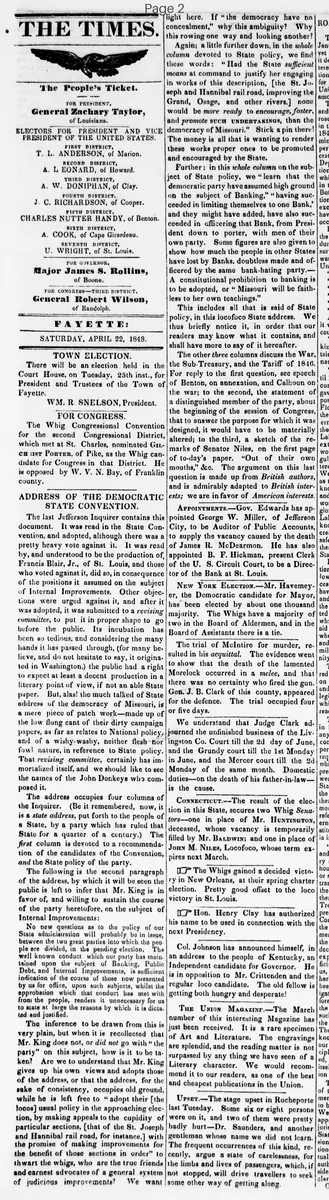
ADDRESS OF THE DEMOCRATIC STATE CONVENTION.
The last Jefferson Inquirer contains this document. It was read in the State Convention, and adopted, although there was a pretty heavy vote against it. It was read by, and understood to be the production of Francis Blair, Jr., of St. Louis, and those who voted against it, did so, in consequence of the positions it assumed on the subject of Internal Improvements. Other objections were urged against it, and after it was adopted, it was submitted to a revising committee, to put it in proper shape to go before the public. Its incubation has been so tedious, and considering the many hands it has passed through, (for many believe, and do not hesitate to say, it originated in Washington,) the public had a right to expect at least a decent production in a literary point of view, if not an able State paper. But, alas! the much talked of State address of the democracy of Missouri, is a mere piece of patch work—made up of the low flung cant of their dirty campaign papers, as far as relates to National policy, and of a wishy-washy, neither flesh nor fowl nature, in reference to State policy.
That revising committee, certainly has immortalized itself, and we should like to see the names of the John Donkeys who composed it.
The address occupies four columns of the Inquirer. (Be it remembered, now, it is a state address, put forth to the people of a State, by a party which has ruled that State for a quarter of a century.)
The first column is devoted to a recommendation of the candidates of the Convention, and the State policy of the party.
The following is the second paragraph of the address, by which it will be seen the public is left to infer that Mr. King is in favor of, and willing to sustain the course of the party heretofore, on the subject of Internal Improvements:
"No new questions as to the policy of our State administration will probably be in issue, between the two great parties into which the people are divided, in the pending election. The well known conduct which our party has maintained upon the subject of Banking, Public Debt, and Internal Improvements, is sufficient indication of the course of those now presented by us for office, upon such subjects, whilst the approbation which that conduct has met with from the people, renders it unnecessary for us to state at large the reasons by which it is dictated and justified."
The inference to be drawn from this is very plain, but when it is recollected that Mr. King does not, or did not go with "the party" on this subject, how is it to be taken? Are we to understand that Mr. King gives up his own views and adopts those of the address, or that the address, for the sake of consistency, occupies old ground, while he is left free to "adopt their [the foco's] usual policy in the approaching election, by making appeals to the cupidity of particular sections, [that of the St. Joseph and Hannibal rail road, for instance.] with the promise of making improvements for the benefit of those sections in order to thwart the whigs, who are the true friends and earnest advocates of a general system of judicious improvements?
We want light here. If "the democracy have no concealment," why this ambiguity? Why this rowing one way and looking another?
Again; a little further down, in the whole column devoted to State policy, we find these words: "Had the State sufficient means at command to justify her engaging in works of this description, [the St. Joseph and Hannibal rail road, improving the Grand, Osage, and other rivers.] none would be more ready to encourage, foster and promote such undertakings, than the democracy of Missouri." Stick a pin there!
The money is all that is wanting to render these works proper ones to be promoted and encouraged by the State.
Further: in this whole column on the subject of State policy, we "learn that the democratic party have assumed high ground on the subject of Banking," "having succeeded in limiting themselves to one Bank," and they might have added, have also succeeded in officering that Bank, from President down to porter, with men of their own party. Some figures are also given to show how much the people in other States have lost by Banks, doubtless made and officered by the same bank-hating party.
A constitutional prohibition to banking is to be adopted, or "Missouri will be faithless to her own teachings."
This includes all that is said of State policy, in this locofoco State address. We thus briefly notice it, in order that our readers may know what it contains, and shall have more to say of it hereafter.
The other three columns discuss the War, the Sub-Treasury, and the Tariff of 1846. For reply to the first question, see speech of Benton, on annexation, and Calhoun on the war; to the second, the statement of a distinguished member of the party, about the beginning of the session of Congress, that to answer the purpose for which it was designed, it would have to be materially altered: to the third, a sketch of the remarks of Senator Niles, on the first page of to-day's paper. "Out of their own mouths." &c. The argument on this last question is made up from British authors, and is admirably adapted to British interests; we are in favor of American interests.
The last Jefferson Inquirer contains this document. It was read in the State Convention, and adopted, although there was a pretty heavy vote against it. It was read by, and understood to be the production of Francis Blair, Jr., of St. Louis, and those who voted against it, did so, in consequence of the positions it assumed on the subject of Internal Improvements. Other objections were urged against it, and after it was adopted, it was submitted to a revising committee, to put it in proper shape to go before the public. Its incubation has been so tedious, and considering the many hands it has passed through, (for many believe, and do not hesitate to say, it originated in Washington,) the public had a right to expect at least a decent production in a literary point of view, if not an able State paper. But, alas! the much talked of State address of the democracy of Missouri, is a mere piece of patch work—made up of the low flung cant of their dirty campaign papers, as far as relates to National policy, and of a wishy-washy, neither flesh nor fowl nature, in reference to State policy.
That revising committee, certainly has immortalized itself, and we should like to see the names of the John Donkeys who composed it.
The address occupies four columns of the Inquirer. (Be it remembered, now, it is a state address, put forth to the people of a State, by a party which has ruled that State for a quarter of a century.)
The first column is devoted to a recommendation of the candidates of the Convention, and the State policy of the party.
The following is the second paragraph of the address, by which it will be seen the public is left to infer that Mr. King is in favor of, and willing to sustain the course of the party heretofore, on the subject of Internal Improvements:
"No new questions as to the policy of our State administration will probably be in issue, between the two great parties into which the people are divided, in the pending election. The well known conduct which our party has maintained upon the subject of Banking, Public Debt, and Internal Improvements, is sufficient indication of the course of those now presented by us for office, upon such subjects, whilst the approbation which that conduct has met with from the people, renders it unnecessary for us to state at large the reasons by which it is dictated and justified."
The inference to be drawn from this is very plain, but when it is recollected that Mr. King does not, or did not go with "the party" on this subject, how is it to be taken? Are we to understand that Mr. King gives up his own views and adopts those of the address, or that the address, for the sake of consistency, occupies old ground, while he is left free to "adopt their [the foco's] usual policy in the approaching election, by making appeals to the cupidity of particular sections, [that of the St. Joseph and Hannibal rail road, for instance.] with the promise of making improvements for the benefit of those sections in order to thwart the whigs, who are the true friends and earnest advocates of a general system of judicious improvements?
We want light here. If "the democracy have no concealment," why this ambiguity? Why this rowing one way and looking another?
Again; a little further down, in the whole column devoted to State policy, we find these words: "Had the State sufficient means at command to justify her engaging in works of this description, [the St. Joseph and Hannibal rail road, improving the Grand, Osage, and other rivers.] none would be more ready to encourage, foster and promote such undertakings, than the democracy of Missouri." Stick a pin there!
The money is all that is wanting to render these works proper ones to be promoted and encouraged by the State.
Further: in this whole column on the subject of State policy, we "learn that the democratic party have assumed high ground on the subject of Banking," "having succeeded in limiting themselves to one Bank," and they might have added, have also succeeded in officering that Bank, from President down to porter, with men of their own party. Some figures are also given to show how much the people in other States have lost by Banks, doubtless made and officered by the same bank-hating party.
A constitutional prohibition to banking is to be adopted, or "Missouri will be faithless to her own teachings."
This includes all that is said of State policy, in this locofoco State address. We thus briefly notice it, in order that our readers may know what it contains, and shall have more to say of it hereafter.
The other three columns discuss the War, the Sub-Treasury, and the Tariff of 1846. For reply to the first question, see speech of Benton, on annexation, and Calhoun on the war; to the second, the statement of a distinguished member of the party, about the beginning of the session of Congress, that to answer the purpose for which it was designed, it would have to be materially altered: to the third, a sketch of the remarks of Senator Niles, on the first page of to-day's paper. "Out of their own mouths." &c. The argument on this last question is made up from British authors, and is admirably adapted to British interests; we are in favor of American interests.
What sub-type of article is it?
Political Critique
Editorial
What themes does it cover?
Deception
Justice
What keywords are associated?
Democratic Convention
Internal Improvements
Banking Policy
State Address
Missouri Politics
Tariff 1846
Sub Treasury
What entities or persons were involved?
Francis Blair, Jr.
Mr. King
Benton
Calhoun
Senator Niles
Where did it happen?
Missouri, St. Louis, St. Joseph, Hannibal
Story Details
Key Persons
Francis Blair, Jr.
Mr. King
Benton
Calhoun
Senator Niles
Location
Missouri, St. Louis, St. Joseph, Hannibal
Event Date
1846
Story Details
Critique of the Democratic address adopted at the State Convention, highlighting ambiguities on internal improvements, banking policy, and national issues like the war, sub-treasury, and tariff, with references to party inconsistencies and candidate positions.