Thank you for visiting SNEWPapers!
Sign up free
The Virginia Gazette
Richmond, Williamsburg, Richmond County, Virginia
What is this article about?
An American writes to Rev. Samuel Henley rebutting his arguments against establishing a bishopric in colonial America. The letter defends the Church of England's need for bishops in Virginia to support clergy, education at the College of William and Mary, moral oversight, and religious propagation, criticizing Henley's inconsistencies as a dissenting minister in the established church.
Clipping
OCR Quality
Full Text
REVEREND SIR,
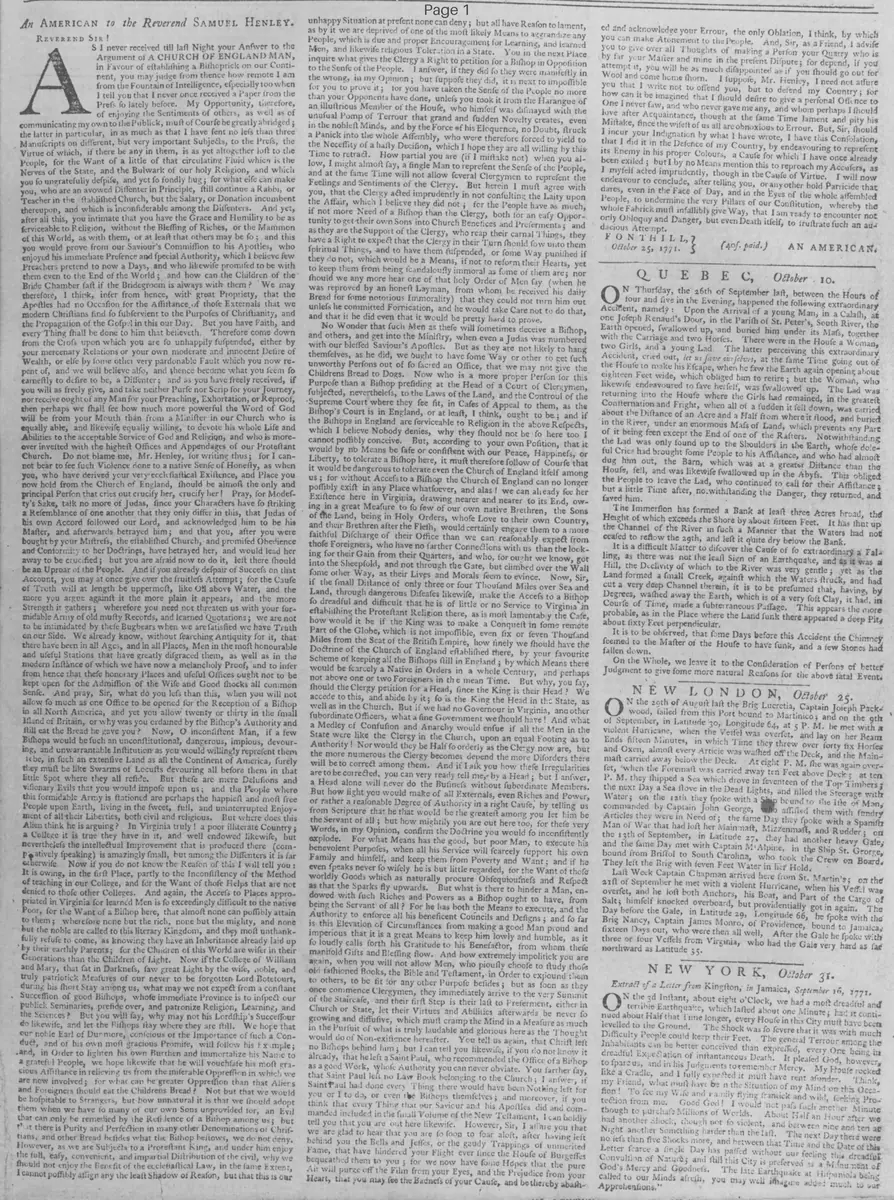
I never received till last Night your Answer to the Argument of A CHURCH OF ENGLAND MAN, in Favour of establishing a Bishoprick on our Continent, you may judge from thence how remote I am from the Fountain of Intelligence, especially too when I tell you that I never once received a Paper from the Press so lately before. My Opportunity, therefore, of enjoying the Sentiments of others, as well as of communicating my own to the Publick, must of Course be greatly abridged; the latter in particular, in as much as that I have sent no less than three Manuscripts on different, but very important Subjects, to the Press, the Virtue of which, if there be any in them, is as yet altogether lost to the People, for the Want of a little of that circulating Fluid which is the Nerves of the State, and the Bulwark of our holy Religion, and which you so ungratefully despise, and yet so fondly hug; for what else can make you, who are an avowed Dissenter in Principle, still continue a Rabbi, or Teacher in the established Church, but the Salary, or Donation incumbent thereupon, and which is inconsiderable among the Dissenters. And yet, after all this, you intimate that you have the Grace and Humility to be as serviceable to Religion, without the Blessing of Riches, or the Mammon of this World, as with them, or at least that others may be so; and this you would prove from our Saviour's Commission to his Apostles, who enjoyed his immediate Presence and special Authority, which I believe few Preachers pretend to now a Days, and who likewise promised to be with them even to the End of the World; and how can the Children of the Bride Chamber fast if the Bridegroom is always with them? We may therefore, I think, infer from hence, with great Propriety, that the Apostles had no Occasion for the Assistance of those Externals that we modern Christians find so subservient to the Purposes of Christianity, and the Propagation of the Gospel in this our Day. But you have Faith, and every Thing shall be done to him that believeth. Therefore come down from the Cross upon which you are so unhappily suspended, either by your mercenary Relations or your own moderate and innocent Desire of Wealth, or else by some other very pardonable Fault which you now repent of, and we will believe also, and thence become what you seem so earnestly to desire to be, a Dissenter; and as you have freely received, if you will as freely give, and take neither Purse nor Scrip for your Journey, nor receive ought of any Man for your Preaching, Exhortation, or Reproof, then perhaps we shall see how much more powerful the Word of God will be from your Mouth than from a Minister in our Church who is equally able, and likewise equally willing, to devote his whole Life and Abilities to the acceptable Service of God and Religion, and who is moreover invested with the highest Offices and Appendages of our Protestant Church. Do not blame me, Mr. Henley, for writing thus; or I cannot bear to see such Violence done to a native Sense of Honesty, as when you, who have derived your very ecclesiastical Existence, and Place you now hold from the Church of England, should be almost the only and principal Person that cries out crucify her, crucify her! Pray, for Modesty's Sake, talk no more of Judas, since your Characters have so striking a Resemblance of one another that they only differ in this, that Judas of his own Accord followed our Lord, and acknowledged him to be his Master, and afterwards betrayed him; and that you, after you were bought by your Mistress, the established Church, and promised Obedience and Conformity to her Doctrines, have betrayed her, and would lead her away to be crucified; but you are afraid now to do it, lest there should be an Uproar of the People. And if you already despair of Success on that Account, you may at once give over the fruitless Attempt; for the Cause of Truth will at length be uppermost, like Oil above Water, and the more you argue against it the more plain it appears, and the more Strength it gathers; wherefore you need not threaten us with your formidable Army of old musty Records, and learned Quotations; we are not to be intimidated by these Bugbears when we are satisfied we have Truth on our Side. We already know, without searching Antiquity for it, that there have been in all Ages, and in all Places, Men in the most honourable and useful Stations that have greatly disgraced them, as well as in the modern Instance of which we have now a melancholy Proof, and to infer from hence that these honorary Places and useful Offices ought not to be kept open for the Admission of the Wise and Good shocks all common Sense. And pray, Sir, what do you less than this, when you will not allow so much as one Office to be opened for the Reception of a Bishop in all North America, and yet you allow twenty or thirty in the small Island of Britain, or why was you ordained by the Bishop's Authority and still eat the Bread he gave you? Now, O inconsistent Man, if a few Bishops would be such an unconstitutional, dangerous, impious, devouring, and unwarrantable Institution as you would willingly represent them to be, in such an extensive Land as all the Continent of America, surely they must be like Swarms of Locusts devouring all before them in that little Spot where they all reside. But these are mere Delusions and visionary Evils that you would impose upon us; and the People where this formidable Army is stationed are perhaps the happiest and most free People upon Earth, living in the sweet, full, and uninterrupted Enjoyment of all their Liberties, both civil and religious. But where does this Alien think he is arguing? In Virginia truly! a poor illiterate Country; a College it is true they have in it, and well endowed likewise, but nevertheless the intellectual Improvement that is produced there (comparatively speaking) is amazingly small, but among the Dissenters it is far otherwise. Now if you do not know the Reason of this I will tell you: It is owing, in the first Place, partly to the Inconsistency of the Method of teaching in our College, and for the Want of those Helps that are not denied to those other Colleges. And again, the Access to Places appropriated in Virginia for learned Men is so exceedingly difficult to the native Poor, or the Want of a Bishop here, that almost none can possibly attain to them; wherefore none but the rich, none but the mighty, and none but the noble are called to this literary Kingdom, and they most unthankfully refuse to come, as knowing they have an Inheritance already laid up by their earthly Parents; for the Children of this World are wiser in their Generations than the Children of Light. Now if the College of William and Mary, that sat in Darkness, saw great Light by the wise, noble, and truly patriotick Measures of our never to be forgotten Lord Botetourt, during his short Stay among us, what may we not expect from a constant Succession of good Bishops, whose immediate Province is to inspect our publick Seminaries, preside over, and patronize Religion, Learning, and the Sciences? But you will say, why may not his Lordship's Successor do likewise, and let the Bishops stay where they are still. We hope that our noble Earl of Dunmore, conscious of the Importance of such a Conduct, and of his own most gracious Promise, will follow his Example; and, in Order to lighten his own Burthen and immortalize his Name to a grateful People, we hope likewise that he will vouchsafe his most gracious Assistance in relieving us from the miserable Oppression in which we are now involved; for what can be greater Oppression than that Aliens and Foreigners should eat the Childrens Bread? Not but that we would be hospitable to Strangers, but how unnatural it is that we should adopt them when we have so many of our own Sons unprovided for, an Evil that can only be remedied by the Residence of a Bishop among us; but if there is Purity and Perfection in many other Denominations of Christians, and other Bread besides what the Bishop bestows, we do not deny. However, as we are Subjects to a Protestant King, and under him enjoy the full, easy, convenient, and impartial Distribution of the civil, why we should not enjoy the Benefit of the ecclesiastical Law, in the same Extent, I cannot possibly assign any the least Shadow of Reason, but that this is our unhappy Situation at present none can deny; but all have Reason to lament, as by it we are deprived of one of the most likely Means to aggrandize any People, which is due and proper Encouragement for Learning, and learned Men, and likewise religious Toleration in a State. You in the next Place inquire what gives the Clergy a Right to petition for a Bishop in Opposition to the Sense of the People. I answer, if they did so they were manifestly in the wrong, in my Opinion; but suppose they did, it is next to impossible for you to prove it; for you have taken the Sense of the People no more than your Opponents have done, unless you took it from the Harangue of an illustrious Member of the House, who himself was dismayed with the unusual Pomp of Terrour that grand and sudden Novelty creates, even in the noblest Minds, and by the Force of his Eloquence, no Doubt, struck a Panick into the whole Assembly, who were therefore forced to yield to the Necessity of a hasty Decision, which I hope they are all willing by this Time to retract. How partial you are (if I mistake not) when you allow, I might almost say, a single Man to represent the Sense of the People, and at the Same Time will not allow several Clergymen to represent the Feelings and Sentiments of the Clergy. But herein I must agree with you, that the Clergy acted imprudently in not consulting the Laity upon the Affair, which I believe they did not; for the People have as much, if not more Need of a Bishop than the Clergy, both for an easy Opportunity to get their own Sons into Church Benefices and Preferments; and as they are the Support of the Clergy, who reap their carnal Things, they have a Right to expect that the Clergy in their Turn should sow unto them spiritual Things, —and to have them suspended, or some Way punished if they do not, which would be a Means, if not to reform their Hearts, yet to keep them from being scandalously immoral as some of them are; nor should we any more hear one of that holy Order of Men say (when he was reproved by an honest Layman, from whom he received his daily Bread for some notorious Immorality) that they could not turn him out unless he committed Fornication, and he would take Care not to do that, and that if he did even that it would be pretty hard to prove. No Wonder that such Men as these will sometimes deceive a Bishop, and others, and get into the Ministry, when even a Judas was numbered with our blessed Saviour's Apostles. But as they are not likely to hang themselves, as he did, we Ought to have some Way or other to get such unworthy Persons out of so sacred an Office, that we may not give the Childrens Bread to Dogs. Now who is a more proper Person for this Purpose than a Bishop presiding at the Head of a Court of Clergymen, subjected, nevertheless, to the Laws of the Land, and the Controul of the Supreme Court where they see fit, in Cases of Appeal to them, as the Bishop's Court is in England, or at least, I think, ought to be; and if the Bishops in England are serviceable to Religion in the above Respects, which I believe Nobody denies, why they should not be so here too I cannot possibly conceive. But, according to your own Position, that it would by no Means be safe or consistent with our Peace, Happiness, or Liberty, to tolerate a Bishop here, it must therefore follow of Course that it would be dangerous to tolerate even the Church of England itself among us; for without Access to a Bishop the Church of England can no longer possibly exist in any Place whatsoever, and alas! we can already see her Existence here in Virginia, drawing nearer and nearer to its End, owing in a great Measure to so few of our own native Brethren, the Sons of the Land, being in Holy Orders, whose Love to their own Country, and their Brethren after the Flesh, would certainly engage them to a more faithful Discharge of their Office than we can reasonably expect from those Foreigners, who have no farther Connections with us than the looking for their Gain from their Quarters, and who, for ought we know, got into the Sheepfold, and not through the Gate, but climbed over the Wall some other Way, as their Lives and Morals seem to evince. Now, Sir, if the small Distance of only three or four Thousand Miles over Sea and Land, through dangerous Diseases likewise, make the Access to a Bishop so dreadful and difficult that he is of little or no Service to Virginia in establishing the Protestant Religion there, as is most lamentably the Case, how would it be if the King was to make a Conquest in some remote Part of the Globe, which is not impossible, even six or seven Thousand Miles from the Seat of the British Empire, how finely we should have the Doctrine of the Church of England established there, by your favourite Scheme of keeping all the Bishops still in England; by which Means there would be scarcely a Native in Orders in a whole Century, and perhaps not above one or two Foreigners in the mean Time. But why, you say, should the Clergy petition for a Head, since the King is their Head? We accede to this, and abide by it; so is the King the Head in the State, as well as in the Church. But if we had no Governour in Virginia, and other subordinate Officers, what a fine Government we should have! And what a Medley of Confusion and Anarchy would ensue if all the Men in the State were like the Clergy in the Church, upon an equal Footing as to Authority! Nor would they be Half so orderly as the Clergy now are, but the more numerous the Clergy becomes depend the more Disorders there will be to correct among them. And if I ask you how these Irregularities are to be corrected, you can very readily tell me,— by a Head; but I answer, a Head alone will never do the Business without subordinate Members. But how lightly you would make of all Externals, even Riches and Power, or rather a reasonable Degree of Authority in a right Cause, by telling us from Scripture that he that would be the greatest among you let him be the Servant of all; but how mightily you are out here too, for these very Words, in my Opinion, confirm the Doctrine you would so inconsistently explode. For what Means has the good, but poor Man, to execute his benevolent Purposes, when all his Service will scarcely support his own Family and himself, and keep them from Poverty and Want; and if he even speaks never so wisely he is but little regarded, for the Want of those worldly Goods which as naturally procure Obsequiousness and Respect as that the Sparks fly upwards. But what is there to hinder a Man, endowed with such Riches and Powers as a Bishop ought to have, from being the Servant of all? For he has both the Means to execute, and the Authority to enforce all his beneficent Councils and Designs; and so far is this Elevation of Circumstances from making a good Man proud and imperious that it is a great Means to keep him lowly and humble, as it so loudly calls forth his Gratitude to his Benefactor, from whom these manifold Gifts and Blessing flow. And how extremely impolitick you are again, when you will not allow Men, who piously choose to study those old fashioned Books, the Bible and Testament, in Order to expound them to others, to be fit for any other Purpose besides; but as soon as they once commence Clergymen, they immediately arrive to the very Summit of the Staircase, and their first Step is their last to Preferment, either in Church or State, let their Virtues and Abilities afterwards be never so growing and diffusive, which must cramp the Mind in a Measure as much in the Pursuit of what is truly laudable and glorious here as the Thought would do of Non-existence hereafter. You tell us again, that Christ left no Bishops behind him; but I can tell you likewise, if you do not know it already, that he left a Saint Paul, who recommended the Office of a Bishop as a good Work, whose Authority you can never obviate. You further say, that Saint Paul left no Law Book belonging to the Church; I answer, if Saint Paul had done every Thing there would have been Nothing left for you or I to do, or even the Bishops themselves; and moreover, if you think that every Thing that our Saviour and his Apostles did and commanded included in the small Volume of the New Testament, I can boldly tell you that you are out here likewise. However, Sir, I assure you that we are glad to hear that you are so soon to soar aloft, after having left behind you the Bells and Jesses, or the gaudy Trappings of unmerited Fame, that have hindered your Flight ever since the House of Burgesses bequeathed them to you; for we now have some Hopes that the pure Air will purge off the Film from your Eyes, and the Prejudice from your Heart, that you may see the Badness of your Cause, and be thereby ed and acknowledge your Errour, the only Oblation, I think, by which you can make Atonement to the People. And, Sir, as a Friend, I advise you to give over all Thoughts of making a Person your Quarry who is by far your Master and mine in the present Dispute; for depend, if you attempt it, you will be as much disappointed as if you should go out for Wool and come home shorn. I suppose, Mr. Henley, I need not assure you that I write not to offend you, but to defend my Country; for how can it be imagined that I should desire to give a personal Offence to One I never saw, and who never gave me any, and whom perhaps I should love after Acquaintance, though at the same Time lament and pity his Mistake, since the wisest of us all are obnoxious to Errour. But, Sir, should I incur your Indignation by what I have wrote, I have this Consolation, that I did it in the Defence of my Country, by endeavouring to represent its Enemy in his proper Colours, a Cause for which I have once already been exiled; but I by no Means mention this to reproach my Accusers, as I myself acted imprudently, though in the Cause of Virtue. I will now endeavour to conclude, after telling you, or any other bold Parricide that dares, even in the Face of Day, and in the Eyes of the whole assembled People, to undermine the very Pillars of our Constitution, whereby the whole Fabrick must infallibly give Way, that I am ready to encounter not only Obloquy and Danger, but even Death itself, to frustrate such an audacious Attempt.
FONTHILL,
October 25, 1771.
S
(40s. paid.)
AN AMERICAN
What sub-type of article is it?
What themes does it cover?
What keywords are associated?
What entities or persons were involved?
Letter to Editor Details
Author
An American
Recipient
The Reverend Samuel Henley
Main Argument
the letter strongly defends the establishment of a bishopric in colonial america, particularly virginia, as essential for the church of england's survival, clergy oversight, moral discipline, education at the college of william and mary, and providing opportunities for native sons, while accusing rev. henley of hypocrisy and betrayal for opposing it despite benefiting from the church.
Notable Details