Thank you for visiting SNEWPapers!
Sign up free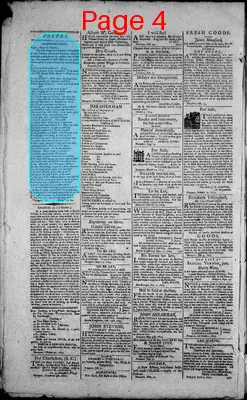
Literary
December 12, 1805
Rhode Island Republican
Newport, Newport County, Rhode Island
What is this article about?
A reader submits an excerpt from Edward Young's 'Complaint' (Night Thoughts), a moral poetic soliloquy addressing ethereal spirits on human folly, madness of kings, and the horrors of war devastating Europe, likening it to a bedlam where reason runs mad.
Clipping
OCR Quality
95%
Excellent
Full Text
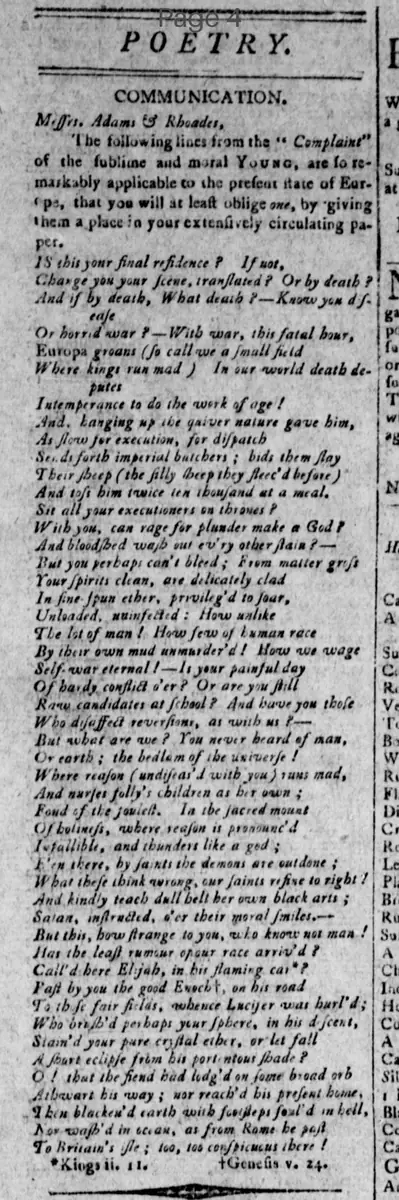
POETRY.
COMMUNICATION.
Messrs. Adams & Rhoades,
The following lines from the "Complaint"
of the sublime and moral Young, are remarkably
applicable to the present state of Europe, that you
will at least oblige one, by giving them a place in
your extensively circulating paper.
IS this your final residence? If not.
Change you your scene, translated? Or by death?
And if by death, What death?—Know you defeat
Or horrid war?—With war, this fatal hour
Europa groans (So call we a small field
Where kings run mad) In our small world death deputes
Intemperance to do the work of age!!
And hanging up the quiver nature gave him,
As sword for execution, for dispatch
Sends forth imperial butchers: bids them flay
Their sheep (the silly sheep they fleeced before)
And toss them twice ten thousand at a meal.
Sit all your executioners on thrones
With you, can rage for plunder make a God
And bloodshed wash out ev'ry other stain?-
But you perhaps can't bleed; From matter gross
Your spirits clean, are delicately clad
In fine-spun ether, privileg'd to soar.
Unloaded, uninfested: How unlike
The lot of man! How few of human race
By their own mud unmurder'd! How we wage
Self-war eternal!—Is your painful day
Of hardy conflict ne'er? Or are you still
Rival candidates at school? And have you those
Who disaffect reversions, as with us?-
But what are we? You never heard of man,
Or earth: the bedlam of the universe!
Where reason (undiseas'd with you) runs mad,
And nurses folly's children as her own;
Fond of the foolest. In the sacred mount
Of holiness, where reason is pronounc'd
Infallible, and thunders like a god;
E'en there, by saints the demons are outdone;
What these think wrong, our saints rise to right?
And kindly teach dull hell her own black arts;
Satan, instructed, learns their moral smiles.--
But this, how strange to you, who know not man!
Has the least rumour of our race arriv'd?
Call'd here Elijah, in his flaming car*?
Past by you the good Enoch, on his road
To th' fair fields, whence Lucifer was hurl'd;
Who brib'd perhaps your sphere, in his descent,
Stain'd your pure crystal ether, or let fall
A short eclipse from his portentous shade?
O! that the fiend had lodg'd on some broad orb
Athwart his ray: nor reach'd his present home.
I ken blacken'd earth await with souls foul'd in hell,
Nor wash'd in ocean, as from Rome he past
To Britain's isle; too, 'twas conspicuous there!
* Kings ii. 11.
Genesis v. 24.
COMMUNICATION.
Messrs. Adams & Rhoades,
The following lines from the "Complaint"
of the sublime and moral Young, are remarkably
applicable to the present state of Europe, that you
will at least oblige one, by giving them a place in
your extensively circulating paper.
IS this your final residence? If not.
Change you your scene, translated? Or by death?
And if by death, What death?—Know you defeat
Or horrid war?—With war, this fatal hour
Europa groans (So call we a small field
Where kings run mad) In our small world death deputes
Intemperance to do the work of age!!
And hanging up the quiver nature gave him,
As sword for execution, for dispatch
Sends forth imperial butchers: bids them flay
Their sheep (the silly sheep they fleeced before)
And toss them twice ten thousand at a meal.
Sit all your executioners on thrones
With you, can rage for plunder make a God
And bloodshed wash out ev'ry other stain?-
But you perhaps can't bleed; From matter gross
Your spirits clean, are delicately clad
In fine-spun ether, privileg'd to soar.
Unloaded, uninfested: How unlike
The lot of man! How few of human race
By their own mud unmurder'd! How we wage
Self-war eternal!—Is your painful day
Of hardy conflict ne'er? Or are you still
Rival candidates at school? And have you those
Who disaffect reversions, as with us?-
But what are we? You never heard of man,
Or earth: the bedlam of the universe!
Where reason (undiseas'd with you) runs mad,
And nurses folly's children as her own;
Fond of the foolest. In the sacred mount
Of holiness, where reason is pronounc'd
Infallible, and thunders like a god;
E'en there, by saints the demons are outdone;
What these think wrong, our saints rise to right?
And kindly teach dull hell her own black arts;
Satan, instructed, learns their moral smiles.--
But this, how strange to you, who know not man!
Has the least rumour of our race arriv'd?
Call'd here Elijah, in his flaming car*?
Past by you the good Enoch, on his road
To th' fair fields, whence Lucifer was hurl'd;
Who brib'd perhaps your sphere, in his descent,
Stain'd your pure crystal ether, or let fall
A short eclipse from his portentous shade?
O! that the fiend had lodg'd on some broad orb
Athwart his ray: nor reach'd his present home.
I ken blacken'd earth await with souls foul'd in hell,
Nor wash'd in ocean, as from Rome he past
To Britain's isle; too, 'twas conspicuous there!
* Kings ii. 11.
Genesis v. 24.
What sub-type of article is it?
Poem
Soliloquy
What themes does it cover?
War Peace
Political
Moral Virtue
What keywords are associated?
Europe War
Kings Madness
Human Folly
Moral Poetry
Edward Young
Night Thoughts
Bloodshed
Reason Mad
What entities or persons were involved?
The Sublime And Moral Young
Literary Details
Title
From The "Complaint" Of ... Young
Author
The Sublime And Moral Young
Subject
Applicable To The Present State Of Europe
Key Lines
Is This Your Final Residence? If Not.
With War, This Fatal Hour Europa Groans (So Call We A Small Field Where Kings Run Mad)
Sit All Your Executioners On Thrones With You, Can Rage For Plunder Make A God And Bloodshed Wash Out Ev'ry Other Stain?
But What Are We? You Never Heard Of Man, Or Earth: The Bedlam Of The Universe!
Where Reason (Undiseas'd With You) Runs Mad, And Nurses Folly's Children As Her Own;