Thank you for visiting SNEWPapers!
Sign up free
Editorial
February 13, 1874
The Sun
New York, New York County, New York
What is this article about?
A critical editorial from The Sun denounces the U.S. Post Office Department's $37 million budget request for 1875 under Postmaster-General Creswell and President Grant, highlighting deficits, corrupt contracts, extravagant spending, and inefficiencies compared to Britain's system, urging Congress to deny appropriations and enforce self-sustainability.
Clipping
OCR Quality
95%
Excellent
Full Text
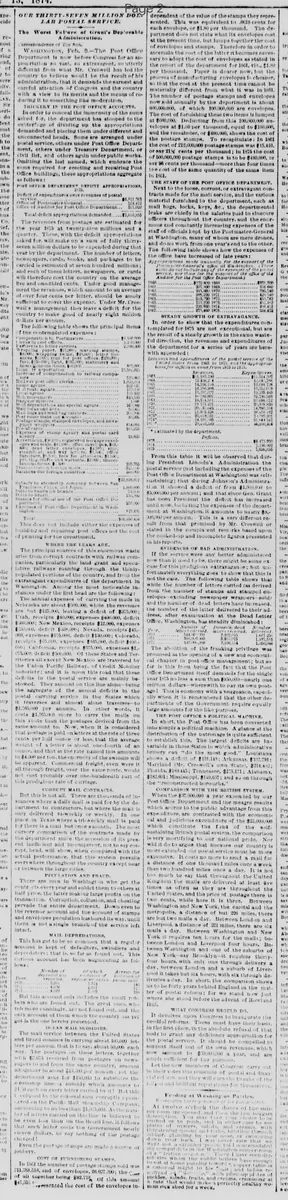
OUR THIRTY-SEVEN MILLION DOLLAR POSTAL SERVICE.
The Worst Failure of Grant's Deplorable Administration.
Correspondence of The Sun.
Washington, Feb. 2.—The Post Office Department is now before Congress for an appropriation so vast, so extravagant, so utterly different from what Mr. Creswell has led the country to believe would be the result of his administration, that it demands the earnest and careful attention of Congress and the country with a view to its merits and the means of reducing it to something like moderation.
TRICKERY IN THE POST OFFICE ACCOUNTS.
In order to conceal the immensity of the sums asked for, the department has stooped to the subterfuge of dividing up the appropriations demanded and placing them under different and unconnected heads. Some are arranged under postal service, others under Post Office Department, others under Treasury Department, or civil list, and others again under public works. Omitting the last named, which embrace the sums required for erecting and repairing Post Office buildings, these appropriations aggregate as follows:
POST OFFICE DEPARTMENT DEFICIT APPROPRIATIONS 1875.
Deficit of expenditures over revenues of postal service $6,811,263
Office of Postmaster-General 681,472
Office of Auditor for Post Office Department 811,020
Total deficit appropriations demanded $7,600,000
The revenues from postage are estimated for the year 1875 at twenty-nine millions and a quarter. These, with the deficit appropriations asked for, will make up a sum of fully thirty-seven million dollars to be expended during that year by the department. The number of letters, newspapers, cards, books, and packages to be carried is estimated at seven hundred millions; and each of these letters, newspapers, or cards will therefore cost the country on the average five and one-third cents. Under good management the revenues, which amount to an average of over four cents per letter, should be amply sufficient to cover the expense. Under Mr. Creswell's management they leave a deficit for the country to make good of nearly eight million dollars per annum.
The following table shows the principal items of the contemplated expenses:
Compensation to Postmasters $4,000,000
Clerks at post offices 5,200,000
Payments to letter carriers 2,000,000
Wrapping paper $270,000; marking stamps $500; wrapping twine $10,000; letter balances $2,000; rent for post offices $500,000; fuel $150,000; light $160,000; stationery and miscellaneous items $50,000 807,000
Inland transportation 15,594,021
Increase of compensation to railway companies 521,000
Railway post office clerks 1,800,000
Route agents 9,913
Mail route agent 1,000
Local agents 11,033
Mail messenger 643.51
Baggage masters 140
Mail depredations and special agents 16,000
Mail locks and keys 8,000
Mail bags and mail bag catchers 20,100
Post route maps (on copper) 85,000
Postage stamps, stamped envelopes, and newspaper wrappers 64,091
Postal cards 100,000
Expenses of stamp agency and postal card 16,270
Advertising, registered package envelope agency 15,800
Open and seals $1,500; office envelopes $9,000; dead letter envelopes $600; ship steam boat, and way letters $1,000; office furniture $5,000; fees for attorneys $700; printing drafts and warrants $10,000; miscellaneous items $50,000 233,765
Transportation freight mails 325,000
Balances due foreign countries 200,100
This does not include either the expenses of building and repairing post offices nor the cost of printing for the department.
WHERE THE LEAKS ARE.
The principal sources of this enormous waste arise from corrupt contracts with railway companies, particularly the land grant and speculative railways running through the thinly-populated portions of the country, and from the extravagant expenditures of the department in Washington. Among the most noticeable instances under the first head are the following:
The annual expenses of carrying the mails in Nebraska are about $500,000, while the revenues are but $125,000, leaving a deficit of $375,000; Utah, receipts $40,000, expenses $400,000, deficit $360,000; New Mexico, receipts $12,000, expenses $50,000, deficit $38,000; Nevada, receipts $45,000, expenses $175,000, deficit $130,000; Colorado, receipts $65,000, expenses $465,000, deficit $400,000; California, receipts $550,000, expenses $1,500,000, deficit $950,000. Of these States and Territories all except New Mexico are traversed by the Union Pacific Railway, of Credit Mobilier notoriety; and it is upon this road that these deficits in the postal service are mainly bestowed. They amount on this line alone—being the aggregate of the annual deficits in the postal carrying service in the States which it traverses and almost alone traverses—to $1,765,000 per annum. In other words, it costs $1,765,000 more to carry the mails on this route than the postages derived from the same amount to. Now, when it is considered that postage is paid on letters at the rate of three cents per half ounce or less, that the average weight of a letter is about one-fourth of an ounce, and that at the rate named this amounts to 4.50 per ton, the enormity of the swindle will be apparent. Commercial freight, even were it all through freight, over the same route, would not cost probably over one-hundredth part of this prodigious rate of carriage.
CORRUPT MAIL CONTRACTS.
But this is not all. There are thousands of instances where a daily mail is paid for by the department to contractors, but where the mail is only delivered bi-weekly or weekly. In one place in Texas where a tri-weekly mail is paid for there is a mail but once a month. The most cursory comparison of the contracts made by the department since the accession of its present inefficient and incompetent, not to say corrupt, head, will show, when compared with the actual performance, that this system prevails everywhere throughout the country except near or between the large cities.
PECULATION AND FRAUD.
There are men in Washington who get the contracts every year and sublet them to others at half price, the latter making large profits on the transaction. Corruption, collusion, and cheating pervade the entire department. Down even to the revenue account and the account of stamps and envelopes peculation has bored its way, until there is not a single branch of the service left intact.
MAIL DEPREDATIONS.
This has got to be so common that a regular account is kept of defaulters, swindlers and depredators; that is, so far as found out. This curious account has been augmenting as follows:
Number of Arrests for Mail depredations
Year 1869 180
1870 494
1871 40
1872 1514
But this account only includes the small robbers who are found out. The great ones, who rob more cunningly, are not found out, and the only account of them which the country has yet got is the one hereby presented.
OCEAN MAIL SUBSIDIES.
The mail service between the United States and Brazil consists in carrying about 100,000 letters per annum, that is to say, about 50,000 each way. The postages on these letters, together with $2,000 received from postages on newspapers to and from the same country, amount altogether to about $15,000 per annum, yet the department asks for $100,000 to subsidize the steamship line which amounts to $3.00 each on every letter carried by it! But this is eclipsed by the colossal sum corruptly squandered on the Pacific Mail Steamship Company, amounting to no less than $1,005,000. As the number of letters carried on this line is believed to be even less than on the Brazil line, it follows that each letter costs the Government nearly eleven dollars, to say nothing of the postage charged!
Even the postage stamps are made a source of jobbery.
COST OF FURNISHING STAMPS.
In 1871 the number of postage stamps sold was 211,788,518, and of envelopes, 26,027,300; the cost of all together being $62,777. Of this amount $47,357 represented the cost of the envelopes independent of the value of the stamps they represented. This was equivalent to .0018 cents for each envelope, or $1.80 per thousand. The department does not state what its envelopes cost at the present time, but lumps together the cost of envelopes and stamps. Therefore in order to ascertain the cost of the latter it becomes necessary to adopt the cost of envelopes as stated in the report of the department for 1871, viz., $1.80 per thousand. Paper is dearer now, but the process of manufacturing envelopes is cheaper, so that the cost at the present time cannot be materially different from what it was in 1871. The number of postage stamps and envelopes now sold annually by the department is about 600,000,000, of which 100,000,000 are envelopes. The cost of furnishing these two items is lumped at $660,000. Deducting from this 100,000,000 envelopes at $1.80 per thousand, equal to $180,000, and the remainder, or $480,000, shows the cost of the postage stamps. To recapitulate: In 1861 the cost of 212,000,000 postage stamps was $15,416, or say 7 1/2 cents per thousand; in 1875 the cost of 500,000,000 postage stamps is to be $480,000, or say 96 cents per thousand—more than four times the cost of the same quantity of the same item in 1861.
THE STAFF OF THE POST OFFICE DEPARTMENT.
Next to the loose, corrupt, or extravagant contracts made for the mail service, and the various material furnished to the department, such as mail bags, locks, keys, &c., the departmental leaks are chiefly in the salaries paid to sinecure officers throughout the country, and the enormous and constantly increasing expenses of the staff of officials kept by the Postmaster-General at Washington, many of whom are mere drones, and do no work from one year's end to the other. The following table shows how the expenses of the office have increased of late years:
Appropriations made annually for the support of the Postmaster-General's office at Washington. These sums do not include any of the expenses of the postal service, nor those for the support of the office of the Auditor for the Post Office Department.
STEADY GROWTH OF EXTRAVAGANCE.
In order to show that the expenditures contemplated for 1875 are not exceptional, but are the result of a steady growth in the same wasteful direction, the revenues and expenditures of the department for a series of years are herewith appended:
Revenues and expenditures of the postal service of the United States from 1863 to 1874 and the appropriations for deficits in same from 1873 to 1874, estimated by the department.
From this table it will be observed that during President Lincoln's Administration the postal service (not including the expenses of the Post Office Department at Washington) was self-sustaining; that during Johnson's Administration it showed a deficit of from $1,000,000 to $5,000,000 per annum; and that since Gen. Grant has been President the deficit has increased until now, including the expenses of the department at Washington, it amounts to nearly $8,000,000 per annum. This is a very different result from that promised by Mr. Creswell or stated in the complacent remarks based upon the cooked-up and incomplete figures presented in his reports.
EVIDENCES OF BAD ADMINISTRATION.
If the service were any better administered now than it used to be, there might be some excuse for this prodigious extravagance; but unfortunately everything goes to show that this is not the case. The following table shows that while the number of letters carried (as derived from the number of stamps and stamped envelopes—excluding newspaper wrappers—sold) and the number of dead letters have increased, the number of the latter delivered to their address, after examination at the Dead Letter Office, Washington, has steadily diminished:
Number of Domestic dead letters received, delivered
Year Letters carried Letters received Delivered
1870 549,100,000 8,912,015 8,975
1871 596,000,000 9,996,740 147,515
1872 615,000,000 9,996,740 1,350,046
The abolition of the franking privilege was promised as the opening of a new and economical chapter in post office management; but so far is this from being the fact that the Post Office Department itself demands for the single year 1875 no less a sum than $950,000—nearly one million dollars—wherewith to pay its own postage! This is economy with a vengeance, especially when it is remembered that the other departments of the Government require equally large amounts for the like purpose.
THE POST OFFICE A POLITICAL MACHINE.
In short, the Post Office has been converted into simply a political machine. A glance at the distribution of the patronage is quite sufficient to establish this. The largest deficits are invariably in those States in which administrative bribery can "do the most good." Louisiana shows a deficit of $131,149; Arkansas, $302,791; Maryland (Mr. Creswell's own State), $214,400; Florida, $159,445; Tennessee, $175,171; Alabama, $186,601; Mississippi, $140,657; and so on through the "reconstructed boroughs."
COMPARISON WITH THE BRITISH SYSTEM.
When the $37,000,000 a year expended by our Post Office Department and the meagre results which accrue to the public advantage from this expenditure, are contrasted with the economical and judicious expenditure of the $25,000,000 which constitute the fund of the self-sustaining British postal system, the comparison is very mortifying to our national pride. Nor will it do to argue that because our country is more extended our postal service must be more expensive. It costs no more to send a mail for a distance of one thousand miles once a week than two hundred miles once a day. It is not too much to say that throughout the United Kingdom the mails are delivered at least five times as often as they are throughout the United States, and the price of postage there is two cents, while here it is three. Between Washington and New York, the capital and the metropolis, a distance of but 226 miles, there are but two mails a day. Between London and Liverpool, a distance of 221 miles, there are six mails a day. Between Washington and New York it requires ten hours for the mails; between London and Liverpool four hours. Between Washington and one of the suburbs of New York say Brooklyn—it requires thirty-four hours, with only one through delivery a day; between London and a suburb of Liverpool it takes but six hours, with six through deliveries a day. In short, the comparison shows us to be forty years behind England in the matter of postal reform; for we stand now just where she stood before the advent of Rowland Hill.
WHAT CONGRESS SHOULD DO.
It devolves upon Congress to inaugurate the needful reforms. These must have their basis, in the first place, in the absolute refusal of that body to grant any deficiency appropriation for the postal service. It should be compelled to support itself out of its own revenues, which now amount to $29,000,000 a year, and are amply sufficient for the purpose.
Let the new members of Congress carry out in their votes this principle of postal and financial reform and they will earn the thanks of the country and brilliant reputations for themselves.
The Worst Failure of Grant's Deplorable Administration.
Correspondence of The Sun.
Washington, Feb. 2.—The Post Office Department is now before Congress for an appropriation so vast, so extravagant, so utterly different from what Mr. Creswell has led the country to believe would be the result of his administration, that it demands the earnest and careful attention of Congress and the country with a view to its merits and the means of reducing it to something like moderation.
TRICKERY IN THE POST OFFICE ACCOUNTS.
In order to conceal the immensity of the sums asked for, the department has stooped to the subterfuge of dividing up the appropriations demanded and placing them under different and unconnected heads. Some are arranged under postal service, others under Post Office Department, others under Treasury Department, or civil list, and others again under public works. Omitting the last named, which embrace the sums required for erecting and repairing Post Office buildings, these appropriations aggregate as follows:
POST OFFICE DEPARTMENT DEFICIT APPROPRIATIONS 1875.
Deficit of expenditures over revenues of postal service $6,811,263
Office of Postmaster-General 681,472
Office of Auditor for Post Office Department 811,020
Total deficit appropriations demanded $7,600,000
The revenues from postage are estimated for the year 1875 at twenty-nine millions and a quarter. These, with the deficit appropriations asked for, will make up a sum of fully thirty-seven million dollars to be expended during that year by the department. The number of letters, newspapers, cards, books, and packages to be carried is estimated at seven hundred millions; and each of these letters, newspapers, or cards will therefore cost the country on the average five and one-third cents. Under good management the revenues, which amount to an average of over four cents per letter, should be amply sufficient to cover the expense. Under Mr. Creswell's management they leave a deficit for the country to make good of nearly eight million dollars per annum.
The following table shows the principal items of the contemplated expenses:
Compensation to Postmasters $4,000,000
Clerks at post offices 5,200,000
Payments to letter carriers 2,000,000
Wrapping paper $270,000; marking stamps $500; wrapping twine $10,000; letter balances $2,000; rent for post offices $500,000; fuel $150,000; light $160,000; stationery and miscellaneous items $50,000 807,000
Inland transportation 15,594,021
Increase of compensation to railway companies 521,000
Railway post office clerks 1,800,000
Route agents 9,913
Mail route agent 1,000
Local agents 11,033
Mail messenger 643.51
Baggage masters 140
Mail depredations and special agents 16,000
Mail locks and keys 8,000
Mail bags and mail bag catchers 20,100
Post route maps (on copper) 85,000
Postage stamps, stamped envelopes, and newspaper wrappers 64,091
Postal cards 100,000
Expenses of stamp agency and postal card 16,270
Advertising, registered package envelope agency 15,800
Open and seals $1,500; office envelopes $9,000; dead letter envelopes $600; ship steam boat, and way letters $1,000; office furniture $5,000; fees for attorneys $700; printing drafts and warrants $10,000; miscellaneous items $50,000 233,765
Transportation freight mails 325,000
Balances due foreign countries 200,100
This does not include either the expenses of building and repairing post offices nor the cost of printing for the department.
WHERE THE LEAKS ARE.
The principal sources of this enormous waste arise from corrupt contracts with railway companies, particularly the land grant and speculative railways running through the thinly-populated portions of the country, and from the extravagant expenditures of the department in Washington. Among the most noticeable instances under the first head are the following:
The annual expenses of carrying the mails in Nebraska are about $500,000, while the revenues are but $125,000, leaving a deficit of $375,000; Utah, receipts $40,000, expenses $400,000, deficit $360,000; New Mexico, receipts $12,000, expenses $50,000, deficit $38,000; Nevada, receipts $45,000, expenses $175,000, deficit $130,000; Colorado, receipts $65,000, expenses $465,000, deficit $400,000; California, receipts $550,000, expenses $1,500,000, deficit $950,000. Of these States and Territories all except New Mexico are traversed by the Union Pacific Railway, of Credit Mobilier notoriety; and it is upon this road that these deficits in the postal service are mainly bestowed. They amount on this line alone—being the aggregate of the annual deficits in the postal carrying service in the States which it traverses and almost alone traverses—to $1,765,000 per annum. In other words, it costs $1,765,000 more to carry the mails on this route than the postages derived from the same amount to. Now, when it is considered that postage is paid on letters at the rate of three cents per half ounce or less, that the average weight of a letter is about one-fourth of an ounce, and that at the rate named this amounts to 4.50 per ton, the enormity of the swindle will be apparent. Commercial freight, even were it all through freight, over the same route, would not cost probably over one-hundredth part of this prodigious rate of carriage.
CORRUPT MAIL CONTRACTS.
But this is not all. There are thousands of instances where a daily mail is paid for by the department to contractors, but where the mail is only delivered bi-weekly or weekly. In one place in Texas where a tri-weekly mail is paid for there is a mail but once a month. The most cursory comparison of the contracts made by the department since the accession of its present inefficient and incompetent, not to say corrupt, head, will show, when compared with the actual performance, that this system prevails everywhere throughout the country except near or between the large cities.
PECULATION AND FRAUD.
There are men in Washington who get the contracts every year and sublet them to others at half price, the latter making large profits on the transaction. Corruption, collusion, and cheating pervade the entire department. Down even to the revenue account and the account of stamps and envelopes peculation has bored its way, until there is not a single branch of the service left intact.
MAIL DEPREDATIONS.
This has got to be so common that a regular account is kept of defaulters, swindlers and depredators; that is, so far as found out. This curious account has been augmenting as follows:
Number of Arrests for Mail depredations
Year 1869 180
1870 494
1871 40
1872 1514
But this account only includes the small robbers who are found out. The great ones, who rob more cunningly, are not found out, and the only account of them which the country has yet got is the one hereby presented.
OCEAN MAIL SUBSIDIES.
The mail service between the United States and Brazil consists in carrying about 100,000 letters per annum, that is to say, about 50,000 each way. The postages on these letters, together with $2,000 received from postages on newspapers to and from the same country, amount altogether to about $15,000 per annum, yet the department asks for $100,000 to subsidize the steamship line which amounts to $3.00 each on every letter carried by it! But this is eclipsed by the colossal sum corruptly squandered on the Pacific Mail Steamship Company, amounting to no less than $1,005,000. As the number of letters carried on this line is believed to be even less than on the Brazil line, it follows that each letter costs the Government nearly eleven dollars, to say nothing of the postage charged!
Even the postage stamps are made a source of jobbery.
COST OF FURNISHING STAMPS.
In 1871 the number of postage stamps sold was 211,788,518, and of envelopes, 26,027,300; the cost of all together being $62,777. Of this amount $47,357 represented the cost of the envelopes independent of the value of the stamps they represented. This was equivalent to .0018 cents for each envelope, or $1.80 per thousand. The department does not state what its envelopes cost at the present time, but lumps together the cost of envelopes and stamps. Therefore in order to ascertain the cost of the latter it becomes necessary to adopt the cost of envelopes as stated in the report of the department for 1871, viz., $1.80 per thousand. Paper is dearer now, but the process of manufacturing envelopes is cheaper, so that the cost at the present time cannot be materially different from what it was in 1871. The number of postage stamps and envelopes now sold annually by the department is about 600,000,000, of which 100,000,000 are envelopes. The cost of furnishing these two items is lumped at $660,000. Deducting from this 100,000,000 envelopes at $1.80 per thousand, equal to $180,000, and the remainder, or $480,000, shows the cost of the postage stamps. To recapitulate: In 1861 the cost of 212,000,000 postage stamps was $15,416, or say 7 1/2 cents per thousand; in 1875 the cost of 500,000,000 postage stamps is to be $480,000, or say 96 cents per thousand—more than four times the cost of the same quantity of the same item in 1861.
THE STAFF OF THE POST OFFICE DEPARTMENT.
Next to the loose, corrupt, or extravagant contracts made for the mail service, and the various material furnished to the department, such as mail bags, locks, keys, &c., the departmental leaks are chiefly in the salaries paid to sinecure officers throughout the country, and the enormous and constantly increasing expenses of the staff of officials kept by the Postmaster-General at Washington, many of whom are mere drones, and do no work from one year's end to the other. The following table shows how the expenses of the office have increased of late years:
Appropriations made annually for the support of the Postmaster-General's office at Washington. These sums do not include any of the expenses of the postal service, nor those for the support of the office of the Auditor for the Post Office Department.
STEADY GROWTH OF EXTRAVAGANCE.
In order to show that the expenditures contemplated for 1875 are not exceptional, but are the result of a steady growth in the same wasteful direction, the revenues and expenditures of the department for a series of years are herewith appended:
Revenues and expenditures of the postal service of the United States from 1863 to 1874 and the appropriations for deficits in same from 1873 to 1874, estimated by the department.
From this table it will be observed that during President Lincoln's Administration the postal service (not including the expenses of the Post Office Department at Washington) was self-sustaining; that during Johnson's Administration it showed a deficit of from $1,000,000 to $5,000,000 per annum; and that since Gen. Grant has been President the deficit has increased until now, including the expenses of the department at Washington, it amounts to nearly $8,000,000 per annum. This is a very different result from that promised by Mr. Creswell or stated in the complacent remarks based upon the cooked-up and incomplete figures presented in his reports.
EVIDENCES OF BAD ADMINISTRATION.
If the service were any better administered now than it used to be, there might be some excuse for this prodigious extravagance; but unfortunately everything goes to show that this is not the case. The following table shows that while the number of letters carried (as derived from the number of stamps and stamped envelopes—excluding newspaper wrappers—sold) and the number of dead letters have increased, the number of the latter delivered to their address, after examination at the Dead Letter Office, Washington, has steadily diminished:
Number of Domestic dead letters received, delivered
Year Letters carried Letters received Delivered
1870 549,100,000 8,912,015 8,975
1871 596,000,000 9,996,740 147,515
1872 615,000,000 9,996,740 1,350,046
The abolition of the franking privilege was promised as the opening of a new and economical chapter in post office management; but so far is this from being the fact that the Post Office Department itself demands for the single year 1875 no less a sum than $950,000—nearly one million dollars—wherewith to pay its own postage! This is economy with a vengeance, especially when it is remembered that the other departments of the Government require equally large amounts for the like purpose.
THE POST OFFICE A POLITICAL MACHINE.
In short, the Post Office has been converted into simply a political machine. A glance at the distribution of the patronage is quite sufficient to establish this. The largest deficits are invariably in those States in which administrative bribery can "do the most good." Louisiana shows a deficit of $131,149; Arkansas, $302,791; Maryland (Mr. Creswell's own State), $214,400; Florida, $159,445; Tennessee, $175,171; Alabama, $186,601; Mississippi, $140,657; and so on through the "reconstructed boroughs."
COMPARISON WITH THE BRITISH SYSTEM.
When the $37,000,000 a year expended by our Post Office Department and the meagre results which accrue to the public advantage from this expenditure, are contrasted with the economical and judicious expenditure of the $25,000,000 which constitute the fund of the self-sustaining British postal system, the comparison is very mortifying to our national pride. Nor will it do to argue that because our country is more extended our postal service must be more expensive. It costs no more to send a mail for a distance of one thousand miles once a week than two hundred miles once a day. It is not too much to say that throughout the United Kingdom the mails are delivered at least five times as often as they are throughout the United States, and the price of postage there is two cents, while here it is three. Between Washington and New York, the capital and the metropolis, a distance of but 226 miles, there are but two mails a day. Between London and Liverpool, a distance of 221 miles, there are six mails a day. Between Washington and New York it requires ten hours for the mails; between London and Liverpool four hours. Between Washington and one of the suburbs of New York say Brooklyn—it requires thirty-four hours, with only one through delivery a day; between London and a suburb of Liverpool it takes but six hours, with six through deliveries a day. In short, the comparison shows us to be forty years behind England in the matter of postal reform; for we stand now just where she stood before the advent of Rowland Hill.
WHAT CONGRESS SHOULD DO.
It devolves upon Congress to inaugurate the needful reforms. These must have their basis, in the first place, in the absolute refusal of that body to grant any deficiency appropriation for the postal service. It should be compelled to support itself out of its own revenues, which now amount to $29,000,000 a year, and are amply sufficient for the purpose.
Let the new members of Congress carry out in their votes this principle of postal and financial reform and they will earn the thanks of the country and brilliant reputations for themselves.
What sub-type of article is it?
Economic Policy
Partisan Politics
Legal Reform
What keywords are associated?
Postal Deficit
Grant Administration
Corrupt Contracts
Mail Subsidies
Department Waste
Railway Overpayments
Political Machine
British Comparison
What entities or persons were involved?
President Grant
Mr. Creswell
Post Office Department
Congress
Union Pacific Railway
Pacific Mail Steamship Company
Editorial Details
Primary Topic
Criticism Of Postal Service Extravagance And Corruption Under Grant Administration
Stance / Tone
Strongly Critical And Accusatory Of Waste And Corruption
Key Figures
President Grant
Mr. Creswell
Post Office Department
Congress
Union Pacific Railway
Pacific Mail Steamship Company
Key Arguments
Department Requests $37 Million Budget Despite $29 Million Revenues, Creating $8 Million Deficit
Corrupt Contracts With Railways Cause Massive Deficits In Western States
Overpayments For Mail Services Not Delivered As Contracted
Peculation And Fraud Permeate All Levels Of The Department
Ocean Mail Subsidies Excessively Subsidize Steamship Companies
Increased Costs For Stamps And Envelopes Indicate Jobbery
Staff And Sinecure Salaries Contribute To Waste
Service Efficiency Declining, With More Dead Letters Undelivered
Post Office Used As Political Machine In Reconstructed States
Us System Lags Behind Efficient British Postal Service
Congress Should Deny Deficit Appropriations To Force Self Sustainability