Thank you for visiting SNEWPapers!
Sign up free
The National Intelligencer And Washington Advertiser
Washington, District Of Columbia
What is this article about?
On November 16, in the U.S. Senate, Mr. Mitchill urges increased defenses for seaports and harbors due to British naval threats, referencing the Danish fleet's capture. He surveys coastal vulnerabilities and calls for preparations. The motion passes unanimously, referred to a select committee including Mitchill, Adams, Sumter, Milledge, and Robinson.
Merged-components note: These three components form a single continuous narrative of Senate proceedings on national defense measures.
Clipping
OCR Quality
Full Text
MONDAY, NOVEMBER 16.
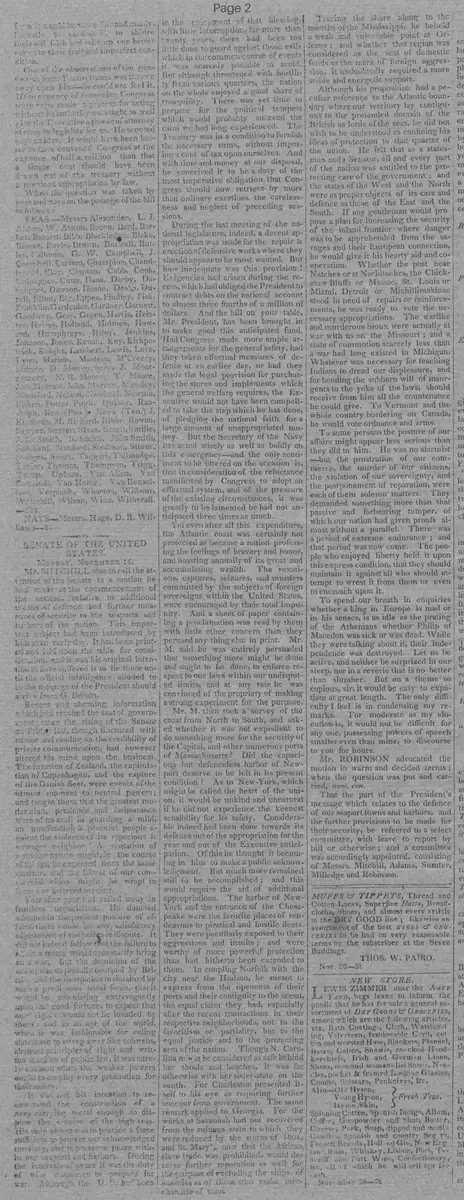
Mr. MITCHILL rose to call the attention of the Senate to a motion he had made at the commencement of the session, relative to additional means of defence, and further measures of security to the seaports and harbors of the nation. This important subject had been introduced by him at an early day. It had been printed and laid upon the table for consideration, and it was his original intention to have suffered it to lie there until the critical intelligence alluded to in the message of the President should arrive from G. Britain.
Recent and alarming information which had reached the seat of government since the rising of the Senate on Friday last, though tinctured with rumor and resting on the credibility of private communication, had however altered his mind upon the business. The invasion of Zealand, the capitulation of Copenhagen, and the capture of the Danish fleet, were events of the utmost moment to neutral powers; and taught them that the greatest moderation, prudence and forbearance were of no avail in guarding a mild, an unoffending & peaceful people against the violence of its rapacious & stronger neighbor. A visitation of a similar nature might, in the course of things, be expected from the same quarter, and the first of our commercial cities might be wrapt in flames or battered to ruins.
Year after year had rolled away in fruitless negotiation. He doubted whether in the present posture of affairs, there would be any satisfactory adjustment of the points in dispute. It did not indeed follow that the failure to effect a treaty would necessarily bring on a war. But the dominion of the ocean was so proudly usurped by Britain, and the usurpation maintained by such a prodigious naval force, that it would be calculating extravagantly upon our good fortune, to expect that our rights would not be invaded by them: and in an age of the world, when it was fashionable for ruling statesmen to sweep away like cobwebs, abstract principles of right and written maxims of public law, it was surely a season when the weaker powers ought to employ every precaution for their safety.
It was not his intention to recommend the construction of a navy carrying metal enough to dispute the empire of the high seas. His only object was to provide a force sufficient to protect our acknowledged territory, and to preserve peace within our seaports and harbors. During the intervals of peace it was the duty of wise statesmen to prepare for war. Although the U. S. had been in the enjoyment of that blessing, with little interruption, for more than twenty years, there had been too little done to guard against those evils which in the common course of events it was scarcely possible to avoid.
But although threatened with hostility from various quarters, the nation on the whole enjoyed a good share of tranquility. There was yet time to prepare for the political tempest which would probably succeed the calm we had long experienced. The Treasury was in a condition to furnish the necessary sums, without imposing a cent of tax upon ourselves. And with time and money at our disposal, he conceived it to be a duty of the most imperative obligation that Congress should now retrieve by more than ordinary exertions the carelessness and neglect of preceding sessions.
During the last meeting of the national legislature, indeed, a decent appropriation was made for the repair & erection of defensive works where they should appear to be most wanted. But how inadequate was this provision! Exigencies had arisen during the recess, which had obliged the President to contract debts on the national account to almost three fourths of a million of dollars. And the bill on your table, Mr. President, has been brought in to make good this anticipated fund.
Had Congress made more ample arrangements for the general safety, had they taken effectual measures of defence at an earlier day, or had they made the legal provision for purchasing the stores and implements which the general welfare requires, the Executive would not have been compelled to take the step which he has done, of pledging the national faith for a large amount of unappropriated money. But the Secretary of the Navy has acted wisely as well as boldly on this emergency and the only sentiment to be uttered on the occasion is, that in consideration of the reluctance manifested by Congress to adopt an effectual system, and of the pressure of the existing circumstances, it was greatly to be lamented he had not anticipated three times as much.
Yet even after all this expenditure, the Atlantic coast was certainly not protected as became a nation professing the feelings of bravery and honor, and boasting annually of its great and accumulating wealth. The vexations, captures, seizures, and murders committed by the subjects of foreign sovereigns within the United States, were encouraged by their total impunity. And a sheet of paper containing a proclamation was read by them with little other concern than they perused any thing else in print. Mr. M. said he was entirely persuaded that something more might be done and ought to be done, to enforce respect to our laws within our undisputed limits, and at any rate he was convinced of the propriety of making a strong experiment for the purpose.
Mr. M. then took a survey of the coast from North to South, and asked whether it was not expedient to do something more for the security of the Capital, and other numerous ports of Massachusetts? Did the capacious but defenceless harbor of Newport deserve to be left in its present condition? As to New-York, which might be called the heart of the union, it would be unkind and unnatural if he did not experience the keenest sensibility for its safety. Considerable indeed had been done towards its defence out of the appropriation for the year and out of the Executive anticipation. Of this he thought it becoming in him to make a public acknowledgment. But much more remained still to be accomplished; and this would require the aid of additional appropriations. The harbor of New-York and the entrance of the Chesapeake were the favorite places of rendezvous to piratical and hostile fleets. They were peculiarly exposed to their aggressions and insults; and were worthy of more powerful protection than had hitherto been extended to them. In coupling Norfolk with the city near the Hudson, he meant to express from the openness of their ports and their contiguity to the ocean, the equal claim they had, especially after the recent transactions in their respective neighborhoods, not to the favoritism or partiality, but to the equal justice and to the protecting arm of the nation. Though N. Carolina might be considered as safe behind her shoals and beaches, it was far otherwise with her sister-state on the south. For Charleston presented itself to his eye as requiring further succour from government. The same remark applied to Georgia. For the works at Savannah had not recovered from the ruinous state to which they were reduced by the storm of 1804, and St. Mary's now that the African slave trade was prohibited, would deserve further reparation as well for the purpose of excluding the ships of enemies as of those who make merchandise of human flesh.
Tracing the shore along to the mouths of the Mississippi, he beheld a weak and vulnerable point at Orleans; and whether that region was considered as the seat of domestic feuds or the mark of foreign aggression, it undoubtedly required a more stable and energetic support.
Although his proposition had a peculiar reference to the Atlantic boundary where our territory lay contiguous to the pretended domain of the British as lords of the seas, he did not wish to be understood as confining his ideas of protection to that quarter of the union. He felt that as a statesman and a Senator, all and every part of the nation was entitled to the protecting care of the government; and the states of the West and the North were as proper objects of its care and defence as those of the East and the South. If any gentleman would propose a plan for increasing the security of the inland frontier where danger was to be apprehended from the savages and their European connection, he would give it his hearty aid and co-operation. Whether the post near Natches or at Natchitoches, the Chickasaw Bluffs or Massac, St. Louis or Miami, Detroit or Michillimackinac stood in need of repairs or reinforcements, he was ready to vote the necessary appropriations. The warlike and murderous Sioux were actually at war with us on the Missouri; and a state of commotion scarcely less than a war had long existed in Michigan. Whatever was necessary for teaching Indians to dread our displeasure, and for bending the stubborn will of insurgents to the yoke of the laws, should receive from him all the countenance he could give. To Vermont and the whole country bordering on Canada, he would vote ordnance and arms.
To some persons the posture of our affairs might appear less serious than they did to him. He was no alarmist—but the prostration of our commerce, the murder of our citizens, the violation of our sovereignty, and the postponement of reparation, were each of them solemn matters. They demanded something more than that passive and forbearing temper, of which our nation had given proofs almost without a parallel. There was a period of extreme endurance; and that period was now come. The people who enjoyed liberty held it upon this express condition, that they should maintain it against all who should attempt to wrest it from them or even to encroach upon it.
To spend our breath in enquiries whether a king in Europe is mad or in his senses, is as idle as the prating of the Athenians whether Philip of Macedon was sick or was dead. While they were talking about it, their independence was destroyed. Let us be active, and neither be surprised in our sleep, nor in a reverie that is no better than slumber. But on a theme so copious, sir, it would be easy to expatiate at great length. The only difficulty I feel is in condensing my remarks. For moderate as my elocution is, it would not be difficult for any one, possessing powers of speech smaller even than mine, to discourse to you for hours.
Mr. ROBINSON advocated the motion in warm and decided terms; when the question was put and carried, nem. con.
That the part of the President's message which relates to the defence of our seaport towns and harbors, and the further provisions to be made for their security, be referred to a select committee, with leave to report by bill or otherwise; and a committee was accordingly appointed, consisting of Messrs. Mitchill, Adams, Sumter, Milledge and Robinson.
What sub-type of article is it?
What themes does it cover?
What keywords are associated?
What entities or persons were involved?
Where did it happen?
Story Details
Key Persons
Location
United States Senate
Event Date
November 16
Story Details
Mr. Mitchill addresses the Senate advocating for enhanced coastal defenses against British threats, citing the capture of the Danish fleet and surveying vulnerabilities from Massachusetts to the Mississippi. He emphasizes preparation for war and national protection. Mr. Robinson supports the motion, which passes unanimously, referring the President's message on seaport defenses to a select committee.