Thank you for visiting SNEWPapers!
Sign up free
Editorial
July 8, 1916
Tulsa Daily World
Tulsa, Tulsa County, Oklahoma
What is this article about?
Editorial supports Charles E. Hughes for president, arguing for a Republican-led national vision of unity and international duty, contrasting it with Democratic sectionalism and narrowness, exemplified by General Hancock. Calls for Republican Congress prioritizing national interests.
Clipping
OCR Quality
98%
Excellent
Full Text
A NATIONAL VISION.
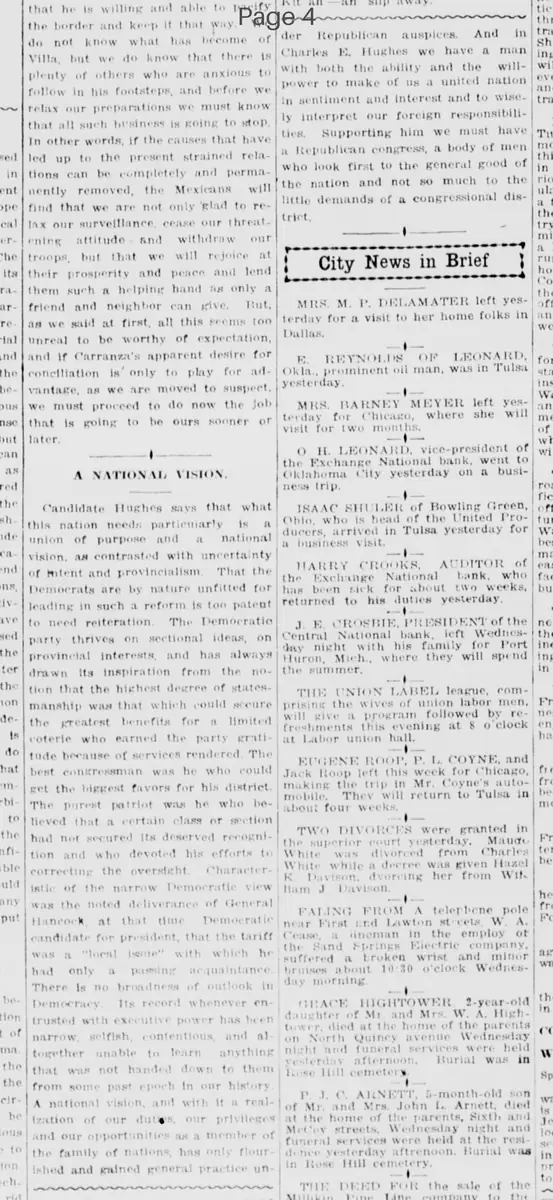
Candidate Hughes says that what this nation needs particularly is a union of purpose and a national vision, as contrasted with uncertainty of intent and provincialism. That the Democrats are by nature unfitted for leading in such a reform is too patent to need reiteration. The Democratic party thrives on sectional ideas, on provincial interests and has always drawn its inspiration from the notion that the highest degree of statesmanship was that which could secure the greatest benefits for a limited coterie who earned the party gratitude because of services rendered. The best congressman was he who could get the biggest favors for his district. The purest patriot was he who believed that a certain class or section had not secured its deserved recognition and who devoted his efforts to correcting the oversight. Characteristic of the narrow Democratic view was the noted deliverance of General Hancock at that time Democratic candidate for president, that the tariff was a "local issue" with which he had only a passing acquaintance.
There is no broadness of outlook in Democracy. Its record whenever entrusted with executive power has been narrow, selfish, contentious and altogether unable to learn anything that was not handed down to them from some past epoch in our history.
A national vision, and with it a realization of our duties, our privileges and our opportunities as a member of the family of nations, has only flourished and gained general practice under Republican auspices. And in Charles E. Hughes we have a man with both the ability and the willpower to make of us a united nation in sentiment and interest and to wisely interpret our foreign responsibilities.
Supporting him we must have a Republican congress, a body of men who look first to the general good of the nation and not so much to the little demands of a congressional district.
Candidate Hughes says that what this nation needs particularly is a union of purpose and a national vision, as contrasted with uncertainty of intent and provincialism. That the Democrats are by nature unfitted for leading in such a reform is too patent to need reiteration. The Democratic party thrives on sectional ideas, on provincial interests and has always drawn its inspiration from the notion that the highest degree of statesmanship was that which could secure the greatest benefits for a limited coterie who earned the party gratitude because of services rendered. The best congressman was he who could get the biggest favors for his district. The purest patriot was he who believed that a certain class or section had not secured its deserved recognition and who devoted his efforts to correcting the oversight. Characteristic of the narrow Democratic view was the noted deliverance of General Hancock at that time Democratic candidate for president, that the tariff was a "local issue" with which he had only a passing acquaintance.
There is no broadness of outlook in Democracy. Its record whenever entrusted with executive power has been narrow, selfish, contentious and altogether unable to learn anything that was not handed down to them from some past epoch in our history.
A national vision, and with it a realization of our duties, our privileges and our opportunities as a member of the family of nations, has only flourished and gained general practice under Republican auspices. And in Charles E. Hughes we have a man with both the ability and the willpower to make of us a united nation in sentiment and interest and to wisely interpret our foreign responsibilities.
Supporting him we must have a Republican congress, a body of men who look first to the general good of the nation and not so much to the little demands of a congressional district.
What sub-type of article is it?
Partisan Politics
What keywords are associated?
National Vision
Charles E. Hughes
Republican Leadership
Democratic Provincialism
Sectional Interests
Foreign Responsibilities
What entities or persons were involved?
Charles E. Hughes
Democrats
Republican Party
General Hancock
Editorial Details
Primary Topic
Support For Charles E. Hughes And Republican National Vision
Stance / Tone
Strongly Pro Republican And Anti Democratic
Key Figures
Charles E. Hughes
Democrats
Republican Party
General Hancock
Key Arguments
Nation Needs Union Of Purpose And National Vision Over Uncertainty And Provincialism
Democrats Thrive On Sectional Ideas And Provincial Interests
Democratic View Is Narrow, As Exemplified By General Hancock's Tariff Statement
Republicans Foster National Vision And International Responsibilities
Charles E. Hughes Has Ability To Unite Nation And Interpret Foreign Duties
Need Republican Congress Focused On National Good Over District Demands