Thank you for visiting SNEWPapers!
Sign up free
The Rhode Island American, And General Advertiser
Providence, Providence County, Rhode Island
What is this article about?
Detailed report on U.S. 15th Congress sessions in Washington, Dec. 9-12, 1817: Senate proposes constitutional amendment for roads/canals, admits Mississippi senators, appoints committees; House debates and passes repeal of internal duties, submits military resolutions, handles elections and claims. (248 chars)
Merged-components note: Merged congressional proceedings (Senate and House) with accompanying tables on internal duties receipts and expenses into single 'domestic_news' component; changed labels from 'table' for the tables.
Clippings
1 of 2
OCR Quality
Full Text
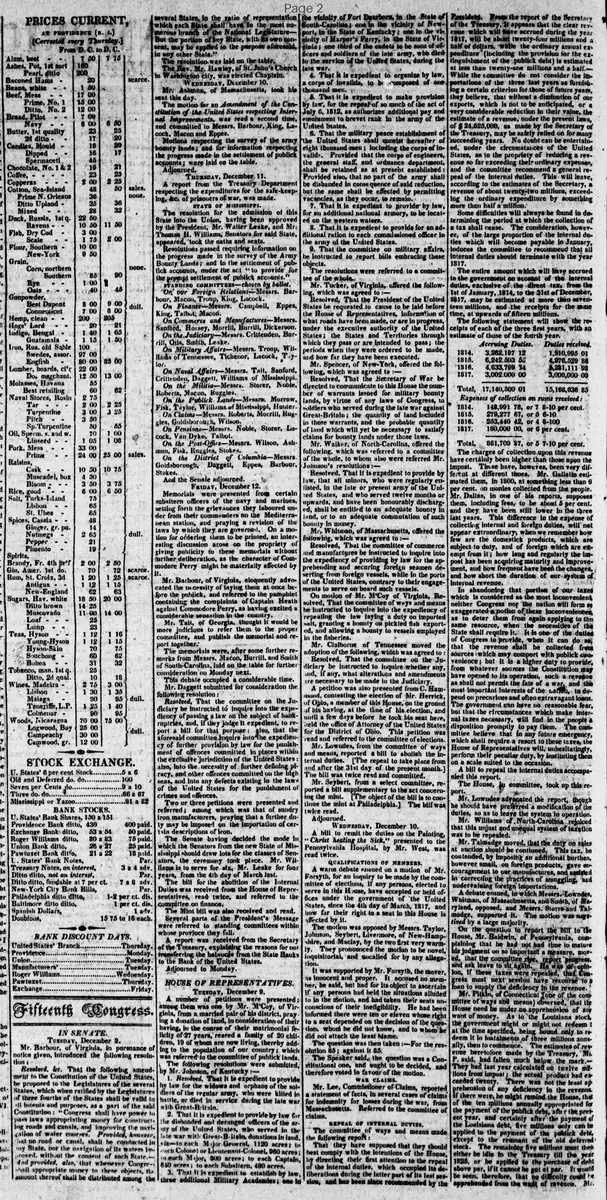
IN SENATE.
Tuesday, December 9.
Mr. Barbour, of Virginia, in pursuance of notice given, introduced the following resolution:
Resolved, &c. That the following amendment to the Constitution of the United States, be proposed to the Legislatures of the several States, which when ratified by the Legislatures of three fourths of the States shall be valid to all intents and purposes, as a part of the said Constitution: "Congress shall have power to pass laws appropriating money for constructing roads and canals, and improving the navigation of water courses. Provided, however, that no road or canal, shall be conducted in any State, nor the navigation of its waters improved, without the consent of such State. And provided, also, that whenever Congress shall appropriate money to these objects, the amount thereof shall be distributed among the several States, in the ratio of representation which each State shall have in the most numerous branch of the National Legislature. But the portion of any State, with its own consent, may be applied to the purpose aforesaid, in any other State."
The resolution was laid on the table.
The Rev. Mr. Hawley, of St. John's Church in Washington city, was elected Chaplain.
WEDNESDAY, December 10.
Mr. Aiken, of Massachusetts, took his seat this day.
The motion for an Amendment of the Constitution of the United States respecting Internal Improvements, was read a second time, and committed to Messrs. Barbour, King, Lacock, Macon and Eppes.
Motions respecting the survey of the army bounty lands; and for information respecting the progress made in the settlement of publick accounts; were laid on the table.
Adjourned.
THURSDAY, December 11.
A report from the Treasury Department respecting the expenditures for the safe-keeping, &c. of prisoners of war, was made.
STATE OF MISSISSIPPI.
The resolution for the admission of this State into the Union, having been approved by the President, Mr. Walter Leake, and Mr. Thomas H. Williams; Senators for said State, appeared, took the oaths and seats.
Resolutions passed requiring information on the progress made in the survey of the Army Bounty Lands; and in the settlement of publick accounts, under the act "to provide for the prompt settlement of publick accounts."
STANDING COMMITTEES—chosen by ballot.
On our Foreign Relations—Messrs. Barbour, Macon, Troup, King, Lacock.
On Finance—Messrs. Campbell, Eppes, King, Talbert, Macon.
On Commerce and Manufactures—Messrs. Sanford, Hosey, Morrill, Burrill, Dickerson.
On the Judiciary—Messrs. Crittenden, Burrill, Otis, Smith, Leake.
On Military Affairs—Messrs. Troup, Williams of Tennessee, Tichenor, Lacock, Taylor.
On Naval Affairs—Messrs. Tait, Sanford, Crittenden, Daggett, Williams of Mississippi.
On the Militia—Messrs. Storer, Noble, Roberts, Macon, Ruggles.
On the Publick Lands—Messrs. Morrow, Fisk, Taylor, Williams of Mississippi, Hunter.
On Claims—Messrs. Roberts, Morrill, Ruggles, Goldsborough, Wilson.
On Pensions—Messrs. Noble, Storer, Lacock, Van Dyke, Talbot.
On the Post-Office—Messrs. Wilson, Ashmun, Fisk, Ruggles, Stokes.
On the District of Columbia—Messrs. Goldsborough, Daggett, Eppes, Barbour, Stokes.
And the Senate adjourned.
FRIDAY, December 12.
Memorials were presented from certain subaltern officers of the navy and marines, setting forth the grievances they laboured under from their commanders on the Mediterranean station, and praying a revision of the laws by which they are governed. On a motion of ordering them to be printed, an interesting discussion arose on the propriety of giving publicity to these memorials without further deliberation, as the character of Commodore Perry might be materially affected by it.
Mr. Barbour, of Virginia, eloquently advocated the necessity of laying them at once before the publick, and referred to the pamphlet containing the complaints of Captain Heath against Commodore Perry, as having excited a considerable sensation in the country.
Mr. Tait, of Georgia, thought it would be more judicious to refer them to the proper committee, and publish the memorial and report together.
The memorials were, after some further remarks from Messrs. Macon, Burrill, and Smith of South-Carolina, laid on the table for further consideration on Monday next.
This debate occupied a considerable time.
Mr. Daggett submitted for consideration the following resolution:
Resolved, That the committee on the Judiciary be instructed to inquire into the expediency of passing a law on the subject of bankruptcies, and, if they judge it expedient, to report a bill for that purpose: also, that the aforesaid committee inquire into the expediency of further provision by law for the punishment of offences committed in places within the exclusive jurisdiction of the United States; also, into the necessity of further defining piracy, and other offences committed on the high seas, and into any defects existing in the laws of the United States for the punishment of crimes and offences.
Two or three petitions were presented and referred; among which was that of sundry iron manufacturers, praying that a further duty may be imposed on the importation of certain descriptions of iron.
The Senate having decided the mode in which the Senators from the new State of Mississippi should draw lots for the classes of Senators, the ceremony took place. Mr. Williams is to serve for six, Mr. Leake for four years, from the 4th day of March last.
The bill for the abolition of the Internal Duties was received from the House of Representatives, read twice, and referred to the Committee on finance.
The Mint bill was also received and read.
Several parts of the President's Message were referred to standing committees within whose province they fall.
A report was received from the Secretary of the Treasury, explaining the reasons for not transferring the balances from the State Banks to the Bank of the United States.
Adjourned to Monday.
HOUSE OF REPRESENTATIVES.
Thursday, December 9.
A number of petitions were presented; among them was one by Mr. M'Coy, of Virginia, from a married pair of his district, praying a donation of land, in consideration of their having, in the course of their matrimonial felicity of 27 years, reared a family of 20 children, 19 of whom are now living, thereby adding to the population of our country; which was referred to the committee of publick lands.
The following resolutions were submitted, by Mr. Johnson, of Kentucky: —
1. Resolved, That it is expedient to provide by law for the widows and orphans of the soldiers of the regular army, who were killed in battle, or died in service during the late war with Great-Britain.
2. That it is expedient to provide by law for the disbanded and deranged officers of the army of the United States, who served in the late war with Great-Britain, donations in land, viz—to each Major-General, 1120 acres; to each Colonel or Lieutenant-Colonel, 960 acres; to each Major, 800 acres; to each Captain, 640 acres; to each Subaltern, 480 acres.
3. That it is expedient to establish by law three additional Military Academies; one in the vicinity of Fort Dearborn, in the State of South-Carolina; one in the vicinity of New-port, in the State of Kentucky; one in the vicinity of Harper's Ferry, in the State of Virginia; one third of the cadets to be sons of officers and soldiers of the late army, who died in the service of the United States, during the late war.
4. That it is expedient to organize by law, a corps of invalids, to be composed, of one thousand men.
5. That it is expedient to make provision by law, for the repeal of so much of the act of July 6, 1812, as authorizes additional pay and emolument to brevet rank in the army of the United States.
6. That the military peace establishment of the United States shall consist hereafter of eight thousand men; including the corps of invalids. Provided that the corps of engineers, the general staff, and ordnance department shall be retained as at present established: Provided also, that no part of the army shall be disbanded in consequence of said reduction, but the same shall be effected by permitting vacancies, as they occur, to remain.
7. That it is expedient, to provide by law, for an additional national armory, to be located on the western waters.
8. That it is expedient to provide for an additional ration to each commissioned officer in the army of the United States.
9. That the committee on military affairs, be instructed to report bills embracing these objects.
The resolutions were referred to a committee of the whole.
Mr. Tucker, of Virginia, offered the following, which was agreed to: —
Resolved, That the President of the United States be requested to cause to be laid before the House of Representatives, information of what roads have been made, or are in progress, under the executive authority of the United States; the States and Territories through which they pass or are intended to pass; the periods when they were ordered to be made, and how far they have been executed.
Mr. Spencer, of New-York, offered the following, which was agreed to: —
Resolved, That the Secretary of War be directed to communicate to this House the number of warrants issued for military bounty lands, by virtue of any laws of Congress, to soldiers who served during the late war against Great-Britain; the quantity of land included in those warrants, and the probable quantity of land which will yet be necessary to satisfy claims for bounty lands under those laws.
Mr. Walker, of North-Carolina, offered the following, which was referred to a committee of the whole, to whom also were referred Mr. Johnson's resolutions: —
Resolved, That it is expedient to provide by law, that all minors, who were regularly enlisted, in the late or present army of the United States, and who served twelve months or upwards, and have been honourably discharged, shall be entitled to an adequate bounty in land, or to an adequate commutation of such bounty in money.
Mr. Whitman, of Massachusetts, offered the following, which was agreed to: —
Resolved, That the committee of commerce and manufactures be instructed to inquire into the expediency of providing by law for the apprehending and securing foreign seamen deserting from foreign vessels, while in the ports of the United States, contrary to their engagements to serve on board such vessels.
On motion of Mr. M'Coy of Virginia, Resolved, That the committee of ways and means be instructed to inquire into the expediency of repealing the law laying a duty on imported salt, granting a bounty on pickled fish exported, and allowing a bounty to vessels employed in the fisheries.
Mr. Claiborne of Tennessee moved the adoption of the following, which was agreed to:
Resolved, That the committee on the Judiciary be instructed to inquire whether any, and, if any, what alterations and amendments are necessary to be made in the Judiciary.
A petition was also presented from C. Hammond, contesting the election of Mr. Herrick, of Ohio, a member of this House, on the ground of his having, at the time of his election, and until a few days before he took his seat here, held the office of Attorney of the United States for the District of Ohio. This petition was read and referred to the committee of elections.
Mr. Lowndes, from the committee of ways and means, reported a bill to abolish the internal duties. [The repeal to take place from and after the 31st day of the present month.]
The bill was twice read and committed.
Mr. Seybert, from a select committee, reported a bill supplementary to the act concerning the mint. [The object of the bill is to continue the mint at Philadelphia.] The bill was twice read.
Adjourned.
Wednesday, December 10.
A bill to remit the duties on the Painting "Christ healing the Sick," presented to the Pennsylvania Hospital, by Mr. West, was read twice.
QUALIFICATIONS OF MEMBERS.
A warm debate ensued on a motion of Mr. Forsyth, for an inquiry to be made by the committee of elections, if any persons, elected to serve in this House, have accepted or held offices under the government of the United States, since the 4th day of March, 1817, and how far their right to a seat in this House is affected by it.
The motion was opposed by Messrs. Taylor, Johnson, Seybert, Livermore, of New-Hampshire, and Maclay, by the two first very warmly. They pronounced the motion to be novel, inquisitorial, and uncalled for by any allegation.
It was supported by Mr. Forsyth, the mover, as innocent and proper. It accused no member, he said, but had for its object to ascertain if any persons had held the situations alluded to in the motion, and had taken their seats unconscious of their ineligibility. He had been informed there were ten or eleven whose right to a seat depended on the decision of the question, whom he did not know, and to whom he did not attach the least blame.
The question was then taken:—For the resolution 85; against it 85!
The Speaker said, the question was a Constitutional one, and ought to be decided, and therefore voted in favour of the motion.
WAR CLAIMS.
Mr. Lee, Commissioner of Claims, reported a statement of facts, in several cases of claims for indemnity for losses during the war, from Massachusetts. Referred to the committee of claims.
REPEAL OF INTERNAL DUTIES,
The committee of ways and means made the following report:
That they have supposed that they should best comply with the intentions of the House, by directing their first attention to the repeal of the internal duties, which occupied its deliberations during the latter part of its last session, and has been since recommended by the President. From the report of the Secretary of the Treasury, it appears that the clear revenue which will have accrued during the year 1817, will be about twenty-four millions and a half of dollars, while the ordinary annual expenditure (including the provision for the extinguishment of the publick debt) is estimated at less than twenty-one millions and a half.
While the committee do not consider the importations of the three last years as furnishing a certain criterion for those of future years, they believe, that without a diminution of our exports, which is not to be anticipated, or a very considerable reduction in their value, the estimate of a revenue, under the present laws, of $24,525,000, as made by the Secretary of the Treasury, may be safely relied on for many succeeding years. No doubt can be entertained, under the circumstances of the United States, as to the propriety of reducing a revenue so far exceeding their ordinary expenses, and the committee recommend a general repeal of the internal duties. This will leave, according to the estimates of the Secretary, a revenue of about twenty-two millions, exceeding the ordinary expenditure by something more than half a million.
Some difficulties will always be found in determining the period at which the collection of a tax shall cease. The consideration, however, of the large proportion of the internal duties which will become payable in January, induces the committee to recommend that all internal duties should terminate with the year 1817.
The entire amount which will have accrued to the government on account of the internal duties, exclusive of the direct tax, from the 1st of January, 1814, to the 31st of December, 1817, may be estimated at more than seventeen millions, and the receipts for the same time, at upwards of fifteen millions.
The following statement will show the receipts of each of the three first years, with an estimate of those of the fourth year.
| 1814. | 3,262,197 | 12 | 1,910,995 | 01 |
| 1815. | 6,242,503 | 55 | 4,976,529 | 86 |
| 1816. | 4,633,799 | 34 | 5,281,111 | 98 |
| 1817. | 3,002,000 | 00 | 3,000,000 | 00 |
| Expenses of collection on sums received: | ||
| 1814. | 148,991 | 78, or 7 8-10 per cent. |
| 1815. | 279,277 | 67, or 5 6-10 |
| 1816. | 253,440 | 42, or 4 8-100 |
| 1817. | 180,000 | 00, or 6 per cent. |
Total, 17,140,500 01
15,168,636 85
Total, 861,709 87, or 5 7-10 per cent.
The charges of collection, upon this revenue have certainly been higher than those upon the impost. These have, however, been very different at different times. Mr. Gallatin estimated them, in 1800, at something less than 6 per cent. on monies collected from the people. Mr. Dallas, in one of his reports, supposes them, including fees, to be about 5 per cent. and they have been still lower in the three last years. This difference in the expense of collecting internal and foreign duties, will not appear extraordinary, when we remember how few are the domestick products, which are subject to duty, and of foreign which are exempt from it; how long and regularly the impost has been acquiring maturity and improvement, and how frequent have been the changes, and how short the duration of our system of internal revenue.
In abandoning that portion of our taxes which is considered as the most inconvenient neither Congress nor the nation will form so exaggerated a notion of these inconveniences as to deter them from again applying to the same resource, when the necessities of the State shall require it. It is one of the duties of Congress to provide, when it can do so, that the revenue shall be collected from sources which may comport with publick convenience; but it is a higher duty to provide, from whatever sources the Constitution may have opened to its operation, such a revenue as shall not permit the ate of a war, and the most important interests of the nation, to depend on precarious and often extravagant loans.
The government can have no reasonable fear, but that the circumstances which make internal taxes necessary, will find in the people a disposition promptly to pay them. The committee believe that in any future emergency, which shall require a resort to these taxes, the House of Representatives will, unhesitatingly, perform their peculiar duty, by instituting them on a scale suited to the occasion.
A bill to repeal the internal duties accompanied this report.
The House, committee, took up this report.
Mr. Lowndes advocated the report, though he should have preferred a modification of the duties, so as to leave the system in operation.
Mr. Williams of North-Carolina rejoiced that this unjust and unequal system of taxation was to be repealed.
Mr. Talmadge moved, that the duty on sales at auction should be continued. This tax, he contended, by imposing an additional burthen, however small, on foreign products, gave encouragement to our manufactures, and assisted in correcting the practices of smuggling, and undervaluing foreign importations.
A debate ensued, in which Messrs. Lowndes, Whitman, of Massachusetts, and Smith, of Maryland, opposed, and Messrs. Storrs and Talmadge, supported it. The motion was negatived by a large majority.
On the question to report the bill to the House, Mr. Baldwin, of Pennsylvania, complaining that he had not had time to mature his judgment on so important a measure, moved, that the committee rise, report progress, and ask leave to sit again. He was of opinion, if these taxes were repealed, that Congress must next session have recourse to a loan to supply the deficiency in the revenue.
Mr. Pitkin, of Connecticut (one of the committee of ways and means) observed, that the House need be under no apprehension of a want of money. As to the Louisiana stock the government might or might not redeem it at the time specified, being bound only to redeem it in instalments of three millions annually, then to commence. The estimates of revenue heretofore made by the Treasury, Mr. P. said, had fallen much below the mark. They had last year calculated on twelve millions from impost; the actual product had exceeded twenty. There was not the least apprehension of any deficiency in the revenue. If there were, he might remind the House, that of the ten millions annually appropriated for the payment of the publick debt, after the present year, and certainly after the payment of the Louisiana debt, five millions only can be applied to the payment of the publick debt, except to the remnant of the old deferred stock. The remaining five millions must then either be idle in the Treasury till the year 1825, or be applied to the purchase of debt above par, if it cannot be got at par. It would be seen, therefore, that no difficulty could be apprehended from the want of revenue. Mr.
added, if it were not important, that this it should pass within the present year, be would, with pleasure, consent to its postponement. Mr. Baldwin's motion was negatived, the bill was reported, and ordered to be engrossed for a third reading to-morrow.
Adjourned.
Thursday, December 11.
On motion of Mr. Parris, of Massachusetts, the naval committee was instructed to report on the alteration of the rank and emoluments of Naval Surgeons.
On motion of Mr. Holmes, of Massachusetts, the committee on roads and canals was instructed to report on the expediency of constructing a canal from Lake Michigan to the Mississippi: a canal to unite the Tennessee and Tombigbee waters; and for improving the navigation of the Tennessee.
Numerous motions on local subjects were made and disposed of, but are interesting only to the sections of the Union they affect.
JUDICIAL PROCEEDINGS.
On motion of Mr. Sampson, of New-York, the judicial committee was instructed to report what legal provisions are necessary to prescribe the effect which the public acts, records, and judicial proceedings of one State shall have in the Courts of any other State: -and also to inquire what provisions by law are necessary to ensure a more prompt publication of the laws of the United States, and a more speedy and general distribution of them.
STANDING ARMY.
Mr. Mercer, of Virginia, moved, that the President of the United States be requested to cause to be laid before this House: a return of the present strength of the army of the United States, with the distribution thereof among the several military posts which it is designed to protect. together with any information which he may be able to afford respecting the competency of such force to preserve and defend the fortifications among which it is distributed, and to aid in constructing and to defend such other military works, if any, as it may be in the contemplation of the government to erect for the more effectual security of the United States, and of the several territories thereof.
IMPOST DUTIES.
On motion of Mr. Smith, of Maryland, a committee was directed to report if any amendments were necessary to the act to regulate the duties on imports and tonnage.
REPEAL OF INTERNAL DUTIES.
The bill to repeal these duties was read a third time.
[A lengthy and able debate ensued on the passage of this bill.-It occupies nearly six columns of the last National Intelligencer.- The bill was opposed with much eloquence and animation, by Messrs. Hopkinson and Baldwin, of Pennsylvania; and advocated with equal eloquence, and better effect, by Messrs. Sergeant, of Pennsylvania, Pitkin, of Connecticut, Holmes, of Massachusetts. Barbour and Johnson, of Virginia, and Smith, of North-Carolina.—We have not room for even a sketch of the debate.]
The question, Shall the bill pass? was thus decided :
Yeas 161
Nays
[The nays were Messrs. Baldwin, of Pennsylvania, Hopkinson, of ditto, Middleton, of Georgia, Jeremiah Nelson, of Massachusetts, Storrs, of New-York.]
So the bill passed, and was sent to the Senate. Adjourned.
Friday, December 12.
Mr. Hopkinson, of Pennsylvania, from the committee on the Judiciary, reported a bill to establish an uniform system of bankruptcy throughout the United States; which was twice read and committed.
Mr. Taylor, of New-York, at the instance of the committee of elections, introduced the following resolution, under the impression that it proposed a course the most respectful to the House, if not the only manner in which the committee could execute the duty required of them:
Resolved, That the President of the United States be requested to communicate to this House, whether any, and, if any, which of the Representatives named in the list hereto annexed, have held any office under the United States since the 4th day of March, in the year 1817; designating the office or offices they have respectively held, the time of appointment and acceptance of the said offices; whether the same are now held, and, if not, when the same were severally resigned.
Annexed to the resolution was a list of the names of the members of the 15th Congress.]
The resolution was agreed to, and a committee appointed to present the same to the President.
Mr. Bloomfield, of New-Jersey, from the committee to whom was referred so much of the President's Message as relates to the surviving Revolutionary Patriots, reported, in part, a bill concerning certain surviving officers and soldiers of the late Revolutionary Army.
(This bill provides that every commissioned and non-commissioned officer or soldier, who had served in the army during the war which terminated in the treaty of peace with Great-Britain in 1783, and reduced to indigence, or by age, sickness, or any other cause, may be unable to procure subsistence by manual labour, shall receive half pay during life, equal to the half of the monthly pay allowed to his grade of service during the Revolutionary War -provided, that no pension thus allowed to a commissioned officer shall exceed the half pay of a Lieutenant Colonel.)
This bill was twice read and committed.
The motion submitted by Mr. Bassett, of Virginia, to amend the rules of the House, was taken up and agreed to. [The question of consideration, which has heretofore been a matter of much contention in the House, in the days of party conflict, is thus expunged from the rules of the House.]
The engrossed bill, supplementary to the act for the establishment of the mint (for continuing the same at Philadelphia) was read a third time, passed, and sent to the Senate for concurrence.
The House adjourned to Monday.
What sub-type of article is it?
What keywords are associated?
What entities or persons were involved?
Where did it happen?
Domestic News Details
Primary Location
Washington City
Event Date
December 9 To 12, 1817
Key Persons
Outcome
admission of mississippi into the union; election of standing committees; referral of various bills and resolutions including repeal of internal duties, which passed the house; constitutional amendment on internal improvements proposed; memorials from naval officers laid on table; bill to abolish internal duties passed house and sent to senate.
Event Details
Proceedings of the Fifteenth Congress in Senate and House of Representatives from December 9 to 12, including introduction of constitutional amendment for internal improvements, election of chaplain, seating of Mississippi senators, appointment of standing committees, discussion of naval memorials, resolutions on military and economic matters, report on repeal of internal duties with financial tables, and passage of related bills.