Thank you for visiting SNEWPapers!
Sign up free
Letter to Editor
July 11, 1766
The Virginia Gazette
Richmond, Williamsburg, Richmond County, Virginia
What is this article about?
A 1764 letter from Maryland warns that British Parliament's impending trade restrictions and taxes on colonies will harm British manufacturers more than Americans, reducing imports, raising prices, and spurring colonial self-sufficiency in goods and currency, critiquing the recent currency act as overly destructive.
Clipping
OCR Quality
98%
Excellent
Full Text
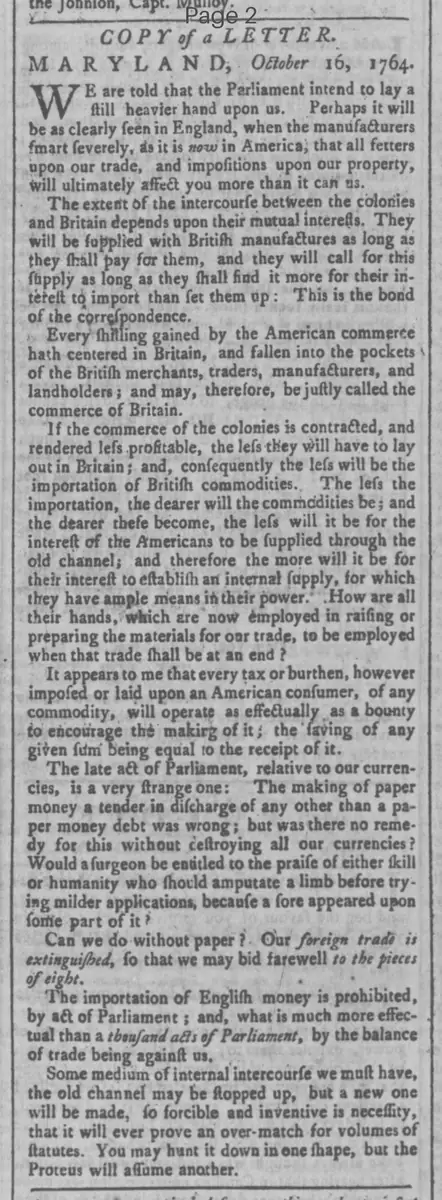
COPY of a LETTER.
MARYLAND, October 16, 1764
We are told that the Parliament intend to lay a still heavier hand upon us. Perhaps it will be as clearly seen in England, when the manufacturers smart severely, as it is now in America, that all fetters upon our trade, and impositions upon our property, will ultimately affect you more than it can us.
The extent of the intercourse between the colonies and Britain depends upon their mutual interest. They will be supplied with British manufactures as long as they shall pay for them, and they will call for this supply as long as they shall find it more for their interest to import than set them up: This is the bond of the correspondence.
Every shilling gained by the American commerce hath centered in Britain, and fallen into the pockets of the British merchants, traders, manufacturers, and landholders; and may, therefore, be justly called the commerce of Britain.
If the commerce of the colonies is contracted, and rendered less profitable, the less they will have to lay out in Britain; and, consequently the less will be the importation of British commodities. The less the importation, the dearer will the commodities be; and the dearer these become, the less will it be for the interest of the Americans to be supplied through the old channel; and therefore the more will it be for their interest to establish an internal supply, for which they have ample means in their power. How are all their hands, which are now employed in raising or preparing the materials for our trade, to be employed when that trade shall be at an end?
It appears to me that every tax or burthen, however imposed or laid upon an American consumer, of any commodity, will operate as effectually as a bounty to encourage the making of it; the saving of any given sum being equal to the receipt of it.
The late Act of Parliament, relative to our currencies, is a very strange one: The making of paper money a tender in discharge of any other than a paper money debt was wrong; but was there no remedy for this without destroying all our currencies?
Would a surgeon be entitled to the praise of either skill or humanity who should amputate a limb before trying milder applications, because a sore appeared upon some part of it?
Can we do without paper? Our foreign trade is extinguished, so that we may bid farewell to the pieces of eight.
The importation of English money is prohibited, by act of Parliament; and, what is much more effectual than a thousand acts of Parliament, by the balance of trade being against us.
Some medium of internal intercourse we must have, the old channel may be stopped up, but a new one will be made, so forcible and inventive is necessity, that it will ever prove an over-match for volumes of statutes. You may hunt it down in one shape, but the Proteus will assume another.
MARYLAND, October 16, 1764
We are told that the Parliament intend to lay a still heavier hand upon us. Perhaps it will be as clearly seen in England, when the manufacturers smart severely, as it is now in America, that all fetters upon our trade, and impositions upon our property, will ultimately affect you more than it can us.
The extent of the intercourse between the colonies and Britain depends upon their mutual interest. They will be supplied with British manufactures as long as they shall pay for them, and they will call for this supply as long as they shall find it more for their interest to import than set them up: This is the bond of the correspondence.
Every shilling gained by the American commerce hath centered in Britain, and fallen into the pockets of the British merchants, traders, manufacturers, and landholders; and may, therefore, be justly called the commerce of Britain.
If the commerce of the colonies is contracted, and rendered less profitable, the less they will have to lay out in Britain; and, consequently the less will be the importation of British commodities. The less the importation, the dearer will the commodities be; and the dearer these become, the less will it be for the interest of the Americans to be supplied through the old channel; and therefore the more will it be for their interest to establish an internal supply, for which they have ample means in their power. How are all their hands, which are now employed in raising or preparing the materials for our trade, to be employed when that trade shall be at an end?
It appears to me that every tax or burthen, however imposed or laid upon an American consumer, of any commodity, will operate as effectually as a bounty to encourage the making of it; the saving of any given sum being equal to the receipt of it.
The late Act of Parliament, relative to our currencies, is a very strange one: The making of paper money a tender in discharge of any other than a paper money debt was wrong; but was there no remedy for this without destroying all our currencies?
Would a surgeon be entitled to the praise of either skill or humanity who should amputate a limb before trying milder applications, because a sore appeared upon some part of it?
Can we do without paper? Our foreign trade is extinguished, so that we may bid farewell to the pieces of eight.
The importation of English money is prohibited, by act of Parliament; and, what is much more effectual than a thousand acts of Parliament, by the balance of trade being against us.
Some medium of internal intercourse we must have, the old channel may be stopped up, but a new one will be made, so forcible and inventive is necessity, that it will ever prove an over-match for volumes of statutes. You may hunt it down in one shape, but the Proteus will assume another.
What sub-type of article is it?
Persuasive
Political
Informative
What themes does it cover?
Economic Policy
Commerce Trade
Politics
What keywords are associated?
Colonial Trade
Parliament Impositions
British Manufacturers
Paper Currency
Self Sufficiency
Currency Act
Letter to Editor Details
Main Argument
british parliamentary impositions on colonial trade and property will ultimately harm britain more than america by reducing imports, increasing prices, and encouraging colonial self-sufficiency in manufacturing and currency.
Notable Details
Analogy To Surgeon Amputating A Limb
Reference To Proteus Assuming Shapes
Critique Of Currency Act As Destructive