Thank you for visiting SNEWPapers!
Sign up free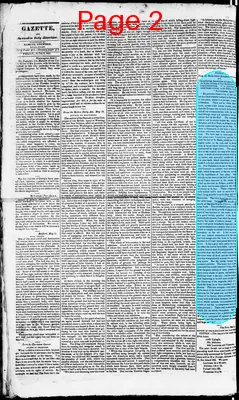
Alexandria Gazette & Daily Advertiser
Alexandria, Virginia
What is this article about?
A letter from Fort Gadsden, Florida, dated April 7, describes the local wilderness, swamps, isolation, difficult communications, river overflows, vegetation including cypress and magnolia, and underlying health hazards in the Gulf Coast vicinity.
Clipping

OCR Quality
Full Text
From the Rhode Island Manufacturer's Journal.
The following description of a part of Florida in the vicinity of Fort Gadsden will be found interesting. It is contained in a letter from a friend to the Editor, dated
"Fort Gadsden, April 7.
"My personal observation, of this country has been hitherto confined to the vicinity of this place, which is at present, a perfect wilderness.
There are no white inhabitants, except a few Indian traders. Nearer than the Georgia line, seventy miles distant and all our communications with the world lead through deep and extensive swamps except that by the Gulf. The messenger who is sent to convey letters, &c. between this place and Fort Scott, is obliged to swim across creeks and lagoons on his way. The route to Pensacola, on the west, is very circuitous and more than three hundred miles long. We have had no intercourse with that place since I came here, and but little with the fort of St. Marks, which lies seventy or eighty miles to the east, and is divided from us by an almost entire tract of swamp intersected by large rivers. The general face of the country, for sixty miles from the coast, is made of swamps covered with heavy timber, and generally overflowed, allowing pine lands which sometimes rise in bluffs 6 or 10 feet above the level of the water. Fort Gadsden is on one of these latter and Pensacola on another, very extensive high, which lying open to the sea, accounts for the healthiness of that place. Immediately on the shore of the Gulf, all along, far as I have observed it, the storms have piled up the sand in ridges, parallel to the shore, and in some places to the height of twenty or 30 feet. These ridges generally extend half a mile or more from the Gulf, lying parallel to each other and equally exposed to the heavy seas. The river Apalachicola is about 150 miles long. Its banks are overflowed nearly all the way in some places several miles back. This overflowed part is covered with a very thick growth of almost every kind of tree common at the north, as well as a great variety peculiar to the South particularly cypress, from which the swamps derive the name of cypress swamps.
Among these trees grow remarkably large and beautiful in great abundance a singular kind of moss which is thought to subsist entirely upon the miasmata in the air. It has no roots nor any radical connection with the tree but only hangs over the limbs in the same manner as if it had been placed there by the hand. It has a grey color, and in the winter when the leaves have fallen, it gives the sunken forests a most dismal appearance. A traveller from the North would suppose that the trees were all dead, and that the whole country was gradually sinking into one watery grave. But the spring changed the prospect entirely. The hoary moss is now concealed by a most luxuriant foliage, which from the great variety of trees, presents almost every shade of green, and furnishes a delicious feast to the eye; and the scene is now beginning to be still more enriched by the blooming of the magnolia, which is indeed the king (or at least president) of all flowers. This tree occupies a very considerable share of the forest, and is always conspicuous for the great size and deep green colour of its leaves; when in bloom, it is covered with milk white blossoms, the smallest of which exceeds in circumference the crown of my hat, (a comparison more true than poetical.) These emit a sweet odour which fills the whole atmosphere. But all this elysian scene is but a gilded sepulchre Within is contained all manner of deadly vapours, and the abodes of poisonous insects and huge snakes."
What sub-type of article is it?
What keywords are associated?
Where did it happen?
Domestic News Details
Primary Location
Fort Gadsden, Florida
Event Date
April 7
Event Details
Description of the wilderness around Fort Gadsden, including swamps, overflowed rivers, heavy timber, pine bluffs, sand ridges from storms, the Apalachicola River, cypress swamps, hanging moss, luxuriant spring foliage, blooming magnolia trees, and hidden dangers of miasmata, poisonous insects, and snakes. Communications are limited to swamp routes and the Gulf, with no white inhabitants except Indian traders.