Thank you for visiting SNEWPapers!
Sign up free
Jenks's Portland Gazette
Portland, Cumberland County, Maine
What is this article about?
French General Dessolles reports to the Minister at War on operations in Germany from June 2-5, 1800. Under General Moreau, French forces repelled an Austrian attack led by General Kray near the Iller River, capturing 2000 prisoners and 8 cannons, forcing the enemy to retreat to the Danube.
Clipping
OCR Quality
Full Text
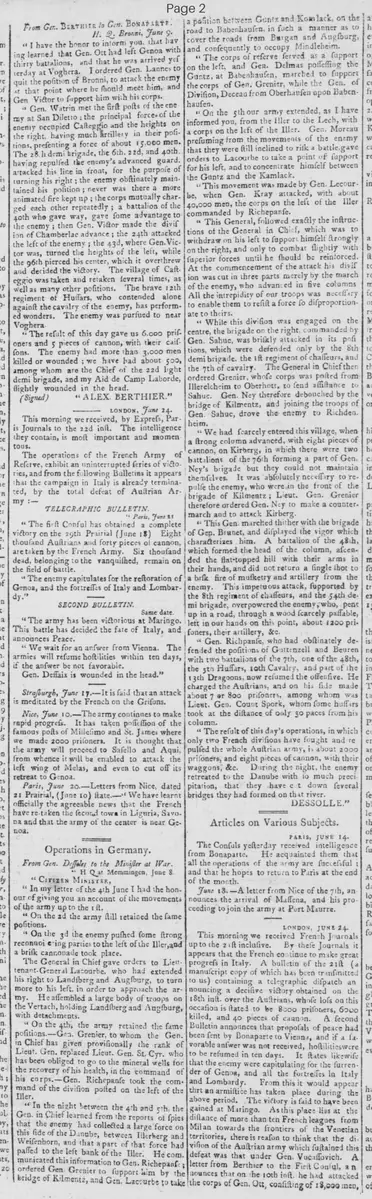
From Gen. Dessolles to the Minister at War.
H. Q. at Memmingen, June 8.
Citizen Minister,
In my letter of the 4th June I had the honor of giving you an account of the movements of the army up to the 1st.
On the 2d the army still retained the same positions.
On the 3d the enemy pushed some strong reconnoitering parties to the left of the Iller, and a brisk cannonade took place.
The General in Chief gave orders to Lieutenant-General Lacourbe, who had extended his right to Landsberg and Augsburg, to turn more to his left, in order to approach the army. He assembled a large body of troops on the Vertach, holding Landsberg and Augsburg, with detachments.
On the 4th, the army retained the same positions.—Gen. Grenier, to whom the Gen. in Chief has given provisionally the rank of Lieut. Gen. replaced Lieut. Gen. St. Cyr, who has been obliged to go to the mineral wells for the recovery of his health, in the command of his corps.—Gen. Richepanse took the command of the division posted on the left of the Iller.
In the night between the 4th and 5th, the Gen. in Chief learned from the reports of spies that the enemy had collected a large force on this side of the Danube, between Illerberg and Weissenhorn, and that a part of that force had passed to the left bank of the Iller. He communicated this information to Gen. Richepanse, ordered Gen. Grenier to support him by the bridge of Kilmentz, and Gen. Lacourbe to take a position between Gunz and Kamlack, on the road to Babenhauen, in such a manner as to cover the roads from Burghausen and Augsburg, and consequently to occupy Mindelheim.
The corps of reserve served as support on the left, and Gen. Delmas passing the Gunz, at Babenhausen, marched to support the corps of Gen. Grenier, while the Gen. of Division, Decaen from Oberhausen upon Babenhausen.
On the 5th our army extended, as I have informed you, from the Iller to the Lech, with a corps on the left of the Iller. Gen. Moreau presuming from the movements of the enemy that they were still inclined to risk a battle, gave orders to Lacourbe to take a point of support for his left, and to concentrate himself between the Gunz and the Kamlack.
This movement was made by Gen. Lacourbe, when Gen. Kray attacked, with about 40,000 men, the corps on the left of the Iller commanded by Richepanse.
This General, followed exactly the instructions of the General in Chief, which was to withdraw on his left to support himself strongly on the right, and only to combat slightly with superior forces until he should be reinforced.
At the commencement of the attack his division was cut in three parts merely by the march of the enemy, who advanced in five columns. All the intrepidity of our troops was necessary to enable them to resist a force so disproportionate to theirs.
While this division was engaged on the centre, the brigade on the right, commanded by Gen. Sahuc, was briskly attacked in its positions, which were defended only by the 8th demi brigade, the 1st regiment of chasseurs, and the 7th of cavalry. The General in Chief therefore ordered Grenier, whose corps was posted from Illerelsheim to Oberrott, to send assistance to Sahuc. Gen. Ney therefore debouched by the bridge of Kilmentz, and joining the troops of Gen. Sahuc, drove the enemy to Reichenheim.
We had scarcely entered this village, when a strong column advanced, with eight pieces of cannon, on Kirchberg, in which there were two battalions of the 76th forming a part of Gen. Ney's brigade but they could not maintain themselves. It was absolutely necessary to repulse the enemy, who were in the front of the brigade of Kilmentz; Lieut. Gen. Grenier therefore ordered Gen. Ney to make a counter march and to attack Kirchberg.
This Gen. marched thither with the brigade of Gen. Brunet, and displayed the vigor which characterizes him. A battalion of the 48th, which formed the head of the column, ascended the flat-topped hill with their arms in their hands, and did not return a single shot to a brisk fire of musketry and artillery from the enemy. This impetuous attack, supported by the 8th regiment of chasseurs, and the 54th demi brigade, overpowered the enemy, who, pent up in a road, through a wood scarcely passable, left in our hands on this point, about 1200 prisoners, their artillery, &c.
Gen. Richepanse, who had obstinately defended the positions of Guttenzell and Beuren with two battalions of the 7th, one of the 48th, the 5th Hussars, 10th Cavalry, and part of the 13th Dragoons, now resumed the offensive. He charged the Austrians, and on his side made about 700 or 800 prisoners, among whom was Lieut. Gen. Count Spork, whom some hussars took at the distance of only 30 paces from his column.
The result of this day's operations, in which only two French divisions have fought and repulsed the whole Austrian army, is about 2000 prisoners, and eight pieces of cannon, with their waggons, &c. During the night, the enemy retreated to the Danube with so much precipitation, that they have cut down several bridges they had formed on that river.
DESSOLLES.
What sub-type of article is it?
What keywords are associated?
What entities or persons were involved?
Where did it happen?
Foreign News Details
Primary Location
Germany
Event Date
June 2 To 5
Key Persons
Outcome
about 2000 prisoners, and eight pieces of cannon, with their waggons; enemy retreated to the danube
Event Details
French army under Gen. Moreau maintained positions along Iller to Lech rivers. On June 5, Austrian Gen. Kray attacked with 40,000 men the corps of Gen. Richepanse left of Iller. French forces, including divisions under Richepanse, Ney, and Grenier, repulsed the attack after fierce fighting at positions like Guttenzell, Beuren, Reichenheim, and Kirchberg, capturing prisoners and artillery. Enemy retreated precipitously to Danube, cutting bridges.