Thank you for visiting SNEWPapers!

Sign up free
Page thumbnail for Edgefield Advertiser
Domestic News June 24, 1841

Edgefield Advertiser

Edgefield, Edgefield County, South Carolina

What is this article about?

Large sunspot visible on Sun's disk, potentially impacting temperatures like 1816's cold summer; astronomers urged to study it. From N.Y. Express, 21st ult.

Clipping
OCR Quality

95% Excellent

Full Text

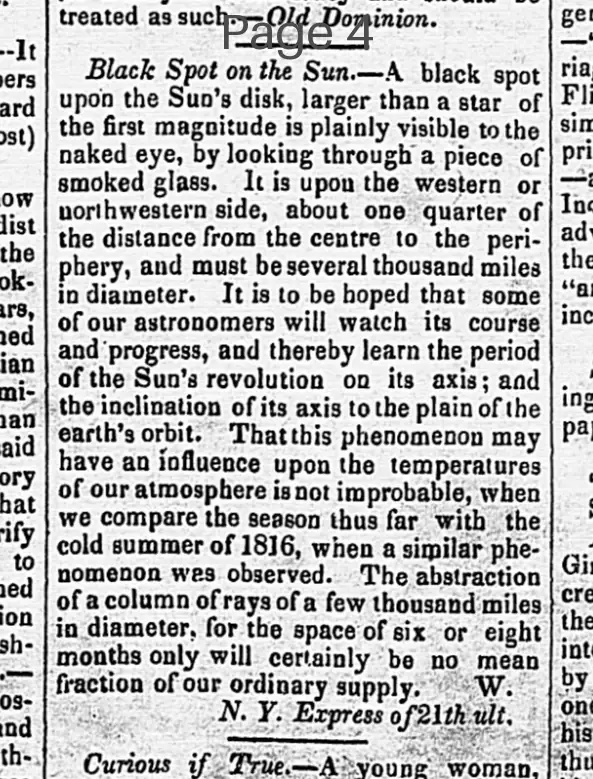
Black Spot on the Sun.—A black spot upon the Sun's disk, larger than a star of the first magnitude is plainly visible to the naked eye, by looking through a piece of smoked glass. It is upon the western or northwestern side, about one quarter of the distance from the centre to the periphery, and must be several thousand miles in diameter. It is to be hoped that some of our astronomers will watch its course and progress, and thereby learn the period of the Sun's revolution on its axis; and the inclination of its axis to the plain of the earth's orbit. That this phenomenon may have an influence upon the temperatures of our atmosphere is not improbable, when we compare the season thus far with the cold summer of 1816, when a similar phenomenon was observed. The abstraction of a column of rays of a few thousand miles in diameter, or the space of six or eight months only will certainly be no mean fraction of our ordinary supply.—N. Y. Express of 21st ult.

What sub-type of article is it?

Weather

What keywords are associated?

Sunspot Black Spot On Sun Astronomical Phenomenon Weather Influence Cold Summer 1816

Where did it happen?

New York

Domestic News Details

Primary Location

New York

Event Date

21st Ult.

Event Details

A black spot upon the Sun's disk, larger than a star of the first magnitude, is plainly visible to the naked eye through smoked glass, located on the western or northwestern side, about one quarter from the centre to the periphery, several thousand miles in diameter. Astronomers are hoped to watch its course to learn the Sun's revolution period and axis inclination. The phenomenon may influence atmospheric temperatures, compared to the cold summer of 1816 when similar was observed, with abstraction of rays over six or eight months being a significant fraction of ordinary supply.

Are you sure?