Thank you for visiting SNEWPapers!
Sign up free
Literary
January 16, 1918
The Northern Wyoming Herald
Park County, Wyoming
What is this article about?
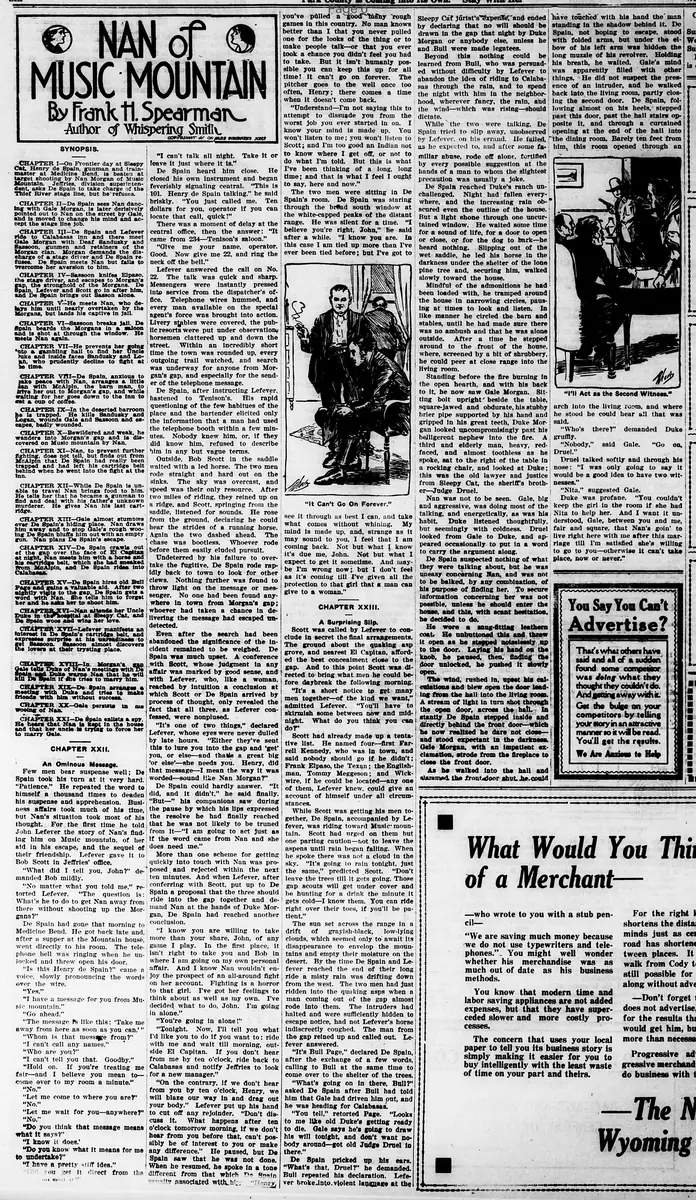
Excerpt from the Western novel 'Music Mountain' by Frank L. Spearman, detailing the romance between gunman Henry de Spain and Nan Morgan amid conflicts with the outlaw Morgan clan. Includes chapter synopses I-XXI and full text of Chapters XXII (mysterious phone message urging rescue) and XXIII (De Spain's infiltration of Duke's ranch during a will-signing).
Clipping
OCR Quality
95%
Excellent
Full Text
MUSIC MOUNTAIN
By Frank L. Spearman
Author of Whispering Smith
CHAPTER I—On Frontier day at Sleepy Cat, Henry de Spain, gunman and trainmaster at Medicine Bend, is beaten at target shooting by Nan Morgan of Music Mountain. Jeffries, division superintendent, asks De Spain to take charge of the Thief River stage line, but he refuses.
CHAPTER II—DeSpain sees Nan dancing with Gale Morgan, is later derisively pointed out to Nan on the street by Gale, and is moved to change his mind and accept the stage line job.
CHAPTER III—De Spain and Lefever ride to Calabasas inn and there meet Gale Morgan with Deaf Sandusky and Sassoon, gunmen and retainers of the Morgan clan. Morgan demands the discharge of a stage driver and De Spain refuses. De Spain meets Nan but fails to overcome her aversion to him.
CHAPTER IV—Sassoon knifes Elpaso, the stage driver, and escapes to Morgan's gap, the stronghold of the Morgans. De Spain, Lefever and Scott go in after him, and De Spain brings out Sassoon alone.
CHAPTER V—He meets Nan, who despises him until nearly overtaken by the Morgans, but lands his captive in jail.
CHAPTER VI—Sassoon breaks jail. De Spain beards the Morgans in a saloon and is shot at through the window. He meets Nan again.
CHAPTER VII—He prevents her going into a gambling hall to find her Uncle Juke and inside faces Sandusky and Logan, who prudently decline to fight at the time.
CHAPTER VIII—De Spain, anxious to make peace with Nan, arranges a little jaunt with McAlpin, the barn man, to drive her out to Morgan's gap, and while waiting for her goes down to the inn to get a cup of coffee.
CHAPTER IX—In the deserted barroom he is trapped. He kills Sandusky and Logan, wounds Gale and Sassoon and escapes, badly wounded.
CHAPTER X—Bewildered and weak, he wanders into Morgan's gap and is discovered on Music mountain by Nan.
CHAPTER XI—Nan, to prevent further fighting, does not tell, but finds out from McAlpin that De Spain had really been trapped and had left his cartridge belt behind when he went into the fight at the inn.
CHAPTER XII—While De Spain is unable to travel Nan brings food to him. He tells her that he became a gunman to find and deal with his father's unknown murderer. He gives Nan his last cartridge.
CHAPTER XIII—Gale almost stumbles over De Spain's hiding place. Nan draws him away and to stop Gale's rough wooing De Spain bluffs him out with an empty gun. Nan plans De Spain's escape.
CHAPTER XIV—De Spain crawls out of the gap over the face of El Capitan at night. Nan meets him with a horse and his cartridge belt, which she had sneaked from McAlpin, and De Spain rides into Calabasas.
CHAPTER XV—De Spain hires old Bull Page and receives valuable aid. After two nightly visits to the gap, De Spain gets a word with Nan. She tells him to forget her and he asks her to shoot him.
CHAPTER XVI—Nan stops to see her Uncle Duke in the hospital at Sleepy Cat, and De Spain woos and wins her love.
CHAPTER XVII—Lefever manifests an interest in De Spain's cartridge belt and expresses surprise at his unreadiness to get Sassoon. Sassoon almost discovers the lovers at their trysting place.
CHAPTER XVIII—In Morgan's Gap Gale tells Duke of Nan's meetings with De Spain and Duke warns Nan that he will kill De Spain if she tries to marry him.
CHAPTER XIX—De Spain arranges a meeting with Duke and tries to make friends with him without success.
CHAPTER XX—Gale persists in his wooing of Nan.
CHAPTER XXI—De Spain enlists a spy. He hears that Nan is kept in the house and that her uncle is trying to force her to marry Gale.
CHAPTER XXII.
An Ominous Message.
Few men bear suspense well; De Spain took his turn at it very hard.
"Patience." He repeated the word to himself a thousand times to deaden his suspense and apprehension. Business affairs took much of his time, but Nan's situation took most of his thought. For the first time he told John Lefever the story of Nan's finding him on Music mountain, of her aid in his escape, and the sequel of their friendship.
Lefever gave it to Bob Scott in Jeffries' office.
"What did I tell you, John?" demanded Bob mildly.
"No matter what you told me," retorted Lefever, "The question is: What's he to do to get Nan away from there without shooting up the Morgans?"
De Spain had gone that morning to Medicine Bend. He got back late and, after a supper at the Mountain house, went directly to his room. The telephone bell was ringing when he unlocked and threw open his door.
"Is this Henry de Spain?" came a voice, slowly pronouncing the words over the wire.
"Yes."
"I have a message for you from Music mountain."
"Go ahead."
"The message is like this: Take me away from here as soon as you can."
"From whom is that message?"
"I can't call any names."
"Who are you?"
"I can't tell you that. Goodby."
"Hold on. If you're treating me fair—and I believe you mean to—come over to my room a minute."
"No."
"Let me come to where you are?"
"No."
"Let me wait for you—anywhere?"
"No."
"Do you think that message means what it says?"
"I know it does."
"Do you know what it means for me to undertake?"
"I have a pretty good idea."
"Did you get it direct from the—"
"I can't talk all night. Take it or leave it just where it is."
De Spain heard him close. He closed his own instrument and began feverishly signaling central. "This is 101. Henry de Spain talking," he said briskly. "You just called me. Ten dollars for you, operator if you can locate that call, quick!"
There was a moment of delay at the central office, then the answer: It came from 234 Tenison's saloon.
"Give me your name, operator. Good. Now give me 22, and ring the neck off the bell."
Lefever answered the call on No. 22. The talk was quick and sharp. Messengers were instantly pressed into service from the dispatcher's office. Telephone wires hummed, and every man available on the special agent's force was brought into action. Livery stables were covered, the public resorts were put under observation, horsemen clattered up and down the street.
Within an incredibly short time the town was rounded up, every outgoing trail watched, and search was underway for anyone from Morgan's gap, and especially for the sender of the telephone message.
De Spain, after instructing Lefever, hastened to Tenison's. His rapid questioning of the few habitues of the place and the bartender elicited only the information that a man had used the telephone booth within a few minutes. Nobody knew him, or, if they did know him, refused to describe him in any but vague terms. Outside, Bob Scott in the saddle waited with a led horse. The two men rode straight and hard out on the sinks. The sky was overcast, and speed was their only resource. After two miles of riding, they reined up on a ridge, and Scott, springing from the saddle, listened for sounds. He rose from the ground, declaring he could hear the strides of a running horse.
Again the two dashed ahead. The chase was bootless. Whoever rode before them easily eluded pursuit.
Undeterred by his failure to overtake the fugitive, De Spain rode rapidly back to town to look for other clues. Nothing further was found to throw light on the message or messenger. No one had been found anywhere in town from Morgan's gap; whoever had taken a chance in delivering the message had escaped undetected.
Even after the search had been abandoned the significance of the incident remained to be weighed. De Spain was much upset. A conference with Scott, whose judgment in any affair was marked by good sense, and with Lefever, who, like a woman, reached by intuition a conclusion at which Scott or De Spain arrived by process of thought, only revealed the fact that all three, as Lefever confessed, were nonplused.
"It's one of two things," declared Lefever, whose eyes were never dulled by late hours. "Either they've sent this to lure you into the gap and 'get' you, or else—and that's a great big 'or else'—she needs you. Henry, did that message—I mean the way it was worded—sound like Nan Morgan?"
De Spain could hardly answer. "It did, and it didn't," he said finally. "But—" his companions saw during the pause by which his lips expressed the resolve he had finally reached that he was not likely to be turned from it. "I am going to act just as if the word came from Nan and she does need me."
More than one scheme for getting quickly into touch with Nan was proposed and rejected within the next ten minutes. And when Lefever, after conferring with Scott, put up to De Spain a proposal that the three should ride into the gap together and demand Nan at the hands of Duke Morgan, De Spain had reached another conclusion.
"I know you are willing to take more than your share, John, of any game I play. In the first place, it isn't right to take you and Bob in where I am going on my own personal affair. And I know Nan wouldn't enjoy the prospect of an all-around fight on her account. Fighting is a horror to that girl. I've got her feelings to think about as well as my own. I've decided what to do, John. I'm going in alone."
"You're going in alone!"
"Tonight. Now, I'll tell you what I'd like you to do if you want to: ride with me and wait till morning, outside El Capitan. If you don't hear from me by ten o'clock, ride back to Calabasas and notify Jeffries to look for a new manager."
"On the contrary, if we don't hear from you by ten o'clock, Henry, we will blaze our way in and drag out your body." Lefever put up his hand to cut off any rejoinder. "Don't discuss it. What happens after ten o'clock tomorrow morning, if we don't hear from you before that, can't possibly be of interest to you or make any difference." He paused, but De Spain saw that he was not done.
When he resumed, he spoke in a tone different from that which De Spain usually associated with him. "Henry, you've pulled a good many 'rough games' in this country. No man knows better than I that you never pulled one for the looks of the thing or to make people talk—or that you ever took a chance you didn't feel you had to take. But it isn't humanly possible you can keep this up for all time! It can't go on forever. The pitcher goes to the well once too often, Henry; there comes a time when it doesn't come back.
"Understand—I'm not saying this to attempt to dissuade you from the worst job you ever started in on. I know your mind is made up. You won't listen to me; you won't listen to Scott; and I'm too good an Indian not to know where I get off, or not to do what I'm told. But this is what I've been thinking of a long, long time; and that is what I feel I ought to say, here and now."
The two men were sitting in De Spain's room. De Spain was staring through the broad south window at the white-capped peaks of the distant range. He was silent for a time. "I believe you're right, John," he said after a while. "I know you are. In this case I am tied up more than I've ever been tied before; but I've got to see it through as best I can, and take what comes without whining. My mind is made up, and, strange as it may sound to you, I feel that I am coming back. Not but what I know it's due me, John. Not but what I expect to get it sometime. And maybe I'm wrong now; but I don't feel as it's coming till I've given all the protection to that girl that a man can give to a woman."
"It Can't Go On Forever."
CHAPTER XXIII.
A Surprising Slip.
Scott was called by Lefever to conclude in secret the final arrangements. The ground about the quaking asp grove, and nearest El Capitan, afforded the best concealment close to the gap. And to this point Scott was directed to bring what men he could before daybreak the following morning.
"It's a short notice to get many men together of the kind we want," admitted Lefever.
"You'll have to skirmish some between now and midnight. What do you think you can do?"
Scott had already made up a tentative list. He named four—first Farrell Kennedy, who was in town, and said nobody should go if he didn't; Frank Elpaso, the Texan; the Englishman, Tommy Meggeson; and Wickwire, if he could be located—any one of them, Lefever knew, could give an account of himself under all circumstances.
While Scott was getting his men together, De Spain, accompanied by Lefever, was riding toward Music mountain. Scott had urged on them but one parting caution—not to leave the aspens until rain began falling. When he spoke there was not a cloud in the sky.
"It's going to rain tonight, just the same," predicted Scott.
"Don't leave the trees till it gets going. Those gap scouts will get under cover and be hunting for a drink the minute it gets cold—I know them. You can ride right over their toes, if you'll be patient."
The sun set across the range in a drift of grayish-black, low-lying clouds, which seemed only to await its disappearance to envelop the mountains and empty their moisture on the desert. By the time De Spain and Lefever reached the end of their long ride a misty rain was drifting down from the west. The two men had just ridden into the quaking asps when a man coming out of the gap almost rode into them.
The intruders had halted and were sufficiently hidden to escape notice, had not Lefever's horse indiscreetly coughed. The man from the gap reined up and called out. Lefever answered.
"It's Bull Page," declared De Spain, after the exchange of a few words, calling to Bull at the same time to come over to the shelter of the trees.
"What's going on in there, Bull?" asked De Spain after Bull had told him that Gale had driven him out, and he was heading for Calabasas.
"You tell," retorted Page. "Looks to me like old Duke's getting ready to die. Gale says he's going to draw his will tonight, and don't want nobody around—got old Judge Druel in there."
De Spain pricked up his ears.
"What's that, Druel?" he demanded.
Bull repeated his declaration. Lefever broke into violent language at the Sleepy Cat jurist's expense, and ended by declaring that no will should be drawn in the gap that night by Duke Morgan or anybody else, unless he and Bull were made legatees.
Beyond this nothing could be learned from Bull, who was persuaded without difficulty by Lefever to abandon the idea of riding to Calabasas through the rain, and to spend the night with him in the neighborhood, wherever fancy, the rain, and the wind—which was rising—should dictate.
While the two were talking, De Spain tried to slip away, unobserved by Lefever, on his errand. He failed, as he expected to, and after some familiar abuse, rode off alone, fortified by every possible suggestion at the hands of a man to whom the slightest precaution was usually a joke.
De Spain reached Duke's ranch unchallenged. Night had fallen everywhere, and the increasing rain obscured even the outline of the house. But a light shone through one uncuttained window. He waited some time for a sound of life, for a door to open or close, or for the dog to bark—he heard nothing. Slipping out of the wet saddle, he led his horse in the darkness under the shelter of the lone pine tree and, securing him, walked slowly toward the house.
Mindful of the admonitions he had been loaded with, he tramped around the house in narrowing circles, pausing at times to look and listen. In like manner he circled the barn and stables, until he had made sure there was no ambush and that he was alone outside. After a time he stepped around to the front of the house, where, screened by a bit of shrubbery, he could peer at close range into the living room.
Standing before the fire burning in the open hearth, and with his back to it, he now saw Gale Morgan. Sitting bolt upright beside the table, square-jawed and obdurate, his stubby brier pipe supported by his hand and gripped in his great teeth, Duke Morgan looked uncompromisingly past his belligerent nephew into the fire. A third and elderly man, heavy, red-faced, and almost toothless as he spoke, sat to the right of the table in a rocking chair, and looked at Duke: this was the old lawyer and justice from Sleepy Cat, the sheriff's brother—Judge Druel.
Nan was not to be seen. Gale, big and aggressive, was doing most of the talking, and energetically, as was his habit. Duke listened thoughtfully, but seemingly with coldness. Druel looked from Gale to Duke, and appeared occasionally to put in a word to carry the argument along.
De Spain suspected nothing of what they were talking about, but he was uneasy concerning Nan, and was not to be balked, by any combination, of his purpose of finding her. To secure information concerning her was not possible, unless he should enter the house, and this, with scant hesitation, he decided to do.
He wore a snug-fitting leathern coat. He unbuttoned this and threw it open as he stepped noiselessly up to the door. Laying his hand on the knob, he paused, then, finding the door unlocked, he pushed it slowly open.
The wind rushed in, upset his calculations and blew open the door leading from the hall into the living room. A stream of light in turn shot through the open door, across the hall. Instantly De Spain stepped inside and directly behind the front door which he now realized he dare not close—and stood expectant in the darkness.
Gale Morgan, with an impatient exclamation, strode from the fireplace to close the front door. As he walked into the hall and slammed the front door shut he could have touched with his hand the man standing in the shadow behind it. De Spain, not hoping to escape, stood with folded arms, but under the elbow of his left arm was hidden the long muzzle of his revolver. Holding his breath, he waited. Gale's mind was apparently filled with other things. He did not suspect the presence of an intruder, and he walked back into the living room, partly closing the second door. De Spain, following almost on his heels, stepped past this door, past the hall stairs opposite it, and through a curtained opening at the end of the hall into the dining room. Barely ten feet from him, this room opened through an arch into the living room, and where he stood he could hear all that was said.
"Who's there?" demanded Duke gruffly.
"Nobody," said Gale. "Go on, Druel."
Druel talked softly and through his nose:
"I was only going to say it would be a good idea to have two witnesses."
"Nita," suggested Gale.
Duke was profane.
"You couldn't keep the girl in the room if she had Nita to help her. And I want it understood, Gale, between you and me, fair and square, that Nan's goin' to live right here with me after this marriage till I'm satisfied she's willing to go to you—otherwise it can't take place, now or never."
By Frank L. Spearman
Author of Whispering Smith
CHAPTER I—On Frontier day at Sleepy Cat, Henry de Spain, gunman and trainmaster at Medicine Bend, is beaten at target shooting by Nan Morgan of Music Mountain. Jeffries, division superintendent, asks De Spain to take charge of the Thief River stage line, but he refuses.
CHAPTER II—DeSpain sees Nan dancing with Gale Morgan, is later derisively pointed out to Nan on the street by Gale, and is moved to change his mind and accept the stage line job.
CHAPTER III—De Spain and Lefever ride to Calabasas inn and there meet Gale Morgan with Deaf Sandusky and Sassoon, gunmen and retainers of the Morgan clan. Morgan demands the discharge of a stage driver and De Spain refuses. De Spain meets Nan but fails to overcome her aversion to him.
CHAPTER IV—Sassoon knifes Elpaso, the stage driver, and escapes to Morgan's gap, the stronghold of the Morgans. De Spain, Lefever and Scott go in after him, and De Spain brings out Sassoon alone.
CHAPTER V—He meets Nan, who despises him until nearly overtaken by the Morgans, but lands his captive in jail.
CHAPTER VI—Sassoon breaks jail. De Spain beards the Morgans in a saloon and is shot at through the window. He meets Nan again.
CHAPTER VII—He prevents her going into a gambling hall to find her Uncle Juke and inside faces Sandusky and Logan, who prudently decline to fight at the time.
CHAPTER VIII—De Spain, anxious to make peace with Nan, arranges a little jaunt with McAlpin, the barn man, to drive her out to Morgan's gap, and while waiting for her goes down to the inn to get a cup of coffee.
CHAPTER IX—In the deserted barroom he is trapped. He kills Sandusky and Logan, wounds Gale and Sassoon and escapes, badly wounded.
CHAPTER X—Bewildered and weak, he wanders into Morgan's gap and is discovered on Music mountain by Nan.
CHAPTER XI—Nan, to prevent further fighting, does not tell, but finds out from McAlpin that De Spain had really been trapped and had left his cartridge belt behind when he went into the fight at the inn.
CHAPTER XII—While De Spain is unable to travel Nan brings food to him. He tells her that he became a gunman to find and deal with his father's unknown murderer. He gives Nan his last cartridge.
CHAPTER XIII—Gale almost stumbles over De Spain's hiding place. Nan draws him away and to stop Gale's rough wooing De Spain bluffs him out with an empty gun. Nan plans De Spain's escape.
CHAPTER XIV—De Spain crawls out of the gap over the face of El Capitan at night. Nan meets him with a horse and his cartridge belt, which she had sneaked from McAlpin, and De Spain rides into Calabasas.
CHAPTER XV—De Spain hires old Bull Page and receives valuable aid. After two nightly visits to the gap, De Spain gets a word with Nan. She tells him to forget her and he asks her to shoot him.
CHAPTER XVI—Nan stops to see her Uncle Duke in the hospital at Sleepy Cat, and De Spain woos and wins her love.
CHAPTER XVII—Lefever manifests an interest in De Spain's cartridge belt and expresses surprise at his unreadiness to get Sassoon. Sassoon almost discovers the lovers at their trysting place.
CHAPTER XVIII—In Morgan's Gap Gale tells Duke of Nan's meetings with De Spain and Duke warns Nan that he will kill De Spain if she tries to marry him.
CHAPTER XIX—De Spain arranges a meeting with Duke and tries to make friends with him without success.
CHAPTER XX—Gale persists in his wooing of Nan.
CHAPTER XXI—De Spain enlists a spy. He hears that Nan is kept in the house and that her uncle is trying to force her to marry Gale.
CHAPTER XXII.
An Ominous Message.
Few men bear suspense well; De Spain took his turn at it very hard.
"Patience." He repeated the word to himself a thousand times to deaden his suspense and apprehension. Business affairs took much of his time, but Nan's situation took most of his thought. For the first time he told John Lefever the story of Nan's finding him on Music mountain, of her aid in his escape, and the sequel of their friendship.
Lefever gave it to Bob Scott in Jeffries' office.
"What did I tell you, John?" demanded Bob mildly.
"No matter what you told me," retorted Lefever, "The question is: What's he to do to get Nan away from there without shooting up the Morgans?"
De Spain had gone that morning to Medicine Bend. He got back late and, after a supper at the Mountain house, went directly to his room. The telephone bell was ringing when he unlocked and threw open his door.
"Is this Henry de Spain?" came a voice, slowly pronouncing the words over the wire.
"Yes."
"I have a message for you from Music mountain."
"Go ahead."
"The message is like this: Take me away from here as soon as you can."
"From whom is that message?"
"I can't call any names."
"Who are you?"
"I can't tell you that. Goodby."
"Hold on. If you're treating me fair—and I believe you mean to—come over to my room a minute."
"No."
"Let me come to where you are?"
"No."
"Let me wait for you—anywhere?"
"No."
"Do you think that message means what it says?"
"I know it does."
"Do you know what it means for me to undertake?"
"I have a pretty good idea."
"Did you get it direct from the—"
"I can't talk all night. Take it or leave it just where it is."
De Spain heard him close. He closed his own instrument and began feverishly signaling central. "This is 101. Henry de Spain talking," he said briskly. "You just called me. Ten dollars for you, operator if you can locate that call, quick!"
There was a moment of delay at the central office, then the answer: It came from 234 Tenison's saloon.
"Give me your name, operator. Good. Now give me 22, and ring the neck off the bell."
Lefever answered the call on No. 22. The talk was quick and sharp. Messengers were instantly pressed into service from the dispatcher's office. Telephone wires hummed, and every man available on the special agent's force was brought into action. Livery stables were covered, the public resorts were put under observation, horsemen clattered up and down the street.
Within an incredibly short time the town was rounded up, every outgoing trail watched, and search was underway for anyone from Morgan's gap, and especially for the sender of the telephone message.
De Spain, after instructing Lefever, hastened to Tenison's. His rapid questioning of the few habitues of the place and the bartender elicited only the information that a man had used the telephone booth within a few minutes. Nobody knew him, or, if they did know him, refused to describe him in any but vague terms. Outside, Bob Scott in the saddle waited with a led horse. The two men rode straight and hard out on the sinks. The sky was overcast, and speed was their only resource. After two miles of riding, they reined up on a ridge, and Scott, springing from the saddle, listened for sounds. He rose from the ground, declaring he could hear the strides of a running horse.
Again the two dashed ahead. The chase was bootless. Whoever rode before them easily eluded pursuit.
Undeterred by his failure to overtake the fugitive, De Spain rode rapidly back to town to look for other clues. Nothing further was found to throw light on the message or messenger. No one had been found anywhere in town from Morgan's gap; whoever had taken a chance in delivering the message had escaped undetected.
Even after the search had been abandoned the significance of the incident remained to be weighed. De Spain was much upset. A conference with Scott, whose judgment in any affair was marked by good sense, and with Lefever, who, like a woman, reached by intuition a conclusion at which Scott or De Spain arrived by process of thought, only revealed the fact that all three, as Lefever confessed, were nonplused.
"It's one of two things," declared Lefever, whose eyes were never dulled by late hours. "Either they've sent this to lure you into the gap and 'get' you, or else—and that's a great big 'or else'—she needs you. Henry, did that message—I mean the way it was worded—sound like Nan Morgan?"
De Spain could hardly answer. "It did, and it didn't," he said finally. "But—" his companions saw during the pause by which his lips expressed the resolve he had finally reached that he was not likely to be turned from it. "I am going to act just as if the word came from Nan and she does need me."
More than one scheme for getting quickly into touch with Nan was proposed and rejected within the next ten minutes. And when Lefever, after conferring with Scott, put up to De Spain a proposal that the three should ride into the gap together and demand Nan at the hands of Duke Morgan, De Spain had reached another conclusion.
"I know you are willing to take more than your share, John, of any game I play. In the first place, it isn't right to take you and Bob in where I am going on my own personal affair. And I know Nan wouldn't enjoy the prospect of an all-around fight on her account. Fighting is a horror to that girl. I've got her feelings to think about as well as my own. I've decided what to do, John. I'm going in alone."
"You're going in alone!"
"Tonight. Now, I'll tell you what I'd like you to do if you want to: ride with me and wait till morning, outside El Capitan. If you don't hear from me by ten o'clock, ride back to Calabasas and notify Jeffries to look for a new manager."
"On the contrary, if we don't hear from you by ten o'clock, Henry, we will blaze our way in and drag out your body." Lefever put up his hand to cut off any rejoinder. "Don't discuss it. What happens after ten o'clock tomorrow morning, if we don't hear from you before that, can't possibly be of interest to you or make any difference." He paused, but De Spain saw that he was not done.
When he resumed, he spoke in a tone different from that which De Spain usually associated with him. "Henry, you've pulled a good many 'rough games' in this country. No man knows better than I that you never pulled one for the looks of the thing or to make people talk—or that you ever took a chance you didn't feel you had to take. But it isn't humanly possible you can keep this up for all time! It can't go on forever. The pitcher goes to the well once too often, Henry; there comes a time when it doesn't come back.
"Understand—I'm not saying this to attempt to dissuade you from the worst job you ever started in on. I know your mind is made up. You won't listen to me; you won't listen to Scott; and I'm too good an Indian not to know where I get off, or not to do what I'm told. But this is what I've been thinking of a long, long time; and that is what I feel I ought to say, here and now."
The two men were sitting in De Spain's room. De Spain was staring through the broad south window at the white-capped peaks of the distant range. He was silent for a time. "I believe you're right, John," he said after a while. "I know you are. In this case I am tied up more than I've ever been tied before; but I've got to see it through as best I can, and take what comes without whining. My mind is made up, and, strange as it may sound to you, I feel that I am coming back. Not but what I know it's due me, John. Not but what I expect to get it sometime. And maybe I'm wrong now; but I don't feel as it's coming till I've given all the protection to that girl that a man can give to a woman."
"It Can't Go On Forever."
CHAPTER XXIII.
A Surprising Slip.
Scott was called by Lefever to conclude in secret the final arrangements. The ground about the quaking asp grove, and nearest El Capitan, afforded the best concealment close to the gap. And to this point Scott was directed to bring what men he could before daybreak the following morning.
"It's a short notice to get many men together of the kind we want," admitted Lefever.
"You'll have to skirmish some between now and midnight. What do you think you can do?"
Scott had already made up a tentative list. He named four—first Farrell Kennedy, who was in town, and said nobody should go if he didn't; Frank Elpaso, the Texan; the Englishman, Tommy Meggeson; and Wickwire, if he could be located—any one of them, Lefever knew, could give an account of himself under all circumstances.
While Scott was getting his men together, De Spain, accompanied by Lefever, was riding toward Music mountain. Scott had urged on them but one parting caution—not to leave the aspens until rain began falling. When he spoke there was not a cloud in the sky.
"It's going to rain tonight, just the same," predicted Scott.
"Don't leave the trees till it gets going. Those gap scouts will get under cover and be hunting for a drink the minute it gets cold—I know them. You can ride right over their toes, if you'll be patient."
The sun set across the range in a drift of grayish-black, low-lying clouds, which seemed only to await its disappearance to envelop the mountains and empty their moisture on the desert. By the time De Spain and Lefever reached the end of their long ride a misty rain was drifting down from the west. The two men had just ridden into the quaking asps when a man coming out of the gap almost rode into them.
The intruders had halted and were sufficiently hidden to escape notice, had not Lefever's horse indiscreetly coughed. The man from the gap reined up and called out. Lefever answered.
"It's Bull Page," declared De Spain, after the exchange of a few words, calling to Bull at the same time to come over to the shelter of the trees.
"What's going on in there, Bull?" asked De Spain after Bull had told him that Gale had driven him out, and he was heading for Calabasas.
"You tell," retorted Page. "Looks to me like old Duke's getting ready to die. Gale says he's going to draw his will tonight, and don't want nobody around—got old Judge Druel in there."
De Spain pricked up his ears.
"What's that, Druel?" he demanded.
Bull repeated his declaration. Lefever broke into violent language at the Sleepy Cat jurist's expense, and ended by declaring that no will should be drawn in the gap that night by Duke Morgan or anybody else, unless he and Bull were made legatees.
Beyond this nothing could be learned from Bull, who was persuaded without difficulty by Lefever to abandon the idea of riding to Calabasas through the rain, and to spend the night with him in the neighborhood, wherever fancy, the rain, and the wind—which was rising—should dictate.
While the two were talking, De Spain tried to slip away, unobserved by Lefever, on his errand. He failed, as he expected to, and after some familiar abuse, rode off alone, fortified by every possible suggestion at the hands of a man to whom the slightest precaution was usually a joke.
De Spain reached Duke's ranch unchallenged. Night had fallen everywhere, and the increasing rain obscured even the outline of the house. But a light shone through one uncuttained window. He waited some time for a sound of life, for a door to open or close, or for the dog to bark—he heard nothing. Slipping out of the wet saddle, he led his horse in the darkness under the shelter of the lone pine tree and, securing him, walked slowly toward the house.
Mindful of the admonitions he had been loaded with, he tramped around the house in narrowing circles, pausing at times to look and listen. In like manner he circled the barn and stables, until he had made sure there was no ambush and that he was alone outside. After a time he stepped around to the front of the house, where, screened by a bit of shrubbery, he could peer at close range into the living room.
Standing before the fire burning in the open hearth, and with his back to it, he now saw Gale Morgan. Sitting bolt upright beside the table, square-jawed and obdurate, his stubby brier pipe supported by his hand and gripped in his great teeth, Duke Morgan looked uncompromisingly past his belligerent nephew into the fire. A third and elderly man, heavy, red-faced, and almost toothless as he spoke, sat to the right of the table in a rocking chair, and looked at Duke: this was the old lawyer and justice from Sleepy Cat, the sheriff's brother—Judge Druel.
Nan was not to be seen. Gale, big and aggressive, was doing most of the talking, and energetically, as was his habit. Duke listened thoughtfully, but seemingly with coldness. Druel looked from Gale to Duke, and appeared occasionally to put in a word to carry the argument along.
De Spain suspected nothing of what they were talking about, but he was uneasy concerning Nan, and was not to be balked, by any combination, of his purpose of finding her. To secure information concerning her was not possible, unless he should enter the house, and this, with scant hesitation, he decided to do.
He wore a snug-fitting leathern coat. He unbuttoned this and threw it open as he stepped noiselessly up to the door. Laying his hand on the knob, he paused, then, finding the door unlocked, he pushed it slowly open.
The wind rushed in, upset his calculations and blew open the door leading from the hall into the living room. A stream of light in turn shot through the open door, across the hall. Instantly De Spain stepped inside and directly behind the front door which he now realized he dare not close—and stood expectant in the darkness.
Gale Morgan, with an impatient exclamation, strode from the fireplace to close the front door. As he walked into the hall and slammed the front door shut he could have touched with his hand the man standing in the shadow behind it. De Spain, not hoping to escape, stood with folded arms, but under the elbow of his left arm was hidden the long muzzle of his revolver. Holding his breath, he waited. Gale's mind was apparently filled with other things. He did not suspect the presence of an intruder, and he walked back into the living room, partly closing the second door. De Spain, following almost on his heels, stepped past this door, past the hall stairs opposite it, and through a curtained opening at the end of the hall into the dining room. Barely ten feet from him, this room opened through an arch into the living room, and where he stood he could hear all that was said.
"Who's there?" demanded Duke gruffly.
"Nobody," said Gale. "Go on, Druel."
Druel talked softly and through his nose:
"I was only going to say it would be a good idea to have two witnesses."
"Nita," suggested Gale.
Duke was profane.
"You couldn't keep the girl in the room if she had Nita to help her. And I want it understood, Gale, between you and me, fair and square, that Nan's goin' to live right here with me after this marriage till I'm satisfied she's willing to go to you—otherwise it can't take place, now or never."
What sub-type of article is it?
Prose Fiction
What themes does it cover?
Love Romance
War Peace
Political
What keywords are associated?
Western Novel
Gunman
Romance
Morgan Clan
Rescue
Frontier Conflict
De Spain
Nan Morgan
What entities or persons were involved?
By Frank L. Spearman
Literary Details
Title
Music Mountain
Author
By Frank L. Spearman
Key Lines
"The Message Is Like This: Take Me Away From Here As Soon As You Can."
"It Can't Go On Forever."
"You Couldn't Keep The Girl In The Room If She Had Nita To Help Her. And I Want It Understood, Gale, Between You And Me, Fair And Square, That Nan's Goin' To Live Right Here With Me After This Marriage Till I'm Satisfied She's Willing To Go To You—Otherwise It Can't Take Place, Now Or Never."