Thank you for visiting SNEWPapers!
Sign up free
Editorial
October 16, 1944
The Wilmington Morning Star
Wilmington, New Hanover County, North Carolina
What is this article about?
Editorial by Neal Stanford warns against public over-optimism about Japan's imminent surrender in WWII, emphasizing Japan's untapped war production capacity, stockpiles, and manpower potential despite inevitable defeat. Contrasts with US production efforts.
Clipping
OCR Quality
98%
Excellent
Full Text
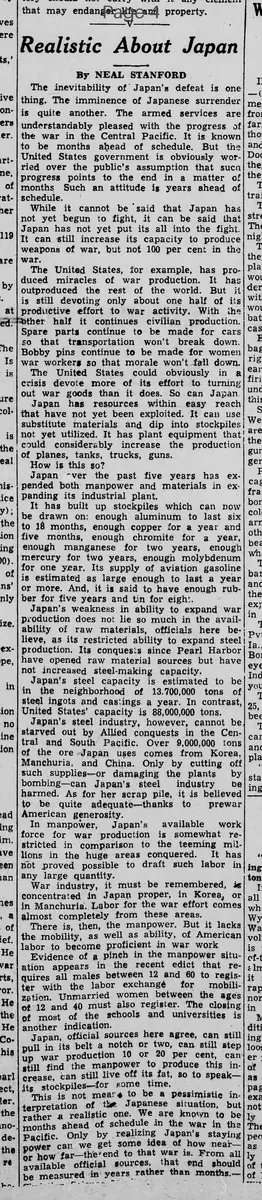
Realistic About Japan
By NEAL STANFORD
The inevitability of Japan's defeat is one thing. The imminence of Japanese surrender is quite another. The armed services are understandably pleased with the progress of the war in the Central Pacific. It is known to be months ahead of schedule. But the United States government is obviously worried over the public's assumption that such progress points to the end in a matter of months Such an attitude is years ahead of schedule.
While it cannot be said that Japan has not yet begun to fight, it can be said that Japan has not yet put its all into the fight.
It can still increase its capacity to produce weapons of war, but not 100 per cent in the war.
The United States, for example, has produced miracles of war production. It has outproduced the rest of the world. But it is still devoting only about one half of its productive effort to war activity. With the other half it continues civilian production.
Spare parts continue to be made for cars so that transportation won't break down.
Bobby pins continue to be made for women war workers so that morale won't fall down.
The United States could obviously in a crisis devote more of its effort to turning out war goods than it does. So can Japan.
Japan has resources within easy reach that have not yet been exploited. It can use substitute materials and dip into stockpiles not yet utilized. It has plant equipment that could considerably increase the production of planes, tanks, trucks, guns.
How is this so?
Japan over the past five years has expended both manpower and materials in expanding its industrial plant.
It has built up stockpiles which can now be drawn on: enough aluminum to last six to 18 months, enough copper for a year and five months, enough chromite for a year, enough manganese for two years, enough mercury for two years, enough molybdenum for one year. Its supply of aviation gasoline is estimated as large enough to last a year or more. And, it is said to have enough rubber for five years and tin for eight.
Japan's weakness in ability to expand war production does not lie so much in the availability of raw materials, officials here believe, as its restricted ability to expand steel production. Its conquests since Pearl Harbor have opened raw material sources but have not increased steel-making capacity.
Japan's steel capacity is estimated to be in the neighborhood of 13,700,000 tons of steel ingots and castings a year. In contrast United States' capacity is 88,000,000 tons.
Japan's steel industry, however, cannot be starved out by Allied conquests in the Central and South Pacific. Over 9,000,000 tons of the ore Japan uses comes from Korea, Manchuria, and China. Only by cutting off such supplies-or damaging the plants by bombing-can Japan's steel industry be harmed. As for her scrap pile, it is believed to be quite adequate--thanks to prewar American generosity.
In manpower, Japan's available work force for war production is somewhat restricted in comparison to the teeming millions in the huge areas conquered. It has not proved possible to draft such labor in any large quantity.
War industry, it must be remembered, is concentrated in Japan proper, in Korea, or in Manchuria. Labor for the war effort comes almost completely from these areas.
There is, then, the manpower. But it lacks the mobility, as well as ability, of American labor to become proficient in war work
Evidence of a pinch in the manpower situation appears in the recent edict that requires all males between 12 and 60 to register with the labor exchange for mobilization. Unmarried women between the ages of 12 and 40 must also register. The closing of most of the schools and universities is another indication.
Japan, official sources here agree, can still pull in its belt a notch or two, can still step up war production 10 or 20 per cent, can still find the manpower to produce this increase, can still live off its fat, so to speak— its stockpiles—for some time.
This is not meant to be a pessimistic interpretation of the Japanese situation, but realistic
Only from all official power can we get some idea of how near-or how far-the end to that war is. It will be measured in years rather than months.
By NEAL STANFORD
The inevitability of Japan's defeat is one thing. The imminence of Japanese surrender is quite another. The armed services are understandably pleased with the progress of the war in the Central Pacific. It is known to be months ahead of schedule. But the United States government is obviously worried over the public's assumption that such progress points to the end in a matter of months Such an attitude is years ahead of schedule.
While it cannot be said that Japan has not yet begun to fight, it can be said that Japan has not yet put its all into the fight.
It can still increase its capacity to produce weapons of war, but not 100 per cent in the war.
The United States, for example, has produced miracles of war production. It has outproduced the rest of the world. But it is still devoting only about one half of its productive effort to war activity. With the other half it continues civilian production.
Spare parts continue to be made for cars so that transportation won't break down.
Bobby pins continue to be made for women war workers so that morale won't fall down.
The United States could obviously in a crisis devote more of its effort to turning out war goods than it does. So can Japan.
Japan has resources within easy reach that have not yet been exploited. It can use substitute materials and dip into stockpiles not yet utilized. It has plant equipment that could considerably increase the production of planes, tanks, trucks, guns.
How is this so?
Japan over the past five years has expended both manpower and materials in expanding its industrial plant.
It has built up stockpiles which can now be drawn on: enough aluminum to last six to 18 months, enough copper for a year and five months, enough chromite for a year, enough manganese for two years, enough mercury for two years, enough molybdenum for one year. Its supply of aviation gasoline is estimated as large enough to last a year or more. And, it is said to have enough rubber for five years and tin for eight.
Japan's weakness in ability to expand war production does not lie so much in the availability of raw materials, officials here believe, as its restricted ability to expand steel production. Its conquests since Pearl Harbor have opened raw material sources but have not increased steel-making capacity.
Japan's steel capacity is estimated to be in the neighborhood of 13,700,000 tons of steel ingots and castings a year. In contrast United States' capacity is 88,000,000 tons.
Japan's steel industry, however, cannot be starved out by Allied conquests in the Central and South Pacific. Over 9,000,000 tons of the ore Japan uses comes from Korea, Manchuria, and China. Only by cutting off such supplies-or damaging the plants by bombing-can Japan's steel industry be harmed. As for her scrap pile, it is believed to be quite adequate--thanks to prewar American generosity.
In manpower, Japan's available work force for war production is somewhat restricted in comparison to the teeming millions in the huge areas conquered. It has not proved possible to draft such labor in any large quantity.
War industry, it must be remembered, is concentrated in Japan proper, in Korea, or in Manchuria. Labor for the war effort comes almost completely from these areas.
There is, then, the manpower. But it lacks the mobility, as well as ability, of American labor to become proficient in war work
Evidence of a pinch in the manpower situation appears in the recent edict that requires all males between 12 and 60 to register with the labor exchange for mobilization. Unmarried women between the ages of 12 and 40 must also register. The closing of most of the schools and universities is another indication.
Japan, official sources here agree, can still pull in its belt a notch or two, can still step up war production 10 or 20 per cent, can still find the manpower to produce this increase, can still live off its fat, so to speak— its stockpiles—for some time.
This is not meant to be a pessimistic interpretation of the Japanese situation, but realistic
Only from all official power can we get some idea of how near-or how far-the end to that war is. It will be measured in years rather than months.
What sub-type of article is it?
War Or Peace
Military Affairs
Economic Policy
What keywords are associated?
Japan War Production
Wwii Pacific
Stockpiles
Manpower Mobilization
Steel Capacity
Us Production
Japanese Surrender
What entities or persons were involved?
Japan
United States
Neal Stanford
Armed Services
Official Sources
Editorial Details
Primary Topic
Realistic Assessment Of Japan's Remaining War Production Capacity
Stance / Tone
Realistic Caution Against Over Optimism
Key Figures
Japan
United States
Neal Stanford
Armed Services
Official Sources
Key Arguments
Japan's Defeat Inevitable But Surrender Not Imminent
Public Assumption Of Quick End Is Years Ahead Of Schedule
Japan Has Untapped Resources, Stockpiles, And Production Potential
Us Devotes Only Half Effort To War, Could Increase Like Japan
Japan's Steel Capacity Limited But Hard To Disrupt
Manpower Restrictions But Can Mobilize More
Japan Can Increase Production 10 20% And Sustain Via Stockpiles