Thank you for visiting SNEWPapers!
Sign up free
Phenix Gazette
Alexandria, Virginia
What is this article about?
In a U.S. Senate speech on Monday, January 16, 1830, Senator Robert Y. Hayne of South Carolina responds to Senator Henry Clay's defense of the protective tariff system. Hayne argues it has condemned the U.S. economy, especially harming the South and West while benefiting Northern manufacturers, and calls for its repeal to restore justice and prosperity.
Clipping
OCR Quality
Full Text
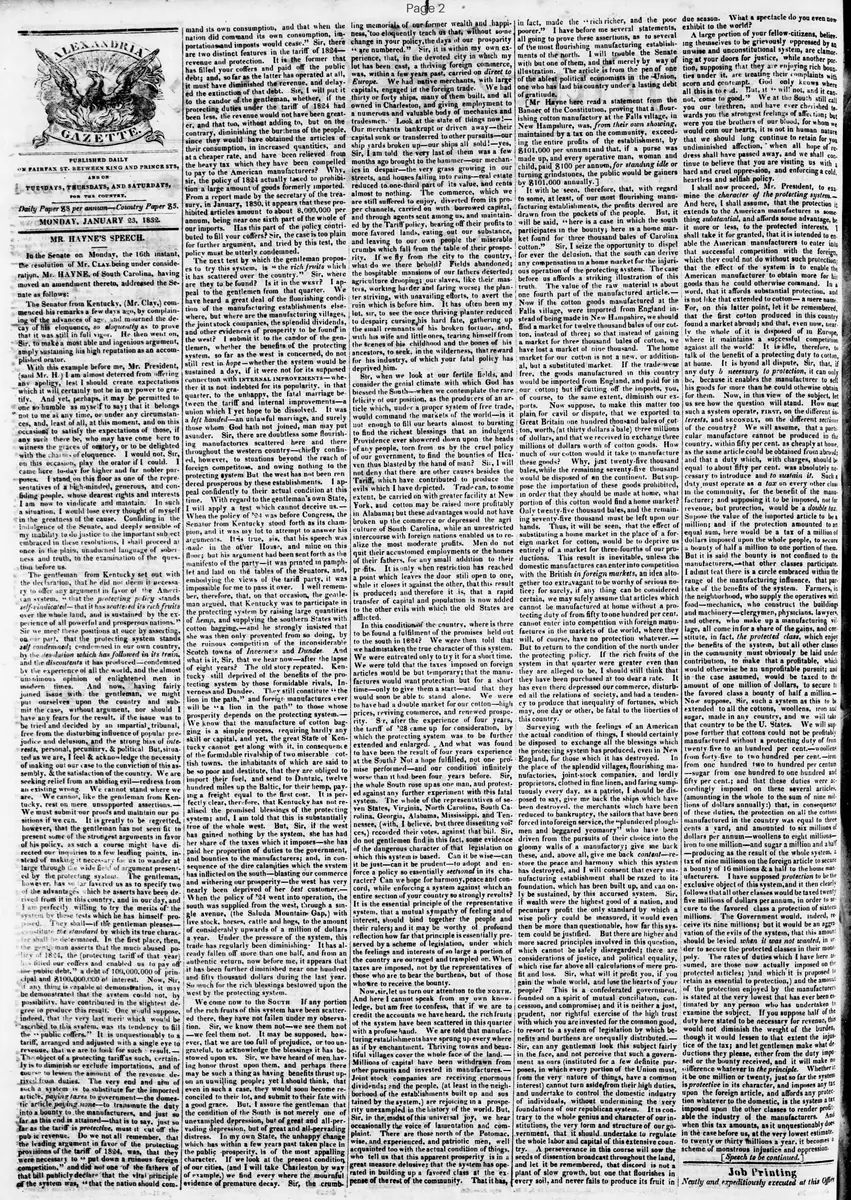
In the Senate on Monday, the 16th instant, the resolution of Mr. Clay being under consideration, Mr. HAYNE, of South Carolina, having moved an amendment thereto, addressed the Senate as follows:
The Senator from Kentucky (Mr. Clay) commenced his remarks a few days ago, by complaining of the advances of age, and mourned the decay of his eloquence, so eloquently as to prove that it was still in full vigor. He then went on, Sir, to make a most able and ingenious argument, amply sustaining his high reputation as an accomplished orator.
With this example before me, Mr. President, (said Mr. H.) I am almost deterred from offering any apology, lest I should create expectations which it will certainly not be in my power to gratify. And yet, perhaps, it may be permitted to one so humble as myself to say, that it belongs not to me at any time, or under any circumstances, and, least of all, at this moment, and on this occasion, to satisfy the expectations of those, if any such there be, who may have come here to witness the graces of oratory, or to be delighted with the charm of eloquence. I would not, Sir, on this occasion, play the orator if I could. I came here to-day for higher and far nobler purposes. I stand on this floor as one of the representatives of a high-minded, generous, and confiding people, whose dearest rights and interests I am now to vindicate and maintain. In such a situation, I would lose every thought of myself in the greatness of the cause. Confiding in the indulgence of the Senate, and deeply sensible of my inability to do justice to the important subject embraced in these resolutions, I shall proceed at once in the plain, unadorned language of soberness and truth, to the examination of the question before us.
The gentleman from Kentucky set out with the declaration, that he did not deem it necessary to offer any argument in favor of the American system; 'that the protecting policy stands self-vindicated - that it has scattered its rich fruits over the whole land, and is sustained by the experience of all powerful and prosperous nations.' Sir, we meet these positions at once by asserting, on our part, that the protecting system stands self-condemned; condemned in our own country, by the desolation which has followed in its train, and the discontents it has produced - condemned by the experience of all the world, and the almost unanimous opinion of enlightened men in modern times. And now, having fairly joined issue with the gentleman, we might put ourselves upon the country and submit the case, without argument, nor should I have any fears for the result, if the issue was to be tried and decided by an impartial tribunal, free from the disturbing influence of popular prejudice and delusion, and the strong bias of interests, personal, pecuniary, & political. But, situated as we are, I feel & acknowledge the necessity of making out our case to the conviction of this assembly, & the satisfaction of the country. We are seeking relief from an abiding evil - redress from an existing wrong.
We cannot stand where we are,
We cannot, like the gentleman from Kentucky, rest on mere unsupported assertions.
We must submit our proofs and maintain our positions if we can. It is greatly to be regretted, however, that the gentleman has not seen fit to present some of the strongest arguments in favor of his policy, as such a course might have directed our inquiries to a few leading points, instead of making it necessary for us to wander at large through the wide field of argument presented by the protecting system. The gentleman, however, has so far favored us as to specify two of the advantages which he asserts have been derived from it in this country, and in our day, and I am perfectly willing to try the merits of the system by these tests which he has himself proposed. They shall - if the gentleman pleases - constitute the standard by which its true character shall be determined. In the first place, then, the gentleman asserts that the much abused policy of 1824, the (protecting tariff of that year) has filled our coffers and enabled us to pay off the public debt - a debt of 100,000,000 of principal and $100,000,000 of interest. Now, Sir, if any thing is capable of demonstration, it may be demonstrated that the system could not, by possibility, have contributed in the slightest degree to produce this result. One would suppose, indeed, that the very last merit which would be ascribed to this system, was its tendency to fill the public coffers. It is unquestionably to a tariff, arranged and adjusted with a single eye to revenue, that we are to look for such result.
The object of a protecting tariff as such, certainly is to diminish or exclude importations, and of course to lessen the amount of the revenue derived from duties. The very end and aim of such a system is to substitute for the imported article, paying taxes to government - the domestic article paying none - to transmute the duty into a bounty to the manufacturers, and just so far as this end is attained - that is to say, just so far as the tariff is protective, must it cut off the public revenue. Do we not all remember, that the leading argument in favor of the protecting provisions of the tariff of 1824, was, that they were necessary to 'put down a ruinous foreign competition,' and did not one of the fathers of that bill publicly declare that the vital principle of the system was, 'that the nation should command its own consumption, and that when the nation did command its own consumption, importations and imposts would cease.' Sir, there are two distinct features in the tariff of 1824 - revenue and protection. It is the former that has filled your coffers and paid off the public debt; and, so far as the latter has operated at all, it must have diminished the revenue, and delayed the extinction of that debt. Sir, I will put it to the candor of the gentleman, whether, if the protecting duties under the tariff of 1824 had been less, the revenue would not have been greater, and that too, without adding to, but on the contrary, diminishing the burthens of the people, since they would have obtained the articles of their consumption, in increased quantities, and at a cheaper rate, and have been relieved from the heavy tax which they have been compelled to pay to the American manufacturers? Why, sir, the policy of 1824 actually taxed to prohibition a large amount of goods formerly imported. From a report made by the secretary of the treasury, in January, 1830, it appears that these prohibited articles amount to about $8,000,000 per annum, being near one sixth part of the whole of our imports. Has this part of the policy contributed to fill your coffers? Sir, the case is too plain for further argument, and tried by this test, the policy must be utterly condemned.
The next test by which the gentleman proposes to try this system, is 'the rich fruits which it has scattered over the country.' Sir, where are they to be found? Is it in the west?
I appeal to the gentlemen from that quarter. We have heard a great deal of the flourishing condition of the manufacturing establishments elsewhere, but where are the manufacturing villages, the joint stock companies, the splendid dividends, and other evidences of prosperity to be found in the west? I submit it to the candor of the gentlemen, whether the benefits of the protecting system, so far as the west is concerned, do not still rest in hope - whether the system would be sustained a day, if it were not for its supposed connection with internal improvements - whether it is not indebted for its popularity, in that quarter, to the unhappy, the fatal marriage between the tariff and internal improvements - a union which I yet hope to be dissolved. It was a left handed - an unlawful marriage, and surely those whom God hath not joined, man may put asunder. Sir, there are doubtless some flourishing manufactories scattered here and there throughout the western country - chiefly confined, however, to situations beyond the reach of foreign competitions, and owing nothing to the protecting system. But the west has not been rendered prosperous by these establishments. I appeal confidently to their actual condition at this time. With regard to the gentleman's own State I will apply a test which cannot deceive us.
When the policy of '24 was before Congress, the Senator from Kentucky stood forth as its champion, and it was my lot to attempt to answer his arguments. It is true, sir, that his speech was made in the other House, and mine on this floor; but his argument had been sent forth as the manifesto of the party - it was printed in pamphlet and laid on the tables of the Senators, and, embodying the views of the tariff party, it was impossible for me to pass it over. I well remember, therefore, that, on that occasion, the gentleman argued, that Kentucky was to participate in the protecting system by raising large quantities of hemp, and supplying the southern States with cotton bagging - and he strongly insisted that she was then only prevented from so doing, by the ruinous competition of the inconsiderable Scotch towns of Inverness and Dundee. And what is it, Sir, that we hear now - after the lapse of eight years? The old story repeated. Kentucky still deprived of the benefits of the protecting system by those formidable rivals, Inverness and Dundee. They still constitute 'the lion in the path,' and foreign manufactures ever will be a lion in the path' to those whose prosperity depends on the protecting system.
We know that the manufacture of cotton bagging is a simple process, requiring hardly any skill or capital, and yet, the great State of Kentucky cannot get along with it, in consequence of the formidable rivalship of two miserable cotton towns, the inhabitants of which are said to be so poor and destitute, that they are obliged to import their fuel, and send to Dantzic, twelve hundred miles up the Baltic, for their hemp, paying a freight equal to the first cost. It is perfectly clear, therefore, that Kentucky has not realized the promised blessings of the protecting system; and, I am told that this is substantially true of the whole west. But, Sir, if the west has gained nothing by the system, she has had her share of the taxes which it imposes - she has paid her proportion of duties to the government, and bounties to the manufacturers; and, in consequence of the dire calamities which the system has inflicted on the south - blasting our commerce and withering our prosperity - the west has very nearly been deprived of her best customer.
When the policy of '24 went into operation, the south was supplied from the west, through a single avenue, (the Saluda Mountain Gap,) with live stock, horses, cattle and hogs, to the amount of considerably upwards of a million of dollars a year. Under the pressure of the system, this trade has regularly been diminishing: It has already fallen off more than one half, and from an authentic return, now before me, it appears that it has been further diminished near one hundred and fifty thousand dollars during the last year. So much for the rich blessings bestowed upon the west by the protecting system.
We come now to the South. If any portion of the rich fruits of this system have been scattered there, they have not fallen under my observation. Sir, we know them not - we see them not - we feel them not. It may be supposed, however, that we are too full of prejudice, or too ungrateful, to acknowledge the blessings it has bestowed upon us. Sir, we have heard of men having honor thrust upon them, and perhaps there may be such a thing as having benefits thrust upon an unwilling people; yet I should think, that even in such a case, they would soon become reconciled to their lot, and submit to their fate with a good grace. But, I assure the gentleman that the condition of the South is not merely one of unexampled depression, but of great and all-pervading distress. In my own State, the unhappy change which has within a few years past taken place in the public prosperity, is of the most appalling character. If we look at the present condition of our cities, (and I will take Charleston by way of example,) we find every where the mournful evidence of premature decay. Sir, the crumbling memorials of our former wealth and happiness, too eloquently teach us that, without some change in your policy, the days of our prosperity 'are numbered.' Sir, it is within my own experience, that, in the devoted city in which my lot has been cast, a thriving foreign commerce, was, within a few years past, carried on direct to Europe. We had native merchants, with large capitals, engaged in the foreign trade. We had thirty or forty ships, many of them built, and all owned in Charleston, and giving employment to a numerous and valuable body of mechanics and tradesmen. Look at the state of things now! Our merchants bankrupt or driven away - their capital sunk or transferred to other pursuits - our ship yards broken up - our ships all sold! - yes, Sir, I am told the very last of them was a few months ago brought to the hammer - our mechanics in despair - the very grass growing in our streets, and houses falling into ruins - real estate reduced to one-third part of its value, and rents almost to nothing. The commerce, which we are still suffered to enjoy, diverted from its proper channels, carried on with borrowed capital, and through agents sent among us, and maintained by the Tariff policy, bearing off their profits to more favored lands, eating out our substance, and leaving to our own people the miserable crumbs which fall from the table of their prosperity. If we fly from the city to the country, what do we there behold? Fields abandoned; the hospitable mansions of our fathers deserted; agriculture drooping; our slaves, like their masters, working harder and faring worse; the planter striving, with unavailing efforts, to avert the ruin which is before him. It has often been my lot, sir, to see the once thriving planter reduced to despair; cursing his hard fate, gathering up the small remnants of his broken fortune, and, with his wife and little ones, tearing himself from the scenes of his childhood and the bones of his ancestors, to seek, in the wilderness, that reward for his industry, of which your fatal policy has deprived him.
Sir, when we look at our fertile fields, and consider the genial climate with which God has blessed the South - when we contemplate the rare felicity of our position, as the producers of an article which, under a proper system of free trade, would command the markets of the world - is it not enough to fill our hearts almost to bursting to find the richest blessings that an indulgent Providence ever showered down upon the heads of any people, torn from us by the cruel policy of our government, to find the bounties of Heaven thus blasted by the hand of man? Sir, I will not deny that there are other causes besides the Tariff, which have contributed to produce the evils which I have depicted. Trade can, to some extent, be carried on with greater facility at New York, and cotton may be raised more profitably in Alabama; but these advantages would not have broken up the commerce or depressed the agriculture of South Carolina, while an unrestricted intercourse with foreign nations enabled us to realize the most moderate profits. Men do not quit their accustomed employments or the homes of their fathers, for any small addition to their profits. It is only when restriction has reached a point which leaves the door still open to one, while it closes it against the other, that this result is produced; and therefore it is, that a rapid transfer of capital and population is now added to the other evils with which the old States are afflicted.
In this condition of the country, where is there to be found a fulfilment of the promises held out to the south in 1824? We were then told that we had mistaken the true character of this system. We were entreated only to try it for a short time. We were told that the taxes imposed on foreign articles would be but temporary; that the manufactures would want protection but for a short time - only to give them a start - and that they would soon be able to stand alone. We were to have had a double market for our cotton - high prices, reviving commerce, and renewed prosperity. Sir, after the experience of four years, the tariff of '28 came up for consideration, by which the protecting system was to be further extended and enlarged. And what was found to have been the result of four years experience at the South? Not a hope fulfilled, not one promise performed - and our condition infinitely worse than it had been four years before. Sir, the whole South rose up as one man, and protested against any further experiment with this fatal system. The whole of the representatives of seven States, Virginia, North Carolina, South Carolina, Georgia, Alabama, Mississippi, and Tennessee, (with, I believe, but three dissenting voices,) recorded their votes, against that bill. Sir, do not gentlemen find in this fact, some evidence of the dangerous character of that legislation on which this system is based. Can it be wise - can it be just - can it be prudent - to adopt and enforce a policy so essentially sectional in its character? Can we hope for harmony, peace and concord, while enforcing a system against which an entire section of your country so strongly revolts? It is the essential principle of the representative system, that a mutual sympathy of feeling and of interest, should bind together the people and their rulers; and it may be worthy of profound reflection how far that principle is essentially preserved by a scheme of legislation, under which the feelings and interests of so large a portion of the country are outraged and trampled on. When taxes are imposed, not by the representatives of those who are to bear the burthens, but of those who are to receive the bounty.
Now, sir, let us turn our attention to the north. And here I cannot speak from my own knowledge, but am free to confess, that if we are to credit the accounts we have heard, the rich fruits of the system have been scattered in this quarter with a profuse hand. We are told that manufacturing establishments have sprung up every where as if by enchantment. Thriving towns and beautiful villages cover the whole face of the land. Millions of capital have been withdrawn from other pursuits and invested in manufactures. Joint stock companies are receiving enormous dividends; and the people, (at least in the neighborhood of the establishments built up and sustained by the system,) are rejoicing in a prosperity unexampled in the history of the world. But, Sir, in the midst of this universal joy, we hear occasionally the voice of lamentation and complaint. There are those north of the Potomac, wise, and experienced, and patriotic men, well acquainted too with the actual condition of things, who tell us that this apparent prosperity is in a great measure delusive; that the system has operated in building up a favored class at the expense of the rest of the community. That it has, in fact, made the 'rich richer, and the poor poorer.' I have before me several statements, all going to prove these assertions, as to several of the most flourishing manufacturing establishments of the north. I will trouble the Senate with but one of them, and that merely by way of illustration. The article is from the pen of one of the ablest political economists in the Union, one who has laid his country under a lasting debt of gratitude.
[Mr Hayne here read a statement from the Banner of the Constitution, proving that a flourishing cotton manufactory at the Falls village, in New Hampshire, was, from their own showing, maintained by a tax on the community, exceeding the entire profits of the establishment, by $101,000 per annum: and that, if a purse was made up, and every operative man, woman and child, paid $100 per annum, for standing idle or turning grindstones, the public would be gainers by $101,000 annually.]
It will be seen, therefore, that, with regard to some, at least, of our most flourishing manufacturing establishments, the profits derived are drawn from the pockets of the people. But, it will be said, 'here is a case in which the south participates in the bounty; here is a home market found for three thousand bales of Carolina cotton.' Sir, I seize the opportunity to dispel for ever the delusion, that the south can derive any compensation in a home market for the injurious operation of the protecting system. The case before us affords a striking illustration of this truth. The value of the raw material is about one fourth part of the manufactured article. Now if the cotton goods manufactured at the Falls village, were imported from England instead of being made in New Hampshire, we should find a market for twelve thousand bales of our cotton, instead of three; so that instead of gaining a market for three thousand bales of cotton, we have lost a market of nine thousand. The home market for our cotton is not a new, or additional, but a substituted market. If the trade were free, the goods manufactured in this country would be imported from England, and paid for in our cotton; but in cutting off the imports, you, of course, to the same extent, diminish our exports. Now suppose, to make this matter too plain for cavil or dispute, that we exported to Great Britain one hundred thousand bales of cotton, worth, (at thirty dollars a bale) three millions of dollars, and that we received in exchange three millions of dollars worth of cotton goods. How much of our cotton would it take to manufacture these goods? Why, just twenty-five thousand bales, while the remaining seventy-five thousand would be disposed of on the continent. But suppose the importation of these goods prohibited, in order that they should be made at home, what portion of this cotton would find a home market? Only twenty-five thousand bales, and the remaining seventy-five thousand must be left upon our hands. Thus, it will be seen, that the effect of substituting a home market in the place of a foreign market for cotton, would be to deprive us entirely of a market for three-fourths of our productions. This result is inevitable, unless the domestic manufactures can enter into competition with the British in foreign markets, an idea altogether too extravagant to be worthy of serious notice; for surely, if any thing can be considered certain, we may safely assume that articles which cannot be manufactured at home without a protecting duty of from fifty to one hundred per cent. cannot enter into competition with foreign manufactures in the markets of the world, where they will, of course, have no protection whatever.
But to return to the condition of the north under the protecting policy. If the rich fruits of the system in that quarter were greater even than they are alleged to be, I should still think that they have been purchased at too dear a rate. It has even there depressed our commerce, disturbed all the relations of society, and had a tendency to produce that inequality of fortunes, which may, one day or other, be fatal to the liberties of this country. Surveying with the feelings of an American the actual condition of things, I should certainly be disposed to exchange all the blessings which the protecting system has produced, even in New England, for those which it has destroyed. In the place of the splendid villages, flourishing manufactories, joint-stock companies, and lordly proprietors, clothed in fine linen, and faring sumptuously every day, as a patriot, I should be disposed to say, give me back the ships which have been destroyed, the merchants which have been reduced to bankruptcy, the sailors that have been forced into foreign service, the 'plundered ploughmen and beggared yeomanry' who have been driven from the pursuits of their choice into the gloomy walls of a manufactory; give me back these, and, above all, give me back content - restore the peace and harmony which this system has destroyed, and I will consent that every manufacturing establishment shall be razed to its foundation, which has been built up, and can only be sustained, by this accursed system. Sir, if wealth were the highest good of a nation, and pecuniary profit the only standard by which a wise policy could be measured, it would even then be more than questionable, how far this system could be justified. But there are higher and more sacred principles involved in this question, which cannot be safely disregarded; there are considerations of justice, and political equality, which rise far above all calculations of mere profit and loss. Sir, what will it profit you, if you gain the whole world, and lose the hearts of your people? This is a confederated government, founded on a spirit of mutual conciliation, concession, and compromise; and it is neither a just, prudent, nor rightful exercise of the high trust with which you are invested for the common good, to resort to a system of legislation by which benefits and burthens are unequally distributed. Sir, can any gentleman look this subject fairly in the face, and not perceive that such a government as ours (instituted for a few definite purposes, in which every portion of the Union must, from the very nature of things, have a common interest) cannot turn aside from their high duties, and undertake to control the domestic industry of individuals, without undermining the very foundations of our republican system. It is contrary to the whole genius and character of our institutions, the very form and structure of our government, that it should undertake to regulate the whole labor and capital of this extensive country. A perseverance in this course will sow the seeds of dissention broadcast throughout the land, and let it be remembered, that discord is not a plant of slow growth, but one that flourishes in every soil, and never fails to produce its fruit in due season. What a spectacle do you even now exhibit to the world? A large portion of your fellow-citizens, believing themselves to be grievously oppressed by an unequal and partial system of legislation, are knocking at your doors for justice, while another portion, supposing themselves to be the favored parties under it, are treating their complaints with scorn and contempt. God only knows where all this is to end. But, it 'will not, and it cannot, come to good.' We at the South still call you our brethren, and have ever cherished towards you the strongest feelings of affection; but were you the brothers of our blood, for whom we would corn our hearts, it is not in human nature that we should long continue to retain for you undiminished affection, 'when all hope of redress shall have passed away, and we shall continue to believe that you are visiting us with a hard and cruel oppression, and enforcing a cold, heartless and selfish policy.'
I shall now proceed, Mr. President, to examine the character of the protecting system. And here, I shall assume, that the protection it extends to the American manufacturer is something substantial, and affords some advantage, be it more or less, to the protected interests. I shall take it for granted, that it is intended to enable the American manufacturers to enter into that successful competition with the foreign, which they could not do without such protection; that the effect of the system is to enable the American manufacturer to obtain more for his goods than he could otherwise command. In a word, that it affords substantial protection, and is not like that extended to cotton - a mere name. For, on this latter point, let it be remembered, that the first cotton produced in this country found a market abroad; and that, even now, nearly the whole of it is disposed of in Europe, where it maintains a successful competition against all the world: It is idle, therefore, to talk of the benefit of a protecting duty to cotton, at home. It is beyond all dispute, Sir, that, if any duty be necessary to protection, it can only be, because it enables the manufacturer to sell his goods for more than he could otherwise obtain for them. Now, in this view of the subject, let us see how the question will stand. How must such a system operate, first, on the different interests, and secondly, on the different sections of the country? We will assume, that a particular manufacture cannot be produced in the country, within fifty per cent. as cheaply at home, as the same article could be obtained from abroad: and that a duty which, with charges, should be equal to about fifty per cent. was absolutely necessary to introduce and to sustain it. Such a duty must operate as a tax on every other class in the community, for the benefit of the manufacturer; and supposing it to be imposed, not for revenue, but protection, would be a double tax. Suppose the value of the imported article to be a million; and if the protection amounted to an equal sum, here would be a tax of a million of dollars imposed upon the whole people, to secure a bounty of half a million to one portion of them. But it is said the bounty is not confined to the manufacturers - that other classes participate. I admit that there is a circle embraced within the range of the manufacturing influence, that partake of the benefits of the system. Farmers, in the neighborhood, who supply the operatives with food - mechanics, who construct the buildings and machinery - clergymen, physicians, lawyers and others, who make up a manufacturing village, all come in for a share of the gains, and constitute, in fact, the protected class, which enjoy the benefits of the system, but all other classes in the community must obviously be laid under contribution, to make that a profitable, which would otherwise be an unprofitable pursuit; and in the case assumed, would be taxed to the amount of one million of dollars, to secure to the favored class a bounty of half a million.
Now suppose, Sir, such a system as this to be extended to all the cottons, woollens, iron and sugar, made in any country, and we will take that country to be the U. States. We will suppose further that cottons could not be profitably manufactured without a protecting duty of from twenty-five to a hundred per cent. - woollens from forty-five to two hundred per cent. - iron from one hundred to two hundred per centum -- sugar from one hundred to one hundred and fifty per cent.; and that these duties were accordingly imposed on these several articles. (amounting in the whole to the sum of nine millions of dollars annually:) that, in consequence of these duties, the protection on all the cottons manufactured in the country was equal to three cents a yard, and amounted to six millions of dollars per annum - woollens to eight millions - iron to one million - and sugar a million and a half - producing as the result of the whole system, a tax of nine millions on the foreign article to secure a bounty of 16 millions & a half to the home manufacturers. I have supposed protection to be the exclusive object of this system, and it then clearly follows that all other classes would be taxed twenty five millions of dollars per annum, in order to secure to the favored class a protection of sixteen millions. The Government would, indeed, receive its nine millions; but it would be an aggravation of the evils of the system, that this amount should be levied when it was not wanted, in order to secure the protected classes in their monopoly. The rates of duties which I have here assumed, are those now actually imposed on the protected articles; )and which it is proposed to retain as essential to protection,) and the amount of the protection enjoyed by the manufacturers is stated at the very lowest that has ever been estimated by any person who has undertaken to examine the subject. If you suppose half of the duty here stated to be necessary for revenue, this would not diminish the weight of the burden, though it would lessen to that extent the injustice of the tax; and let gentlemen make what deductions they please, either from the duty imposed or the bounty received, and it will make no difference whatever in the principle. Whether it be one million or twenty, just so far as the system is protective in its character, and imposes any tax upon the foreign article, and affords any protection whatever to the domestic, is the system a tax imposed upon the other classes to render profitable the industry of the manufacturers. And when this tax amounts, as it unquestionably does in the case before us, at the very lowest estimate, to twenty or thirty millions a year, it becomes a scheme of monstrous injustice and oppression.
Speech to be continued.
What sub-type of article is it?
What themes does it cover?
What keywords are associated?
What entities or persons were involved?
Where did it happen?
Story Details
Key Persons
Location
The Senate
Event Date
Monday, The 16th Instant
Story Details
Senator Hayne delivers a speech critiquing the protective tariff system, arguing it fails to fill public coffers, harms the West and devastates the South's economy and commerce, while unjustly benefiting Northern manufacturers through taxes on the rest of the nation, and warns of sectional discord.