Thank you for visiting SNEWPapers!
Sign up free
Virginia Argus
Richmond, Virginia
What is this article about?
In a U.S. Senate speech on April 9, 1808, Mr. Giles defends John Smith against accusations of complicity in Aaron Burr's conspiracy. He analyzes Burr's letter to Smith, Smith's interactions, and later actions to argue Smith's innocence and lack of knowledge of illicit plans.
Merged-components note: Continuation of Mr. Giles's speech in the Senate.
Clipping
OCR Quality
Full Text
FRIDAY, APRIL 9, 1808.
CLOSE OF JOHN SMITH.
SPEECH OF MR. GILES.
(CONTINUED.)
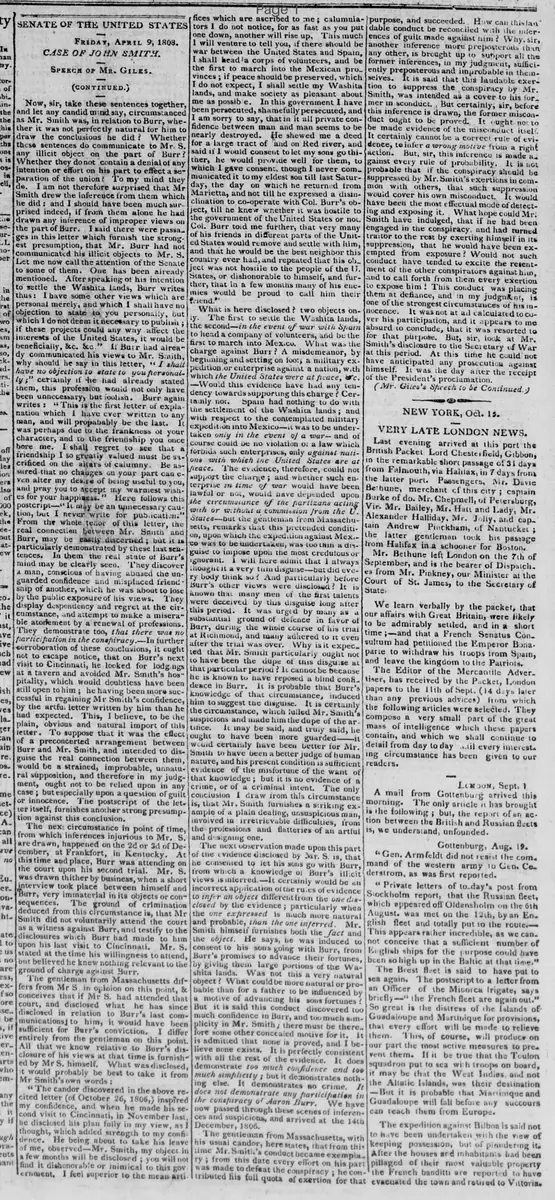
Now, sir, take these sentences together, and let any candid mind say, circumstanced as Mr. Smith was, in relation to Burr, whether it was not perfectly natural for him to draw the conclusions he did? Whether these sentences do communicate to Mr. S. any illicit object on the part of Burr? Whether they do not contain a denial of any intention or effort on his part to effect a separation of the union? To my mind they do. I am not therefore surprised that Mr. Smith drew the inference from them which he did: and I should have been much surprised indeed, if from them alone he had drawn any inference of improper views on the part of Burr. I said there were passages in this letter which furnish the strongest presumption, that Mr. Burr had not communicated his illicit objects to Mr. S. Let me now call the attention of the Senate to some of them. One has been already mentioned. After speaking of his intention to settle the Washita lands, Burr writes thus: I have some other views which are personal merely, and which I shall have no objection to state to you personally, but which I do not deem it necessary to publish; if these projects could any way affect the interests of the United States, it would be beneficially, &c. &c. If Burr had already communicated his views to Mr. Smith, why should he say in this letter, "I shall have no objection to state to you personally;" certainly if he had already stated them, this profession would not only have been unnecessary but foolish. Burr again writes: "This is the first letter of explanation which I have ever written to any man, and will probably be the last. It was perhaps due to the frankness of your character, and to the friendship you once bore me. I shall regret to see that a friendship I so greatly valued must be sacrificed on the altars of calumny. Be assured that no changes on your part can even alter my desire of being useful to you, and pray you to accept my warmest wishes for your happiness." Here follows this postscript-"It may be an unnecessary caution, but I never write for publication."
From the whole tenor of this letter, the real connection between Mr. Smith and Burr, may be easily discerned; but it is particularly demonstrated by these last sentences. In them the real state of Burr's mind may be clearly seen. They discover a man, conscious of having abused the unguarded confidence and misplaced friendship of another, which he was about to lose by the public exposure of his views. They display despondency and regret at the circumstance, and attempt to make a miserable atonement by a renewal of professions. They demonstrate too, that there was no participation in the conspiracy. In further corroboration of these conclusions, it ought not to escape notice, that on Burr's next visit to Cincinnati, he looked for lodgings at a tavern and avoided Mr. Smith's hospitality, which would doubtless have been still open to him; he having been more successful in regaining Mr. Smith's confidence, by the artful letter written by him than he had expected. This, I believe, to be the plain, obvious and natural import of this letter. To suppose that it was the effect of a preconcerted arrangement between Burr and Mr. Smith, and intended to disguise the real connection between them, would be a strained, improbable, unnatural supposition, and therefore in my judgment, ought not to be relied upon in any case; but especially upon a question of guilt or innocence. The postscript of the letter itself, furnishes another strong presumption against this conclusion.
The next circumstance in point of time, from which inferences injurious to Mr. S. are drawn, happened on the 2d or 3d of December, at Frankfort, in Kentucky. At this time and place, Burr was attending on the court upon his second trial. Mr. S. was drawn thither by business, when a short interview took place between himself and Burr, very immaterial in its objects or consequences. The ground of crimination deduced from this circumstance is, that Mr. Smith did not voluntarily attend the court as a witness against Burr, and testify to the disclosures which Burr had made to him upon his last visit to Cincinnati. Mr. S. stated at the time his willingness to attend, but believed he knew nothing relevant to the ground of charge against Burr.
The gentleman from Massachusetts differs from Mr. S. in opinion on this point, & conceives that if Mr. S. had attended that court, and disclosed what he has since disclosed in relation to Burr's last communications to him, it would have been sufficient for Burr's conviction. I differ entirely from the gentleman on this point. All that we know relative to Burr's disclosure of his views at that time is furnished by Mr. S. himself. What was disclosed, it would probably be best to take it from Mr. Smith's own words:
"The candor discovered in the above recited letter (of October 26, 1806,) inspired my confidence, and when he made his second visit to Cincinnati, in November last, he disclosed his plan fully in my view, as I thought, which added strength to my confidence. He being about to take his leave of me, observed-Mr. Smith, my object in a few months will be disclosed; you will not find it dishonorable or inimical to this government, I feel superior to the mean artifices which are ascribed to me: calumniators I do not notice, for as fast as you put one down, another will rise up. This much I will venture to tell you, if there should be war between the United States and Spain, I shall head a corps of volunteers, and be the first to march into the Mexican provinces; if peace should be preserved, which I do not expect, I shall settle my Washita lands, and make society as pleasant about me as possible. In this government I have been persecuted, shamefully persecuted, and I am sorry to say, that in it all private confidence between man and man seems to be nearly destroyed. He shewed me a deed for a large tract of land on Red river, and said if I would consent to let my sons go thither, he would provide well for them, to which I gave consent, though I never communicated it to my eldest son till last Saturday, the day on which he returned from Marietta, and not till he expressed a disinclination to co-operate with Col. Burr's object, till he knew whether it was hostile to the government of the United States or not. Col. Burr told me further, that very many of his friends in different parts of the United States would remove and settle with him, and that he would be the best neighbor this country ever had, and repeated that his object was not hostile to the people of the U. States, or dishonorable to himself, and further, that in a few months many of his enemies would be proud to call him their friend."
What is here disclosed? Two objects only. The first to settle the Washita lands, the second-in the event of war with Spain to head a company of volunteers, and be the first to march into Mexico. What was the charge against Burr? A misdemeanor, by beginning and setting on foot a military expedition or enterprise against a nation, with which the United States were at peace, &c. -Would this evidence have had any tendency towards supporting this charge? Certainly not. Spain had nothing to do with the settlement of the Washita lands; and with respect to the contemplated military expedition into Mexico-it was to be undertaken only in the event of a war- and of course could be no violation of a law which forbids such enterprises, only against nations with which the United States are at peace. The evidence, therefore, could not support the charge; and whether such enterprise in time of war would have been lawful or not, would have depended upon the circumstance of the marauders acting with or without a commission from the U. States-but the gentleman from Massachusetts, remarks that this pretended condition, upon which the expedition against Mexico was to be undertaken, was too thin a disguise to impose upon the most credulous or ignorant. I will here admit that I always thought it a very thin disguise-but did everybody think so? And particularly before Burr's other views were disclosed? It is known that many men of the first talents were deceived by this disguise long after this period. It was urged by many as a substantial ground of defence in favor of Burr, during the whole course of his trial at Richmond, and many adhered to it even after the trial was over. Why is it expected that Mr. Smith particularly ought not to have been the dupe of this disguise at that particular period? It cannot be because he is known to have reposed a blind confidence in Burr. It is probable that Burr's knowledge of that circumstance, induced him to suggest the disguise. It is certainly the circumstance, which lulled Mr. Smith's suspicions and made him the dupe of the artifice. It may be said, and truly said, he ought to have been more guarded-it would certainly have been better for Mr. Smith to have been a better judge of human nature, and his present condition is sufficient evidence of the misfortune of the want of that knowledge; but it is no evidence of a crime, or of a criminal intent. The only conclusion I draw from this circumstance is, that Mr. Smith furnishes a striking example of a plain dealing, unsuspicious man, involved in irretrievable difficulties, from the professions and flatteries of an artful and designing one.
The next observation made upon this part of the evidence disclosed by Mr. S. is, that he consented to let his sons go with Burr, from which a knowledge of Burr's illicit views is inferred.-It certainly would be an incorrect application of the rules of evidence to infer an object different from the one disclosed by the evidence; particularly when the one expressed is much more natural and probable, than the one inferred. Mr. Smith himself furnishes both the fact and the object. He says, he was induced to consent to his sons going with Burr, from Burr's promises to advance their fortunes, by giving them large portions of the Washita lands. Was not this a very natural object? What could be more natural or probable than for a father to be influenced by a motive of advancing his sons fortunes? But it is said this Conduct discovered too much confidence in Burr, and too much simplicity in Mr. Smith; there must be therefore some other concealed motive for it. It is admitted that none is proved, and I believe none exists. It is perfectly consistent with all the rest of the evidence. It does demonstrate too much confidence and too much simplicity: but it demonstrates nothing else. It demonstrates no crime. It does not demonstrate any participation in the conspiracy of Aaron Burr. We have now passed through these scenes of inferences and suspicions, and arrived at the 14th December, 1806.
The gentleman from Massachusetts, with his usual candor, here states, that from this time Mr. Smith's conduct became exemplary; from this date every effort on his part was made to defeat the conspiracy; he contributed his full quota of exertion for that purpose, and succeeded. How can this laudable conduct be reconciled with the inferences of guilt made against him? Why, sir, another inference more preposterous than any other, is brought up to support all the former inferences, in my judgment, sufficiently preposterous and improbable in themselves. It is said that this laudable exertion to suppress the conspiracy by Mr. Smith, was intended as a cover to his former misconduct. But certainly, sir, before this inference is drawn; the former misconduct ought to be proved. It ought not to be made evidence of the misconduct itself. It certainly cannot be a correct rule of evidence, to infer a wrong motive from a right action. But, sir, this inference is made against every rule of probability. It is not probable that if the conspiracy should be suppressed by Mr. Smith's exertions in common with others, that such suppression would cover his own misconduct. It would have been the most effectual mode of detecting and exposing it. What hope could Mr. Smith have indulged, that if he had been engaged in the conspiracy, and had turned traitor to the rest by exerting himself in its suppression, that he would have been exempted from exposure? Would not such conduct have tended to excite the resentment of the other conspirators against him, and to call forth from them every exertion to expose him! This conduct was placing them at defiance, and in my judgment, is one of the strongest circumstances of his innocence. It was not at all calculated to cover his participation, and it appears to me absurd to conclude, that it was resorted to for that purpose. But, sir, look at Mr. Smith's disclosure to the Secretary of War at this period. At this time he could not have anticipated any prosecution against himself. It was the day after the receipt of the President's proclamation.
(Mr. Giles's Speech to be Continued.)
What sub-type of article is it?
What themes does it cover?
What keywords are associated?
What entities or persons were involved?
Where did it happen?
Story Details
Key Persons
Location
Senate Of The United States; Cincinnati; Frankfort, Kentucky
Event Date
April 9, 1808
Story Details
Mr. Giles argues in defense of John Smith, analyzing Burr's letter and Smith's interactions to show no knowledge of conspiracy, emphasizing Smith's innocence through later actions against the plot.