Thank you for visiting SNEWPapers!
Sign up free
The Litchfield County Post
Litchfield, Litchfield County, Connecticut
What is this article about?
In the British House of Commons on July 19, Mr. Huskisson moved for copies of U.S. tariffs from 1824 and 1828, criticizing their detrimental impact on British manufactures and violations of reciprocity treaties. Debate highlighted potential retaliation but favored non-retaliatory approach; motion agreed to.
Merged-components note: Continuation of the article on the British House of Commons debate regarding the American Tariff.
Clipping
OCR Quality
Full Text
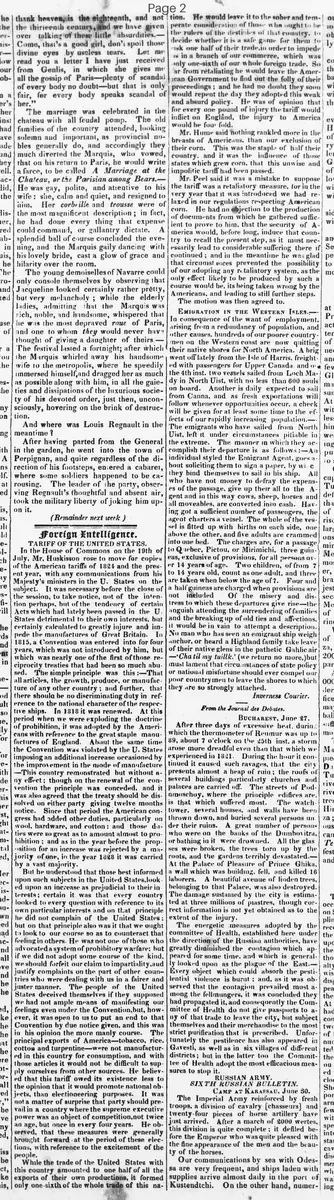
TARIFF OF THE UNITED STATES.
In the House of Commons on the 19th of July, Mr. Huskisson rose to move for copies of the American tariffs of 1824 and the present year, with any communications from his Majesty's ministers in the U. States on the subject. It was necessary before the close of the session, to take notice, not of the intention perhaps, but of the tendency of certain Acts which had lately been passed in the U. States detrimental to their own interests, but certainly calculated to greatly injure and impede the manufactures of Great Britain. In 1815, a Convention was entered into for four years, which was not introduced by him, but which was nearly one of the first of those reciprocity treaties that had been so much abused. The simple principle was this:—That all articles, the growth, produce, or manufacture of any other country: and further, that there should be no discriminating duty in reference to the national character of the respective ships. In 1818 it was renewed. At this period when we were exploding the doctrine of prohibition, it was adopted by the Americans with reference to the great staple manufactures of England. About the same time the Convention was violated by the U. States imposing an additional increase occasioned by the improvement in the mode of manufacture—This country remonstrated but without any effect; though on the renewal of the convention the principle was conceded, and it was also agreed that the treaty should be dissolved on either party giving twelve months notice. Since that period the American congress had added other duties, particularly on wool, hardware, and cotton: and those duties were so great as to amount almost to prohibition; and as in the year before the proposition for an increase was rejected by a majority of one, in the year 1828 it was carried by a vast majority.
But he understood that those best informed upon such subjects in the United States, looked upon an increase as prejudicial to their interests; certain it was that every country looked to every question with reference to its own particular interests and on that principle he did not complain of the United States: but on that principle also was it that we ought to look to our course so as to counteract that feeling in others. He was not one of these who advocated a system of prohibitory warfare; but if we did not adopt some course of the kind, we should forfeit our claim to impartiality, and justify complaints on the part of other countries who were dealing with us in a fairer and juster manner. The people of the United States deceived themselves if they supposed we had not ample means of manifesting our feelings even under the Convention, but, however, it was open to us to put an end to that Convention by due notice given, and this was in his opinion the more manly course. The principal exports of America—tobacco, rice, cotton and turpentine—were not manufactured in this country for consumption, and with those articles it would not be difficult to supply ourselves from other sources. He believed that this tariff owed its existence less to the opinion that it would promote national objects, than electioneering purposes. It was not a matter of surprise that party should prevail in a country where the supreme executive power was an object of competition, not twice an age, but once in every four years.
He observed, that these measures were generally brought forward—at the period of these elections, with reference to the excitement of the people.
While the trade of the United States with this country amounted to one half of all the exports of their own productions, it formed only one-sixth of the whole trade of this nation. He would leave it to the sober and temperate consideration of those who ought to be the rulers of the destinies of that country, to decide whether it is a safe game for them to risk one half of their trade, in order to impede us in a branch of our commerce, which was only one-sixth of our whole foreign trade. So far from retaliating he would leave the American Government to find out the folly of their proceedings; and he had no doubt they soon would repent the day they adopted this weak and absurd policy. He was of opinion that for every one pound of injury the tariff would inflict on England, the injury to America would be fourfold.
Mr. Hume said nothing rankled more in the breasts of Americans, than our exclusion of their corn. This was the staple of half their country, and it was the influence of those states which grew corn, that this unwise and impolitic tariff had been passed.
Mr. Peel said it was a mistake to suppose the tariff was a retaliatory measure, for in the very year that it was introduced we had relaxed in our regulations respecting American corn. He had no objection to the production of documents from which he gathered sufficient to prove to him, that the security of America would, before long, induce that country to recall the present step, as it must necessarily lead to considerable suffering there if continued; and in the meantime he was glad that circumstances prevented the possibility of our adopting any retaliatory system, as the only effect likely to be produced by such a course would be, its being taken wrong by the Americans, and leading to still further steps.
The motion was then agreed to.
What sub-type of article is it?
What keywords are associated?
What entities or persons were involved?
Where did it happen?
Foreign News Details
Primary Location
United States
Event Date
19th Of July
Key Persons
Outcome
motion for copies of american tariffs of 1824 and present year, with communications from british ministers in the u. states, agreed to. no retaliatory measures proposed; expectation that u.s. would soon repent the tariff policy.
Event Details
In the House of Commons, Mr. Huskisson moved for documents on U.S. tariffs, highlighting their violation of 1815 and 1818 reciprocity conventions, additional duties on wool, hardware, and cotton amounting to near prohibition, and their injury to British manufactures. He noted the 1828 tariff's passage by vast majority for electioneering purposes and suggested ending the convention with notice. Mr. Hume attributed the tariff to U.S. resentment over British corn exclusion. Mr. Peel clarified it was not retaliatory and anticipated U.S. reversal due to self-inflicted suffering.