Thank you for visiting SNEWPapers!
Sign up free
Story
November 22, 1890
Huntsville Gazette
Huntsville, Madison County, Alabama
What is this article about?
Mlle. Bilcesco, a 23-year-old Romanian woman, becomes the first female Doctor of Laws in France by passing her exam at the Paris law faculty in the late 1880s. She advocates for women's equal rights in education and family law, highlighting maternal rights.
Clipping
OCR Quality
98%
Excellent
Full Text
A MODERN PORTIA.
Mlle. Bilcesco Is Now a Full-Fledged Doctor of Laws.
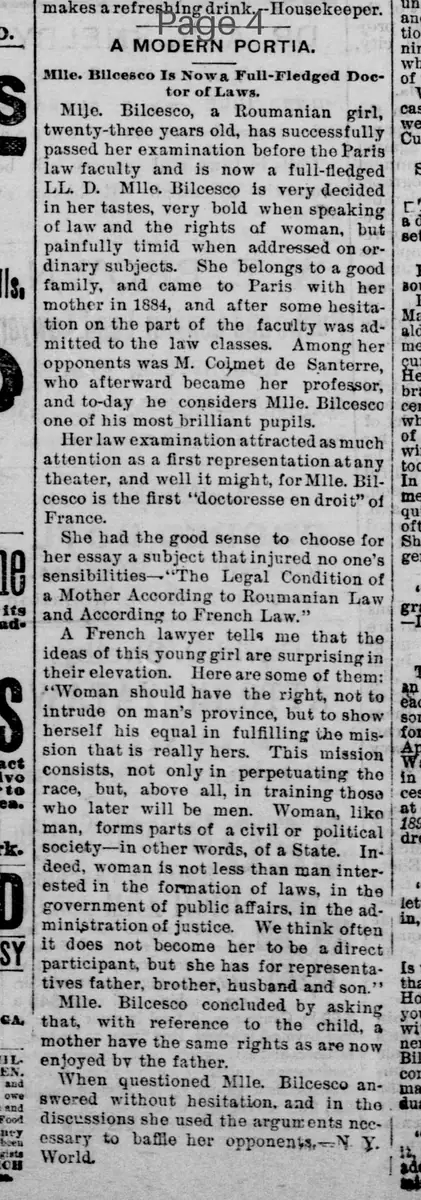
Mlle. Bilcesco, a Roumanian girl, twenty-three years old, has successfully passed her examination before the Paris law faculty and is now a full-fledged LL. D. Mlle. Bilcesco is very decided in her tastes, very bold when speaking of law and the rights of woman, but painfully timid when addressed on ordinary subjects. She belongs to a good family, and came to Paris with her mother in 1884, and after some hesitation on the part of the faculty was admitted to the law classes. Among her opponents was M. Colmet de Santerre, who afterward became her professor, and to-day he considers Mlle. Bilcesco one of his most brilliant pupils. Her law examination attracted as much attention as a first representation at any theater, and well it might, for Mlle. Bilcesco is the first "doctoresse en droit" of France. She had the good sense to choose for her essay a subject that injured no one's sensibilities—"The Legal Condition of a Mother According to Roumanian Law and According to French Law." A French lawyer tells me that the ideas of this young girl are surprising in their elevation. Here are some of them: Woman should have the right, not to intrude on man's province, but to show herself his equal in fulfilling the mission that is really hers. This mission consists, not only in perpetuating the race, but, above all, in training those who later will be men. Woman, like man, forms part of a civil or political society—in other words, of a State. Indeed, woman is not less than man interested in the formation of laws, in the government of public affairs, in the administration of justice. We think often it does not become her to be a direct participant, but she has for representatives father, brother, husband and son. Mlle. Bilcesco concluded by asking that, with reference to the child, a mother have the same rights as are now enjoyed by the father. When questioned Mlle. Bilcesco answered without hesitation, and in the discussions she used the arguments necessary to baffle her opponents.—N. Y. World.
Mlle. Bilcesco Is Now a Full-Fledged Doctor of Laws.
Mlle. Bilcesco, a Roumanian girl, twenty-three years old, has successfully passed her examination before the Paris law faculty and is now a full-fledged LL. D. Mlle. Bilcesco is very decided in her tastes, very bold when speaking of law and the rights of woman, but painfully timid when addressed on ordinary subjects. She belongs to a good family, and came to Paris with her mother in 1884, and after some hesitation on the part of the faculty was admitted to the law classes. Among her opponents was M. Colmet de Santerre, who afterward became her professor, and to-day he considers Mlle. Bilcesco one of his most brilliant pupils. Her law examination attracted as much attention as a first representation at any theater, and well it might, for Mlle. Bilcesco is the first "doctoresse en droit" of France. She had the good sense to choose for her essay a subject that injured no one's sensibilities—"The Legal Condition of a Mother According to Roumanian Law and According to French Law." A French lawyer tells me that the ideas of this young girl are surprising in their elevation. Here are some of them: Woman should have the right, not to intrude on man's province, but to show herself his equal in fulfilling the mission that is really hers. This mission consists, not only in perpetuating the race, but, above all, in training those who later will be men. Woman, like man, forms part of a civil or political society—in other words, of a State. Indeed, woman is not less than man interested in the formation of laws, in the government of public affairs, in the administration of justice. We think often it does not become her to be a direct participant, but she has for representatives father, brother, husband and son. Mlle. Bilcesco concluded by asking that, with reference to the child, a mother have the same rights as are now enjoyed by the father. When questioned Mlle. Bilcesco answered without hesitation, and in the discussions she used the arguments necessary to baffle her opponents.—N. Y. World.
What sub-type of article is it?
Biography
Personal Triumph
What themes does it cover?
Triumph
Justice
Moral Virtue
What keywords are associated?
Women's Rights
Law Degree
First Doctoresse
Paris Faculty
Maternal Rights
Roumanian Student
What entities or persons were involved?
Mlle. Bilcesco
M. Colmet De Santerre
Where did it happen?
Paris, France
Story Details
Key Persons
Mlle. Bilcesco
M. Colmet De Santerre
Location
Paris, France
Event Date
After 1884
Story Details
A 23-year-old Romanian woman, Mlle. Bilcesco, overcomes faculty hesitation to study law in Paris, passes her examination to become France's first female Doctor of Laws, and presents an essay on maternal rights under Romanian and French law, advocating for women's equality in societal roles.