Thank you for visiting SNEWPapers!
Sign up free
Literary
July 4, 1814
Kentucky Gazette
Lexington, Fayette County, Kentucky
What is this article about?
Masonic oration by George G. Ross, Esq., delivered June 24, 1814, to Lexington Lodge No. 1, celebrating St. John's anniversary. It praises Freemasonry's enduring principles of charity, benevolence, brotherly love, morality, and religion, defends against prejudices, and urges masons to embody virtue and compassion.
Clipping
OCR Quality
98%
Excellent
Full Text
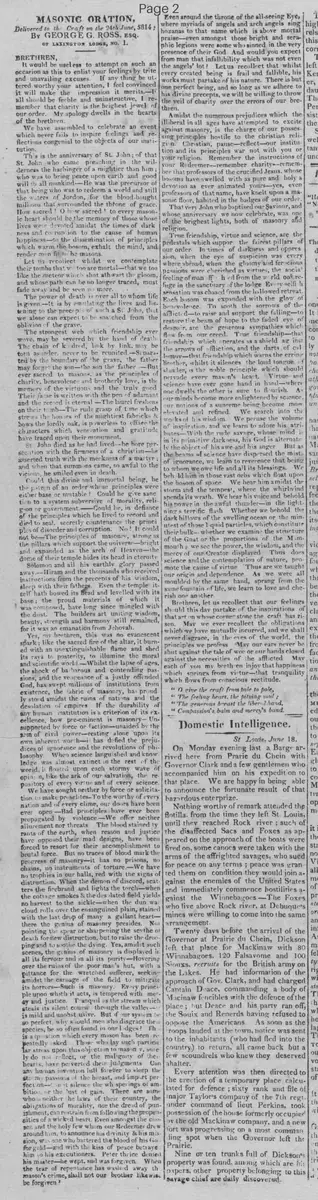
MASONIC ORATION.
Delivered to the Craft on the 24th June, 1814;
By GEORGE G. ROSS, ESQ
OF Lexington Lodge, No. 1
BRETHREN.
It would be useless to attempt on such an occasion as this to enlist your feelings by trite and unavailing excuses. If any thing be uttered worthy your attention, I feel convinced it will make the impression it merits. If all should be feeble and uninstructive, I remember that charity is the brightest jewel of our order. My apology dwells in the hearts of the brethren.
We have assembled to celebrate an event which never fails to inspire feelings and reflections congenial to the objects of our institution.
This is the anniversary of St. John; of that St. John who came preaching in the wilderness the harbinger of a mightier than him; who was to bring peace upon earth and good will to all mankind--He was the precursor of that being who was to redeem a world and still the waters of Jordan, for the blood-bought millions that surrounded the throne of grace.
How sacred! O how sacred! to every masonic heart should be the memory of those whose lives were devoted amidst the times of darkness and corruption to the cause of human happiness--to the dissemination of principles which warm the bosom, exalt the mind, and render men fit to be masons.
Let us recollect whilst we contemplate their tombs that we too are mortal--that we too like the meteor which shot athwart the gloom and whose path can be no longer traced, must fade away and be seen no more.
The power of death is over all to whom life is given.--it is by emulating the lives and listening to the precepts of such a St John, that we alone can expect to be snatched from the oblivion of the grave.
The strongest web which friendship ever wove, may be severed by the hand of death. The chain of kindred, link by link, may be torn asunder, never to be reunited--Separated by the boundary of the grave, the father may forget the son--the son the father--But ever sacred to masons, as the principles of charity, benevolence and brotherly love, is the memory of the virtuous and the truly good.
Their fame is written with the pen of adamant and the record is eternal--The laurel freshens on their tomb--The rude grasp of time which strews the honors of the mightiest fabricks and bows the lordly oak, is powerless to efface the characters which veneration and gratitude have traced upon their monument.
St John died as he had lived--he bore persecution with the firmness of a christian--he asserted truth with the meekness of a martyr: and when that summons came, so awful to the vicious, he smiled even in death.
Could this divine and immortal being be the patron of an order whose principles were either base or mutable? Could he give sanction to a system subversive of morality, religion or government.--Could he, in defiance of the principles which he lived to record and died to seal, secretly countenance the principles of disorder and corruption. No! It could not be--The principles of masonry, strong as the pillars which support the universe--bright and expanded as the arch of Heaven--the dome of their temple hides its head in eternity.
Solomon and all his earthly glory passed away.--Hiram and the thousands who received instructions from the precepts of his wisdom, sleep with their fathers. Even the temple itself hath bowed its head and levelled with its base; the proud materials of which it was composed, have long since mingled with the dust. The builders art uniting wisdom, beauty, strength and harmony still remained, for it was an emanation from Jehovah.
Yes, my brethren, this was no evanescent spark; like the sacred fire of the altar, it burned with an unextinguishable flame and shed its rays to posterity, to illumine the moral and scientific world. Whilst the lapse of ages, the shock of barbarous and contending passions, and the vengeance of a justly offended God, has swept millions of institutions from existence, the fabric of masonry, has proudly stood amidst the ruins of nations and the desolation of the empires. If the durability of any human institution is a criterion of its excellence, how pre-eminent is masonry--Unsupported by force or faction--unaided by the arm of civil power--resting alone upon its own inherent worth--has defied the prejudices of ignorance and the revolutions of philosophy. When science languished and knowledge was almost extinct in the rest of the world, it floated upon each stormy wave of opinion, like the ark of our salvation, the repository of every virtue and of every science.
We have sought neither by force or solicitation to make proselytes--To the worthy of every nation and of every clime, our doors have been ever open--Bad principles have ever been propagated by violence--We offer neither allurement nor threats. The blood stained tyrants of the earth, when reason and justice have opposed their mad designs, have been forced to resort for their accomplishment to brutal force. But no traces of blood mark the progress of masonry--it has no prisons, no chains, no instruments of torture.--We have no trophies in our halls, red with the signs of destruction. When the demon of discord, scatters the firebrand and lights the torch--when the cottage smokes and the desolated field yields no harvest to the sickle--when the dun war cloud rolls over the ensanguined plain, stained with the last drop of many a gallant heart--there the genius of masonry presides. Not pointing the spear or sharpening the scythe of death for new destruction, but to raise the drooping and to soothe the dying. Yes, amidst such scenes, the genius of masonry is displayed in all its fervour and in all its purity--Hovering over the ruins of the poor man's hut, with a pittance for the wretched sufferer, seeking amidst the carnage of the field to mitigate its horrors--Such is masonry. Every principle upon which it acts, is tempered with mercy and justice. Tranquil as the stream which steals its silent course through the valley--is mild and unobtrusive. But if our system be so perfect, why should men who disgrace their species, be so often found in our lodges? It is a question which every mason has been repeatedly asked. Those who lay such particular stress upon this objection to masonry, surely do not reflect, or the malignity of their hearts, have perverted their judgments. Can any human invention lull forever to sleep the stormy passions of the breast, and impart perfect and perpetual silence the whisperings of ambition or the lust of gain. There are some who neither the laws of their country, the obligations of morality, nor the dread of punishment, can restrain from following the propensities of a wicked heart. Even amongst the chosen and the holy few whom our Redeemer drew around him, to announce his divinity and his mission, was one who bartered the blood of his God for gold--and with the kiss of peace betrayed him to his executioners. Peter thrice denied his master--he wept, and was forgiven. When the tear of repentance has washed away the mason's crime, shall not our brother likewise be forgiven?
Even around the throne of the all-seeing Eye, where myriads of angels and arch angels sing hosannas to that name which is above mortal praise--even amongst those bright and seraphic legions were some who sinned in the very presence of their God. And would you expect from man that infallibility which was not even the angels' lot? Let us recollect that whilst every created being is frail and fallible, his works must partake of his nature. There is but one perfect being, and so long as we adhere to his divine precepts, we will be willing to throw the veil of charity over the errors of our brethren.
Amidst the numerous prejudices which the illiberal in all ages have attempted to excite against masonry, is the charge of our possessing principles hostile to the christian religion. Christian, pause--reflect--our institution and its principles war not with you or your religion. Remember the instructions of your Redeemer--remember charity--remember that professors of the crucified Jesus, whose bosoms have swelled with as pure and holy a devotion as ever animated yours--yes, even professors of that name, have knelt upon a masonic floor, habited in the badges of our order. That very John who baptised our Saviour, and whose anniversary we now celebrate, was one of the brightest lights, both of masonry and religion.
True friendship, virtue and science, are the pedestals which support the fairest pillars of our order. In times of darkness and oppression, when the eye of suspicion was every where abroad, when the gloomy and ferocious passions were cherished as virtues, the social feeling of man fled from the world and took refuge in the sanctuary of the lodge. Every selfish sensation was chased from the hallowed retreat. Each bosom was expanded with the glow of benevolence. To sooth the sorrows of the afflicted--to raise and support the falling--to restore the beam of hope to the faded eye of despair, are the generous sympathies which flow from our creed. True friendship--that friendship which operates as a shield against the arrows of affliction, and the darts of calumny--that friendship which warns the erring brother, whilst it silences the loud tongue of slander, is the noble principle which should pervade every mason's heart. Virtue and science have ever gone hand in hand--where one dwells the other is sure to flourish. As our minds become more enlightened by science, our notions of a supreme being become more elevated and refined. We search into the works of his wisdom. We peruse the volume of inspiration, and we learn to adore his attributes--With the rude savage, whose mind is in its primitive darkness, his God is alternately the object of his awe and his anger. But as the beams of science have dispersed the mists of ignorance, we learn to reverence that being to whom we owe life and all its blessings. We behold him in those vast orbs which float upon the bosom of space. We hear him amidst the storm and the tempest, where the whirlwind spends its wrath. We hear his voice and behold his power in the awful thunder--in the lightning's terrific flash. Whether we behold the dark billows of the swelling ocean or the minutest of those liquid particles, which constitute their bulk--whether we examine the structure of the Gnat or the proportions of the Mammoth--we see the power, the wisdom, and the mercy of our Creator displayed. Thus does science and the contemplation of nature, promote the cause of virtue. Thus are we taught our origin and dependence. As we were all moulded by the same hand, sprang from the same fountain of life, we learn to love and cherish one another.
Brethren, let us recollect that our feelings should this day partake of the inspirations of that art on whose corner stone the craft has risen. May we ever recollect the obligations which we have mutually incurred, and we shall never disgrace, in the eyes of the world, the principles we profess. May our ears never be shut against the tale of woe or our hands closed against the necessities of the afflicted. May each of you, my brethren, enjoy that happiness which springs from virtue--that tranquility which flows from conscious rectitude.
"O give the craft from pole to pole
The feeling heart, the pitying soul;
The generous breast the liberal hand.
Compassion's balm and mercy's band."
Delivered to the Craft on the 24th June, 1814;
By GEORGE G. ROSS, ESQ
OF Lexington Lodge, No. 1
BRETHREN.
It would be useless to attempt on such an occasion as this to enlist your feelings by trite and unavailing excuses. If any thing be uttered worthy your attention, I feel convinced it will make the impression it merits. If all should be feeble and uninstructive, I remember that charity is the brightest jewel of our order. My apology dwells in the hearts of the brethren.
We have assembled to celebrate an event which never fails to inspire feelings and reflections congenial to the objects of our institution.
This is the anniversary of St. John; of that St. John who came preaching in the wilderness the harbinger of a mightier than him; who was to bring peace upon earth and good will to all mankind--He was the precursor of that being who was to redeem a world and still the waters of Jordan, for the blood-bought millions that surrounded the throne of grace.
How sacred! O how sacred! to every masonic heart should be the memory of those whose lives were devoted amidst the times of darkness and corruption to the cause of human happiness--to the dissemination of principles which warm the bosom, exalt the mind, and render men fit to be masons.
Let us recollect whilst we contemplate their tombs that we too are mortal--that we too like the meteor which shot athwart the gloom and whose path can be no longer traced, must fade away and be seen no more.
The power of death is over all to whom life is given.--it is by emulating the lives and listening to the precepts of such a St John, that we alone can expect to be snatched from the oblivion of the grave.
The strongest web which friendship ever wove, may be severed by the hand of death. The chain of kindred, link by link, may be torn asunder, never to be reunited--Separated by the boundary of the grave, the father may forget the son--the son the father--But ever sacred to masons, as the principles of charity, benevolence and brotherly love, is the memory of the virtuous and the truly good.
Their fame is written with the pen of adamant and the record is eternal--The laurel freshens on their tomb--The rude grasp of time which strews the honors of the mightiest fabricks and bows the lordly oak, is powerless to efface the characters which veneration and gratitude have traced upon their monument.
St John died as he had lived--he bore persecution with the firmness of a christian--he asserted truth with the meekness of a martyr: and when that summons came, so awful to the vicious, he smiled even in death.
Could this divine and immortal being be the patron of an order whose principles were either base or mutable? Could he give sanction to a system subversive of morality, religion or government.--Could he, in defiance of the principles which he lived to record and died to seal, secretly countenance the principles of disorder and corruption. No! It could not be--The principles of masonry, strong as the pillars which support the universe--bright and expanded as the arch of Heaven--the dome of their temple hides its head in eternity.
Solomon and all his earthly glory passed away.--Hiram and the thousands who received instructions from the precepts of his wisdom, sleep with their fathers. Even the temple itself hath bowed its head and levelled with its base; the proud materials of which it was composed, have long since mingled with the dust. The builders art uniting wisdom, beauty, strength and harmony still remained, for it was an emanation from Jehovah.
Yes, my brethren, this was no evanescent spark; like the sacred fire of the altar, it burned with an unextinguishable flame and shed its rays to posterity, to illumine the moral and scientific world. Whilst the lapse of ages, the shock of barbarous and contending passions, and the vengeance of a justly offended God, has swept millions of institutions from existence, the fabric of masonry, has proudly stood amidst the ruins of nations and the desolation of the empires. If the durability of any human institution is a criterion of its excellence, how pre-eminent is masonry--Unsupported by force or faction--unaided by the arm of civil power--resting alone upon its own inherent worth--has defied the prejudices of ignorance and the revolutions of philosophy. When science languished and knowledge was almost extinct in the rest of the world, it floated upon each stormy wave of opinion, like the ark of our salvation, the repository of every virtue and of every science.
We have sought neither by force or solicitation to make proselytes--To the worthy of every nation and of every clime, our doors have been ever open--Bad principles have ever been propagated by violence--We offer neither allurement nor threats. The blood stained tyrants of the earth, when reason and justice have opposed their mad designs, have been forced to resort for their accomplishment to brutal force. But no traces of blood mark the progress of masonry--it has no prisons, no chains, no instruments of torture.--We have no trophies in our halls, red with the signs of destruction. When the demon of discord, scatters the firebrand and lights the torch--when the cottage smokes and the desolated field yields no harvest to the sickle--when the dun war cloud rolls over the ensanguined plain, stained with the last drop of many a gallant heart--there the genius of masonry presides. Not pointing the spear or sharpening the scythe of death for new destruction, but to raise the drooping and to soothe the dying. Yes, amidst such scenes, the genius of masonry is displayed in all its fervour and in all its purity--Hovering over the ruins of the poor man's hut, with a pittance for the wretched sufferer, seeking amidst the carnage of the field to mitigate its horrors--Such is masonry. Every principle upon which it acts, is tempered with mercy and justice. Tranquil as the stream which steals its silent course through the valley--is mild and unobtrusive. But if our system be so perfect, why should men who disgrace their species, be so often found in our lodges? It is a question which every mason has been repeatedly asked. Those who lay such particular stress upon this objection to masonry, surely do not reflect, or the malignity of their hearts, have perverted their judgments. Can any human invention lull forever to sleep the stormy passions of the breast, and impart perfect and perpetual silence the whisperings of ambition or the lust of gain. There are some who neither the laws of their country, the obligations of morality, nor the dread of punishment, can restrain from following the propensities of a wicked heart. Even amongst the chosen and the holy few whom our Redeemer drew around him, to announce his divinity and his mission, was one who bartered the blood of his God for gold--and with the kiss of peace betrayed him to his executioners. Peter thrice denied his master--he wept, and was forgiven. When the tear of repentance has washed away the mason's crime, shall not our brother likewise be forgiven?
Even around the throne of the all-seeing Eye, where myriads of angels and arch angels sing hosannas to that name which is above mortal praise--even amongst those bright and seraphic legions were some who sinned in the very presence of their God. And would you expect from man that infallibility which was not even the angels' lot? Let us recollect that whilst every created being is frail and fallible, his works must partake of his nature. There is but one perfect being, and so long as we adhere to his divine precepts, we will be willing to throw the veil of charity over the errors of our brethren.
Amidst the numerous prejudices which the illiberal in all ages have attempted to excite against masonry, is the charge of our possessing principles hostile to the christian religion. Christian, pause--reflect--our institution and its principles war not with you or your religion. Remember the instructions of your Redeemer--remember charity--remember that professors of the crucified Jesus, whose bosoms have swelled with as pure and holy a devotion as ever animated yours--yes, even professors of that name, have knelt upon a masonic floor, habited in the badges of our order. That very John who baptised our Saviour, and whose anniversary we now celebrate, was one of the brightest lights, both of masonry and religion.
True friendship, virtue and science, are the pedestals which support the fairest pillars of our order. In times of darkness and oppression, when the eye of suspicion was every where abroad, when the gloomy and ferocious passions were cherished as virtues, the social feeling of man fled from the world and took refuge in the sanctuary of the lodge. Every selfish sensation was chased from the hallowed retreat. Each bosom was expanded with the glow of benevolence. To sooth the sorrows of the afflicted--to raise and support the falling--to restore the beam of hope to the faded eye of despair, are the generous sympathies which flow from our creed. True friendship--that friendship which operates as a shield against the arrows of affliction, and the darts of calumny--that friendship which warns the erring brother, whilst it silences the loud tongue of slander, is the noble principle which should pervade every mason's heart. Virtue and science have ever gone hand in hand--where one dwells the other is sure to flourish. As our minds become more enlightened by science, our notions of a supreme being become more elevated and refined. We search into the works of his wisdom. We peruse the volume of inspiration, and we learn to adore his attributes--With the rude savage, whose mind is in its primitive darkness, his God is alternately the object of his awe and his anger. But as the beams of science have dispersed the mists of ignorance, we learn to reverence that being to whom we owe life and all its blessings. We behold him in those vast orbs which float upon the bosom of space. We hear him amidst the storm and the tempest, where the whirlwind spends its wrath. We hear his voice and behold his power in the awful thunder--in the lightning's terrific flash. Whether we behold the dark billows of the swelling ocean or the minutest of those liquid particles, which constitute their bulk--whether we examine the structure of the Gnat or the proportions of the Mammoth--we see the power, the wisdom, and the mercy of our Creator displayed. Thus does science and the contemplation of nature, promote the cause of virtue. Thus are we taught our origin and dependence. As we were all moulded by the same hand, sprang from the same fountain of life, we learn to love and cherish one another.
Brethren, let us recollect that our feelings should this day partake of the inspirations of that art on whose corner stone the craft has risen. May we ever recollect the obligations which we have mutually incurred, and we shall never disgrace, in the eyes of the world, the principles we profess. May our ears never be shut against the tale of woe or our hands closed against the necessities of the afflicted. May each of you, my brethren, enjoy that happiness which springs from virtue--that tranquility which flows from conscious rectitude.
"O give the craft from pole to pole
The feeling heart, the pitying soul;
The generous breast the liberal hand.
Compassion's balm and mercy's band."
What sub-type of article is it?
Essay
What themes does it cover?
Moral Virtue
Religious
Friendship
What keywords are associated?
Masonic Oration
St John Anniversary
Freemasonry Principles
Charity Benevolence
Brotherly Love
Moral Virtue
Religious Devotion
Science Enlightenment
What entities or persons were involved?
By George G. Ross, Esq Of Lexington Lodge, No. 1
Literary Details
Title
Masonic Oration.
Author
By George G. Ross, Esq Of Lexington Lodge, No. 1
Subject
Delivered To The Craft On The 24th June, 1814; Anniversary Of St. John
Form / Style
Prose Oration
Key Lines
This Is The Anniversary Of St. John; Of That St. John Who Came Preaching In The Wilderness The Harbinger Of A Mightier Than Him; Who Was To Bring Peace Upon Earth And Good Will To All Mankind He Was The Precursor Of That Being Who Was To Redeem A World And Still The Waters Of Jordan, For The Blood Bought Millions That Surrounded The Throne Of Grace.
The Principles Of Masonry, Strong As The Pillars Which Support The Universe Bright And Expanded As The Arch Of Heaven The Dome Of Their Temple Hides Its Head In Eternity.
True Friendship, Virtue And Science, Are The Pedestals Which Support The Fairest Pillars Of Our Order.
"O Give The Craft From Pole To Pole
The Feeling Heart, The Pitying Soul;
The Generous Breast The Liberal Hand.
Compassion's Balm And Mercy's Band."