Thank you for visiting SNEWPapers!
Sign up free
Literary
July 21, 1791
The New Hampshire Gazette And General Advertiser
Portsmouth, Rockingham County, New Hampshire
What is this article about?
The essay 'THE ECONOMIST' contrasts Fervidus, a hasty and chaotic individual who achieves little due to precipitancy, with Lentulus, a moderate and industrious man who plans well and succeeds in his endeavors, emphasizing the proverb 'Make not more haste than good speed.'
Clipping
OCR Quality
98%
Excellent
Full Text
THE ECONOMIST.
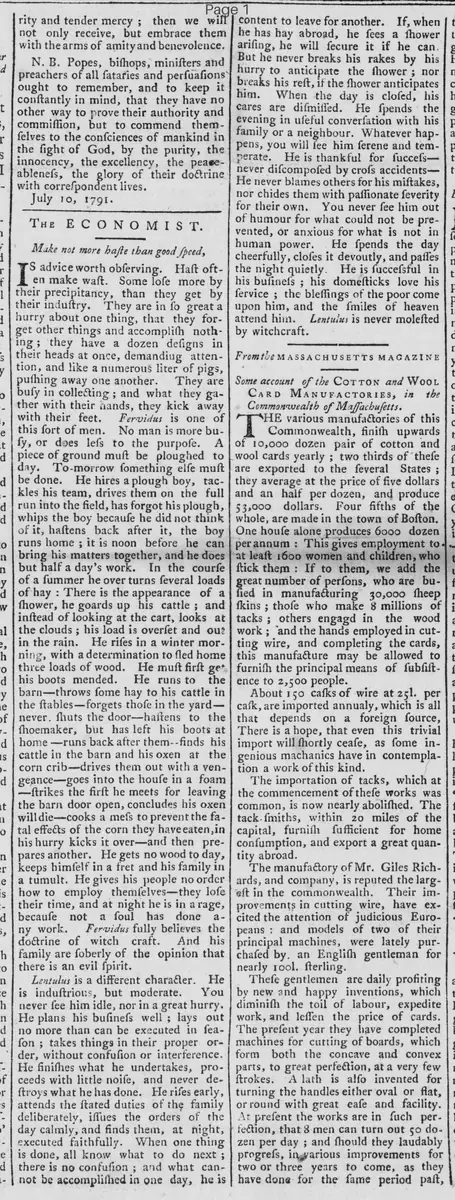
Make not more haste than good speed, is advice worth observing. Haste often makes waste. Some lose more by their precipitancy, than they get by their industry. They are in so great a hurry about one thing, that they forget other things and accomplish nothing; they have a dozen designs in their heads at once, demanding attention, and like a numerous litter of pigs, pushing away one another. They are busy in collecting; and what they gather with their hands, they kick away with their feet. Fervidus is one of this sort of men. No man is more busy, or does less to the purpose. A piece of ground must be ploughed to day. To-morrow something else must be done. He hires a plough boy, tackles his team, drives them on the full run into the field, has forgot his plough, whips the boy because he did not think of it, hastens back after it, the boy runs home; it is noon before he can bring his matters together, and he does but half a day's work. In the course of a summer he over turns several loads of hay: There is the appearance of a shower, he goads up his cattle: and instead of looking at the cart, looks at the clouds; his load is overset and lost in the rain. He rises in a winter morning, with a determination to sled home three loads of wood. He must first get his boots mended. He runs to the barn--throws some hay to his cattle in the stables--forgets those in the yard--never shuts the door--hastens to the shoemaker, but has left his boots at home--runs back after them--finds his cattle in the barn and his oxen at the corn crib--drives them out with a vengeance--goes into the house in a foam--strikes the first he meets for leaving the barn door open, concludes his oxen will die--cooks a mess to prevent the fatal effects of the corn they have eaten, in his hurry kicks it over--and then prepares another. He gets no wood to day, keeps himself in a fret and his family in a tumult. He gives his people no order how to employ themselves--they lose their time, and at night he is in a rage, because not a soul has done any work. Fervidus fully believes the doctrine of witch craft. And his family are soberly of the opinion that there is an evil spirit.
Lentulus is a different character. He is industrious, but moderate. You never see him idle, nor in a great hurry. He plans his business well; lays out no more than can be executed in season; takes things in their proper order, without confusion or interference. He finishes what he undertakes, proceeds with little noise, and never destroys what he has done. He rises early, attends the stated duties of the family deliberately, issues the orders of the day calmly, and finds them, at night, executed faithfully. When one thing is done, all know what to do next; there is no confusion; and what cannot be accomplished in one day, he is content to leave for another. If, when he has hay abroad, he sees a shower arising, he will secure it if he can. But he never breaks his rakes by his hurry to anticipate the shower; nor breaks his rest, if the shower anticipates him. When the day is closed, his cares are dismissed. He spends the evening in useful conversation with his family or a neighbour. Whatever happens, you will see him serene and temperate. He is thankful for success--never discomposed by cross accidents--He never blames others for his mistakes, nor chides them with passionate severity for their own. You never see him out of humour for what could not be prevented, or anxious for what is not in human power. He spends the day cheerfully, closes it devoutly, and passes the night quietly. He is successful in his business: his domestics love his service; the blessings of the poor come upon him, and the smiles of heaven attend him. Lentulus is never molested by witchcraft.
Make not more haste than good speed, is advice worth observing. Haste often makes waste. Some lose more by their precipitancy, than they get by their industry. They are in so great a hurry about one thing, that they forget other things and accomplish nothing; they have a dozen designs in their heads at once, demanding attention, and like a numerous litter of pigs, pushing away one another. They are busy in collecting; and what they gather with their hands, they kick away with their feet. Fervidus is one of this sort of men. No man is more busy, or does less to the purpose. A piece of ground must be ploughed to day. To-morrow something else must be done. He hires a plough boy, tackles his team, drives them on the full run into the field, has forgot his plough, whips the boy because he did not think of it, hastens back after it, the boy runs home; it is noon before he can bring his matters together, and he does but half a day's work. In the course of a summer he over turns several loads of hay: There is the appearance of a shower, he goads up his cattle: and instead of looking at the cart, looks at the clouds; his load is overset and lost in the rain. He rises in a winter morning, with a determination to sled home three loads of wood. He must first get his boots mended. He runs to the barn--throws some hay to his cattle in the stables--forgets those in the yard--never shuts the door--hastens to the shoemaker, but has left his boots at home--runs back after them--finds his cattle in the barn and his oxen at the corn crib--drives them out with a vengeance--goes into the house in a foam--strikes the first he meets for leaving the barn door open, concludes his oxen will die--cooks a mess to prevent the fatal effects of the corn they have eaten, in his hurry kicks it over--and then prepares another. He gets no wood to day, keeps himself in a fret and his family in a tumult. He gives his people no order how to employ themselves--they lose their time, and at night he is in a rage, because not a soul has done any work. Fervidus fully believes the doctrine of witch craft. And his family are soberly of the opinion that there is an evil spirit.
Lentulus is a different character. He is industrious, but moderate. You never see him idle, nor in a great hurry. He plans his business well; lays out no more than can be executed in season; takes things in their proper order, without confusion or interference. He finishes what he undertakes, proceeds with little noise, and never destroys what he has done. He rises early, attends the stated duties of the family deliberately, issues the orders of the day calmly, and finds them, at night, executed faithfully. When one thing is done, all know what to do next; there is no confusion; and what cannot be accomplished in one day, he is content to leave for another. If, when he has hay abroad, he sees a shower arising, he will secure it if he can. But he never breaks his rakes by his hurry to anticipate the shower; nor breaks his rest, if the shower anticipates him. When the day is closed, his cares are dismissed. He spends the evening in useful conversation with his family or a neighbour. Whatever happens, you will see him serene and temperate. He is thankful for success--never discomposed by cross accidents--He never blames others for his mistakes, nor chides them with passionate severity for their own. You never see him out of humour for what could not be prevented, or anxious for what is not in human power. He spends the day cheerfully, closes it devoutly, and passes the night quietly. He is successful in his business: his domestics love his service; the blessings of the poor come upon him, and the smiles of heaven attend him. Lentulus is never molested by witchcraft.
What sub-type of article is it?
Essay
Prose Fiction
What themes does it cover?
Moral Virtue
Temperance
What keywords are associated?
Haste
Industry
Moderation
Fervidus
Lentulus
Moral Essay
Proverb
Witchcraft
Literary Details
Title
The Economist.
Key Lines
Make Not More Haste Than Good Speed, Is Advice Worth Observing. Haste Often Makes Waste.
Fervidus Is One Of This Sort Of Men. No Man Is More Busy, Or Does Less To The Purpose.
Lentulus Is A Different Character. He Is Industrious, But Moderate.
He Plans His Business Well; Lays Out No More Than Can Be Executed In Season; Takes Things In Their Proper Order, Without Confusion Or Interference.
He Is Successful In His Business: His Domestics Love His Service; The Blessings Of The Poor Come Upon Him, And The Smiles Of Heaven Attend Him.