Thank you for visiting SNEWPapers!
Sign up free
Story
May 29, 1846
The Daily Union
Washington, District Of Columbia
What is this article about?
Letters from a U.S. Army officer detail events leading to and including battles against Mexican forces near Matamoras, Texas, on May 8-9, 1846, under General Taylor. Describes captures, artillery exchanges, charges, casualties, and victories at Palo Alto and Resaca de la Palma, with editorial praise for Taylor.
Clipping
OCR Quality
95%
Excellent
Full Text
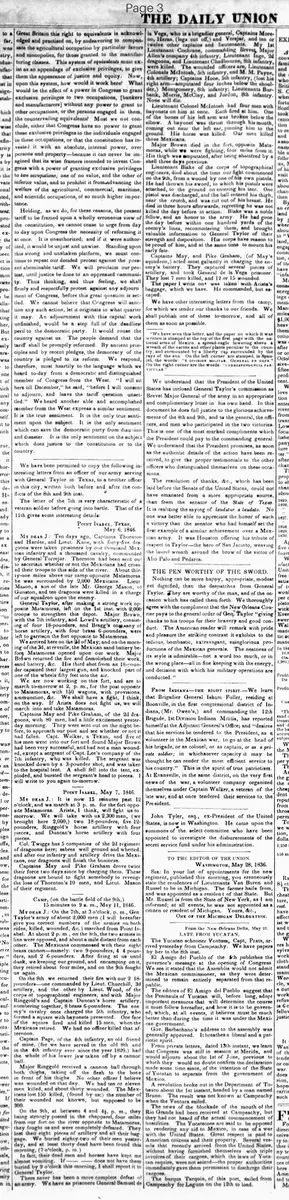
We have been permitted to copy the following interesting letters from an officer of our army serving with General Taylor in Texas, to a brother officer in this city, written both before and after the conflicts of the 8th and 9th inst.
The letter of the 7th is very characteristic of a veteran soldier before going into battle. That of the 11th gives some interesting details:
Point Isabel, Texas,
May 6, 1846.
My dear J.: Ten days ago, Captains Thornton and Hardee, and Lieut. Kane, with forty-five dragoons were taken prisoners by one thousand Mexican infantry and a thousand cavalry, commanded by General Torrejon. Thornton had been sent out to ascertain whether or not the Mexicans had crossed their troops to this side of the river. About thirty-one miles above our camp opposite Matamoras, he was surrounded by 2,000 Mexicans. Lieut. Mason, a son of the late Mr. George Mason, of Gunston, and ten dragoons were killed in a charge of our squadron upon the enemy.
General Taylor, after making a strong work opposite Matamoras, left on the 1st inst. with 2,000 troops to strengthen this depot. Major Brown, with the 7th infantry, and Lowd's artillery, consisting of four 18-pounders, and Bragg's company of horse artillery, with four brass 6-pounders, were left to garrison the fort opposite to Matamoras.
We arrived here on the 2d of May; and on the morning of the 3d, at reveille, the Mexican sand battery before Matamoras opened upon our work. Major Brown returned the fire and demolished their work, sand battery, &c. His third shot from an 18-pounder capsized their largest gun, and knocked part of one of the wheels fifty feet into the air.
We are now working on this fort, and are to march to-morrow at 2, p. m., for the post opposite to Matamoras, with 150 wagons, with provisions, ammunition, &c. We shall have a fight, I think on the way. If Arista does not fight us, we will march in and take Matamoras.
Captains May and Pike Graham, of the 2d dragoons, with 80 men, had a little excitement yesterday morning. They were sent out on the night before, to approach our post and see whether or not it had fallen. Capt. Walker, a Texan, and five of his men went into our fort and found Major Brown had been very successful, and had not a man wounded, except a sergeant of Capt. Lee's company of the 7th infantry, who was killed. The sergeant was knocked down by a 3-pounder shot, and was taken to the hospital tent. A shell fell into the tent, exploded, and bursted the sergeant's head to pieces.
I will write to you again to-morrow.
Point Isabel, May 7, 1846.
My dear J.: It is now 15 minutes past 12 o'clock, and we march at 3 p. m. for the fort opposite Matamoras. Arista, I think, will fight us to-morrow. We will take with us 2,300 men, (we brought here 2,000,) two 18-pounders, five 12-pounders, Ringgold's horse artillery with four pieces, and Duncan's horse artillery with four pieces.
Col. Twiggs has 5 companies of the 2d regiment of dragoons here; sabres well ground and whetted and after our infantry and artillery drive the Mexicans, our dragoons will finish the business.
Captains May and Pike Graham drove twice their force two days since by charging them. These dragoons are bound to fight somebody to revenge the loss of Thornton's 10 men, and Lieut. Mason of their regiment.
Camp, (on the battle field of the 9th,
15 minutes to 9 a. m., May 11, 1846.
My dear J.: On the 7th, at 3 o'clock, p. m., Gen. Taylor's army of about 2,000 men (I will hereafter give you correct numbers of the armies on both sides, killed, wounded, &c.) marched from Point Isabel. At about 2 p. m., on the 8th, the two armies in line were opposed, and about a mile distant from each other: The Mexicans commenced with their eight brass cannon—namely: two 9-pounders, 4 4-pounders, and 2 6-pounders. After firing at us until dusk, we keeping our ground, and encamping on it, they retired about four miles, and on the 9th fought us again.
On the 8th we returned their fire with our 2 18-pounders—one commanded by Lieut. Churchill, 3d artillery, and the other by Lieut. Wood, of the corps of topographical engineers, and with Major Ringgold's and Captain Duncan's horse artillery numbering together, 8 brass 6-pounders. The enemy's cavalry once charged the 5th infantry, who formed a square with bayonets presented. One face of the square fired and killed 15 men, when the Mexicans retired. We had no officer killed that afternoon.
Captain Page, of the 4th infantry, an old friend of mine, (for we have served in the old 5th and in the 4th infantry ever since the year 1820,) had the whole of his lower jaw taken off by a cannon ball.
Major Ringgold received a cannon ball through both thighs, taking off the flesh to the bone in front of his thighs. No other officer I believe was wounded on that day. We had ten or eleven men killed, and about thirty wounded. The Mexicans lost 150 killed, (found by us;) the number of their wounded not known, but supposed to be 300.
On the 9th, at between 4 and 4½, p. m., they being strongly posted in the chapparal, four miles from our fort on the river opposite to Matamoras, they fought us and were completely defeated. They lost their eight pieces of artillery and all their baggage. We buried eighty-two of their men yesterday, and at least thirty dead have been found this morning, (7 o'clock, p. m.)
In fact, their dead men and horses have kept me almost vomiting. If [someone] does not have them buried by 9 o'clock this morning, I shall report it to General Taylor.
There never has been a more complete defeat of an army. We have as prisoners General Samuel de la Vega, who is a brigadier general, Captains Moreno, Heras, (leg cut off,) and Veramendi, and ten or twelve other captains and lieutenants. My 1st Lieutenant Cochrane, commanding Brevet Major Allen's company 4th infantry, Lieutenant Inge, 2d dragoons, and Lieutenant Chadbourne, 5th infantry, were killed. The wounded officers are, Lieutenant Colonels McIntosh, 5th infantry, and M. M. Payne, 4th artillery; Captains Hooe, 5th infantry, (lost his right arm—amputated four inches below the shoulder,) Montgomery, 8th infantry; Lieutenants Burbank, Morris, McClay, and Jordon, 5th infantry.
None will die.
Lieutenant Colonel McIntosh had four men with bayonets on him at once. Each fired at him. One of the bones of his left arm was broken below the elbow. A bayonet was thrust through his mouth, coming out near the left ear, pinning him to the ground. His horse was killed. Our men killed those Mexicans.
Major Brown died in the fort, opposite Matamoras, while we were fighting, four miles from it. His thigh was amputated, after being shattered by a shell three days previous.
Lieutenant Blake of the corps of topographical engineers, died about the time our fight commenced on the 9th, from a wound by one of his own pistols. He had thrown his sword, to which his pistols were attached, to the ground on entering his tent. One pistol was discharged, and the ball entered his thigh, near the crotch, and was cut out of his breast. He died in three hours afterwards, regretting he was not killed the day before in action. Blake was a noble fellow, and an honor to the army. He had gone the day before within one hundred yards of the enemy's lines, reconnoitering them, and brought valuable information to General Taylor of their strength and disposition. His corps have reason to be proud of him, and at the same time to mourn his early fate.
Captains May, and Pike Graham, (of May's squadron,) acted most gallantly in charging the enemy's battery. They captured several pieces of artillery, and took General de la Vega prisoner. They lost 7 men killed, and 12 or 15 wounded.
The paper I write on was taken with Arista's baggage, which we have. He commanded, but escaped.
We have other interesting letters from the camp, for which we tender our thanks to our friends. We shall publish one of these to-morrow, and all of them as soon as possible.
We have seen this letter, and the paper on which it was written is stamped at the top of the first page with the national arms of Mexico, a spread-eagle towering above a wreath of the cactus and other plants peculiar to the country, and surmounted by a liberty cap surrounded by the rays of the sun. On the left corner are stamped, in Spanish, the words: "4 DIVISION MILITAR, GENERAL EN JEFE"
On the right corner are the words: "CORRESPONDENCIA PARTICULAR"
We understand that the President of the United States has inclosed General Taylor's commission as Brevet Major General of the army in an appropriate and complimentary letter in his own hand. In this document he does full justice to the glorious achievements of the 8th and 9th, and to the general, the officers, and men who participated in the two victories.
This is one of the most marked compliments which the President could pay to the commanding general.
We understand that the President promises, as soon as the authentic details of the action have been received, to give the proper testimonials to the other officers who distinguished themselves on these occasions.
The resolution of thanks, &c., which has been laid before the Senate of the United States, could not have emanated from a more appropriate source, than from the senator of the State of Texas. It is realizing the saying of laudatur a laudato. No one was better able to appreciate the honor of such a victory than the senator who had himself set the first example of a similar achievement over a Mexican army. It was Houston offering his tribute of respect to Taylor—the hero of San Jacinto, weaving the laurel wreath around the brow of the victor of Palo Alto and Resaca de la Palma.
THE PEN WORTHY OF THE SWORD.
Nothing can be more happy, appropriate, modest yet dignified, than the despatches from General Taylor. They are worthy of the man, and of the occasion which has called them forth. We thoroughly agree with the compliment that the New Orleans Courier pays to the general order of Gen. Taylor "giving thanks to his troops for their bravery and good conduct. The American reader will remark with pride and pleasure the striking contrast it exhibits to the tedious, bombastic, extravagant, vainglorious productions of the Mexican generals. The neatness of its style is admirable—not a word too much, or in the wrong place—all in fine keeping with the energy, and decision with which his military operations are conducted."
The letter of the 7th is very characteristic of a veteran soldier before going into battle. That of the 11th gives some interesting details:
Point Isabel, Texas,
May 6, 1846.
My dear J.: Ten days ago, Captains Thornton and Hardee, and Lieut. Kane, with forty-five dragoons were taken prisoners by one thousand Mexican infantry and a thousand cavalry, commanded by General Torrejon. Thornton had been sent out to ascertain whether or not the Mexicans had crossed their troops to this side of the river. About thirty-one miles above our camp opposite Matamoras, he was surrounded by 2,000 Mexicans. Lieut. Mason, a son of the late Mr. George Mason, of Gunston, and ten dragoons were killed in a charge of our squadron upon the enemy.
General Taylor, after making a strong work opposite Matamoras, left on the 1st inst. with 2,000 troops to strengthen this depot. Major Brown, with the 7th infantry, and Lowd's artillery, consisting of four 18-pounders, and Bragg's company of horse artillery, with four brass 6-pounders, were left to garrison the fort opposite to Matamoras.
We arrived here on the 2d of May; and on the morning of the 3d, at reveille, the Mexican sand battery before Matamoras opened upon our work. Major Brown returned the fire and demolished their work, sand battery, &c. His third shot from an 18-pounder capsized their largest gun, and knocked part of one of the wheels fifty feet into the air.
We are now working on this fort, and are to march to-morrow at 2, p. m., for the post opposite to Matamoras, with 150 wagons, with provisions, ammunition, &c. We shall have a fight, I think on the way. If Arista does not fight us, we will march in and take Matamoras.
Captains May and Pike Graham, of the 2d dragoons, with 80 men, had a little excitement yesterday morning. They were sent out on the night before, to approach our post and see whether or not it had fallen. Capt. Walker, a Texan, and five of his men went into our fort and found Major Brown had been very successful, and had not a man wounded, except a sergeant of Capt. Lee's company of the 7th infantry, who was killed. The sergeant was knocked down by a 3-pounder shot, and was taken to the hospital tent. A shell fell into the tent, exploded, and bursted the sergeant's head to pieces.
I will write to you again to-morrow.
Point Isabel, May 7, 1846.
My dear J.: It is now 15 minutes past 12 o'clock, and we march at 3 p. m. for the fort opposite Matamoras. Arista, I think, will fight us to-morrow. We will take with us 2,300 men, (we brought here 2,000,) two 18-pounders, five 12-pounders, Ringgold's horse artillery with four pieces, and Duncan's horse artillery with four pieces.
Col. Twiggs has 5 companies of the 2d regiment of dragoons here; sabres well ground and whetted and after our infantry and artillery drive the Mexicans, our dragoons will finish the business.
Captains May and Pike Graham drove twice their force two days since by charging them. These dragoons are bound to fight somebody to revenge the loss of Thornton's 10 men, and Lieut. Mason of their regiment.
Camp, (on the battle field of the 9th,
15 minutes to 9 a. m., May 11, 1846.
My dear J.: On the 7th, at 3 o'clock, p. m., Gen. Taylor's army of about 2,000 men (I will hereafter give you correct numbers of the armies on both sides, killed, wounded, &c.) marched from Point Isabel. At about 2 p. m., on the 8th, the two armies in line were opposed, and about a mile distant from each other: The Mexicans commenced with their eight brass cannon—namely: two 9-pounders, 4 4-pounders, and 2 6-pounders. After firing at us until dusk, we keeping our ground, and encamping on it, they retired about four miles, and on the 9th fought us again.
On the 8th we returned their fire with our 2 18-pounders—one commanded by Lieut. Churchill, 3d artillery, and the other by Lieut. Wood, of the corps of topographical engineers, and with Major Ringgold's and Captain Duncan's horse artillery numbering together, 8 brass 6-pounders. The enemy's cavalry once charged the 5th infantry, who formed a square with bayonets presented. One face of the square fired and killed 15 men, when the Mexicans retired. We had no officer killed that afternoon.
Captain Page, of the 4th infantry, an old friend of mine, (for we have served in the old 5th and in the 4th infantry ever since the year 1820,) had the whole of his lower jaw taken off by a cannon ball.
Major Ringgold received a cannon ball through both thighs, taking off the flesh to the bone in front of his thighs. No other officer I believe was wounded on that day. We had ten or eleven men killed, and about thirty wounded. The Mexicans lost 150 killed, (found by us;) the number of their wounded not known, but supposed to be 300.
On the 9th, at between 4 and 4½, p. m., they being strongly posted in the chapparal, four miles from our fort on the river opposite to Matamoras, they fought us and were completely defeated. They lost their eight pieces of artillery and all their baggage. We buried eighty-two of their men yesterday, and at least thirty dead have been found this morning, (7 o'clock, p. m.)
In fact, their dead men and horses have kept me almost vomiting. If [someone] does not have them buried by 9 o'clock this morning, I shall report it to General Taylor.
There never has been a more complete defeat of an army. We have as prisoners General Samuel de la Vega, who is a brigadier general, Captains Moreno, Heras, (leg cut off,) and Veramendi, and ten or twelve other captains and lieutenants. My 1st Lieutenant Cochrane, commanding Brevet Major Allen's company 4th infantry, Lieutenant Inge, 2d dragoons, and Lieutenant Chadbourne, 5th infantry, were killed. The wounded officers are, Lieutenant Colonels McIntosh, 5th infantry, and M. M. Payne, 4th artillery; Captains Hooe, 5th infantry, (lost his right arm—amputated four inches below the shoulder,) Montgomery, 8th infantry; Lieutenants Burbank, Morris, McClay, and Jordon, 5th infantry.
None will die.
Lieutenant Colonel McIntosh had four men with bayonets on him at once. Each fired at him. One of the bones of his left arm was broken below the elbow. A bayonet was thrust through his mouth, coming out near the left ear, pinning him to the ground. His horse was killed. Our men killed those Mexicans.
Major Brown died in the fort, opposite Matamoras, while we were fighting, four miles from it. His thigh was amputated, after being shattered by a shell three days previous.
Lieutenant Blake of the corps of topographical engineers, died about the time our fight commenced on the 9th, from a wound by one of his own pistols. He had thrown his sword, to which his pistols were attached, to the ground on entering his tent. One pistol was discharged, and the ball entered his thigh, near the crotch, and was cut out of his breast. He died in three hours afterwards, regretting he was not killed the day before in action. Blake was a noble fellow, and an honor to the army. He had gone the day before within one hundred yards of the enemy's lines, reconnoitering them, and brought valuable information to General Taylor of their strength and disposition. His corps have reason to be proud of him, and at the same time to mourn his early fate.
Captains May, and Pike Graham, (of May's squadron,) acted most gallantly in charging the enemy's battery. They captured several pieces of artillery, and took General de la Vega prisoner. They lost 7 men killed, and 12 or 15 wounded.
The paper I write on was taken with Arista's baggage, which we have. He commanded, but escaped.
We have other interesting letters from the camp, for which we tender our thanks to our friends. We shall publish one of these to-morrow, and all of them as soon as possible.
We have seen this letter, and the paper on which it was written is stamped at the top of the first page with the national arms of Mexico, a spread-eagle towering above a wreath of the cactus and other plants peculiar to the country, and surmounted by a liberty cap surrounded by the rays of the sun. On the left corner are stamped, in Spanish, the words: "4 DIVISION MILITAR, GENERAL EN JEFE"
On the right corner are the words: "CORRESPONDENCIA PARTICULAR"
We understand that the President of the United States has inclosed General Taylor's commission as Brevet Major General of the army in an appropriate and complimentary letter in his own hand. In this document he does full justice to the glorious achievements of the 8th and 9th, and to the general, the officers, and men who participated in the two victories.
This is one of the most marked compliments which the President could pay to the commanding general.
We understand that the President promises, as soon as the authentic details of the action have been received, to give the proper testimonials to the other officers who distinguished themselves on these occasions.
The resolution of thanks, &c., which has been laid before the Senate of the United States, could not have emanated from a more appropriate source, than from the senator of the State of Texas. It is realizing the saying of laudatur a laudato. No one was better able to appreciate the honor of such a victory than the senator who had himself set the first example of a similar achievement over a Mexican army. It was Houston offering his tribute of respect to Taylor—the hero of San Jacinto, weaving the laurel wreath around the brow of the victor of Palo Alto and Resaca de la Palma.
THE PEN WORTHY OF THE SWORD.
Nothing can be more happy, appropriate, modest yet dignified, than the despatches from General Taylor. They are worthy of the man, and of the occasion which has called them forth. We thoroughly agree with the compliment that the New Orleans Courier pays to the general order of Gen. Taylor "giving thanks to his troops for their bravery and good conduct. The American reader will remark with pride and pleasure the striking contrast it exhibits to the tedious, bombastic, extravagant, vainglorious productions of the Mexican generals. The neatness of its style is admirable—not a word too much, or in the wrong place—all in fine keeping with the energy, and decision with which his military operations are conducted."
What sub-type of article is it?
Historical Event
Military Action
What themes does it cover?
Bravery Heroism
Triumph
What keywords are associated?
Mexican American War
Battle Of Palo Alto
Resaca De La Palma
General Taylor
Mexican Defeat
Us Army Victories
Dragoon Charges
Artillery Battle
What entities or persons were involved?
General Taylor
General Arista
Major Ringgold
Captain Thornton
Lieut. Mason
Major Brown
Captain May
Pike Graham
General Torrejon
General Samuel De La Vega
Lieutenant Colonel Mcintosh
Captain Page
Lieutenant Blake
Where did it happen?
Point Isabel, Texas; Near Matamoras
Story Details
Key Persons
General Taylor
General Arista
Major Ringgold
Captain Thornton
Lieut. Mason
Major Brown
Captain May
Pike Graham
General Torrejon
General Samuel De La Vega
Lieutenant Colonel Mcintosh
Captain Page
Lieutenant Blake
Location
Point Isabel, Texas; Near Matamoras
Event Date
May 6 11, 1846
Story Details
U.S. forces under General Taylor engage Mexican army led by Arista in battles on May 8 and 9 near Matamoras, resulting in decisive American victories with captures of artillery, baggage, and prisoners; details casualties, heroic charges, and artillery duels.