Thank you for visiting SNEWPapers!
Sign up free
The New Hampshire Gazette
Portsmouth, Rockingham County, New Hampshire
What is this article about?
U.S. Congress proceedings March 1-4: Sen. Randolph urges information on Spanish American states' slavery policies amid Panama Congress invitation; debates on canals, navy yards, coinage, constitutional amendments; House considers slave trade suppression and Dismal Swamp Canal stock.
Merged-components note: Merged continuation of congressional proceedings across pages 1 and 2.
Clippings
1 of 2
OCR Quality
Full Text
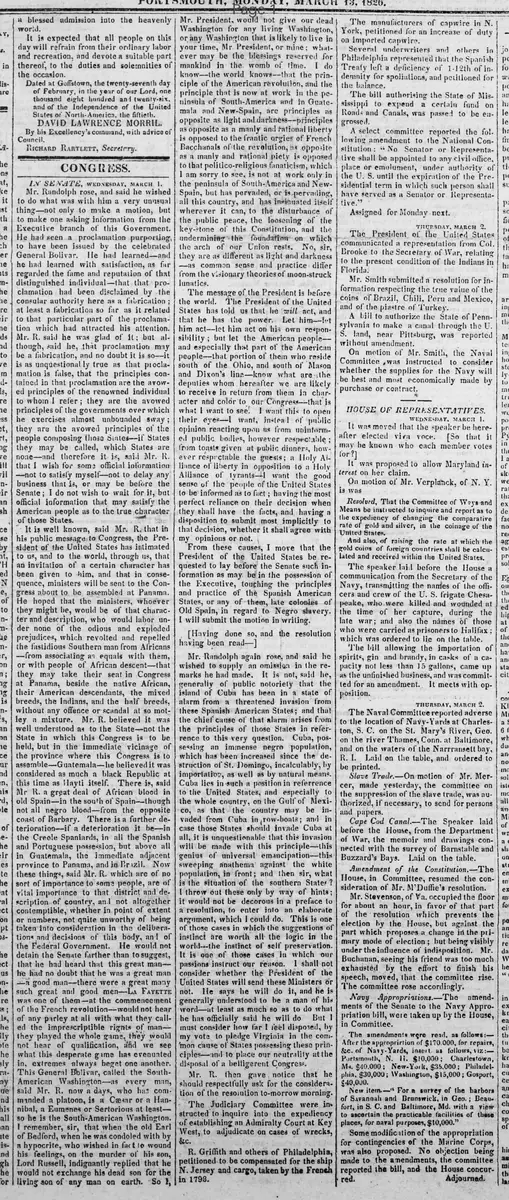
IN SENATE, WEDNESDAY, MARCH 1.
Mr. Randolph rose, and said he wished to do what was with him a very unusual thing—not only to make a motion, but to make one asking information from the Executive branch of this Government. He had seen a proclamation purporting to have been issued by the celebrated General Bolivar. He had learned—and he had learned with satisfaction, as far regarded the fame and reputation of that distinguished individual—that that proclamation had been disclaimed by the consular authority here as a fabrication; at least a fabrication so far as it related to that particular part of the proclamation which had attracted his attention. Mr. R. said he was glad of it; but although, said he, that proclamation may be a fabrication, and no doubt it is so—it is as unquestionably true as that proclamation is false, that the principles contained in that proclamation are the avowed principles of the renowned individual to whom I refer; they are the avowed principles of the governments over which he exercises almost unbounded sway; they are the avowed principles of the people composing those States—if States they may be called, which States are none—and therefore it is, said Mr. R. that I wish for some official information—not to satisfy myself—not to delay any business that is, or may be before the Senate: I do not wish to wait for it, but official information that may satisfy the American people as to the true character of those States.
It is well known, said Mr. R. that in his public message to Congress, the President of the United States has intimated to us, and to the world, through us, that an invitation of a certain character has been given to him, and that in consequence, ministers will be sent to the Congress about to be assembled at Panama. He hoped that the ministers, whoever they might be, would be of that character and description, who would labor under none of the odious and exploded prejudices, which revolted and repelled the fastidious Southern man from Africans—from associating as equals with them, or with people of African descent—that they may take their seat in Congress at Panama, beside the native African, their American descendants, the mixed breeds, the Indians, and the half breeds, without any offence or scandal at so motley a mixture. Mr. R. believed it was well understood as to the State—not the State in which this Congress is to be held, but in the immediate vicinage of the province where this Congress is to assemble—Guatemala—he believed it was considered as much a black Republic at this time as Hayti itself. There is, said Mr. R. a great deal of African blood in old Spain—in the south of Spain—though not all negro blood—from the opposite coast of Barbary. There is a further deterioration—if a deterioration it be—in the Creole Spaniards, in all the Spanish and Portuguese possessions, but above all in Guatemala, the immediate adjacent province to Panama, and in Brazil. Now these things, said Mr. R. which are of no sort of importance to some people, are of vital importance to that district and description of country, and not altogether contemptible, whether in point of extent or numbers, not quite unworthy of being taken into consideration in the deliberations and decisions of this body, and of the Federal Government. He would not detain the Senate farther than to suggest, that he had heard that this great man—he had no doubt that he was a great man—a good man—there were a great many such great and good men—La Fayette was one of them—at the commencement of the French revolution—would not hear of any parley at all with what they called the imprescriptible rights of man—they played the whole game, they would not hear of qualification, and we see what this desperate game has eventuated in, extremes always beget one another. This General Bolivar, called the South American Washington—as every man, said Mr. R. now a days, who has commanded a platoon, is a Caesar or a Hannibal, a Demosthenes or Sertorius at least—so he is the South American Washington. I remember, sir, that when the old Earl of Bedford, when he was condoled with by a hypocrite, who wished in act to wound his feelings, on the murder of his son, Lord Russell, indignantly replied that he would not exchange his dead son for the living son of any man on earth. So I, Mr. President, would not give our dead Washington for any living Washington, or any Washington that is likely to live in your time, Mr. President, or mine; whatever may be the blessings reserved for mankind in the womb of time. I do know—the world knows—that the principle of the American revolution, and the principle that is now at work in the peninsula of South-America and in Guatemala and New-Spain, are principles as opposite as light and darkness—principles as opposite as a manly and rational liberty is opposed to the frantic orgies of French Bacchanals of the revolution, as opposite as a manly and rational piety is opposed to that politico-religious fanaticism, which I am sorry to see, is not at work only in the peninsula of South-America and New-Spain, but has pervaded, or is pervading, all this country, and has introduced itself wherever it can, to the disturbance of the public peace, the loosening of the key-stone of this Constitution, and the undermining the foundation on which the arch of our Union rests. No, sir, they are as different as light and darkness—as common sense and practice differ from the visionary theories of moon-struck lunatics.
The message of the President is before the world. The President of the United States has told us that he will act, and that he has the power. Let him—let him act—let him act on his own responsibility; but let the American people—and especially that part of the American people—that portion of them who reside south of the Ohio, and south of Mason and Dixon's line—know what are the deputies whom hereafter we are likely to receive in return from them in character and color to our Congress—that is what I want to see. I want this to open their eyes—I want, instead of public opinion reacting upon us from uninformed public bodies, however respectable; from toasts given at public dinners, however respectable the guests; a Holy Alliance of liberty in opposition to a Holy Alliance of tyrants—I want the good sense of the people of the United States to be informed as to fact; having the most perfect reliance on their decision when they shall have the facts, and having a disposition to submit most implicitly to that decision, whether it shall agree with my opinions or not.
From these causes, I move that the President of the United States be requested to lay before the Senate such information as may be in the possession of the Executive, touching the principles and practice of the Spanish American States, or any of them, late colonies of Old Spain, in regard to Negro slavery.
I will submit the motion in writing.
[Having done so, and the resolution having been read—]
Mr. Randolph again rose, and said he wished to supply an omission in the remarks he had made. It is not, said he, generally of public notoriety that the island of Cuba has been in a state of alarm from a threatened invasion from these Spanish American States; and that the chief cause of that alarm arises from the principles of those States in reference to this very question. Cuba, possessing an immense negro population, which has been increased since the destruction of St. Domingo, incalculably, by importation, as well as by natural means. Cuba lies in such a position in reference to the United States, and especially to the whole country, on the Gulf of Mexico, as that the country may be invaded from Cuba in row-boats; and in case those States should invade Cuba at all, it is unquestionable that this invasion will be made with this principle—this genius of universal emancipation—this sweeping anathema against the white population, in front; and then sir, what is the situation of the southern States? I throw out these only by way of hints; it would not be decorous in a preface to a resolution, to enter into an elaborate argument, which I could do. This is one of those cases in which the suggestions of instinct are worth all the logic in the world—the instinct of self preservation. It is one of those cases in which our passions instruct our reason. I shall not consider whether the President of the United States will send these Ministers or not. He says he will do it, and he is generally understood to be a man of his word—at least as much so as to do what he has officially said he will do. But I must consider how far I feel disposed, by my vote to pledge Virginia in the common cause of States possessing these principles—and to place our neutrality at the disposal of a belligerent Congress.
Mr. R. then gave notice that he should respectfully ask for the consideration of the resolution to-morrow morning.
The Judiciary Committee were instructed to inquire into the expediency of establishing an Admiralty Court at Key West, to adjudicate on cases of wrecks, &c.
R. Griffith and others of Philadelphia, petitioned to be compensated for the ship N. Jersey and cargo, taken by the French in 1798.
The manufacturers of capwire in N. York, petitioned for an increase of duty on imported capwire.
Several underwriters and others in Philadelphia represented that the Spanish Treaty left a deficiency of 1-12th of indemnity or spoliations, and petitioned for the balance.
The bill authorising the State of Mississippi to expend a certain fund on Roads and Canals, was passed to be engrossed.
A select committee reported the following amendment to the National Constitution: "No Senator or Representative shall be appointed to any civil office, place or emolument, under authority of the U. S. until the expiration of the Presidential term in which such person shall have served as a Senator or Representative."
Assigned for Monday next.
THURSDAY, MARCH 2.
The President of the United States communicated a representation from Col. Brooke to the Secretary of War, relating to the present condition of the Indians in Florida.
Mr. Smith submitted a resolution for information respecting the true value of the coins of Brazil, Chili, Peru and Mexico, and of the piastre of Turkey.
A bill to authorize the State of Pennsylvania to make a canal through the U. S. land, near Pittsburg, was reported without amendment.
On motion of Mr. Smith, the Naval Committee was instructed to consider whether the supplies for the Navy will be best and most economically made by purchase or contract.
HOUSE OF REPRESENTATIVES.
WEDNESDAY, MARCH 1.
It was moved that the speaker be hereafter elected viva voce. [So that it may be known who each member votes for?]
It was proposed to allow Maryland interest on her claim.
On motion of Mr. Verplanck, of N. Y. it was
Resolved, That the Committee of Ways and Means be instructed to inquire and report as to the expediency of changing the comparative rate of gold and silver, in the coinage of the United States,
And also, of raising the rate at which the gold coins of foreign countries shall be calculated and received within the United States.
The speaker laid before the House a communication from the Secretary of the Navy, transmitting the names of the officers and crew of the U. S. frigate Chesapeake, who were killed and wounded at the time of her capture, during the late war; and also the names of those who were carried as prisoners to Halifax; which was ordered to lie on the table.
The bill allowing the importation of spirits, gin and brandy, in casks of a capacity not less than 15 gallons, came up as the unfinished business, and was committed for an amendment. It meets with opposition.
THURSDAY, MARCH 2.
The Naval Committee reported adverse to the location of Navy-Yards at Charleston, S. C. on the St. Mary's River, Geo. on the river Thames, Conn. at Baltimore, and on the waters of the Narragansett Bay, R. I. Laid on the table, and ordered to be printed.
Slave Trade.—On motion of Mr. Mercer, made yesterday, the committee on the suppression of the slave trade, was authorized, if necessary, to send for persons and papers.
Cape Cod Canal.—The Speaker laid before the House, from the Department of War, the memoir and drawings connected with the survey of Barnstable and Buzzard's Bays. Laid on the table.
Amendment of the Constitution.—The House, in Committee, resumed the consideration of Mr. M'Duffie's resolution.
Mr. Stevenson, of Va. occupied the floor for about an hour, in favor of that part of the resolution which prevents the election by the House, but against the part which proposes a change in the primary mode of election; but being visibly under the influence of indisposition. Mr. Buchanan, seeing his friend was too much exhausted by the effort to finish his speech, moved that the committee rise.
The committee rose accordingly.
Navy Appropriations.—The amendments of the Senate to the Navy Appropriation bill, were taken up by the House, in Committee.
The amendments were read, as follows:——
After the appropriation of $170,000, for repairs, &c. of Navy-Yards, insert as follows, viz:——
Portsmouth, N. H. $10,000; Charlestown, Ms. $40,000; New-York, $35,000; Philadelphia, $30,000; Washington, $15,000; Gosport, $40,000.
New item.—"For a survey of the harbors of Savannah and Brunswick, in Geo.; Beaufort, in S. C. and Baltimore, Md. with a view to ascertain the practicable facilities of those places, for naval purposes, $10,000."
Some modification of the appropriation for Contingencies of the Marine Corps. was also proposed. No objection being made to the amendments, the committee reported the bill, and the House concurred.
Adjourned.
CONGRESS.
CONTINUED FROM FIRST PAGE.
IN SENATE FRIDAY, MARCH 3.
Agreeably to notice, Mr. Benton asked, and having obtained leave, introduced a bill "to authorize the President of the United States to cause the reserved Salt Springs in the State of Missouri, to be exposed to public sale;" and a bill "to authorize the President of the United States to cause the reserved Lead Mines, in the State of Missouri, to be exposed to public sale," which were severally twice read and referred.
Mr. Bell rose and said, there were several very important subjects of an Executive character before the Senate, and his impression was, that the public interest required that these subjects should have preference over the ordinary business of legislation. He therefore moved that the Senate proceed to the consideration of Executive business, which motion prevailed—Ayes 13, Noes 12; and the Senate remained with closed doors till past 3 o'clock; and then adjourned to Monday.
HOUSE OF REPRESENTATIVES.
FRIDAY, MARCH 3.
The bill from the Senate, "to authorize the Legislature of the State of Mississippi to appropriate the amount of the three per cent. fund, arising from the sale of public lands," was twice read and referred to the Committee on Public Lands.
Dismal Swamp Canal.—The House then went into Committee of the whole, Mr. Condict, of N. J. in the chair, on the bill for the subscription of Stock in the Dismal Swamp Canal Company; which occupied the remainder of the day. And the House adjourned, without deciding on the bill.
SATURDAY, MARCH 4.
On motion of Mr. Newton, of Va. it was resolved, That the Committee on Commerce be instructed to inquire into the expediency of having the coast of the United States surveyed.
Mr. Cook, of Illinois, laid on the table the following:——
Resolved, That the Committee of the whole on the state of the Union, be discharged from the consideration of the several resolutions that have been referred to it, proposing to amend the Constitution of the U. States, and that they, together with such other resolutions as are lying on the table, on the same subject, be referred to a Select Committee.
Dismal Swamp Canal.—On motion of Mr. Stewart, of Penn. the House then went into committee of the whole, Mr. Condict, of N. J. in the chair, on the unfinished business of yesterday, which was the consideration of the bill "authorizing the Secretary of the Treasury to subscribe for stock in the Dismal Swamp Canal Company."
Mr. Newton, of Va. moved to strike out the following proviso in the second section of the bill:
"Provided, That the Dividends becoming due to the United States, on said stock, shall be the same, as if the amount of expenditures on said Canal had been made from actual subscriptions, and that no debt or debts, on the part of said company, existed."
Mr. Newton observed, that, if this feature were stricken out, the present bill would resemble that passed at the last session for the Delaware and Chesapeake Canal, and he presumed it would be the wish of the House to put both companies on the same footing.
The question being taken, the motion was agreed to without a division.
What sub-type of article is it?
What keywords are associated?
What entities or persons were involved?
Where did it happen?
Domestic News Details
Primary Location
Washington
Event Date
March 1 4
Key Persons
Event Details
Senate debate led by Mr. Randolph on requesting executive information about Spanish American states' principles on Negro slavery due to concerns over Panama Congress and racial composition; various petitions, bills on roads, canals, navy appropriations, constitutional amendments; House discussions on speaker election, coinage rates, slave trade suppression, Dismal Swamp Canal stock subscription, and navy yard locations.