Thank you for visiting SNEWPapers!
Sign up free
The National Republican And Ohio Political Register
Cincinnati, Hamilton County, Ohio
What is this article about?
The Illinois Legislature, through contested elections and mob intimidation, passed a resolution for a constitutional convention to potentially introduce slavery, overturning an anti-slavery clause. This involved ousting member Nicholas Hansen and replacing him with John Shaw, amid lobbying and public disturbances in Edwardsville and Vandalia.
Clipping
OCR Quality
Full Text
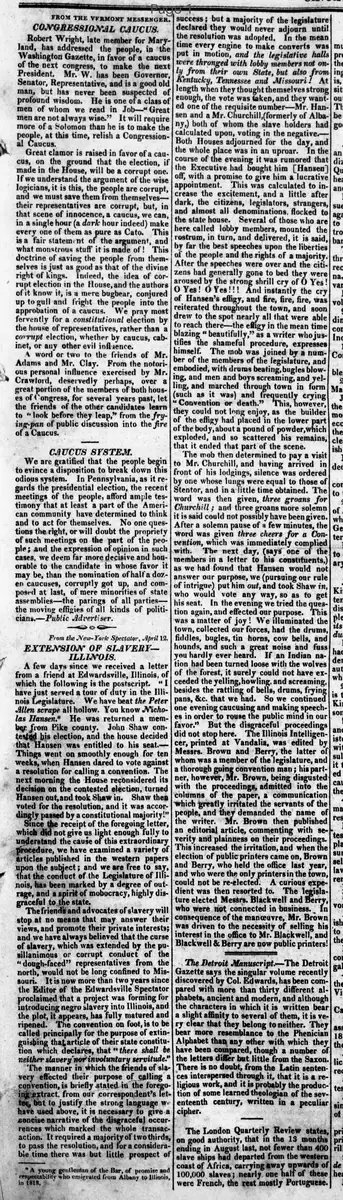
EXTENSION OF SLAVERY-
ILLINOIS.
A few days since we received a letter from a friend at Edwardsville, Illinois, of which the following is the postscript. "I have just served a tour of duty in the Illinois Legislature. We have beat the Peter Allen scrape all hollow. You know Nicholas Hansen.* He was returned a member from Pike county. John Shaw contested his election, and the house decided that Hansen was entitled to his seat. Things went on smoothly enough for ten weeks, when Hansen dared to vote against a resolution for calling a convention. The next morning the House reconsidered its decision on the contested election, turned Hansen out, and took Shaw in. Shaw then voted for the resolution, and it was accordingly passed by a constitutional majority!"
Since the receipt of the foregoing letter, which did not give us light enough fully to understand the cause of this extraordinary procedure, we have examined a variety of articles published in the western papers upon the subject; and we are free to say, that the conduct of the Legislature of Illinois, has been marked by a degree of outrage, and a spirit of mobocracy, highly disgraceful to the state.
The friends and advocates of slavery will stop at no means that may answer their views, and promote their private interests; and we have always believed that the curse of slavery, which was extended by the pusillanimous or corrupt conduct of the "dough-faced" representatives from the north, would not be long confined to Missouri. It is now more than two years since the Editor of the Edwardsville Spectator proclaimed that a project was forming for introducing negro slavery into Illinois, and the plot, it appears, has fully matured and ripened. The convention on foot, is to be called principally for the purpose of extinguishing that article of their state constitution which declares, that "there shall be neither slavery nor involuntary servitude."
The manner in which the friends of slavery effected their purpose of calling a convention, is briefly stated in the foregoing extract, from our correspondent's letter, but to justify the strong language we have used above, it is necessary to give a concise narrative of the disgraceful occurrences which marked the whole transaction. It required a majority of two thirds, to pass the resolution, and for a considerable time there was but little prospect of success; but a majority of the legislature declared they would never adjourn until the resolution was adopted. In the mean time every engine to make converts was put in motion, and the legislative halls were thronged with lobby members not only from their own State, but also from Kentucky, Tennessee and Missouri! At length when they thought themselves strong enough, the vote was taken, and they wanted one of the requisite number--Mr. Hansen and a Mr. Churchill, (formerly of Albany,) both of whom the slave holders had calculated upon, voting in the negative.-- Both Houses adjourned for the day, and the whole place was in an uproar. In the course of the evening it was rumored that the Executive had bought him [Hansen] off, with a promise to give him a lucrative appointment. This was calculated to increase the excitement, and a little after dark, the citizens, legislators, strangers, and almost all denominations, flocked to the state house. Several of those who are here called lobby members, mounted the rostrum, in turn, and delivered, it is said, by far the best speeches upon the liberties of the people and the rights of a majority. After the speeches were over and the citizens had generally gone to bed they were aroused by the strong shrill cry of O Yes! O Yes! O Yes!!! And instantly the cry of Hansen's effigy, and fire, fire, fire, was reiterated throughout the town, and soon drew to the spot nearly all that were able to reach there--the effigy in the mean time blazing "beautifully," as a writer who justifies the shameful procedure, expresses himself. The mob was joined by a number of the members of the legislature, and embodied, with drums beating, bugles blowing, and men and boys screaming, and yelling, and marched through town in form (such as it was) and frequently crying "Convention or death." This, however they could not long enjoy, as the builder of the effigy had placed in the lower part of the body, about a pound of powder, which exploded, and so scattered his remains, that it ended that part of the scene. The mob then determined to pay a visit to Mr. Churchill, and having arrived in front of his lodgings, silence was ordered by one whose lungs were equal to those of Stentor, and in a little time obtained. The word was then given, three groans for Churchill; and three groans more solemn it is said could not possibly have been given. After a solemn pause of a few minutes, the word was given three cheers for a Convention, which was immediately complied with. The next day, (says one of the members in a letter to his constituents,) as we had found that Hansen would not answer our purpose, we (pursuing our rule of intrigue) put him out, and took Shaw in, who would vote any way, so as to get his seat. In the evening we tried the question again, and effected our purpose. This was a matter of joy! We illuminated the town, collected our forces, had the drums, fiddles, bugles, tin horns, cow bells, and hounds, and such a great noise and fuss you hardly ever heard. If an Indian nation had been turned loose with the wolves of the forest, it surely could not have exceeded the yelling, howling, and screaming, besides the rattling of bells, drums, frying pans, &c. that we had. So we continued one evening caucusing and making speeches in order to rouse the public mind in our favor." But the disgraceful proceedings did not stop here. The Illinois Intelligencer, printed at Vandalia, was edited by Messrs. Brown and Berry, the latter of whom was a member of the legislature, and a thorough going convention man; his partner, however, Mr. Brown, being disgusted with the proceedings, admitted into the columns of the paper, a communication which greatly irritated the servants of the people, and they demanded the name of the writer. Mr. Brown then published an editorial article, commenting with severity and plainness on their proceedings. This increased the irritation, and when the election of public printers came on, Brown and Berry, who held the office last year, and who were the only printers in the town, could not be re-elected. A curious expedient was then resorted to. The legislature elected Messrs. Blackwell and Berry, who were not connected in business. In consequence of the manoeuvre, Mr. Brown was driven to the necessity of selling his interest in the office to Mr. Blackwell, and Blackwell & Berry are now public printers!
What sub-type of article is it?
What keywords are associated?
What entities or persons were involved?
Where did it happen?
Domestic News Details
Primary Location
Illinois
Key Persons
Outcome
resolution for constitutional convention passed by two-thirds majority after ousting hansen and seating shaw; public printers changed from brown and berry to blackwell and berry.
Event Details
In the Illinois Legislature, Nicholas Hansen was initially seated over John Shaw's contest but removed after voting against a convention resolution, allowing Shaw to vote for it and secure passage. This followed intense lobbying, rumors of bribery, and mob actions including burning Hansen's effigy, parading with cries of 'Convention or death,' and groaning at Churchill's lodgings. The convention aimed to alter the state constitution to allow slavery. Additionally, the legislature replaced public printers due to critical editorials.