Thank you for visiting SNEWPapers!
Sign up free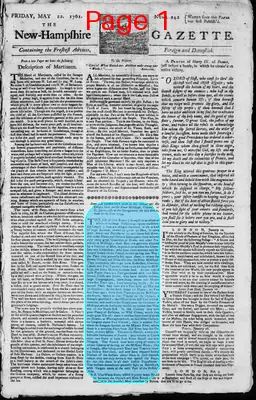
The New Hampshire Gazette
Portsmouth, Rockingham County, New Hampshire
What is this article about?
A 1754 report detailing French settlements along the Mississippi, Ohio, Wabash, and Missouri rivers, including navigation difficulties, forts with garrisons, fertile lands, provisions transport, and conflicts or alliances with Native American tribes like Cherokees, Chickasaws, and others against the English.
Clipping
OCR Quality
Full Text
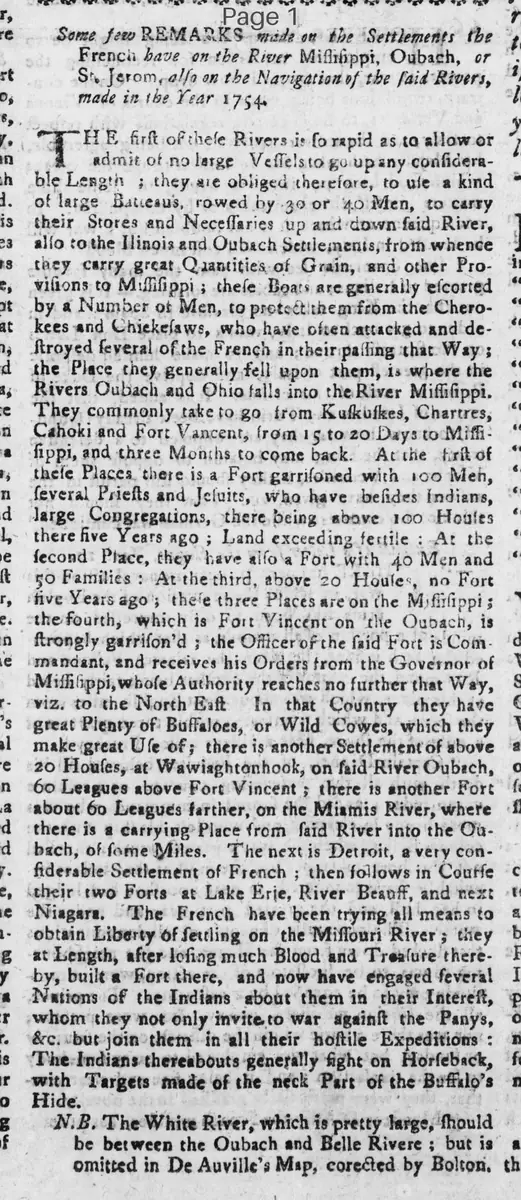
The first of these Rivers is so rapid as to allow or admit of no large Vessels to go up any considerable Length; they are obliged therefore, to use a kind of large Batteaus, rowed by 30 or 40 Men, to carry their Stores and Necessaries up and down said River, also to the Illinois and Ohio Settlements, from whence they carry great Quantities of Grain, and other Provisions to Mississippi; these Boats are generally escorted by a Number of Men, to protect them from the Cherokees and Chickasaws, who have often attacked and destroyed several of the French in their passing that Way; the Place they generally fell upon them, is where the Rivers Ohio and Wabash falls into the River Mississippi. They commonly take to go from Kaskaskias, Chartres, Cahokia and Fort Vincennes, from 15 to 20 Days to Mississippi, and three Months to come back. At the first of these Places there is a Fort garrisoned with 100 Men, several Priests and Jesuits, who have besides Indians, large Congregations, there being above 100 Houses there five Years ago; Land exceeding fertile: At the second Place, they have also a Fort with 40 Men and 50 Families: At the third, above 20 Houses, no Fort five Years ago; these three Places are on the Mississippi; the fourth, which is Fort Vincennes on the Wabash, is strongly garrisoned; the Officer of the said Fort is Commandant, and receives his Orders from the Governor of Mississippi, whose Authority reaches no further that Way, viz. to the North East In That Country they have great Plenty of Buffaloes, or Wild Cows, which they make great Use of: there is another Settlement of above 20 Houses, at Wabash, on said River Wabash, 60 Leagues above Fort Vincennes; there is another Fort about 60 Leagues farther, on the Miamis River, where there is a carrying Place from said River into the Wabash, of some Miles. The next is Detroit, a very considerable Settlement of French: then follows in Course their two Forts at Lake Erie, River Beauharnois, and next Niagara. The French have been trying all means to obtain Liberty of settling on the Missouri River; they at Length, after losing much Blood and Treasure thereby, built a Fort there, and now have engaged several Nations of the Indians about them in their Interest, whom they not only invite to war against the English, &c. but join them in all their hostile Expeditions: The Indians thereabouts generally fight on Horseback, with Targets made of the neck Part of the Buffalo's Hide.
N. B. The White River, which is pretty large, should be between the Wabash and Belle Rivere; but is omitted in De l'Isle's Map, corrected by Bolton.
What sub-type of article is it?
What keywords are associated?
Where did it happen?
Domestic News Details
Primary Location
River Mississippi, Ohio, St. Louis
Event Date
Year 1754
Outcome
chickasaws and cherokees have often attacked and destroyed several french; french lost much blood and treasure in settling missouri river
Event Details
Report on French settlements using batteaus for navigation due to rapid rivers, escorted against Indian attacks; forts at Kaskaskias (100 men, 100+ houses), Chartres (40 men, 50 families), Cahokia (20+ houses), Fort Vincennes (strongly garrisoned); other settlements at Wabash, Miamis River, Detroit, Lake Erie, Niagara; efforts to settle Missouri with Indian alliances against English.