Thank you for visiting SNEWPapers!
Sign up free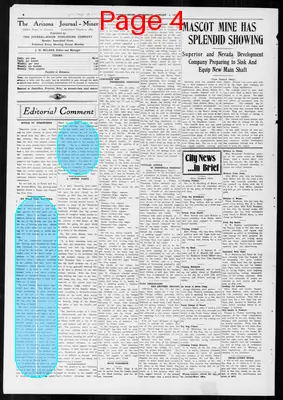
Editorial
January 4, 1911
Weekly Journal Miner
Prescott, Yavapai County, Arizona
What is this article about?
The editorial celebrates improved US-British relations, contrasting past provocations like those under President Cleveland with current amity, but criticizes an unnamed American naval officer for overstepping authority by suggesting alliances and misrepresenting American identity while hosted in Britain.
Clipping
OCR Quality
98%
Excellent
Full Text
NO MORE TAIL TWISTING.
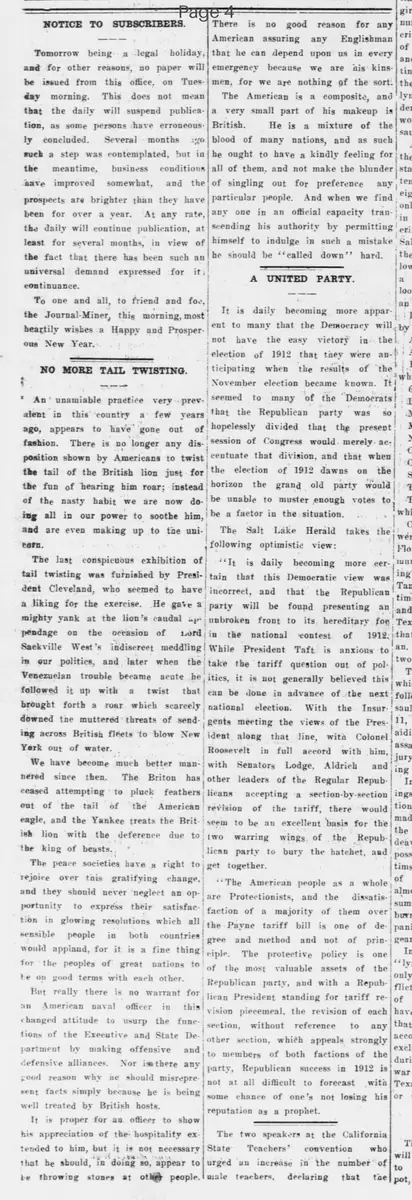
An unamiable practice very prevalent in this country a few years ago, appears to have gone out of fashion. There is no longer any disposition shown by Americans to twist the tail of the British lion just for the fun of hearing him roar; instead of the nasty habit we are now doing all in our power to soothe him, and are even making up to the unicorn. The last conspicuous exhibition of tail twisting was furnished by President Cleveland, who seemed to have a liking for the exercise. He gave a mighty yank at the lion's caudal appendage on the occasion of Lord Sackville West's indiscreet meddling in our politics, and later when the Venezuelan trouble became acute he followed it up with a twist that brought forth a roar which scarcely downed the muttered threats of sending across British fleets to blow New York out of water. We have become much better mannered since then. The Briton has ceased attempting to pluck feathers out of the tail of the American eagle, and the Yankee treats the British lion with the deference due to the king of beasts. The peace societies have a right to rejoice over this gratifying change, and they should never neglect an opportunity to express their satisfaction in glowing resolutions which all sensible people in both countries would applaud, for it is a fine thing for the peoples of great nations to be on good terms with each other. But really there is no warrant for an American naval officer in this changed attitude to usurp the functions of the Executive and State Department by making offensive and defensive alliances. Nor is there any good reason why he should misrepresent facts simply because he is being well treated by British hosts. It is proper for an officer to show his appreciation of the hospitality extended to him, but it is not necessary that he should, in doing so, appear to be throwing stones at other people.
There is no good reason for any American assuring any Englishman that he can depend upon us in every emergency because we are his kinsmen, for we are nothing of the sort. The American is a composite, and a very small part of his makeup is British. He is a mixture of the blood of many nations, and as such he ought to have a kindly feeling for all of them, and not make the blunder of singling out for preference any particular people. And when we find any one in an official capacity transcending his authority by permitting himself to indulge in such a mistake he should be "called down" hard.
An unamiable practice very prevalent in this country a few years ago, appears to have gone out of fashion. There is no longer any disposition shown by Americans to twist the tail of the British lion just for the fun of hearing him roar; instead of the nasty habit we are now doing all in our power to soothe him, and are even making up to the unicorn. The last conspicuous exhibition of tail twisting was furnished by President Cleveland, who seemed to have a liking for the exercise. He gave a mighty yank at the lion's caudal appendage on the occasion of Lord Sackville West's indiscreet meddling in our politics, and later when the Venezuelan trouble became acute he followed it up with a twist that brought forth a roar which scarcely downed the muttered threats of sending across British fleets to blow New York out of water. We have become much better mannered since then. The Briton has ceased attempting to pluck feathers out of the tail of the American eagle, and the Yankee treats the British lion with the deference due to the king of beasts. The peace societies have a right to rejoice over this gratifying change, and they should never neglect an opportunity to express their satisfaction in glowing resolutions which all sensible people in both countries would applaud, for it is a fine thing for the peoples of great nations to be on good terms with each other. But really there is no warrant for an American naval officer in this changed attitude to usurp the functions of the Executive and State Department by making offensive and defensive alliances. Nor is there any good reason why he should misrepresent facts simply because he is being well treated by British hosts. It is proper for an officer to show his appreciation of the hospitality extended to him, but it is not necessary that he should, in doing so, appear to be throwing stones at other people.
There is no good reason for any American assuring any Englishman that he can depend upon us in every emergency because we are his kinsmen, for we are nothing of the sort. The American is a composite, and a very small part of his makeup is British. He is a mixture of the blood of many nations, and as such he ought to have a kindly feeling for all of them, and not make the blunder of singling out for preference any particular people. And when we find any one in an official capacity transcending his authority by permitting himself to indulge in such a mistake he should be "called down" hard.
What sub-type of article is it?
Foreign Affairs
War Or Peace
What keywords are associated?
Us British Relations
Diplomacy
Naval Officer
Peace Societies
Venezuelan Trouble
American Identity
What entities or persons were involved?
President Cleveland
Lord Sackville West
American Naval Officer
British Lion
American Eagle
Peace Societies
Editorial Details
Primary Topic
Criticism Of American Naval Officer's Overreach In Us British Relations
Stance / Tone
Supportive Of Improved Relations But Critical Of Unauthorized Diplomacy And Misrepresentation
Key Figures
President Cleveland
Lord Sackville West
American Naval Officer
British Lion
American Eagle
Peace Societies
Key Arguments
Past Us Provocations Like Cleveland's Actions On Sackville West And Venezuela Have Ceased.
Current Us British Relations Are Amicable, With Mutual Respect.
Peace Societies Should Celebrate This Change.
American Naval Officer Should Not Usurp Executive Functions By Suggesting Alliances.
Officer Should Not Misrepresent Facts Or American Identity Due To British Hospitality.
Americans Are A Composite Of Many Nations, Not Primarily British Kinsmen.
Officials Overstepping Authority Should Be Reprimanded.