Thank you for visiting SNEWPapers!
Sign up free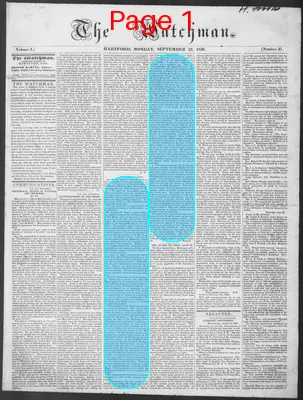
Literary
September 12, 1836
The Watchman
Hartford, Hartford County, Connecticut
What is this article about?
An essay in the Watchman defends Mr. Seagrove W. Magill, a theology student licensed by the New Haven West Association, against their pamphlet excusing his rejection for ordination by the Georgia Presbytery. It argues the refusal stemmed from Magill's moral inability to affirm the Presbyterian confession of faith due to doctrinal disagreements, not technicalities, and critiques the Association's implications about the Presbytery's sincerity, referencing Jonathan Edwards on moral vs. natural inability.
Clipping
OCR Quality
98%
Excellent
Full Text
FOR THE WATCHMAN.
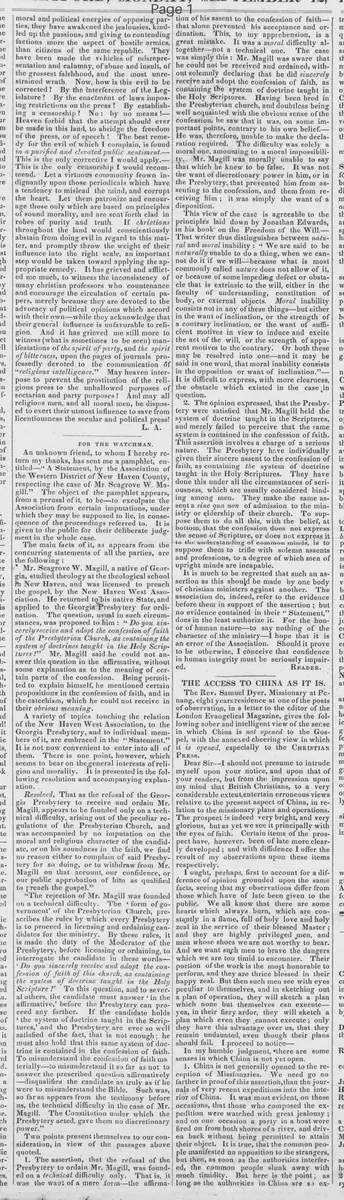
An unknown friend, to whom I hereby return my thanks, has sent me a pamphlet, entitled—"A Statement, by the Association of the Western District of New Haven County, respecting the case of Mr. Seagrove W. Magill." The object of the pamphlet appears, from a perusal of it, to be—to exculpate the Association from certain imputations, under which they may be supposed to lie, in consequence of the proceedings referred to. It is given to the public for their deliberate judgment in the whole case.
The main facts of it, as appears from the concurring statements of all the parties, are the following:
Mr. Seagrove W. Magill, a native of Georgia, studied theology at the theological school in New Haven, and was licensed to preach the gospel, by the New Haven West Association. He returned to his native State, and applied to the Georgia Presbytery for ordination. The question, usual in such circumstances, was proposed to him: "Do you sincerely receive and adopt the confession of faith of the Presbyterian Church, as containing the system of doctrines taught in the Holy Scriptures?" Mr. Magill said he could not answer this question in the affirmative, without some explanation as to the meaning of certain parts of the confession. Being permitted to explain himself, he mentioned certain propositions in the confession of faith, and in the catechism, which he could not receive in their obvious meaning.
A variety of topics touching the relation of the New Haven West Association, to the Georgia Presbytery, and to individual members of it, are embraced in the "Statement." It is not now convenient to enter into all of them. There is one point, however, which seems to bear on the general interests of religion and morality. It is presented in the following resolution and accompanying explanation.
Resolved, That as the refusal of the Georgia Presbytery to receive and ordain Mr. Magill, appears to be founded only on a technical difficulty, arising out of the peculiar regulations of the Presbyterian Church, and was accompanied by no imputation on the moral and religious character of the candidate, or on his soundness in the faith, we find no reason either to complain of said Presbytery for so doing, or to withdraw from Mr. Magill on that account, our confidence, or our public approbation of him as qualified to preach the gospel."
"The rejection of Mr. Magill was founded on a technical difficulty. The form of government of the Presbyterian Church, prescribes the rules by which every Presbytery is to proceed in licensing and ordaining candidates for the ministry. By these rules, it is made the duty of the Moderator of the Presbytery, before licensing or ordaining, to interrogate the candidate in these words— 'Do you sincerely receive and adopt the confession of faith of this church, as containing the system of doctrine taught in the Holy Scripture?' To this question, and to several others, the candidate must answer 'in the affirmative,' before the Presbytery can proceed any farther. If the candidate holds the system of doctrine taught in the Scriptures,' and the Presbytery are ever so well satisfied of the fact, that is not enough; he must also hold that this same system of doctrine is contained in the confession of faith. To misunderstand the confession of faith materially—to misunderstand it so far as not to answer the prescribed question affirmatively—disqualifies the candidate as truly as if he were to misunderstand the Bible. Such was, so far as appears from the testimony before us, the technical difficulty in the case of Mr. Magill. The Constitution under which the Presbytery acted, gave them no discretionary power.'"
Two points present themselves to our consideration, in view of the passages above quoted.
1. The assertion, that the refusal of the Presbytery to ordain Mr. Magill, was founded on a technical difficulty only. That is, it was the want of a mere form—the affirmation of his assent to the confession of faith— that alone prevented his acceptance and ordination. This, to my apprehension, is a great mistake. It was a moral difficulty altogether not a technical one. The case was simply this: Mr. Magill was aware that he could not be received and ordained, without solemnly declaring that he did sincerely receive and adopt the confession of faith, as containing the system of doctrine taught in the Holy Scriptures. Having been bred in the Presbyterian church, and doubtless being well acquainted with the obvious sense of the confession, he saw that it was, on some important points, contrary to his own belief. He was, therefore, unable to make the declaration required. The difficulty was solely a moral one, amounting to a moral impossibility. Mr. Magill was morally unable to say that which he knew to be false. It was not the want of discretionary power in him, or in the Presbytery, that prevented him from assenting to the confession, and them from receiving him; it was simply the want of a disposition.
This view of the case is agreeable to the principles laid down by Jonathan Edwards, in his book on the Freedom of the Will.— That writer thus distinguishes between natural and moral inability: "We are said to be naturally unable to do a thing, when we cannot do it if we will—because what is most commonly called nature does not allow of it, or because of some impeding defect or obstacle that is extrinsic to the will, either in the faculty of understanding, constitution of body, or external objects. Moral inability consists not in any of these things—but either in the want of inclination, or the strength of a contrary inclination, or the want of sufficient motives in view to induce and excite the act of the will, or the strength of apparent motives to the contrary. Or both these may be resolved into one—and it may be said in one word, that moral inability consists in the opposition or want of inclination."
It is difficult to express, with more clearness, the obstacle which existed in the case in question.
2. The opinion expressed, that the Presbytery were satisfied that Mr. Magill held the system of doctrine taught in the Scriptures, and merely failed to perceive that the same system is contained in the confession of faith. This assertion involves a charge of a serious nature. 'The Presbytery have individually given their sincere assent to the confession of faith, as containing the system of doctrine taught in the Holy Scriptures. They have done this under all the circumstances of seriousness, which are usually considered binding among men. They make the same assent a sine qua non of admission to the ministry or eldership of their church. To suppose them to do all this, with the belief, at bottom, that the confession does not express the sense of Scripture, or does not express it to the understanding of common minds, is to suppose them to trifle with solemn assents and professions, to a degree of which men of upright minds are incapable.
It is much to be regretted that such an assertion as this should be made by one body of christian ministers against another. The association do, indeed, refer to the evidence before them in support of the assertion; but no evidence contained in their "Statement," does in the least authorize it. For the honor of human nature—to say nothing of the character of the ministry—I hope that it is an error of the Association. Should it prove to be otherwise, I conceive that confidence in human integrity must be seriously impaired.
READER.
An unknown friend, to whom I hereby return my thanks, has sent me a pamphlet, entitled—"A Statement, by the Association of the Western District of New Haven County, respecting the case of Mr. Seagrove W. Magill." The object of the pamphlet appears, from a perusal of it, to be—to exculpate the Association from certain imputations, under which they may be supposed to lie, in consequence of the proceedings referred to. It is given to the public for their deliberate judgment in the whole case.
The main facts of it, as appears from the concurring statements of all the parties, are the following:
Mr. Seagrove W. Magill, a native of Georgia, studied theology at the theological school in New Haven, and was licensed to preach the gospel, by the New Haven West Association. He returned to his native State, and applied to the Georgia Presbytery for ordination. The question, usual in such circumstances, was proposed to him: "Do you sincerely receive and adopt the confession of faith of the Presbyterian Church, as containing the system of doctrines taught in the Holy Scriptures?" Mr. Magill said he could not answer this question in the affirmative, without some explanation as to the meaning of certain parts of the confession. Being permitted to explain himself, he mentioned certain propositions in the confession of faith, and in the catechism, which he could not receive in their obvious meaning.
A variety of topics touching the relation of the New Haven West Association, to the Georgia Presbytery, and to individual members of it, are embraced in the "Statement." It is not now convenient to enter into all of them. There is one point, however, which seems to bear on the general interests of religion and morality. It is presented in the following resolution and accompanying explanation.
Resolved, That as the refusal of the Georgia Presbytery to receive and ordain Mr. Magill, appears to be founded only on a technical difficulty, arising out of the peculiar regulations of the Presbyterian Church, and was accompanied by no imputation on the moral and religious character of the candidate, or on his soundness in the faith, we find no reason either to complain of said Presbytery for so doing, or to withdraw from Mr. Magill on that account, our confidence, or our public approbation of him as qualified to preach the gospel."
"The rejection of Mr. Magill was founded on a technical difficulty. The form of government of the Presbyterian Church, prescribes the rules by which every Presbytery is to proceed in licensing and ordaining candidates for the ministry. By these rules, it is made the duty of the Moderator of the Presbytery, before licensing or ordaining, to interrogate the candidate in these words— 'Do you sincerely receive and adopt the confession of faith of this church, as containing the system of doctrine taught in the Holy Scripture?' To this question, and to several others, the candidate must answer 'in the affirmative,' before the Presbytery can proceed any farther. If the candidate holds the system of doctrine taught in the Scriptures,' and the Presbytery are ever so well satisfied of the fact, that is not enough; he must also hold that this same system of doctrine is contained in the confession of faith. To misunderstand the confession of faith materially—to misunderstand it so far as not to answer the prescribed question affirmatively—disqualifies the candidate as truly as if he were to misunderstand the Bible. Such was, so far as appears from the testimony before us, the technical difficulty in the case of Mr. Magill. The Constitution under which the Presbytery acted, gave them no discretionary power.'"
Two points present themselves to our consideration, in view of the passages above quoted.
1. The assertion, that the refusal of the Presbytery to ordain Mr. Magill, was founded on a technical difficulty only. That is, it was the want of a mere form—the affirmation of his assent to the confession of faith— that alone prevented his acceptance and ordination. This, to my apprehension, is a great mistake. It was a moral difficulty altogether not a technical one. The case was simply this: Mr. Magill was aware that he could not be received and ordained, without solemnly declaring that he did sincerely receive and adopt the confession of faith, as containing the system of doctrine taught in the Holy Scriptures. Having been bred in the Presbyterian church, and doubtless being well acquainted with the obvious sense of the confession, he saw that it was, on some important points, contrary to his own belief. He was, therefore, unable to make the declaration required. The difficulty was solely a moral one, amounting to a moral impossibility. Mr. Magill was morally unable to say that which he knew to be false. It was not the want of discretionary power in him, or in the Presbytery, that prevented him from assenting to the confession, and them from receiving him; it was simply the want of a disposition.
This view of the case is agreeable to the principles laid down by Jonathan Edwards, in his book on the Freedom of the Will.— That writer thus distinguishes between natural and moral inability: "We are said to be naturally unable to do a thing, when we cannot do it if we will—because what is most commonly called nature does not allow of it, or because of some impeding defect or obstacle that is extrinsic to the will, either in the faculty of understanding, constitution of body, or external objects. Moral inability consists not in any of these things—but either in the want of inclination, or the strength of a contrary inclination, or the want of sufficient motives in view to induce and excite the act of the will, or the strength of apparent motives to the contrary. Or both these may be resolved into one—and it may be said in one word, that moral inability consists in the opposition or want of inclination."
It is difficult to express, with more clearness, the obstacle which existed in the case in question.
2. The opinion expressed, that the Presbytery were satisfied that Mr. Magill held the system of doctrine taught in the Scriptures, and merely failed to perceive that the same system is contained in the confession of faith. This assertion involves a charge of a serious nature. 'The Presbytery have individually given their sincere assent to the confession of faith, as containing the system of doctrine taught in the Holy Scriptures. They have done this under all the circumstances of seriousness, which are usually considered binding among men. They make the same assent a sine qua non of admission to the ministry or eldership of their church. To suppose them to do all this, with the belief, at bottom, that the confession does not express the sense of Scripture, or does not express it to the understanding of common minds, is to suppose them to trifle with solemn assents and professions, to a degree of which men of upright minds are incapable.
It is much to be regretted that such an assertion as this should be made by one body of christian ministers against another. The association do, indeed, refer to the evidence before them in support of the assertion; but no evidence contained in their "Statement," does in the least authorize it. For the honor of human nature—to say nothing of the character of the ministry—I hope that it is an error of the Association. Should it prove to be otherwise, I conceive that confidence in human integrity must be seriously impaired.
READER.
What sub-type of article is it?
Essay
What themes does it cover?
Religious
Moral Virtue
What keywords are associated?
Presbyterian Ordination
Confession Of Faith
Moral Inability
Jonathan Edwards
New Haven Association
Georgia Presbytery
Literary Details
Subject
On The Ordination Case Of Mr. Seagrove W. Magill And The Presbyterian Confession Of Faith
Key Lines
Resolved, That As The Refusal Of The Georgia Presbytery To Receive And Ordain Mr. Magill, Appears To Be Founded Only On A Technical Difficulty...
It Was A Moral Difficulty Altogether Not A Technical One.
This View Of The Case Is Agreeable To The Principles Laid Down By Jonathan Edwards, In His Book On The Freedom Of The Will.— That Writer Thus Distinguishes Between Natural And Moral Inability...