Thank you for visiting SNEWPapers!
Sign up free
The Daily Record
Dunn, Harnett County, North Carolina
What is this article about?
Drew Pearson's column profiles William Averell Harriman, a millionaire railroad heir turned diplomat and administrator, as a surprising top Democratic presidential contender. It contrasts his father's ruthlessness with Harriman's public service dedication and political growth from conservative to liberal.
Clipping
OCR Quality
Full Text
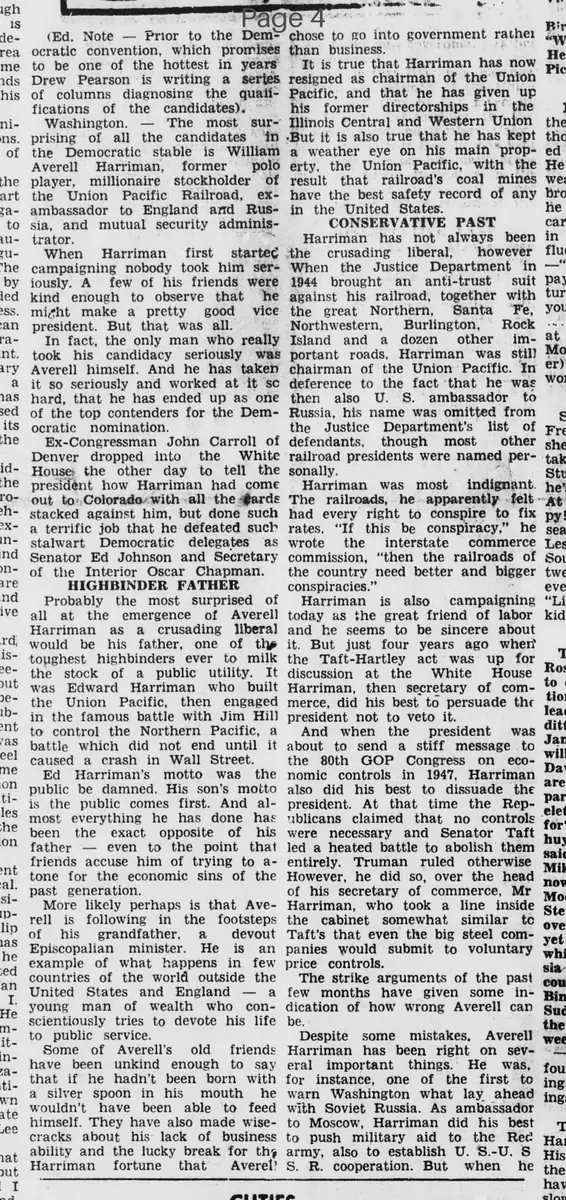
Washington. - The most surprising of all the candidates in the Democratic stable is William Averell Harriman, former polo player, millionaire stockholder of the Union Pacific Railroad, ex-ambassador to England and Russia, and mutual security administrator.
When Harriman first started campaigning nobody took him seriously. A few of his friends were kind enough to observe that he might make a pretty good vice president. But that was all.
In fact, the only man who really took his candidacy seriously was Averell himself. And he has taken it so seriously and worked at it so hard that he has ended up as one of the top contenders for the Democratic nomination.
Ex-Congressman John Carroll of Denver dropped into the White House the other day to tell the president how Harriman had come out to Colorado with all the cards stacked against him, but done such a terrific job that he defeated such stalwart Democratic delegates as Senator Ed Johnson and Secretary of the Interior Oscar Chapman.
HIGHBINDER FATHER
Probably the most surprised of all at the emergence of Averell Harriman as a crusading liberal would be his father, one of the toughest highbinders ever to milk the stock of a public utility. It was Edward Harriman who built the Union Pacific, then engaged in the famous battle with Jim Hill to control the Northern Pacific, a battle which did not end until it caused a crash in Wall Street.
Ed Harriman's motto was the public be damned. His son's motto is the public comes first. And almost everything he has done has been the exact opposite of his father even to the point that friends accuse him of trying to atone for the economic sins of the past generation.
More likely perhaps is that Averell is following in the footsteps of his grandfather, a devout Episcopalian minister. He is an example of what happens in few countries of the world outside the United States and England: a young man of wealth who conscientiously tries to devote his life to public service.
Some of Averell's old friends have been unkind enough to say that if he hadn't been born with a silver spoon in his mouth he wouldn't have been able to feed himself. They have also made wise-cracks about his lack of business ability and the lucky break for the Harriman fortune that Averell chose to go into government rather than business.
It is true that Harriman has now resigned as chairman of the Union Pacific, and that he has given up his former directorships in the Illinois Central and Western Union. But it is also true that he has kept a weather eye on his main property, the Union Pacific, with the result that railroad's coal mines have the best safety record of any in the United States.
CONSERVATIVE PAST
Harriman has not always been the crusading liberal, however. When the Justice Department in 1944 brought an anti-trust suit against his railroad, together with the Great Northern, Santa Fe, Northwestern, Burlington, Rock Island and a dozen other important roads.
Harriman was still chairman of the Union Pacific. In deference to the fact that he was then also U. S. ambassador to Russia, his name was omitted from the Justice Department's list of defendants, though most other railroad presidents were named personally.
Harriman was most indignant. The railroads, he apparently felt, had every right to conspire to fix rates. "If this be conspiracy," he wrote the interstate commerce commission, "then the railroads of the country need better and bigger conspiracies."
Harriman is also campaigning today as a great friend of labor and he seems to be sincere about it. But just four years ago when the Taft-Hartley act was up for discussion at the White House Harriman, then secretary of commerce, did his best to persuade the president not to veto it.
And when the president was about to send a stiff message to the 80th GOP Congress on economic controls in 1947, Harriman also did his best to dissuade the president. At that time the Republicans claimed that no controls were necessary and Senator Taft led a heated battle to abolish them entirely. Truman ruled otherwise. However, he did so, over the head of his secretary of commerce, Mr. Harriman, who took a line inside the cabinet somewhat similar to Taft's that even the big steel companies would submit to voluntary price controls.
The strike arguments of the past few months have given some indication of how wrong Averell can be.
Despite some mistakes, Averell Harriman has been right on several important things. He was, for instance, one of the first to warn Washington what lay ahead with Soviet Russia. As ambassador to Moscow, Harriman did his best to push military aid to the Red army, also to establish U. S.-U. S. S. R. cooperation. But when he found it impossible, he began sending a steady drum-beat of warnings back to Washington.
ABLE TO LEARN
The most important thing about Harriman is that he has learned. His views have not solidified with the passing of the years. They have broadened. Beginning as a slow, timid, ponderous person when he first came to Washington, Averell has gradually grown up.
I recall talking to him after Roosevelt and Churchill met on a battleship in the North Atlantic in the early days of the war. Harriman was with them, and upon his return I dropped in to see if I could pick up some human interest stories. I knew Averell well enough to realize that I could get no diplomatic secrets from him not even an inkling. He was too much of a scared rabbit.
So I asked him a few simple nonsecret questions, about pleasantries and pastimes aboard ship. Averell, however, was hesitant. Finally I asked whether the Prime Minister and the President wore evening dress when they'd dined on the battleship at night.
"I am afraid," said Harriman "that that would be confidential and I must not discuss it."
As I walked out of his hotel, I glanced at the afternoon papers. They featured a picture of Roosevelt and Churchill aboard ship in evening dress.
About ten years has passed since then, but in that ten years, the onetime timid Mr. Harriman has become a rip-roaring, rostrum-pounding candidate for president. And I'm almost beginning to think he might make a pretty good one.
What sub-type of article is it?
What themes does it cover?
What keywords are associated?
What entities or persons were involved?
Where did it happen?
Story Details
Key Persons
Location
Washington, D.C.
Story Details
Profile of William Averell Harriman as an unexpected top contender for the Democratic presidential nomination, contrasting his ruthless father's legacy with his own commitment to public service and liberal causes, detailing his political evolution, past conservative stances, and growth into a confident candidate.