Thank you for visiting SNEWPapers!
Sign up free
Richmond Enquirer
Richmond, Richmond County, Virginia
What is this article about?
On January 9, 1824, in the Virginia House of Delegates, Mr. Briggs spoke against a bill providing relief to Ro. Douthat, likely related to duelling consequences. He traced duelling's origins from savage societies through medieval chivalry to modern times, advocating to uphold anti-duelling laws to protect society.
Clipping
OCR Quality
Full Text
FRIDAY, JAN 9, 1824.
DEBATE ON
THE BILL FOR THE RELIEF OF RO. DOUTHAT.—[Continued.]
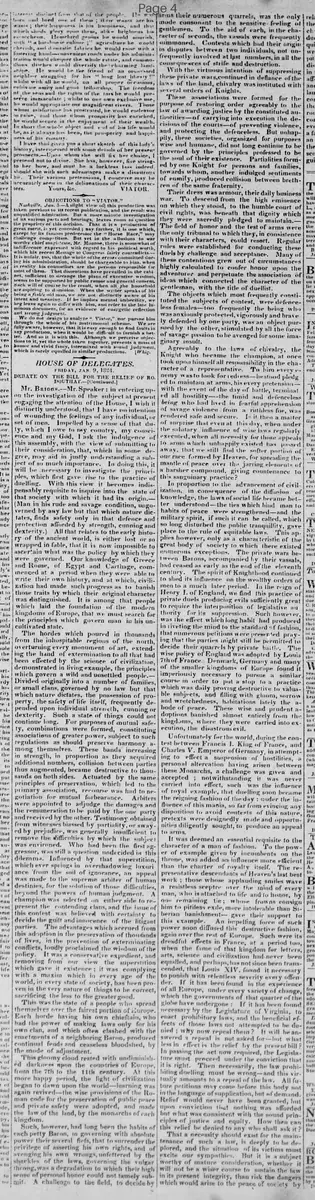
Mr. Briggs.—Mr. Speaker: in entering upon the investigation of the subject at present engaging the attention of the House, I wish it distinctly understood, that I have no intention of wounding the feelings of any individual, or set of men. "Impelled by a sense of that duty, which I owe to my country, my conscience and my God, I ask the indulgence of this assembly, with the view of submitting to their consideration, that, which in some degree, may aid in justly understanding a subject of so much importance. In doing this, it will be necessary to investigate the principles, which first gave rise to the practice of duelling. With this view it becomes indispensably requisite to inquire into the state of that society with which it had its origin.—
(Man in his rude and savage condition, ungoverned by any law but that which nature dictates, finds safety only in that defence and protection afforded by strength, cunning and dexterity.) All that relates to the early history of the ancient world, is either lost or so wrapped in fable, that it is now impossible to ascertain what was the policy by which they were governed. Our knowledge of Greece and Rome, of Egypt and Carthage, commenced at a period when they were able to write their own history, and at which, civilization had made such progress as to banish those traits by which their original character was distinguished. It is among that people which laid the foundation of the modern kingdoms of Europe, that we must search for the principles which govern man in his uncultivated state.
The hordes which poured in thousands from the inhospitable regions of the north, overturning every monument of art, extending the hand of extermination to all that had been effected by the science of civilization, demonstrated in living example, the principles which govern a wild and unsettled people.—
Divided originally into a number of families, or small clans, governed by no law but that which nature dictates, the possession of property, the safety of life itself, frequently depended upon individual strength, cunning or dexterity. Such a state of things could not continue long. For purposes of mutual safety, combinations were formed, constituting associations of greater power, subject to such regulations as should preserve harmony among themselves. These bands increasing in strength, in proportion as they acquired additional numbers, collision between parties thus augmented, became destructive to thousands on both sides. Actuated by the same principles of preservation, which led to the primary association, recourse was had to negotiation for mutual forbearance. Arbiters were appointed to adjudge the damages and the remuneration to be paid by the one party and received by the other. Testimony obtained from witnesses biassed by partiality, or swayed by prejudice, was generally insufficient to remove the difficulties by which the subject was environed. Who had been the first aggressor, was still a question undecided in this dilemma. Influenced by that superstition, which ever springs in overshadowing luxuriance from the soil of ignorance, an appeal was made to the supreme arbiter of human destinies, for the solution of those difficulties. beyond the powers of human judgment. A champion was selected on either side to represent the contending clans, and the issue of this contest was believed with certainty to decide the guilt and innocence of the litigant parties. The advantages which accrued from this adoption in the preservation of thousands of lives, in the prevention of exterminating conflicts, loudly proclaimed the wisdom of the policy. It was a conservative expedient, and removing from our view the superstition which gave it existence; it was complying with a maxim which in every age of the world, in every state of society, has been proven in the very nature of things to be correct, sacrificing the less to the greater good.
This was the state of a people who spread themselves over the fairest portion of Europe. Each horde having his own chieftain, who had the power of making laws only for his own clan, and which often clashed with the enactments of a neighboring Baron, produced continual feuds and ceaseless bloodshed, by the mode of adjustment.
This gloomy cloud rested with undiminished darkness upon the countries of Europe, from the 7th to the 11th century. At this more happy period, the light of civilization began to dawn upon the world—learning was again revived—the wise provisions of the Roman code for the preservation of public peace and private safety were adopted, and made the law of the land, by the monarchs of each kingdom.
Such, however, had long been the habits of each petty Baron, in governing with absolute power their several fiefs, that to surrender the privilege of asserting his own rights, and of avenging his own wrongs, unfettered by the shackles of the laws, governing the vulgar throng, was a degradation to which their high sense of personal honor could not tamely submit. A challenge to the field, to decide by arms their numerous quarrels, was the only mode consonant to the sensitive-feeling of gentlemen. To the aid of each, in the character of seconds, the vassals were frequently summoned. Contests which had their origin in disputes between two individuals, not unfrequently involved at last numbers, in all the consequences of strife and destruction.
With the virtuous intention of suppressing these private wars, continued in defiance of the laws of the land, chivalry was instituted with several orders of Knights.
These associations were formed for the purpose of restoring order agreeably to the law of awarding justice by the constituted authorities—of carrying into execution the decisions of the courts—of preventing violence, and protecting the defenceless. But unhappily, these societies, organized for purposes wise and humane, did not long continue to be governed by the principles professed to be the soul of their existence. Partialities formed by one Knight for persons and families, towards whom, another indulged sentiments of enmity, produced collision between brethren of the same fraternity.
Their dress was armour, their daily business war. To descend from the high eminence on which they stood, to the humble court of civil rights, was beneath that dignity which they were sacredly pledged to maintain.—
The field of honor and the test of arms were the only tribunal to which they, in consistence with their characters, could resort. Regular rules were established for conducting these duels by challenge and acceptance. Many of these contentions grew out of circumstances highly calculated to confer honor upon the adventurer and perpetuate the association of ideas which connected the character of the gentleman, with the title of duellist.
The objects which most frequently constituted the subjects of contest, were defenceless females—too frequently the being who was anxiously protected, vigorously and bravely defended by one party, was an object pursued by the other, stimulated by all the force of savage passion to be avenged for some imaginary insult.
Agreeably to the laws of chivalry, the Knight who became the champion, at once took upon himself all responsibility in the character of a representative. To him every enemy was to look for redress—he stood pledged to maintain at arms. his every pretension—with the event of the day of battle, terminated all hostility—the timid and defenceless being who had lived in fearful apprehension of savage violence from a ruthless foe, was rendered safe and secure. Is it then a matter of surprise that even at this day, when under the salutary influence of wise laws regularly executed, when all necessity for those appeals to arms which unhappily existed has passed away. that we still find the softer portion of our race formed by Heaven. for spreading the mantle of peace over the jarring elements of a harsher compound, giving countenance to this sanguinary practice?
In proportion to the advancement of civilization, in consequence of the diffusion of knowledge. the laws of social life became better understood—the ties which bind man to habits of peace were strengthened—and the military spirit, if such it can be called, which so long disturbed the public tranquillity, gave place to the rule of equitable laws. This applies however, only as a characteristic of the great body of society to which there existed numerous exceptions. The private wars between Barons, accompanied by their vassals, had ceased as early as the end of the eleventh century. The spirit of Knighthood continued to shed its influence on the wealthy orders of men to a much later period. In the reign of Henry I. of England, we find this practice of private duels producing evils sufficiently great to require the interposition of legislative authority for its suppression. Such however. was the effect which long habit had produced in riveting the mind to the standard of fashion, that numerous petitions were presented praying that the parties sought still be permitted to decide their quarrels by private battle. The wise policy of England was adopted by Louis 7th of France. Denmark, Germany and many of the smaller kingdoms of Europe found it imperiously necessary to pursue a similar course in order to put a stop to a practice which was daily proving destructive to valuable subjects, and filling with gloom, sorrow and wretchedness, habitations lately the abode of peace. These wise and prudent adoptions banished almost entirely from the kingdoms, where they were carried into execution, the disastrous evil.
Unfortunately for the world, during the contest between Francis I. King of France, and Charles V. Emperor of Germany, in attempting to effect a suspension of hostilities, a personal altercation having arisen between these Monarchs, a challenge was given and accepted; notwithstanding it was never carried into effect, such was the influence of royal example, that duelling soon became the reigning fashion of the day: under the influence of this mania, so far from evincing any disposition to avoid contests of this nature. pretexts were designedly made and opportunities diligently sought, to produce an appeal to arms.
It was deemed an essential requisite to the character of a man of fashion. To the power of example given by incumbents on the throne, was added an influence more efficient than the charter of royalty itself. The representative descendants of Heaven's last best work; those whose applauding smiles wave a resistless sceptre over the mind of every man, who is attached to life and to honor, by one remaining tie; whose frowns consign him to pitiless exile, more intolerable than Siberian banishment—gave their support to this example. An impelling force of such power soon diffused this destructive fashion, again over the rest of Europe. Such were its dreadful effects in France, at a period too, when the fame of that kingdom for letters, arts, science and civilization had never been equalled, and perhaps, has not since been transcended, that Louis XIV. found it necessary to punish with relentless severity every offender. If it has been found in the experience of all Europe, under every variety of change, which the governments of that quarter of the globe have undergone: If it has been found necessary by the Legislature of Virginia, to enact prohibitory laws, and the beneficial effects of those laws not attempted to be denied; why now repeal them? 'It will be answered a repeal is not asked for—but what less in effect is the relief by the present bill ?
In passing the act now required, the Legislature must proceed under the conviction that it is right. Then necessarily, the law prohibiting duelling must be wrong—and this virtually amounts to a repeal of the law. All future petitions may come before this body not in the language of supplication, but of demand. Relief would never have been granted, but upon conviction that nothing was afforded but what was consistent with the sound principles of justice and equity. How then can this relief be denied to any who shall ask it ?
That a necessity should exist for the maintenance of such a law, is deeply to be deplored, and the situation of its victims must excite our sympathies. But it is a subject worthy of mature consideration, whether it will not be a wiser course to sustain the law in its present integrity, than risk the dangers which would arise to the peace of society by relaxing its bonds. How many instances does the history of our state afford, of the melancholy effects resulting from the practice of duelling. In the habitation of peace and tranquillity, has it not cast the shade of gloomy wretchedness ? The hapless widow and unpitied orphan. are the sad monuments of its disastrous effects. Those who once rejoiced in the prospect of comfort and subsistence, afforded by the honest industry of a patron and parent, whose bosoms swelled with that laudable pride, which ever springs from a conscientiousness of virtue and honor: On those whom the morning had witnessed, surrounding him who was the stay of their every comfort and the pillar of future hope, the evening closed in sad bereavement, robbed of a father and a friend, cast upon the charity of an unfriendly world, destined to encounter the frowns of the mercenary, to brook the scoffs of giddy vanity, and bear in silent anguish the insults of vice.
(Debate to be continued.)
What sub-type of article is it?
What keywords are associated?
What entities or persons were involved?
Where did it happen?
Domestic News Details
Primary Location
Virginia
Event Date
Friday, Jan 9, 1824
Key Persons
Event Details
Mr. Briggs delivered a speech in the House of Delegates debating the bill for the relief of Ro. Douthat, likely involving duelling penalties. He examined the historical origins of duelling from primitive societies, through barbarian hordes, medieval chivalry, and European monarchies, arguing that anti-duelling laws should be maintained to prevent societal harm, as granting relief would effectively repeal them.