Thank you for visiting SNEWPapers!
Sign up free
The New Hampshire Gazette And General Advertiser
Portsmouth, Exeter, Rockingham County, New Hampshire
What is this article about?
A letter from M.W. to J.S. P-lk, Esq., a Maryland delegate, opposes petitions for establishing a state church. It poses 23 queries arguing that such establishments violate religious liberty, conscience, and Protestant principles, citing history, scripture, and the American Congress's role in freeing religion.
Merged-components note: Continuation of the letter across pages, text flows seamlessly from query 20 to 21.
Clippings
1 of 2
OCR Quality
Full Text
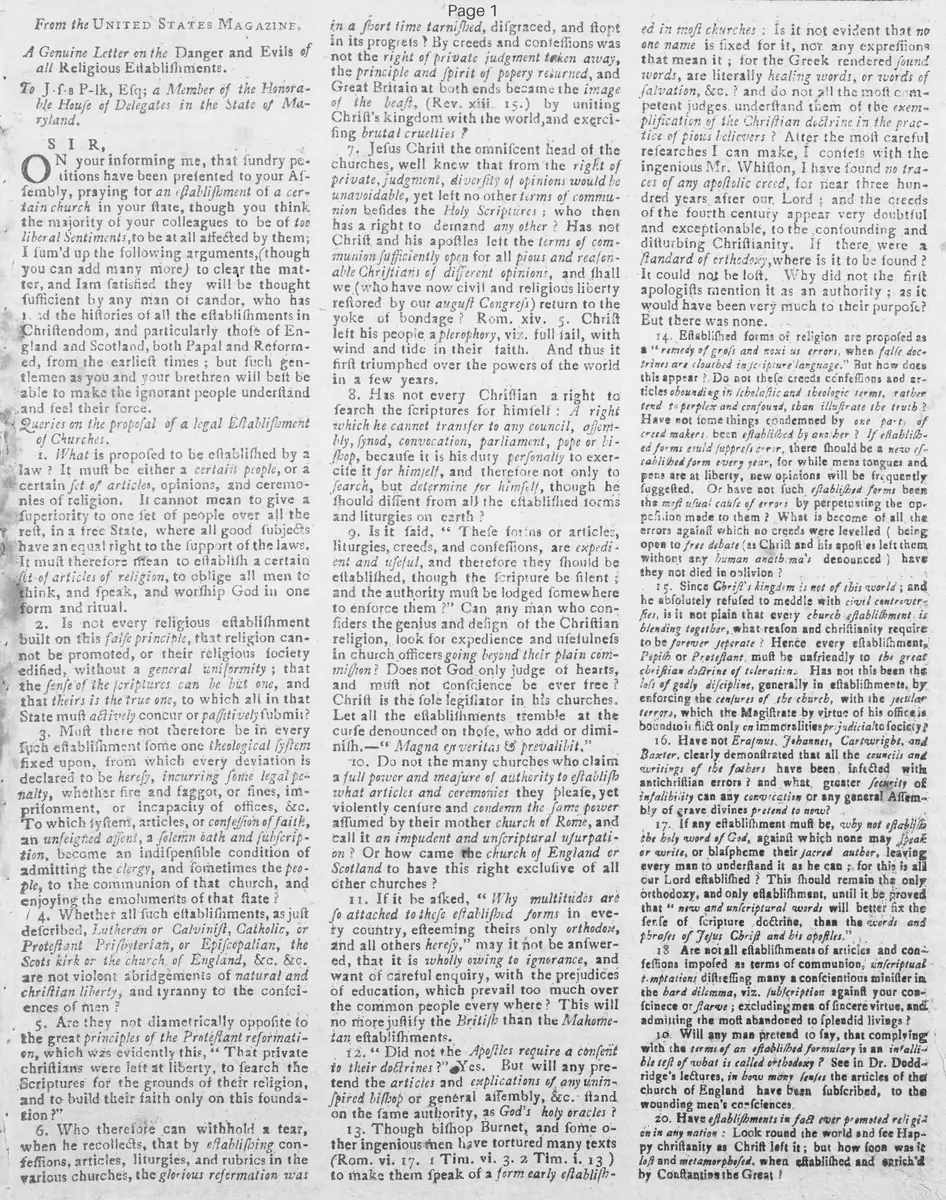
A Genuine Letter on the Danger and Evils of all Religious Establishments.
To J. s. P-lk, Esq; a Member of the Honourable House of Delegates in the State of Maryland.
SIR,
In your informing me, that sundry petitions have been presented to your Assembly, praying for an establishment of a certain church in your state. though you think the majority of your colleagues to be of too liberal Sentiments. to be at all affected by them; I sum'd up the following arguments, (though you can add many more) to clear the matter, and I am satisfied they will be thought sufficient by any man of candor. who has read the histories of all the establishments in Christendom. and particularly those of England and Scotland, both Papal and Reformed. from the earliest times: but such gentlemen as you and your brethren will best be able to make the ignorant people understand and feel their force.
Queries on the proposal of a legal Establishment of Churches.
1. What is proposed to be established by a law? It must be either a certain people, or a certain set of articles, opinions, and ceremonies of religion.
It cannot mean to give a superiority to one set of people over all the rest, in a free State, where all good subjects have an equal right to the support of the laws.
It must therefore mean to establish a certain set of articles of religion, to oblige all men to think, and speak, and worship God in one form and ritual.
2. Is not every religious establishment built on this false principle, that religion cannot be promoted, or their religious society edified, without a general uniformity; that the sense of the Scriptures can be but one, and that theirs is the true one. to which all in that State must actively concur or passively submit?
3. Must there not therefore be in every such establishment some one theological system fixed upon. from which every deviation is declared to be heresy, incurring some legal penalty, whether fire and faggot, or fines, imprisonment, or incapacity of offices. &c.
To which system, articles, or confession of faith. an unfeigned assent, a solemn oath and subscription, become an indispensable condition of admitting the clergy. and sometimes the people, to the communion of that church, and enjoying the emoluments of that state?
4. Whether all such establishments, as just described, Lutheran or Calvinist. Catholic, or Protestant Presbyterian, or Episcopalian, the Scots kirk or the church of England, &c. &c. are not violent abridgements of natural and christian liberty, and tyranny to the consciences of men
5. Are they not diametrically opposite to the great principles of the Protestant reformation. which was evidently this. "That private christians were left at liberty. to search the Scriptures for the grounds of their religion, and to build their faith only on this foundation?"
6. Who therefore can withhold a tear. when he recollects, that by establishing confessions. articles, liturgies, and rubrics in the various churches, the glorious reformation was in a short time tarnished, disgraced, and stopt in its progress? By creeds and confessions was not the right of private judgment taken away, the principle and spirit of popery returned, and Great Britain at both ends became the image of the beast, (Rev. xiii. 15.) by uniting Christ's kingdom with the world, and exercising brutal cruelties?
7. Jesus Christ the omniscient head of the churches. well knew that from the right of private, judgment, diversity of opinions would be unavoidable, yet left no other terms of communion besides the Holy Scriptures; who then has a right to demand any other? Has not Christ and his apostles left the terms of communion sufficiently open for all pious and reasonable Christians of different opinions, and shall we (who have now civil and religious liberty restored by our august Congress) return to the yoke of bondage? Rom. xiv. 5. Christ left his people a plethora, viz. full sail, with wind and tide in their faith. And thus it first triumphed over the powers of the world in a few years.
8. Has not every Christian a right to search the scriptures for himself: A right which he cannot transfer to any council, assembly. synod, convocation, parliament. pope or bishop. because it is his duty personally to exercise it for himself. and therefore not only to search. but determine for himself, though he should dissent from all the established forms and liturgies on earth?
9. Is it said. "These forms or articles. liturgies, creeds, and confessions, are expedient and useful. and therefore they should be established. though the scripture be silent: and the authority must be lodged somewhere to enforce them?" Can any man who considers the genius and design of the Christian religion, look for expedience and usefulness in church officers going beyond their plain commission? Does not God only judge of hearts, and must not conscience be ever free?
Christ is the sole legislator in his churches. Let all the establishments tremble at the curse denounced on those. who add or diminish." Magna est veritas et prævalebit."
10. Do not the many churches who claim a full power and measure of authority to establish what articles and ceremonies they please, yet violently censure and condemn the same power assumed by their mother church of Rome. and call it an impudent and unscriptural usurpation? Or how came the church of England or Scotland to have this right exclusive of all other churches?
11. If it be asked, "Why multitudes are so attached to these established forms in every country, esteeming theirs only orthodox, and all others heresy." may it not be answered, that it is wholly owing to ignorance. and want of careful enquiry, with the prejudices of education. which prevail too much over the common people every where? This will no more justify the British than the Mahometan establishments.
12. "Did not the Apostles require a consent to their doctrines?" Yes. But will any pretend the articles and explications of any uninspired bishop or general assembly, &c. stand on the same authority, as God's holy oracles?
13. Though bishop Burnet, and some other ingenious men have tortured many texts (Rom. vi. 17. 1 Tim. vi. 3. 2 Tim. i. 13) to make them speak of a form early established in most churches: Is it not evident that no one name is fixed for it. nor any expressions that mean it: for the Greek rendered sound words, are literally healing words, or words of salvation, &c.? and do not all the most competent judges. understand them of the exemplification of the Christian doctrine in the practice of pious believers? After the most careful researches I can make. I confess with the ingenious Mr. Whiston, I have found no traces of any apostolic creed, for near three hundred years after our. Lord; and the creeds of the fourth century appear very doubtful and exceptionable, to the confounding and disturbing Christianity. If there were a standard of orthodoxy, where is it to be found?
It could not be lost. Why did not the first apologists mention it as an authority; as it would have been very much to their purpose? But there was none.
14. Established forms of religion are proposed as a remedy of gross and noxious errors, when false doctrines are clothed in scripture language." But how does this appear? Do not these creeds confessions and articles abounding in scholastic and theologic terms. rather tend to perplex and confound. than illustrate the truth? Have not some things condemned by one party of creed makers, been established by another? If established forms could suppress error. there should be a new established form every year, for while mens tongues and pens are at liberty, new opinions will be frequently suggested. Or have not such established forms been the most usual cause of errors by perpetuating the opposition made to them? What is become of all the errors against which no creeds were levelled (being open to free debate (as Christ and his apostles left them without any human anathemas denounced) have they not died in oblivion?
15. Since Christ's kingdom is not of this world; and he absolutely refused to meddle with civil controversies, is it not plain that every church establishment. is blending together, what reason and christianity require to be forever separate? Hence every establishment, Popish or Protestant, must be unfriendly to the great christian doctrine of toleration. Has not this been the loss of godly discipline, generally in establishments, by enforcing the censures of the church, with the secular terrors, which the Magistrate by virtue of his office is bound to inflict only on immoralities prejudicial to society?
16. Have not Erasmus. Johannes, Cartwright. and Baxter, clearly demonstrated that all the councils and writings of the fathers have been, infected with antichristian errors? and what. greater security of infallibility can any convocation or any general Assembly of grave divines pretend to now?
17. If any establishment must be, why not establish the holy word of God, against which none may speak or write, or blaspheme their sacred author, leaving every man to understand it as he can; for this is all Our Lord established? This should remain the only orthodoxy, and only establishment, until it be proved that "new and unscriptural words will better fix the sense of scripture doctrine, than the words and phrases of Jesus Christ and his apostles."
18 Are not all establishments of articles and confessions imposed as terms of communion, sinful temptations distressing many a conscientious minister in the hard dilemma, viz. subscription against your conscience or starve; excluding men of sincere virtue, and admitting the most abandoned to splendid livings?
19. Will any man pretend to say, that complying with the terms of an established formulary is an infallible test of what is called orthodoxy? See in Dr. Doddridge's lectures, in how many senses the articles of the church of England have been subscribed, to the wounding men's consciences.
20. Have establishments in fact ever promoted religion in any nation: Look round the world and see Happy christianity as Christ left it: but how soon was it lost and metamorphosed. when established and enriched by Constantine the Great!
21. Do not all establishments in general derogate from the authority and sufficiency of scripture, encroach on the liberty of conscience, and independency of Christian churches, tending to divisions, factions, and separations, extinguishing peace, charity, truth and virtue?
22. Religion prevails by its intrinsic beauty, and can bear no worldly mixture. Did not Constantine the Great by bringing the world into the church; and Athanasius by his creeds, instead of establishing religion, establish a hot bed of ignorance, indolence, superstition, heresy, barbarity, and luxury, in the old world to this day?
23. These few considerations being duly weighed, and candidly considered, and such answers given to the questions as every man of reading and penetration must give; have we not infinite cause of gratitude to the author of all wisdom, who has put it in the hearts of the American Congress, of endless fame, to have religion, and every man's conscience free as the air we breathe, and our souls unhackled with any of the Establishments; which have occasioned most of the error, animosities, persecutions, civil wars, and much of the bloodshed of the old world?
I am, Sir, much at your service,
Lewes, March 3, 1779.
M. W.
P. S. Nothing here said is meant to exclude every religious society (that is an individual church or congregation) to fix its own terms of communion, for which (if too narrow) it is only accountable to God: But the civil powers have no connexion with it as a congregation, though they protect the individuals as subjects: unless perhaps every State should incorporate the elders or church-wardens, &c. to manage the affairs in it, as the wardens are in England; which if limited to a moderate sum, would secure legacies, &c. Let us all beseech the Almighty Saviour of our country, that true liberty, civil and divine, may for ever emancipate the Americans (and even the poor Africans here) from every bondage, and this unchristian yoke of partial establishments, which fetter souls and foment bigotry, which gave a mean narrowness to the soul, raise rancours, parties, and destroy civil and social happiness.
What sub-type of article is it?
What themes does it cover?
What keywords are associated?
What entities or persons were involved?
Letter to Editor Details
Author
M. W.
Recipient
J. S. P Lk, Esq; A Member Of The Honourable House Of Delegates In The State Of Maryland.
Main Argument
religious establishments by law violate natural and christian liberty, impose tyranny on consciences, contradict protestant reformation principles, and hinder true religion; the american congress has wisely freed religion and conscience.
Notable Details