Thank you for visiting SNEWPapers!
Sign up free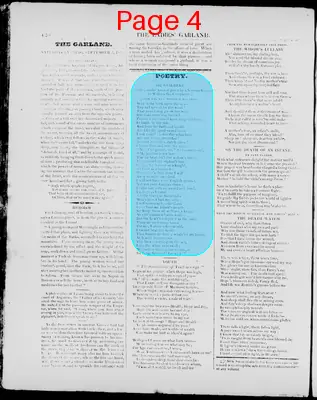
Poem
September 2, 1826
The Ladies' Garland
Harpers Ferry, Jefferson County, West Virginia
What is this article about?
Sir Guilbert, a loyal Norman knight, refuses William the Conqueror's offer of English land and a bride after the conquest, citing the land's curse from widows and orphans, and chooses to return to his birth tower in Normandie.
Clipping
OCR Quality
95%
Excellent
Full Text
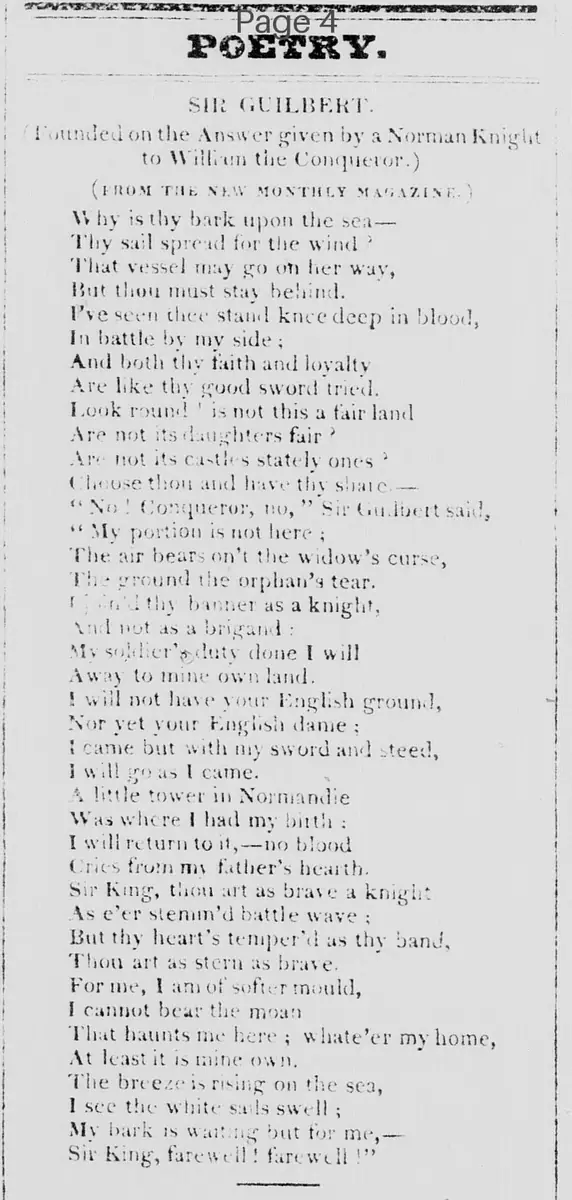
POETRY.
SIR GUILBERT.
(Founded on the Answer given by a Norman Knight to William the Conqueror.)
(FROM THE NEW MONTHLY MAGAZINE.)
Why is thy bark upon the sea--
Thy sail spread for the wind
That vessel may go on her way,
But thou must stay behind.
I've seen thee stand knee deep in blood,
In battle by my side;
And both thy faith and loyalty
Are like thy good sword tried.
Look round! 'tis not this a fair land
Are not its daughters fair
Are not its castles stately ones
Choose thou and have thy share
"No: Conqueror, no," Sir Guilbert said,
"My portion is not here;
The air bears on't the widow's curse,
The ground the orphan's tear.
I won thy banner as a knight,
And not as a brigand:
My soldier's duty done I will
Away to mine own land.
I will not have your English ground,
Nor yet your English dame:
I came but with my sword and steed,
I will go as I came.
A little tower in Normandie
Was where I had my birth:
I will return to it,--no blood
Cries from my father's hearth.
Sir King, thou art as brave a knight
As e'er stemm'd battle wave;
But thy heart's temper'd as thy hand,
Thou art as stern as brave.
For me, I am of softer mould,
I cannot bear the moan
That haunts me here; whate'er my home,
At least it is mine own.
The breeze is rising on the sea,
I see the white sails swell;
My bark is waiting but for me,
Sir King, farewell! farewell!
SIR GUILBERT.
(Founded on the Answer given by a Norman Knight to William the Conqueror.)
(FROM THE NEW MONTHLY MAGAZINE.)
Why is thy bark upon the sea--
Thy sail spread for the wind
That vessel may go on her way,
But thou must stay behind.
I've seen thee stand knee deep in blood,
In battle by my side;
And both thy faith and loyalty
Are like thy good sword tried.
Look round! 'tis not this a fair land
Are not its daughters fair
Are not its castles stately ones
Choose thou and have thy share
"No: Conqueror, no," Sir Guilbert said,
"My portion is not here;
The air bears on't the widow's curse,
The ground the orphan's tear.
I won thy banner as a knight,
And not as a brigand:
My soldier's duty done I will
Away to mine own land.
I will not have your English ground,
Nor yet your English dame:
I came but with my sword and steed,
I will go as I came.
A little tower in Normandie
Was where I had my birth:
I will return to it,--no blood
Cries from my father's hearth.
Sir King, thou art as brave a knight
As e'er stemm'd battle wave;
But thy heart's temper'd as thy hand,
Thou art as stern as brave.
For me, I am of softer mould,
I cannot bear the moan
That haunts me here; whate'er my home,
At least it is mine own.
The breeze is rising on the sea,
I see the white sails swell;
My bark is waiting but for me,
Sir King, farewell! farewell!
What sub-type of article is it?
Ballad
What themes does it cover?
Moral Virtue
Patriotism
Political
What keywords are associated?
Sir Guilbert
William Conqueror
Norman Knight
Loyalty
Widow Curse
Return Normandie
Conquest Refusal
What entities or persons were involved?
From The New Monthly Magazine.
Poem Details
Title
Sir Guilbert.
Author
From The New Monthly Magazine.
Subject
Founded On The Answer Given By A Norman Knight To William The Conqueror.
Form / Style
Rhymed Quatrains
Key Lines
"No: Conqueror, No," Sir Guilbert Said,
"My Portion Is Not Here;
The Air Bears On't The Widow's Curse,
The Ground The Orphan's Tear.
I Will Not Have Your English Ground,
Nor Yet Your English Dame:
I Came But With My Sword And Steed,
I Will Go As I Came.