Thank you for visiting SNEWPapers!
Sign up free
Gazette Of The United States
New York, New York County, New York
What is this article about?
A lawyer, admitted to the bar in 1781, reflects on his education and travels, criticizing general reading methods in history and law. He advocates focused study on specific events or points, using multiple sources, and recommends preparatory history reading, especially ancient historians, before legal training.
Clipping
OCR Quality
Full Text
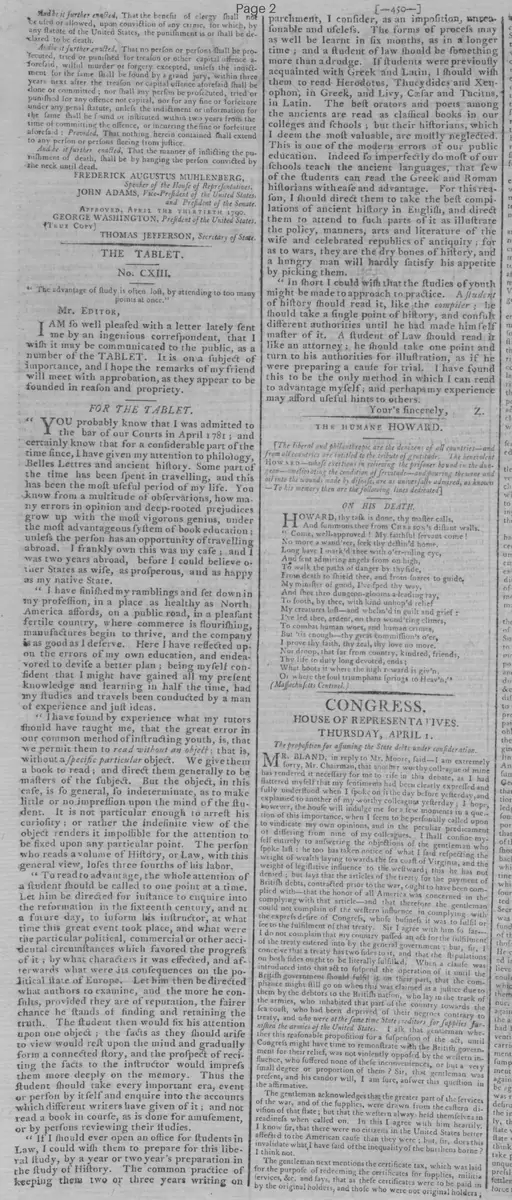
No. CXIII.
The advantage of study is often lost, by attending to too many points at once."
Mr. EDITOR,
I am well pleased with a letter lately sent to me by an ingenious correspondent, that I wish it may be communicated to the public, as a number of the TABLET. It is on a subject of importance, and I hope the remarks of my friend will meet with approbation, as they appear to be founded in reason and propriety.
FOR THE TABLET.
You probably know that I was admitted to the bar of our Courts in April 1781; and certainly know that for a considerable part of the time since, I have given my attention to philology, Belles Lettres and ancient history. Some part of the time has been spent in travelling, and this has been the most useful period of my life. You know from a multitude of observations, how many errors in opinion and deep-rooted prejudices grow up with the most vigorous genius, under the most advantageous system of book education; unless the person has an opportunity of travelling abroad. I frankly own this was my case; and I was two years abroad, before I could believe other States as wise, as prosperous, and as happy as my native State.
I have finished my ramblings and set down in my profession, in a place as healthy as North America affords, on a public road, in a pleasant fertile country, where commerce is flourishing, manufactures begin to thrive, and the company is as good as I deserve. Here I have reflected upon the errors of my own education, and endeavored to devise a better plan; being myself confident that I might have gained all my present knowledge and learning in half the time, had my studies and travels been conducted by a man of experience and just ideas.
I have found by experience what my tutors should have taught me, that the great error in our common method of instructing youth, is, that we permit them to read without an object; that is, without a specific particular object. We give them a book to read; and direct them generally to be masters of the subject. But the object, in this case, is so general, so indeterminate, as to make little or no impression upon the mind of the student. It is not particular enough to arrest his curiosity; or rather the indefinite view of the object renders it impossible for the attention to be fixed upon any particular point. The person who reads a volume of History, or Law, with this general view, loses three fourths of his labor.
To read to advantage, the whole attention of a student should be called to one point at a time. Let him be directed for instance to enquire into the reformation in the sixteenth century, and at a future day, to inform his instructor, at what time this great event took place, and what were the particular political, commercial or other accidental circumstances which favored the progress of it; by what characters it was effected, and afterwards what were its consequences on the political state of Europe. Let him then be directed what authors to examine, and the more he consults, provided they are of reputation, the fairer chance he stands of finding and retaining the truth. The student then would fix his attention upon one object; the facts as they should arise to view would rest upon the mind and gradually form a connected story, and the prospect of reciting the facts to the instructor would impress them more deeply on the memory. Thus the student should take every important era, event or person by itself and enquire into the accounts which different writers have given of it; and not read a book in course, as is done for amusement, or by persons reviewing their studies.
If I should ever open an office for students in Law, I could wish them to prepare for this liberal study, by a year or two year's preparation in the study of History. The common practice of keeping them two or three years writing on parchment, I consider, as an imposition, unreasonable and useless. The forms of process may as well be learnt in six months, as in a longer time; and a student of law should be something more than a drudge. If students were previously acquainted with Greek and Latin, I should wish them to read Herodotus, Thucydides and Xenophon, in Greek, and Livy, Cæsar and Tacitus, in Latin. The best orators and poets among the ancients are read as classical books in our colleges and schools; but their historians, which I deem the most valuable, are mostly neglected. This is one of the modern errors of our public education. Indeed so imperfectly do most of our schools teach the ancient languages, that few of the students can read the Greek and Roman historians with ease and advantage. For this reason, I should direct them to take the best compilations of ancient history in English, and direct them to attend to such parts of it as illustrate the policy, manners, arts and literature of the wise and celebrated republics of antiquity; for as to wars, they are the dry bones of history, and a hungry man will hardly satisfy his appetite by picking them.
In Short I could wish that the studies of youth might be made to approach to practice. A student of history should read it, like the compiler; he should take a single point of history, and consult different authorities until he had made himself master of it. A student of Law should read it like an attorney; he should take one point and turn to his authorities for illustration, as if he were preparing a cause for trial. I have found this to be the only method in which I can read to advantage myself; and perhaps my experience may afford useful hints to others.
Your's sincerely,
Z.
What sub-type of article is it?
What themes does it cover?
What keywords are associated?
What entities or persons were involved?
Letter to Editor Details
Author
Z.
Recipient
Mr. Editor
Main Argument
the common method of instructing youth by general reading without specific objects wastes time and effort; instead, students should focus on one particular point or event at a time, consulting multiple reputable sources to deeply understand and retain knowledge, especially in history as preparation for law.
Notable Details