Thank you for visiting SNEWPapers!
Sign up free
Letter to Editor
October 8, 1828
Literary Cadet And Rhode Island Statesman
Providence, Providence County, Rhode Island
What is this article about?
A student criticizes the new president of Brown University for radically changing regulations since 1827, treating students like slaves, failing to enforce rules consistently, and disrupting studies with military drills, appealing to public opinion for redress.
Clipping
OCR Quality
98%
Excellent
Full Text
[For the Literary Cadet.]
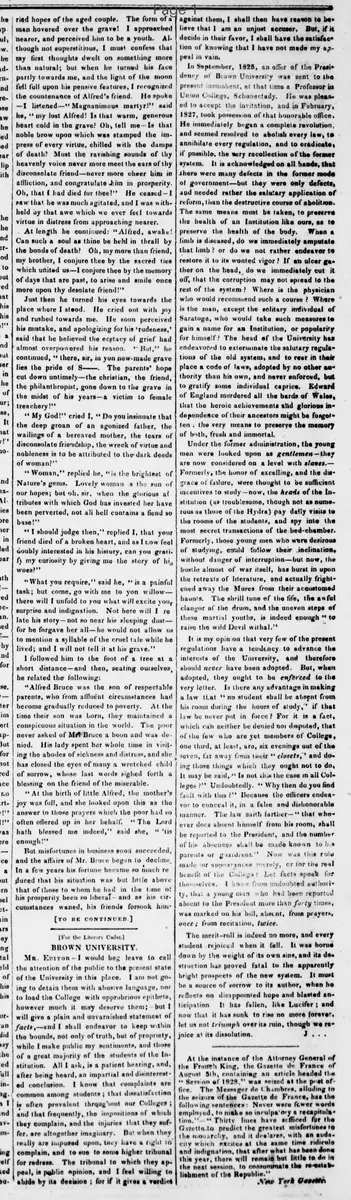
BROWN UNIVERSITY.
Mr. Editor-I would beg leave to call the attention of the public to the present state of the University in this place. I am not going to detain them with abusive language, nor to load the College with opprobrious epithets, however much it may deserve them;-but I will give a plain and unvarnished statement of facts,-and I shall endeavor to keep within the bounds, not only of truth, but of propriety, while I make public my sentiments, and those of a great majority of the students of the Institution. All I ask, is a patient hearing, and, after being heard, an impartial and disinterested conclusion. I know that complaints are common among students; that dissatisfaction is often prevalent throughout our Colleges; and that frequently, the impositions of which they complain, and the injuries that they suffer, are altogether imaginary. But when they really are imposed upon, they have a right to complain, and to call to some higher tribunal for redress. The tribunal to which they appeal, is public opinion, and I feel willing to abide by its decision ; for if it gives a verdict against them, I shall then have reason to believe that I am an unjust accuser. But, if it decide in their favor, I shall have the satisfaction of knowing that I have not made my appeal in vain.
In September, 1825, an offer of the Presidency of Brown University was sent to the present incumbent, at that time a Professor in Union College, Schenectady. He was pleased to accept the invitation, and in February, 1827, took possession of that honorable office. He immediately began a complete revolution, and seemed resolved to abolish every law, to annihilate every regulation, and to eradicate, if possible, the very recollection of the former system. It is acknowledged on all hands, that there were many defects in the former mode of government-but they were only defects and needed rather the salutary application of reform, than the destructive course of abolition. The same means must be taken, to preserve the health of an Institution like ours, as to preserve the health of the body. When a limb is diseased, do we immediately amputate that limb? or do we not rather endeavor to restore it to its wonted vigor? If an ulcer gathers on the head, do we immediately cut it off, that the corruption may not spread to the rest of the system? Where is the physician who would recommend such a course ? Where is the man, except the solitary individual of Saratoga, who would take such measures to gain a name for an Institution, or popularity for himself? The head of the University has endeavored to exterminate the salutary regulations of the old system, and to rear in their place a code of laws, adopted by no other authority than his own, and never enforced, but to gratify some individual caprice. Edward of England murdered all the bards of Wales, that the heroic achievements and glorious independence of their ancestors might be forgotten : the very means to preserve the memory of both, fresh and immortal.
Under the former administration, the young men were looked upon as gentlemen-they are now considered on a level with slaves.- Formerly, the honor of excelling, and the disgrace of failure, were thought to be sufficient incentives to study-now, the heads of the Institution (as troublesome, though not as numerous as those of the Hydra) pay daily visits to the rooms of the students, and spy into the most secret transactions of the bed-chamber. Formerly, those young men who were desirous of studying, could follow their inclination, without danger of interruption-but now, the bustle almost of war itself, has burst in upon the retreats of literature, and actually frightened away the Muses from their accustomed haunts. The shrill tone of the fife, the awful clangor of the drum, and the uneven steps of these martial youths, is indeed enough "to raise the wild Devil withal.'
It is my opinion that very few of the present regulations have a tendency to advance the interests of the University, and therefore should never have been adopted. But, when adopted, they ought to be enforced to the very letter. Is there any advantage in making a law that "no student shall be absent from his room during the hours of study," if that law be never put in force? For it is a fact, which can neither be denied nor disputed, that of the few who are yet members of College, one third, at least, are, six evenings out of the seven, far away from their "closets," and doing those things which they ought not to do, It may be said, "Is not this the case in all Colleges?" Undoubtedly. "Why then do you find fault with this ?" Because the officers endeavor to conceal it, in a false and dishonorable manner. The law saith farther-"that whoever does absent himself from his room, shall be reported to the President, and the number of his absences shall be made known to his parents or guardians." Now was this rule made for appearances merely, or for the real benefit of the College? Let facts speak for themselves. I know from undoubted authority, that a young man who had been reported absent to the President more than forty times, was marked on his bill, absent, from prayers, once; from recitation, twice.
The merit-roll is indeed no more, and every student rejoiced when it fell. It was borne down by the weight of its own sins, and its destruction has proved fatal to the apparently bright prospects of the new system. It must be a source of sorrow to its author, when he reflects on disappointed hope and blasted anticipation It has fallen, like Lucifer; and now that it has sunk to rise no more forever, let us not triumph over its ruin, though we rejoice at its dissolution.
BROWN UNIVERSITY.
Mr. Editor-I would beg leave to call the attention of the public to the present state of the University in this place. I am not going to detain them with abusive language, nor to load the College with opprobrious epithets, however much it may deserve them;-but I will give a plain and unvarnished statement of facts,-and I shall endeavor to keep within the bounds, not only of truth, but of propriety, while I make public my sentiments, and those of a great majority of the students of the Institution. All I ask, is a patient hearing, and, after being heard, an impartial and disinterested conclusion. I know that complaints are common among students; that dissatisfaction is often prevalent throughout our Colleges; and that frequently, the impositions of which they complain, and the injuries that they suffer, are altogether imaginary. But when they really are imposed upon, they have a right to complain, and to call to some higher tribunal for redress. The tribunal to which they appeal, is public opinion, and I feel willing to abide by its decision ; for if it gives a verdict against them, I shall then have reason to believe that I am an unjust accuser. But, if it decide in their favor, I shall have the satisfaction of knowing that I have not made my appeal in vain.
In September, 1825, an offer of the Presidency of Brown University was sent to the present incumbent, at that time a Professor in Union College, Schenectady. He was pleased to accept the invitation, and in February, 1827, took possession of that honorable office. He immediately began a complete revolution, and seemed resolved to abolish every law, to annihilate every regulation, and to eradicate, if possible, the very recollection of the former system. It is acknowledged on all hands, that there were many defects in the former mode of government-but they were only defects and needed rather the salutary application of reform, than the destructive course of abolition. The same means must be taken, to preserve the health of an Institution like ours, as to preserve the health of the body. When a limb is diseased, do we immediately amputate that limb? or do we not rather endeavor to restore it to its wonted vigor? If an ulcer gathers on the head, do we immediately cut it off, that the corruption may not spread to the rest of the system? Where is the physician who would recommend such a course ? Where is the man, except the solitary individual of Saratoga, who would take such measures to gain a name for an Institution, or popularity for himself? The head of the University has endeavored to exterminate the salutary regulations of the old system, and to rear in their place a code of laws, adopted by no other authority than his own, and never enforced, but to gratify some individual caprice. Edward of England murdered all the bards of Wales, that the heroic achievements and glorious independence of their ancestors might be forgotten : the very means to preserve the memory of both, fresh and immortal.
Under the former administration, the young men were looked upon as gentlemen-they are now considered on a level with slaves.- Formerly, the honor of excelling, and the disgrace of failure, were thought to be sufficient incentives to study-now, the heads of the Institution (as troublesome, though not as numerous as those of the Hydra) pay daily visits to the rooms of the students, and spy into the most secret transactions of the bed-chamber. Formerly, those young men who were desirous of studying, could follow their inclination, without danger of interruption-but now, the bustle almost of war itself, has burst in upon the retreats of literature, and actually frightened away the Muses from their accustomed haunts. The shrill tone of the fife, the awful clangor of the drum, and the uneven steps of these martial youths, is indeed enough "to raise the wild Devil withal.'
It is my opinion that very few of the present regulations have a tendency to advance the interests of the University, and therefore should never have been adopted. But, when adopted, they ought to be enforced to the very letter. Is there any advantage in making a law that "no student shall be absent from his room during the hours of study," if that law be never put in force? For it is a fact, which can neither be denied nor disputed, that of the few who are yet members of College, one third, at least, are, six evenings out of the seven, far away from their "closets," and doing those things which they ought not to do, It may be said, "Is not this the case in all Colleges?" Undoubtedly. "Why then do you find fault with this ?" Because the officers endeavor to conceal it, in a false and dishonorable manner. The law saith farther-"that whoever does absent himself from his room, shall be reported to the President, and the number of his absences shall be made known to his parents or guardians." Now was this rule made for appearances merely, or for the real benefit of the College? Let facts speak for themselves. I know from undoubted authority, that a young man who had been reported absent to the President more than forty times, was marked on his bill, absent, from prayers, once; from recitation, twice.
The merit-roll is indeed no more, and every student rejoiced when it fell. It was borne down by the weight of its own sins, and its destruction has proved fatal to the apparently bright prospects of the new system. It must be a source of sorrow to its author, when he reflects on disappointed hope and blasted anticipation It has fallen, like Lucifer; and now that it has sunk to rise no more forever, let us not triumph over its ruin, though we rejoice at its dissolution.
What sub-type of article is it?
Persuasive
Investigative
Reflective
What themes does it cover?
Education
Morality
What keywords are associated?
Brown University
President Criticism
Student Regulations
College Reform
1827 Changes
Public Opinion Appeal
Enforcement Failures
What entities or persons were involved?
Mr. Editor
Letter to Editor Details
Recipient
Mr. Editor
Main Argument
the new president of brown university has imposed arbitrary and unenforced regulations that treat students like slaves and disrupt their studies, contrary to the more gentlemanly former system; the writer appeals to public opinion for redress on behalf of the students.
Notable Details
Analogy To Medical Treatment Of Diseased Limbs
Reference To Edward Of England Murdering Bards
Comparison Of Administrators To Hydra Heads
Quote From Shakespeare: 'To Raise The Wild Devil Withal'
Biblical Allusion To Lucifer's Fall