Thank you for visiting SNEWPapers!
Sign up free
The Virginia Gazette
Richmond, Williamsburg, Richmond County, Virginia
What is this article about?
Criticus rebuts J.H.'s argument for diocesan episcopacy by asserting that Timothy and Titus were evangelists accompanying Paul, not fixed bishops, and that apostolic commissions involved unique miraculous powers without implying perpetual succession. He demands factual scriptural evidence over suppositions and questions the necessity of episcopacy for church preservation.
Clipping
OCR Quality
Full Text
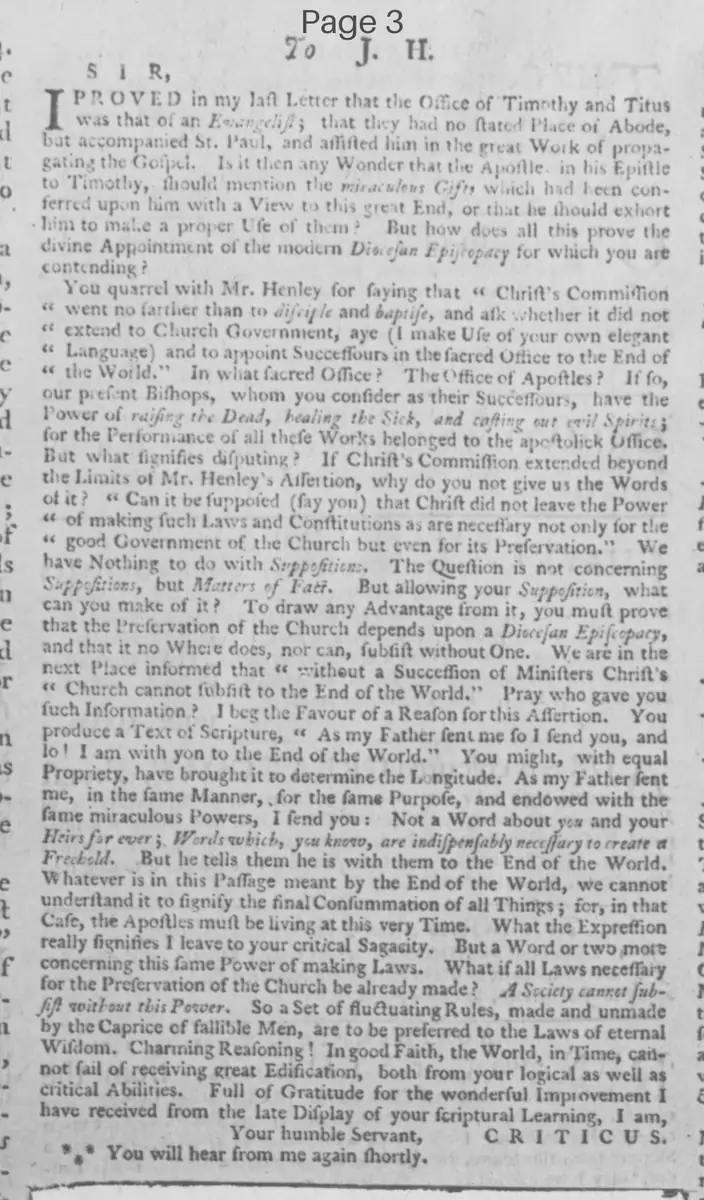
J. H.
SIR,
PROVED in my last Letter that the Office of Timothy and Titus was that of an Evangelist; that they had no stated Place of Abode, but accompanied St. Paul, and assisted him in the great Work of propagating the Gospel. Is it then any Wonder that the Apostle in his Epistle to Timothy, should mention the miraculous Gift, which had been conferred upon him with a View to this great End, or that he should exhort him to make a proper Use of them? But how does all this prove the divine Appointment of the modern Diocesan Episcopacy for which you are contending?
You quarrel with Mr. Henley for saying that " Christ’s Commission went no farther than to disciple and baptise, and ask whether it did not " extend to Church Government, aye (I make Use of your own elegant Language) and to appoint Successors in the sacred Office to the End of the World." In what sacred Office? The Office of Apostles? If so, our present Bishops, whom you consider as their Successors, have the Power of raising the Dead, healing the Sick, and casting out evil Spirits; for the Performance of all these Works belonged to the apostolick Office.
But what signifies disputing? If Christ’s Commission extended beyond the Limits of Mr. Henley’s Assertion, why do you not give us the Words of it? " Can it be supposed (say you) that Christ did not leave the Power of making such Laws and Constitutions as are necessary not only for the good Government of the Church but even for its Preservation." We have Nothing to do with Suppositions. The Question is not concerning Suppositions, but Matters of Fact. But allowing your Supposition, what can you make of it? To draw any Advantage from it, you must prove that the Preservation of the Church depends upon a Diocesan Episcopacy, and that it no Where does, nor can, subsist without One. We are in the next Place informed that " without a Succession of Ministers Christ’s Church cannot subsist to the End of the World." Pray who gave you such Information ? I beg the Favour of a Reason for this Assertion. You produce a Text of Scripture, " As my Father sent me so I send you, and lo! I am with you to the End of the World." You might, with equal Propriety, have brought it to determine the Longitude. As my Father sent me, in the same Manner, for the same Purpose, and endowed with the same miraculous Powers, I send you: Not a Word about you and your Heirs for ever; Words which, you know, are indispensably necessary to create a Freehold. But he tells them he is with them to the End of the World.
Whatever is in this Passage meant by the End of the World, we cannot understand it to signify the final Consummation of all Things; for, in that Case, the Apostles must be living at this very Time. What the Expression really signifies I leave to your critical Sagacity. But a Word or two more concerning this same Power of making Laws. What if all Laws necessary for the Preservation of the Church be already made? A Society cannot subsist without this Power. So a Set of fluctuating Rules, made and unmade by the Caprice of fallible Men, are to be preferred to the Laws of eternal Wisdom. Charming Reasoning! In good Faith, the World, in Time, cannot fail of receiving great Edification, both from your logical as well as critical Abilities. Full of Gratitude for the wonderful Improvement I have received from the late Display of your scriptural Learning, I am,
Your humble Servant,
CRITICUS.
You will hear from me again shortly.
What sub-type of article is it?
What themes does it cover?
What keywords are associated?
What entities or persons were involved?
Letter to Editor Details
Author
Criticus
Recipient
J. H.
Main Argument
the offices of timothy and titus were those of evangelists, not diocesan bishops, and apostolic commissions do not establish perpetual episcopal succession; church preservation does not require diocesan episcopacy, and scriptural evidence is lacking for such claims.
Notable Details