Thank you for visiting SNEWPapers!
Sign up free
The Midland Journal
Rising Sun, Cecil County, Maryland
What is this article about?
Article by Emil Wenig in American Farmer discusses German farming challenges, importance of experimental stations, commercial fertilizers, laws of vegetable nutrition, nitrogen's role, green manuring with legumes, and benefits of liming followed by manuring.
Merged-components note: Continuation of the same article on farming methods in Germany, with text flowing sequentially from one component to the next.
Clipping
OCR Quality
Full Text
Farmers, Gardeners, Horticulturists Dairy and Stockmen are requested to write for this Department.
Farming Methods in Germany.
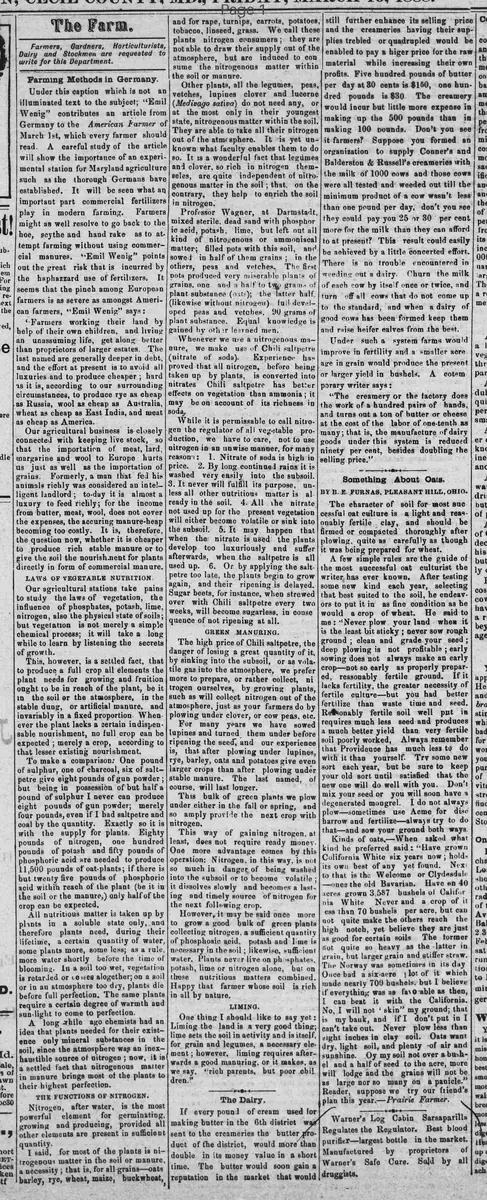
Under this caption which is not an illuminated text to the subject; "Emil Wenig" contributes an article from Germany to the American Farmer of March 1st, which every farmer should read. A careful study of the article will show the importance of an experimental station for Maryland agriculture such as the thorough Germans have established. It will be seen what an important part commercial fertilizers play in modern farming. Farmers might as well resolve to go back to the hoe, scythe and hand rake as to attempt farming without using commercial manures. "Emil Wenig" points out the great risk that is incurred by the haphazard use of fertilizers. It seems that the pinch among European farmers is as severe as amongst American farmers, "Emil Wenig" says:
Farmers working their land by help of their own children, and living an unassuming life, get along better than proprietors of larger estates. The last named are generally deeper in debt, and the effort at present is to avoid all luxuries and to produce cheaper; hard as it is, according to our surrounding circumstances, to produce rye as cheap as Russia, wool as cheap as Australia, wheat as cheap as East India, and meat as cheap as America.
Our agricultural business is closely connected with keeping live stock, so that the importation of meat, lard, margarine and wool to Europe hurts us just as well as the importation of grains. Formerly, a man that fed his animals richly was considered an intelligent landlord; to-day it is almost a luxury to feed richly; for the income from butter, meat, wool, does not cover the expenses, the accruing manure-heap becoming too costly. It is, therefore, the question now, whether it is cheaper to produce rich stable manure or to give the soil the nourishment for plants directly in form of commercial manure.
LAWS OF VEGETABLE NUTRITION.
Our agricultural stations take pains to study the laws of vegetation, the influence of phosphates, potash, lime, nitrogen, also the physical state of soils; but vegetation is not merely a simple chemical process; it will take a long while to learn by listening the secrets of growth.
This, however, is a settled fact, that to produce a full crop all elements the plant needs for growing and fruition ought to be in reach of the plant, be it in the soil or the atmosphere, in the stable dung, or artificial manure, and invariably in a fixed proportion. Whenever the plant lacks a certain indispensable nourishment, no full crop can be expected; merely a crop, according to that lesser existing nourishment.
To make a comparison: One pound of sulphur, one of charcoal, six of saltpetre give eight pounds of gun powder; but being in possession of but half a pound of sulphur I never can produce eight pounds of gun powder; merely four pounds, even if I had saltpetre and coal by the quantity. Exactly so it is with the supply for plants. Eighty pounds of nitrogen, one hundred pounds of potash and fifty pounds of phosphoric acid are needed to produce 11,500 pounds of oat-plants; if there is but twenty five pounds of phosphoric acid within reach of the plant (be it in the soil or the manure,) only half of the crop can be expected.
All nutritious matter is taken up by plants in a soluble state only, and therefore plants need, during their lifetime, a certain quantity of water. Some plants more, some less; as a rule, more water shortly before the time of blooming. In a soil too wet, vegetation is retarded or ceases altogether; on a soil or in an atmosphere too dry, plants die before full perfection. The same plants require a certain degree of warmth and sun-light to come to perfection.
A long while ago chemists had an idea that plants needed for their existence only mineral substances in the soil, since the atmosphere was an inexhaustible source of nitrogen; now, it is a settled fact that nitrogenous matter in manure brings most of the plants to their highest perfection.
THE FUNCTIONS OF NITROGEN.
Nitrogen, after water, is the most powerful element for germinating, growing and producing, provided all other elements are present in sufficient quantity.
I said, or most of the plants is nitrogenous matter in the soil or manure, a necessity; that is, for all grains--oats barley, rye, wheat, maize, buckwheat,
and for rape, turnips, carrots, potatoes. tobacco, linseed, grass. We call these plants nitrogen consumers; they are not able to draw their supply out of the atmosphere, but are induced to consume the nitrogenous matter within the soil or manure.
Other plants, all the legumes, peas, vetches, lupines clover and lucerne (Medicago sativa) do not need any, or at the most only in their youngest state, nitrogenous matter within the soil, They are able to take all their nitrogen out of the atmosphere. It is yet unknown what faculty enables them to do so. It is a wonderful fact that legumes and clover, so rich in nitrogen themselves, are quite independent of nitrogenous matter in the soil; that, on the contrary, they help to enrich the soil in nitrogen.
Professor Wagner, at Darmstadt. mixed sterile, dead sand with phosphoric acid, potash. lime, but left out all kind of nitrogenous or ammoniacal matter; filled pots with this soil, and sowed in half of them grains; in the others, peas and vetches. The first pots produced very miserable plants of grains, one and a half to two grams of plant substance (oats:); the latter half (likewise without nitrogen) full-developed peas and vetches, 90 grams of plant substance. Equal knowledge is gained by other learned men.
Whenever we use a nitrogenous manure, we make use of Chili saltpetre (nitrate of soda). Experience has proved that all nitrogen, before being taken up by plants, is converted into nitrates Chili saltpetre has better effects on vegetation than ammonia; it may be on account of its richness in soda.
While it is permissible to call nitrogen the regulator of all vegetable production, we have to care, not to use nitrogen in an unwise manner, for many reasons: 1. Nitrate of soda is high in price. 2. By long continued rains it is washed very easily into the subsoil. 3. It never will fulfill its purpose, unless all other nutritious matter is already in the soil. 4. All the nitrate not used up for the present vegetation will either become volatile or sink into the subsoil. 5. It may happen that when the nitrate is used the plants develop too luxuriously and suffer afterwards, when the saltpetre is all used up. 6. Or by applying the saltpetre too late, the plants begin to grow again, and their ripening is delayed.
Sugar beets, for instance, when strewed over with Chili saltpetre every two weeks, will become sugarless, in consequence of not ripening at all.
GREEN MANURING.
The high price of Chili saltpetre, the danger of losing a great quantity of it, by sinking into the subsoil, or as volatile gas into the atmosphere, we prefer more to prepare, or rather collect, nitrogen ourselves, by growing plants such as will collect nitrogen out of the atmosphere, just as your farmers do by plowing under clover, or cow peas, etc.
For many years we have sowed lupines and turned them under before ripening the seed, and our experience is, that after plowing under lupines, rye, barley, oats and potatoes give even larger crops than after plowing under stable manure. The last named, of course, will last longer.
This bulk of green plants we plow under either in the fall or spring, and so amply provide the next crop with nitrogen.
This way of gaining nitrogen, at least, does not require ready money.
One more advantage comes by this operation: Nitrogen, in this way, is not so much in danger of being washed into the subsoil or to become volatile; it dissolves slowly and becomes a lasting and timely source of nitrogen for the next following crop.
However, it may be said once more to grow a good bulk of green plants collecting nitrogen, a sufficient quantity of phosphoric acid. potash and lime is necessary in the soil; likewise, sufficient water. Plants never live on phosphates, potash, lime or nitrogen alone, but on these nutritious matters combined.
Happy that farmer whose soil is rich in all by nature.
LIMING.
One thing I should like to say yet :
Liming the land is a very good thing; lime sets the soil in activity and is itself, for grain and legumes, a necessary element; however, liming requires afterwards a good manuring, or it makes, as we say, rich parents, but poor children."
What sub-type of article is it?
What themes does it cover?
What keywords are associated?
What entities or persons were involved?
Where did it happen?
Story Details
Key Persons
Location
Germany
Event Date
March 1st
Story Details
Emil Wenig describes German farmers' economic struggles, advocates for experimental stations like in Maryland, stresses balanced use of commercial fertilizers, explains laws of plant nutrition requiring fixed proportions of elements, details nitrogen's crucial role for most crops versus legumes' atmospheric fixation, warns against misuse of nitrate of soda, promotes green manuring with lupines and clover for cost-effective nitrogen, and advises liming followed by manuring.