Thank you for visiting SNEWPapers!
Sign up free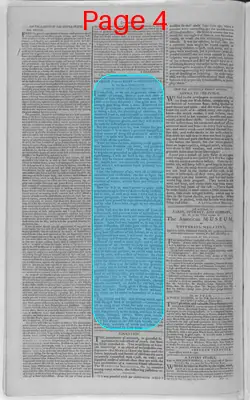
Literary
March 20, 1790
Gazette Of The United States
New York, New York County, New York
What is this article about?
Extract from Baron Poellnitz's essay on agriculture, exploring natural laws of vegetation through air, sun, light, and water mixtures. Discusses practical improvements like deep plowing and summer fallow for wheat cultivation, referencing Jethro Tull's innovations and the limited role of dung.
Clipping
OCR Quality
95%
Excellent
Full Text
* General Jackson's Speech.
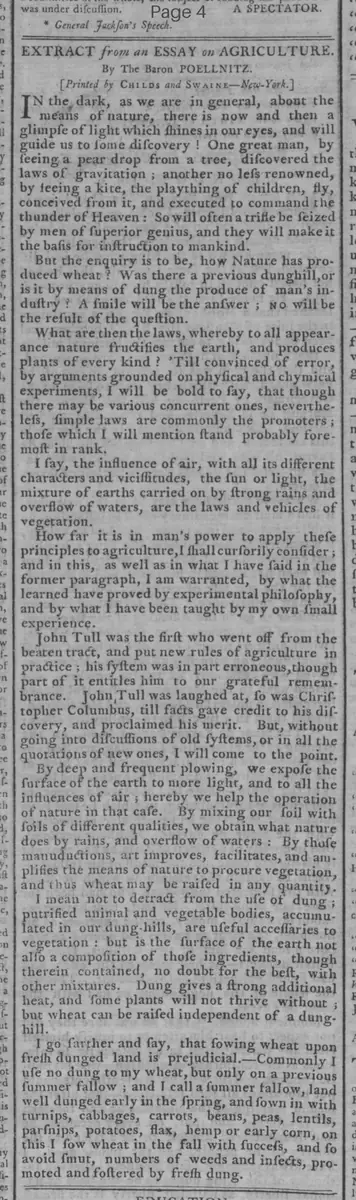
EXTRACT from an ESSAY on AGRICULTURE.
By The Baron POELLNITZ.
[Printed by CHILDS and SWAINE—New-York.]
IN the dark, as we are in general, about the means of nature, there is now and then a glimpse of light which shines in our eyes, and will guide us to some discovery! One great man, by seeing a pear drop from a tree, discovered the laws of gravitation; another no less renowned, by seeing a kite, the plaything of children, fly, conceived from it, and executed to command the thunder of Heaven: So will often a trifle be seized by men of superior genius, and they will make it the basis for instruction to mankind.
But the enquiry is to be, how Nature has produced wheat? Was there a previous dunghill, or is it by means of dung the produce of man's industry? A miller will be the answer; No will be the result of the question.
What are then the laws, whereby to all appearance nature fructifies the earth, and produces plants of every kind? 'Till convinced of error, by arguments grounded on physical and chemical experiments, I will be bold to say, that though there may be various concurrent ones, nevertheless, simple laws are commonly the promoters; those which I will mention stand probably foremost in rank.
I say, the influence of air, with all its different characters and vicissitudes, the sun or light, the mixture of earths carried on by strong rains and overflow of waters, are the laws and vehicles of vegetation.
How far it is in man's power to apply these principles to agriculture, I shall cursorily consider; and in this, as well as in what I have said in the former paragraph, I am warranted, by what the learned have proved by experimental philosophy, and by what I have been taught by my own small experience.
John Tull was the first who went off from the beaten tract, and put new rules of agriculture in practice; his system was in part erroneous, though part of it entitles him to our grateful remembrance. John Tull was laughed at, so was Christopher Columbus, till facts gave credit to his discovery, and proclaimed his merit. But, without going into discussions of old systems, or in all the quotations of new ones, I will come to the point.
By deep and frequent plowing, we expose the surface of the earth to more light, and to all the influences of air; hereby we help the operation of nature in that case. By mixing our soil with soils of different qualities, we obtain what nature does by rains, and overflow of waters: By those manuductions, art improves, facilitates, and amplifies the means of nature to procure vegetation, and thus wheat may be raised in any quantity.
I mean not to detract from the use of dung: putrified animal and vegetable bodies, accumulated in our dung-hills, are useful accessories to vegetation: but is the surface of the earth not also a composition of those ingredients, though therein contained, no doubt for the best, with other mixtures. Dung gives a strong additional heat, and some plants will not thrive without; but wheat can be raised independent of a dung-hill.
I go farther and say, that sowing wheat upon fresh dunged land is prejudicial. Commonly I use no dung to my wheat, but only on a previous summer fallow; and I call a summer fallow, land well dunged early in the spring, and sown in with turnips, cabbages, carrots, beans, peas, lentils, parsnips, potatoes, flax, hemp or early corn, on this I sow wheat in the fall with success, and so avoid rust, numbers of weeds and insects, promoted and fostered by fresh dung.
EXTRACT from an ESSAY on AGRICULTURE.
By The Baron POELLNITZ.
[Printed by CHILDS and SWAINE—New-York.]
IN the dark, as we are in general, about the means of nature, there is now and then a glimpse of light which shines in our eyes, and will guide us to some discovery! One great man, by seeing a pear drop from a tree, discovered the laws of gravitation; another no less renowned, by seeing a kite, the plaything of children, fly, conceived from it, and executed to command the thunder of Heaven: So will often a trifle be seized by men of superior genius, and they will make it the basis for instruction to mankind.
But the enquiry is to be, how Nature has produced wheat? Was there a previous dunghill, or is it by means of dung the produce of man's industry? A miller will be the answer; No will be the result of the question.
What are then the laws, whereby to all appearance nature fructifies the earth, and produces plants of every kind? 'Till convinced of error, by arguments grounded on physical and chemical experiments, I will be bold to say, that though there may be various concurrent ones, nevertheless, simple laws are commonly the promoters; those which I will mention stand probably foremost in rank.
I say, the influence of air, with all its different characters and vicissitudes, the sun or light, the mixture of earths carried on by strong rains and overflow of waters, are the laws and vehicles of vegetation.
How far it is in man's power to apply these principles to agriculture, I shall cursorily consider; and in this, as well as in what I have said in the former paragraph, I am warranted, by what the learned have proved by experimental philosophy, and by what I have been taught by my own small experience.
John Tull was the first who went off from the beaten tract, and put new rules of agriculture in practice; his system was in part erroneous, though part of it entitles him to our grateful remembrance. John Tull was laughed at, so was Christopher Columbus, till facts gave credit to his discovery, and proclaimed his merit. But, without going into discussions of old systems, or in all the quotations of new ones, I will come to the point.
By deep and frequent plowing, we expose the surface of the earth to more light, and to all the influences of air; hereby we help the operation of nature in that case. By mixing our soil with soils of different qualities, we obtain what nature does by rains, and overflow of waters: By those manuductions, art improves, facilitates, and amplifies the means of nature to procure vegetation, and thus wheat may be raised in any quantity.
I mean not to detract from the use of dung: putrified animal and vegetable bodies, accumulated in our dung-hills, are useful accessories to vegetation: but is the surface of the earth not also a composition of those ingredients, though therein contained, no doubt for the best, with other mixtures. Dung gives a strong additional heat, and some plants will not thrive without; but wheat can be raised independent of a dung-hill.
I go farther and say, that sowing wheat upon fresh dunged land is prejudicial. Commonly I use no dung to my wheat, but only on a previous summer fallow; and I call a summer fallow, land well dunged early in the spring, and sown in with turnips, cabbages, carrots, beans, peas, lentils, parsnips, potatoes, flax, hemp or early corn, on this I sow wheat in the fall with success, and so avoid rust, numbers of weeds and insects, promoted and fostered by fresh dung.
What sub-type of article is it?
Essay
What themes does it cover?
Agriculture Rural
Nature
What keywords are associated?
Agriculture
Wheat Cultivation
Natural Laws
Jethro Tull
Summer Fallow
Dung Use
Deep Plowing
Vegetation Principles
What entities or persons were involved?
By The Baron Poellnitz
Literary Details
Title
Extract From An Essay On Agriculture
Author
By The Baron Poellnitz
Subject
On The Laws Of Nature In Agriculture And Wheat Cultivation
Key Lines
One Great Man, By Seeing A Pear Drop From A Tree, Discovered The Laws Of Gravitation ; Another No Less Renowned, By Seeing A Kite, The Plaything Of Children, Fly. Conceived From It, And Executed To Command The Thunder Of Heaven
I Say, The Influence Of Air, With All Its Different Characters And Vicissitudes, The Sun Or Light, The Mixture Of Earths Carried On By Strong Rains And Overflow Of Waters, Are The Laws And Vehicles Of Vegetation.
By Deep And Frequent Plowing, We Expose The Surface Of The Earth To More Light, And To All The Influences Of Air ; Hereby We Help The Operation Of Nature In That Case.
Wheat Can Be Raised Independent Of A Dung Hill.
I Call A Summer Fallow, Land Well Dunged Early In The Spring, And Sown In With Turnips, Cabbages, Carrots, Beans, Peas, Lentils, Parsnips, Potatoes, Flax, Hemp Or Early Corn, On This I Sow Wheat In The Fall With Success