Thank you for visiting SNEWPapers!
Sign up free
Literary
July 23, 1874
The Rutland Daily Globe
Rutland, Rutland County, Vermont
What is this article about?
A children's article describes the beautiful oval nest of the Long-tailed Titmouse, built by the female in Europe using moss, wool, and lichens. It details her family life, egg-laying, and bird habits, encouraging readers to study bird life for useful lessons.
Clipping
OCR Quality
98%
Excellent
Full Text
CHILDREN'S DEPARTMENT.
The Long-tailed Titmice.
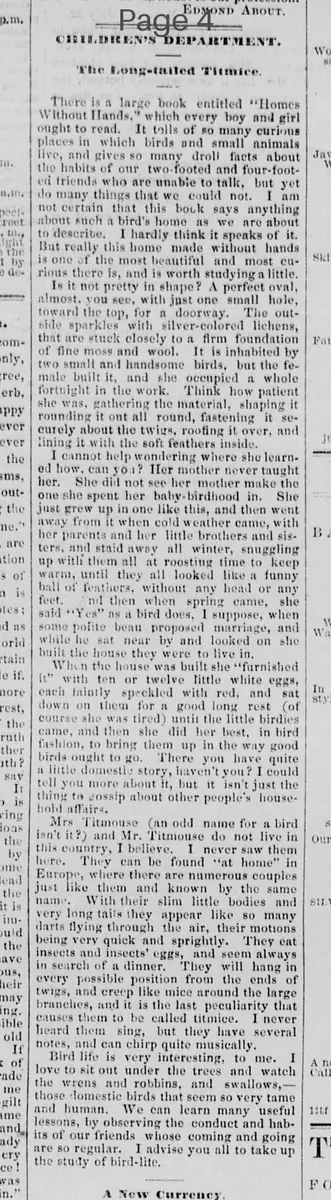
There is a large book entitled "Homes Without Hands," which every boy and girl ought to read. It tells of so many curious places in which birds and small animals live, and gives so many droll facts about the habits of our two-footed and four-footed friends who are unable to talk, but yet do many things that we could not. I am not certain that this book says anything about such a bird's home as we are about to describe. I hardly think it speaks of it. But really this home made without hands is one of the most beautiful and most curious there is, and is worth studying a little.
Is it not pretty in shape? A perfect oval, almost, you see, with just one small hole, toward the top, for a doorway. The outside sparkles with silver-colored lichens, that are stuck closely to a firm foundation of fine moss and wool. It is inhabited by two small and handsome birds, but the female built it, and she occupied a whole fortnight in the work. Think how patient she was, gathering the material, shaping it, rounding it out all round, fastening it securely about the twigs, roofing it over, and lining it with the soft feathers inside.
I cannot help wondering where she learned how, can you? Her mother never taught her. She did not see her mother make the one she spent her baby-birdhood in. She just grew up in one like this, and then went away from it when cold weather came, with her parents and her little brothers and sisters, and staid away all winter, snuggling up with them all at roosting time to keep warm, until they all looked like a funny ball of feathers, without any head or any feet. And then when spring came, she said "Yes" as a bird does, I suppose, when some polite beau proposed marriage, and while he sat near by and looked on she built the house they were to live in.
When the house was built she "furnished it" with ten or twelve little white eggs, each faintly speckled with red, and sat down on them for a good long rest (of course she was tired) until the little birdies came, and then she did her best, in bird fashion, to bring them up in the way good birds ought to go. There you have quite a little domestic story, haven't you? I could tell you more about it, but it isn't just the thing to gossip about other people's household affairs.
Mrs Titmouse (an odd name for a bird isn't it?) and Mr. Titmouse do not live in this country, I believe. I never saw them here. They can be found "at home" in Europe, where there are numerous couples just like them and known by the same name. With their slim little bodies and very long tails they appear like so many darts flying through the air, their motions being very quick and sprightly. They eat insects and insects' eggs, and seem always in search of a dinner. They will hang in every possible position from the ends of twigs, and creep like mice around the large branches, and it is the last peculiarity that causes them to be called titmice. I never heard them sing, but they have several notes, and can chirp quite musically.
Bird life is very interesting, to me. I love to sit out under the trees and watch the wrens and robins, and swallows,—those domestic birds that seem so very tame and human. We can learn many useful lessons, by observing the conduct and habits of our friends whose coming and going are so regular. I advise you all to take up the study of bird-life.
The Long-tailed Titmice.
There is a large book entitled "Homes Without Hands," which every boy and girl ought to read. It tells of so many curious places in which birds and small animals live, and gives so many droll facts about the habits of our two-footed and four-footed friends who are unable to talk, but yet do many things that we could not. I am not certain that this book says anything about such a bird's home as we are about to describe. I hardly think it speaks of it. But really this home made without hands is one of the most beautiful and most curious there is, and is worth studying a little.
Is it not pretty in shape? A perfect oval, almost, you see, with just one small hole, toward the top, for a doorway. The outside sparkles with silver-colored lichens, that are stuck closely to a firm foundation of fine moss and wool. It is inhabited by two small and handsome birds, but the female built it, and she occupied a whole fortnight in the work. Think how patient she was, gathering the material, shaping it, rounding it out all round, fastening it securely about the twigs, roofing it over, and lining it with the soft feathers inside.
I cannot help wondering where she learned how, can you? Her mother never taught her. She did not see her mother make the one she spent her baby-birdhood in. She just grew up in one like this, and then went away from it when cold weather came, with her parents and her little brothers and sisters, and staid away all winter, snuggling up with them all at roosting time to keep warm, until they all looked like a funny ball of feathers, without any head or any feet. And then when spring came, she said "Yes" as a bird does, I suppose, when some polite beau proposed marriage, and while he sat near by and looked on she built the house they were to live in.
When the house was built she "furnished it" with ten or twelve little white eggs, each faintly speckled with red, and sat down on them for a good long rest (of course she was tired) until the little birdies came, and then she did her best, in bird fashion, to bring them up in the way good birds ought to go. There you have quite a little domestic story, haven't you? I could tell you more about it, but it isn't just the thing to gossip about other people's household affairs.
Mrs Titmouse (an odd name for a bird isn't it?) and Mr. Titmouse do not live in this country, I believe. I never saw them here. They can be found "at home" in Europe, where there are numerous couples just like them and known by the same name. With their slim little bodies and very long tails they appear like so many darts flying through the air, their motions being very quick and sprightly. They eat insects and insects' eggs, and seem always in search of a dinner. They will hang in every possible position from the ends of twigs, and creep like mice around the large branches, and it is the last peculiarity that causes them to be called titmice. I never heard them sing, but they have several notes, and can chirp quite musically.
Bird life is very interesting, to me. I love to sit out under the trees and watch the wrens and robins, and swallows,—those domestic birds that seem so very tame and human. We can learn many useful lessons, by observing the conduct and habits of our friends whose coming and going are so regular. I advise you all to take up the study of bird-life.
What sub-type of article is it?
Essay
What themes does it cover?
Nature
Moral Virtue
What keywords are associated?
Titmice
Bird Nests
Nature Observation
Children's Education
European Birds
Bird Habits
Literary Details
Title
The Long Tailed Titmice.
Key Lines
Is It Not Pretty In Shape? A Perfect Oval, Almost, You See, With Just One Small Hole, Toward The Top, For A Doorway.
Think How Patient She Was, Gathering The Material, Shaping It, Rounding It Out All Round, Fastening It Securely About The Twigs, Roofing It Over, And Lining It With The Soft Feathers Inside.
We Can Learn Many Useful Lessons, By Observing The Conduct And Habits Of Our Friends Whose Coming And Going Are So Regular.
I Advise You All To Take Up The Study Of Bird Life.