Thank you for visiting SNEWPapers!
Sign up free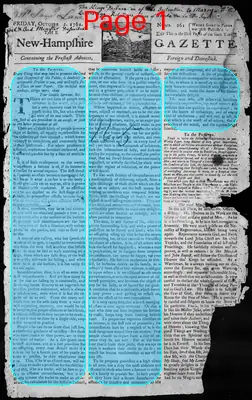
Letter to Editor
October 2, 1761
The New Hampshire Gazette
Portsmouth, Rockingham County, New Hampshire
What is this article about?
An anonymous letter urges financial prudence, criticizing excessive providence or none at all, and advises saving at least a quarter of annual income to avoid ruin, ensure family security, and achieve true happiness through moral and rational living.
Clipping
OCR Quality
98%
Excellent
Full Text
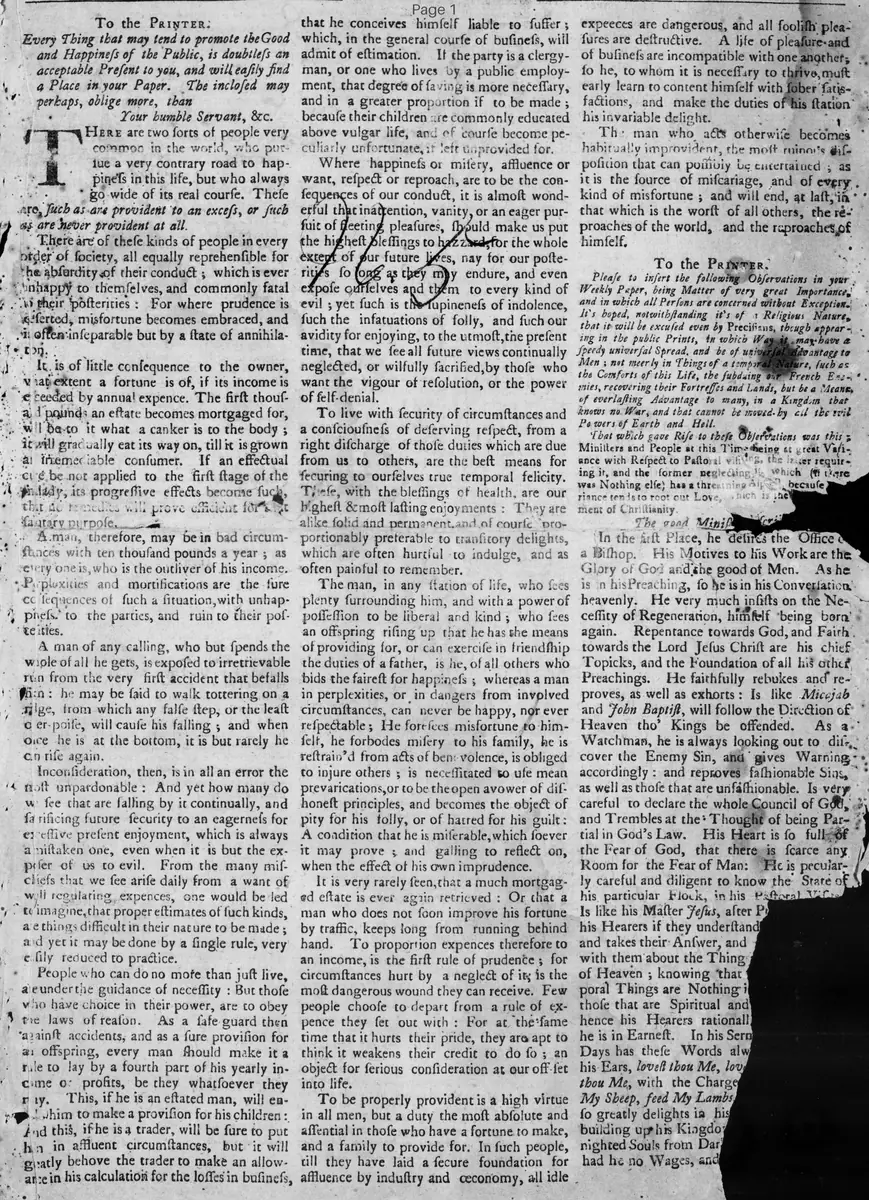
To the Printer:
Every Thing that may lend to promote the Good and Happiness of the Public, is doubtless an acceptable Present to you, and will easily find a Place in your Paper. The enclosed may perhaps, oblige more, than
Your humble Servant, &c.
Here are two sorts of people very common in the world, who pursue a very contrary road to happiness in this life, but who always go wide of its real course. These are, such as are provident to an excess, or such as are never provident at all.
There are of these kinds of people in every order of society, all equally reprehensible for the absurdity of their conduct: which is ever unhappy to themselves, and commonly fatal to their posterities: For where prudence is deserted, misfortune becomes embraced, and it often inseparable but by a state of annihilation.
It is of little consequence to the owner, what extent a fortune is of, if its income is exceeded by annual expence. The first thousand pounds an estate becomes mortgaged for, will be to it what a canker is to the body; it will gradually eat its way on, till it is grown an irretrievable consumer. If an effectual check be not applied to the first stage of the malady, its progressive effects become such, that no remedies will prove sufficient for a salutary purpose.
A man, therefore, may be in bad circumstances with ten thousand pounds a year; as every one is, who is the outliver of his income. Perplexities and mortifications are the sure consequences of such a situation, with unhappiness to the parties, and ruin to their posterities.
A man of any calling, who but spends the whole of all he gets, is exposed to irretrievable ruin from the very first accident that befalls him: he may be said to walk tottering on a ridge, from which any false step, or the least overpoise, will cause his falling; and when once he is at the bottom, it is but rarely he can rise again.
Inconsideration, then, is in all an error the most unpardonable: And yet how many do we see that are falling by it continually, and sacrificing future security to an eagerness for excessive present enjoyment, which is always a mistaken one, even when it is but the excess of us to evil. From the many mischiefs that we see arise daily from a want of duly regulating expenses, one would be led to imagine, that proper estimates of such kinds, are things difficult in their nature to be made; and yet it may be done by a single rule, very easily reduced to practice.
People who can do no more than just live, are under the guidance of necessity: But those who have choice in their power, are to obey the laws of reason. As a safe guard then against accidents, and as a sure provision for offspring, every man should make it a rule to lay by a fourth part of his yearly income or profits, be they whatsoever they may. This, if he is an estated man, will enable him to make a provision for his children: And this, if he is a trader, will be sure to put him in affluent circumstances, but it will greatly behove the trader to make an allowance in his calculation for the loss in business that he conceives himself liable to suffer: which, in the general course of business, will admit of estimation. If the party is a clergyman, or one who lives by a public employment, that degree of saving is more necessary, and in a greater proportion is to be made; because their children are commonly educated above vulgar life, and of course become peculiarly unfortunate, if left unprovided for.
Where happiness or misery, affluence or want, respect or reproach, are to be the consequences of our conduct, it is almost wonderful that inattention, vanity, or an eager pursuit of fleeting pleasures, should make us put the highest Blessings to hazard for the whole extent of our future lives, nay for our posterities so long as they may endure, and even expose ourselves and them to every kind of evil: yet such is the Supineness of indolence, such the infatuations of folly, and such our avidity for enjoying, to the utmost, the present time, that we see all future views continually neglected, or wilfully sacrificed, by those who want the vigour of resolution, or the power of self-denial.
To live with security of circumstances and a consciousness of deserving respect, from a right discharge of those duties which are due from us to others, are the best means for securing to ourselves true temporal felicity. These, with the blessings of health, are our highest & most lasting enjoyments: They are alike solid and permanent, and of course proportionably preferable to transitory delights, which are often hurtful to indulge, and as often painful to remember.
The man, in any station of life, who sees plenty surrounding him, and with a power of possession to be liberal and kind: who sees an offspring rising up that he has the means of providing for, or can exercise in friendship the duties of a father, is he, of all others who bids the fairest for happiness; whereas a man in perplexities, or in dangers from involved circumstances, can never be happy, nor ever respectable; He forces misfortune to himself, he forebodes misery to his family, he is restrain'd from acts of benevolence, is obliged to injure others; is necessitated to use mean prevarications, or to be the open avower of dishonest principles, and becomes the object of pity for his folly, or of hatred for his guilt: A condition that he is miserable, which soever it may prove; and galling to reflect on, when the effect of his own imprudence.
It is very rarely seen, that a much mortgaged estate is ever again retrieved: Or that a man who does not soon improve his fortune by traffic, keeps long from running behind hand. To proportion expenses therefore to an income, is the first rule of prudence; for circumstances hurt by a neglect of it; is the most dangerous wound they can receive. Few people choose to depart from a rule of expense they set out with: For at the same time that it hurts their pride, they are apt to think it weakens their credit to do so; an object for serious consideration at our outset into life.
To be properly provident is a high virtue in all men, but a duty the most absolute and essential in those who have a fortune to make, and a family to provide for. In such people, till they have laid a secure foundation for affluence by industry and oeconomy, all idle expenses are dangerous, and all foolish pleasures are destructive. A life of pleasure and of business are incompatible with one another; so he, to whom it is necessary to thrive, must early learn to content himself with sober satisfactions, and make the duties of his station his invariable delight.
The man who acts otherwise becomes habitually improvident, the most ruinous disposition that can possibly be entertained; as it is the source of miscarriage, and of every kind of misfortune; and will end, at last, in that which is the worst of all others, the reproaches of the world, and the reproaches of himself.
Every Thing that may lend to promote the Good and Happiness of the Public, is doubtless an acceptable Present to you, and will easily find a Place in your Paper. The enclosed may perhaps, oblige more, than
Your humble Servant, &c.
Here are two sorts of people very common in the world, who pursue a very contrary road to happiness in this life, but who always go wide of its real course. These are, such as are provident to an excess, or such as are never provident at all.
There are of these kinds of people in every order of society, all equally reprehensible for the absurdity of their conduct: which is ever unhappy to themselves, and commonly fatal to their posterities: For where prudence is deserted, misfortune becomes embraced, and it often inseparable but by a state of annihilation.
It is of little consequence to the owner, what extent a fortune is of, if its income is exceeded by annual expence. The first thousand pounds an estate becomes mortgaged for, will be to it what a canker is to the body; it will gradually eat its way on, till it is grown an irretrievable consumer. If an effectual check be not applied to the first stage of the malady, its progressive effects become such, that no remedies will prove sufficient for a salutary purpose.
A man, therefore, may be in bad circumstances with ten thousand pounds a year; as every one is, who is the outliver of his income. Perplexities and mortifications are the sure consequences of such a situation, with unhappiness to the parties, and ruin to their posterities.
A man of any calling, who but spends the whole of all he gets, is exposed to irretrievable ruin from the very first accident that befalls him: he may be said to walk tottering on a ridge, from which any false step, or the least overpoise, will cause his falling; and when once he is at the bottom, it is but rarely he can rise again.
Inconsideration, then, is in all an error the most unpardonable: And yet how many do we see that are falling by it continually, and sacrificing future security to an eagerness for excessive present enjoyment, which is always a mistaken one, even when it is but the excess of us to evil. From the many mischiefs that we see arise daily from a want of duly regulating expenses, one would be led to imagine, that proper estimates of such kinds, are things difficult in their nature to be made; and yet it may be done by a single rule, very easily reduced to practice.
People who can do no more than just live, are under the guidance of necessity: But those who have choice in their power, are to obey the laws of reason. As a safe guard then against accidents, and as a sure provision for offspring, every man should make it a rule to lay by a fourth part of his yearly income or profits, be they whatsoever they may. This, if he is an estated man, will enable him to make a provision for his children: And this, if he is a trader, will be sure to put him in affluent circumstances, but it will greatly behove the trader to make an allowance in his calculation for the loss in business that he conceives himself liable to suffer: which, in the general course of business, will admit of estimation. If the party is a clergyman, or one who lives by a public employment, that degree of saving is more necessary, and in a greater proportion is to be made; because their children are commonly educated above vulgar life, and of course become peculiarly unfortunate, if left unprovided for.
Where happiness or misery, affluence or want, respect or reproach, are to be the consequences of our conduct, it is almost wonderful that inattention, vanity, or an eager pursuit of fleeting pleasures, should make us put the highest Blessings to hazard for the whole extent of our future lives, nay for our posterities so long as they may endure, and even expose ourselves and them to every kind of evil: yet such is the Supineness of indolence, such the infatuations of folly, and such our avidity for enjoying, to the utmost, the present time, that we see all future views continually neglected, or wilfully sacrificed, by those who want the vigour of resolution, or the power of self-denial.
To live with security of circumstances and a consciousness of deserving respect, from a right discharge of those duties which are due from us to others, are the best means for securing to ourselves true temporal felicity. These, with the blessings of health, are our highest & most lasting enjoyments: They are alike solid and permanent, and of course proportionably preferable to transitory delights, which are often hurtful to indulge, and as often painful to remember.
The man, in any station of life, who sees plenty surrounding him, and with a power of possession to be liberal and kind: who sees an offspring rising up that he has the means of providing for, or can exercise in friendship the duties of a father, is he, of all others who bids the fairest for happiness; whereas a man in perplexities, or in dangers from involved circumstances, can never be happy, nor ever respectable; He forces misfortune to himself, he forebodes misery to his family, he is restrain'd from acts of benevolence, is obliged to injure others; is necessitated to use mean prevarications, or to be the open avower of dishonest principles, and becomes the object of pity for his folly, or of hatred for his guilt: A condition that he is miserable, which soever it may prove; and galling to reflect on, when the effect of his own imprudence.
It is very rarely seen, that a much mortgaged estate is ever again retrieved: Or that a man who does not soon improve his fortune by traffic, keeps long from running behind hand. To proportion expenses therefore to an income, is the first rule of prudence; for circumstances hurt by a neglect of it; is the most dangerous wound they can receive. Few people choose to depart from a rule of expense they set out with: For at the same time that it hurts their pride, they are apt to think it weakens their credit to do so; an object for serious consideration at our outset into life.
To be properly provident is a high virtue in all men, but a duty the most absolute and essential in those who have a fortune to make, and a family to provide for. In such people, till they have laid a secure foundation for affluence by industry and oeconomy, all idle expenses are dangerous, and all foolish pleasures are destructive. A life of pleasure and of business are incompatible with one another; so he, to whom it is necessary to thrive, must early learn to content himself with sober satisfactions, and make the duties of his station his invariable delight.
The man who acts otherwise becomes habitually improvident, the most ruinous disposition that can possibly be entertained; as it is the source of miscarriage, and of every kind of misfortune; and will end, at last, in that which is the worst of all others, the reproaches of the world, and the reproaches of himself.
What sub-type of article is it?
Philosophical
Reflective
Ethical Moral
What themes does it cover?
Morality
Economic Policy
What keywords are associated?
Financial Prudence
Saving Income
Family Provision
Moral Duty
Excessive Spending
Posterity Security
Economic Ruin
What entities or persons were involved?
Your Humble Servant, &C.
To The Printer
Letter to Editor Details
Author
Your Humble Servant, &C.
Recipient
To The Printer
Main Argument
financial prudence is essential for personal happiness and family security; individuals should save at least a quarter of their annual income to avoid ruin from excessive spending or accidents, prioritizing reason over fleeting pleasures.
Notable Details
Recommends Laying By A Fourth Part Of Yearly Income As A Rule For All Men.
Warns That Exceeding Income Leads To Mortgages And Irretrievable Ruin.
Emphasizes Greater Saving For Clergymen And Public Employees Due To Their Children's Education.