Thank you for visiting SNEWPapers!
Sign up free
Editorial
August 5, 1919
The Alaska Daily Empire
Juneau, Alaska
What is this article about?
Editorial argues that the US should ratify the Treaty of Versailles despite dissatisfaction with the Shantung settlement favoring Japan, to enable joining the League of Nations, which would protect China and allow future resolution of the issue through international mechanisms.
Clipping
OCR Quality
98%
Excellent
Full Text
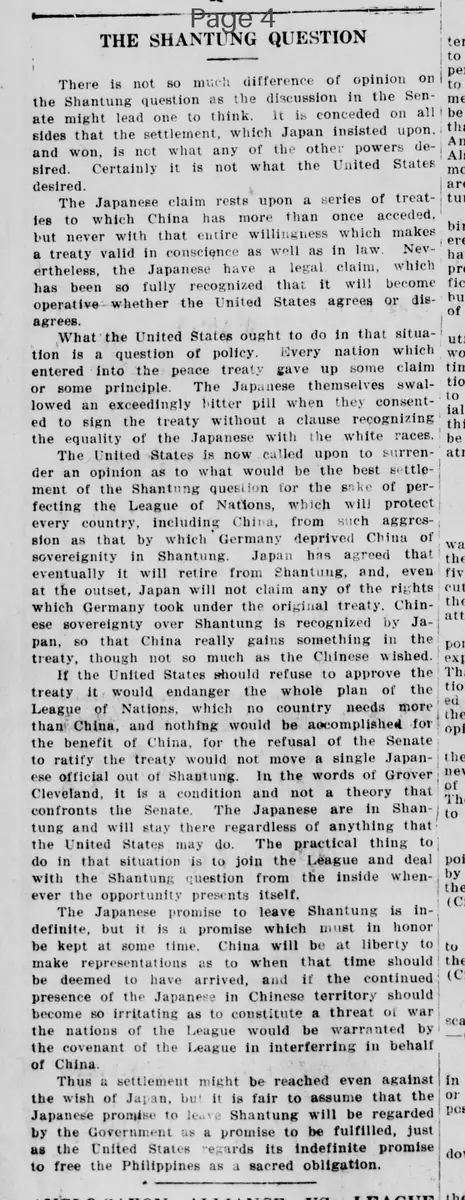
THE SHANTUNG QUESTION
There is not so much difference of opinion on the Shantung question as the discussion in the Senate might lead one to think. It is conceded on all sides that the settlement, which Japan insisted upon, and won, is not what any of the other powers desired. Certainly it is not what the United States desired.
The Japanese claim rests upon a series of treaties to which China has more than once acceded, but never with that entire willingness which makes a treaty valid in conscience as well as in law. Nevertheless, the Japanese have a legal claim, which has been so fully recognized that it will become operative whether the United States agrees or disagrees.
What the United States ought to do in that situation is a question of policy. Every nation which entered into the peace treaty gave up some claim or some principle. The Japanese themselves swallowed an exceedingly bitter pill when they consented to sign the treaty without a clause recognizing the equality of the Japanese with the white races.
The United States is now called upon to surrender an opinion as to what would be the best settlement of the Shantung question for the sake of perfecting the League of Nations, which will protect every country, including China, from such aggression as that by which Germany deprived China of sovereignty in Shantung. Japan has agreed that eventually it will retire from Shantung, and, even at the outset, Japan will not claim any of the rights which Germany took under the original treaty. Chinese sovereignty over Shantung is recognized by Japan, so that China really gains something in the treaty, though not so much as the Chinese wished.
If the United States should refuse to approve the treaty it would endanger the whole plan of the League of Nations, which no country needs more than China, and nothing would be accomplished for the benefit of China, for the refusal of the Senate to ratify the treaty would not move a single Japanese official out of Shantung. In the words of Grover Cleveland, it is a condition and not a theory that confronts the Senate. The Japanese are in Shantung and will stay there regardless of anything that the United States may do. The practical thing to do in that situation is to join the League and deal with the Shantung question from the inside whenever the opportunity presents itself.
The Japanese promise to leave Shantung is indefinite, but it is a promise which must in honor be kept at some time. China will be at liberty to make representations as to when that time should be deemed to have arrived, and if the continued presence of the Japanese in Chinese territory should become so irritating as to constitute a threat of war the nations of the League would be warranted by the covenant of the League in interfering in behalf of China.
Thus a settlement might be reached even against the wish of Japan, but it is fair to assume that the Japanese promise to leave Shantung will be regarded by the Government as a promise to be fulfilled, just as the United States regards its indefinite promise to free the Philippines as a sacred obligation.
There is not so much difference of opinion on the Shantung question as the discussion in the Senate might lead one to think. It is conceded on all sides that the settlement, which Japan insisted upon, and won, is not what any of the other powers desired. Certainly it is not what the United States desired.
The Japanese claim rests upon a series of treaties to which China has more than once acceded, but never with that entire willingness which makes a treaty valid in conscience as well as in law. Nevertheless, the Japanese have a legal claim, which has been so fully recognized that it will become operative whether the United States agrees or disagrees.
What the United States ought to do in that situation is a question of policy. Every nation which entered into the peace treaty gave up some claim or some principle. The Japanese themselves swallowed an exceedingly bitter pill when they consented to sign the treaty without a clause recognizing the equality of the Japanese with the white races.
The United States is now called upon to surrender an opinion as to what would be the best settlement of the Shantung question for the sake of perfecting the League of Nations, which will protect every country, including China, from such aggression as that by which Germany deprived China of sovereignty in Shantung. Japan has agreed that eventually it will retire from Shantung, and, even at the outset, Japan will not claim any of the rights which Germany took under the original treaty. Chinese sovereignty over Shantung is recognized by Japan, so that China really gains something in the treaty, though not so much as the Chinese wished.
If the United States should refuse to approve the treaty it would endanger the whole plan of the League of Nations, which no country needs more than China, and nothing would be accomplished for the benefit of China, for the refusal of the Senate to ratify the treaty would not move a single Japanese official out of Shantung. In the words of Grover Cleveland, it is a condition and not a theory that confronts the Senate. The Japanese are in Shantung and will stay there regardless of anything that the United States may do. The practical thing to do in that situation is to join the League and deal with the Shantung question from the inside whenever the opportunity presents itself.
The Japanese promise to leave Shantung is indefinite, but it is a promise which must in honor be kept at some time. China will be at liberty to make representations as to when that time should be deemed to have arrived, and if the continued presence of the Japanese in Chinese territory should become so irritating as to constitute a threat of war the nations of the League would be warranted by the covenant of the League in interfering in behalf of China.
Thus a settlement might be reached even against the wish of Japan, but it is fair to assume that the Japanese promise to leave Shantung will be regarded by the Government as a promise to be fulfilled, just as the United States regards its indefinite promise to free the Philippines as a sacred obligation.
What sub-type of article is it?
Foreign Affairs
War Or Peace
What keywords are associated?
Shantung Question
League Of Nations
Peace Treaty
Japan China
Us Ratification
Senate Debate
What entities or persons were involved?
United States
Japan
China
Senate
League Of Nations
Grover Cleveland
Editorial Details
Primary Topic
Shantung Question And Us Treaty Ratification
Stance / Tone
Pragmatic Support For Ratifying The Treaty To Join The League Of Nations
Key Figures
United States
Japan
China
Senate
League Of Nations
Grover Cleveland
Key Arguments
Japanese Legal Claim To Shantung Is Recognized Despite Moral Qualms
All Nations Compromised In The Peace Treaty, Including Japan On Racial Equality
Ratifying The Treaty Enables Us Entry Into The League, Benefiting China Against Aggression
Refusing Ratification Achieves Nothing For China And Endangers The League
Japan Promises Eventual Withdrawal From Shantung, Enforceable Via League Mechanisms
Practical Approach: Join League And Address Shantung Internally