Thank you for visiting SNEWPapers!
Sign up free
Wheeling Daily Intelligencer
Wheeling, Ohio County, West Virginia
What is this article about?
In 1854, U.S. Representatives F.B. Cutting and John C. Breckenridge exchange letters after a heated House debate, nearly leading to a duel in Maryland, but resolve the honor dispute amicably through clarification and retraction. (187 characters)
Clipping
OCR Quality
Full Text
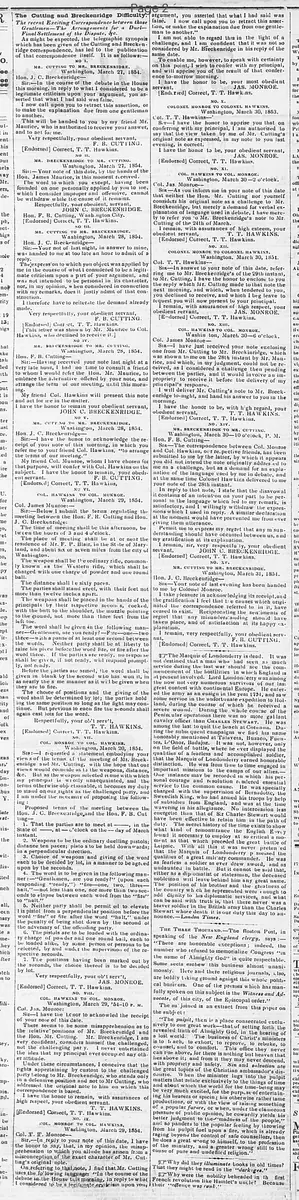
The recent Exciting Correspondence between those Gentlemen—The Arrangements for 'Duel'—Final Settlement of the Dispute, &c.
As might be expected, the telegraphic synopsis which has been given of the Cutting and Breckenridge correspondence, has led to the publication of that correspondence itself. It is as follows:
NO I.
MR. CUTTING TO MR. BRECKENRIDGE.
Washington, March 27, 1854.
Hon. J. C. Breckenridge
Sir:—In the course of the debate in the House this morning, in reply to what I considered to be a legitimate criticism upon your argument, you asserted that what I had said was false.
I now call upon you to retract this assertion, or to make the explanation due from one gentleman to another.
This will be handed to you by my friend Mr. Maurice, who is authorized to receive your answer, and to act for me.
Very respectfully, your obedient servant,
F. B. CUTTING.
[Endorsed] Correct, T. T. Hawkins.
NO II.
MR. BRECKENRIDGE TO MR. CUTTING.
Washington, March 27, 1854.
Sir:—Your note of this date, by the hands of the Hon. James Maurice, is this moment received.
The word to which you except, having been founded on one personally applied by you to me, which I consider improper and offensive, cannot be withdrawn while the cause of it remains.
Respectfully, your obedient servant,
JOHN C. BRECKENRIDGE.
Hon. F. B. Cutting. Washington City.
[Endorsed] Correct, T. T. Hawkins.
NO III.
MR. CUTTING TO MR. BRECKENRIDGE.
Washington, March 28, 1854.
Hon. J. C. Breckenridge—
Sir:—Your note of last night, in answer to mine was handed to me at too late an hour to admit of reply.
The expression to which you object was applied by me in the course of what I considered to be a legitimate criticism upon a part of your argument, and was not intended to be personal in its character, nor, in my opinion, when considered in connection with my remarks, does it justly admit of that construction.
I therefore have to reiterate the demand already made.
Very respectfully, your obedient servant,
F. B. CUTTING.
[Endorsed] Correct, T. T. Hawkins.
[This letter was shown by Mr. Maurice to Col. Hawkins, who declined to receive it.]
NO IV.
MR. BRECKENRIDGE TO MR. CUTTING.
Washington, March 28, 1854.
Hon. F. B. Cutting—
Sir:—Having received your note last night at a very late hour, I had no time to consult a friend to whom I would refer the Hon. Mr. Maurice, to embrace the alternative offered by your note, and arrange the terms of our meeting, until this morning.
My friend Col. Hawkins will present this note and act for me in the matter.
I have the honor to remain your obedient servant,
JOHN C. BRECKENRIDGE.
NO V.
MR. CUTTING TO MR. BRECKENRIDGE.
Washington, March 28, 1854.
Hon. J. C. Breckenridge—
Sir:—I have the honor to acknowledge the receipt of your note of this morning, in which you refer me to your friend Col. Hawkins. 'to arrange the terms of our meeting.'
My friend Col. Munroe, whom I have chosen for that purpose, will confer with Col. Hawkins on the subject. I have the honor to remain, your obedient servant,
F. B. CUTTING.
[Endorsed] Correct, T. T. Hawkins.
NO VI.
COL. HAWKINS TO COL. MUNROE.
Washington, March 29, 1854.
Col. James Munroe:—
Sir:—Below I submit the terms regulating the meeting between the Hon. F. B. Cutting and Hon. J. C. Breckenridge:
The time of meeting shall be this afternoon, between the hours of 3 and 4 o'clock.
The place of meeting shall be at or near the residence of Mr. F. P. Blair, in the State of Maryland, and about six or seven miles from the city of Washington.
The weapon shall be the ordinary rifle, commonly known as the Western rifle, which shall be charged with one charge of powder and one round ball.
The distance shall be sixty paces.
The parties shall stand erect, with their feet not more than twelve inches apart.
The weapons shall be placed in the hands of the principals by their respective seconds, cocked, with the butt to the shoulder, the muzzle pointing to the ground, not more than three feet from the left toe.
The word shall be given in the following manner—Gentlemen, are you ready?—Fire—one—two—three—with a pause of at least one second between the words. Neither party shall be at liberty to raise his piece before the word fire, or fire after the word three. If the parties are ready, no response shall be given, if not ready, will respond promptly, not ready.
Before the parties are armed, the word shall be given in blank by the second who has won it, in as nearly the same manner as it will be given when they are to fire.
The choice of positions and the giving of the word shall be determined by lot; the parties holding the same position so long as the fight may continue. But previous to each fire the seconds shall again cast lots for the word.
Respectfully, your obt servant,
T. T. HAWKINS.
[Endorsed] Correct, T. T. Hawkins.
NO. VII.
COL. MONROE TO COL. HAWKINS.
Washington, March 29, 1854.
Sir:—I requested a statement embodying your views of the terms of the meeting of Mr. Breckenridge and Mr. Cutting, with the hope that our views would coincide as to the weapons, distance, &c. But as the weapon selected is one with which my principal is wholly unacquainted, and the terms otherwise objectionable, it becomes my duty to stand on our rights as the challenged party, and I am under the necessity of proposing the following:
Proposed terms of the meeting between the Hon. J. C. Breckenridge and the Hon. F. B. Cutting
1. That the parties are to meet at — in the State of —, at — o'clock on the — day of March instant.
2. Weapons to be the ordinary duelling pistols; distance ten paces; pistols to be held downwards; in a perpendicular direction.
3. Choice of weapons and giving of the word each to be decided by lot, in a manner to be agreed upon by the seconds.
4. The word is to be given in the following manner:—"Gentlemen, are you ready?" (upon each responding "ready," ) "fire—one, two, three—halt,"—not less than one, nor more than two seconds to elapse between each word from the "fire" to "halt."
5. Neither party shall be permitted to elevate his pistol from a perpendicular position before the word "fire" or fire after the word "halt," under the penalty of being shot down by the second of the adversary of the offending party.
6. The pistols are to be loaded with the ordinary charge of powder and one round ball, each to be loaded alike, by some person or persons to be elected, by and under the supervision of the respective seconds.
7. The positions having been marked out by the seconds, the choice thereof is to be decided by lot.
Very respectfully, your ob't serv't,
JAS. MONROE.
[Endorsed] Correct, T. T. Hawkins.
NO. VIII.
COL. HAWKINS TO COL. MONROE.
Washington, March 29, '54—10 P. M.
Col. Jas. Monroe:
Sir—I have the honor to acknowledge the receipt of your note of this date.
There seems to be some misapprehension as to the relative positions of Mr. Breckenridge and the Hon. Mr. Cutting. Mr. Breckenridge, I am very confident, considers himself the challenged, not the challenging party. I never entertained the idea that my principal ever occupied any other attitude.
Under these circumstances, I conceive that the rights appertaining by custom to the challenged party belong to Mr. Breckenridge, who stands only in a defensive position and not to Mr. Cutting, who addressed the original note to him on which this correspondence is based.
I have the honor to remain, with assurances of high respect, your obedient servant,
T. T. HAWKINS.
[Endorsed] Correct, T. T. Hawkins.
NO. IX.
COL. MONROE TO COL. HAWKINS.
Washington, March 29, 1854.
Col. T. T. Hawkins—
Sir,—In reply to your note of this date, I have the honor to say, that, in my opinion, the misapprehension to which you allude has arisen from a mis conception of the exact character of Mr. Cutting's original note.
On referring to that note, I find that Mr. Cutting uses the following language: "In the course of the debate in the House this morning, in reply to what I considered to be a legitimate criticism upon your argument, you asserted that what I had said was false. I now call upon you to retract this assertion, or make the explanation due from one gentleman to another."
I am not able to regard this in the light of a challenge, and I am confident that it was not so considered by Mr. Breckenridge in his reply of the same date.
To enable me, however, to speak with certainty on this point, I wish to confer with my principal, and will apprise you of the result of that conference to-morrow morning.
I have the honor to be, your most obedient servant,
JAS. MONROE.
[Endorsed] Correct, T. T. Hawkins.
NO. X.
COL. HAWKINS TO COL. MONROE.
Washington, March 30—2 o'clock.
Col. Jas. Monroe—
Sir—As you inform me in your note of this date that neither the Hon. Mr. Cutting nor yourself considers his original note as a challenge to Mr. Breckenridge, but merely a demand for verbal explanation of language used in debate, I have merely to refer you to Mr. Breckenridge's note to Mr. Cutting of the 27th of March.
I remain, with assurances of high esteem, your obedient servant,
T. T. HAWKINS.
[Endorsed] Correct, T. T. Hawkins.
NO. XI.
COL. MONROE TO COL. HAWKINS.
Washington, March 30, 1854.
Col. T. T. Hawkins—
Sir—In answer to your note of this date, referring me to Mr. Breckenridge's of the 27th instant, to Mr. Cutting, I have the honor to enclose to you the reply which Mr. Cutting made to that note the next morning, and which, when tendered to you, you declined to receive, and which I beg leave to request you will now present to your principal.
I remain, with assurances of high respect, your obedient servant,
JAS. MONROE.
[Endorsed] Correct, T. T. Hawkins.
NO. XII.
COL. HAWKINS TO COL. MONROE.
Washington, March 30—6 o'clock.
Col. James Monroe—
Sir—I have just received your note enclosing one from Mr. Cutting to Mr. Breckenridge, which was shown to me on the 28th instant by Mr. Maurice, and which, in my judgment, could not be received, as I considered a challenge then pending between the parties, and it would involve an impropriety to receive it before the delivery of my principal's response.
I will deliver Mr. Cutting's note to Mr. Breckenridge to-night, and hand his answer to you in the morning.
I have the honor to be, with high regard, your obedient servant,
T. T. HAWKINS.
[Endorsed] Correct, T. T. Hawkins.
NO. XIII.
MR. BRECKENRIDGE TO MR. CUTTING.
Washington, March 30—10 o'clock, P. M.
Hon. F. B. Cutting—
Sir—The correspondence between Col. Monroe and Col. Hawkins, our respective friends, has been submitted to me by the latter, by which it appears you did not intend the note originally addressed to me as a challenge, but as a demand for an explanation of the language used by me in debate, and at the same time Colonel Hawkins delivered to me your note of the 28th instant.
In reply to that note, I state that the disavowal it contains of an intention on your part to be personal with the language which led to my remark, is satisfactory, and I willingly withdraw the expressions which I used in reply. A similar declaration at the moment would have prevented me from ever giving them utterance.
Permit me to express my regret that any misunderstanding should have occurred between us, and my gratification at its explanation.
I remain, sir, very respectfully, your obedient servant,
JOHN C. BRECKENRIDGE.
[Endorsed] Correct, T. T. Hawkins.
NO. XIV.
MR. CUTTING TO MR. BRECKENRIDGE.
Washington, March 31, 1854.
Hon. J. C. Breckenridge—
Sir—Your note of last evening has been handed to me by Colonel Monroe.
I take pleasure in acknowledging its receipt, and the gratification I feel that the causes which originated the correspondence referred to in it, have ceased to exist.
Reciprocating the sentiments of regret that any misunderstanding should have taken place, and of satisfaction at its happy explanation.
I remain, very respectfully, your obedient servant,
F. B. CUTTING.
[Endorsed] Correct, T. T. Hawkins.
What sub-type of article is it?
What themes does it cover?
What keywords are associated?
What entities or persons were involved?
Where did it happen?
Story Details
Key Persons
Location
Washington, And Near The Residence Of Mr. F. P. Blair In Maryland
Event Date
March 27 31, 1854
Story Details
A political debate in the House leads to an exchange where Breckenridge calls Cutting's statement false. Cutting demands retraction, escalating to duel arrangements with rifles at 60 paces, but negotiations over terms and who is challenged lead to Cutting clarifying his initial note was not a challenge, resulting in Breckenridge withdrawing his words and a peaceful settlement.