Thank you for visiting SNEWPapers!
Sign up free
The Enquirer
Richmond, Henrico County, Virginia
What is this article about?
Phocion's letter defends the U.S. War of 1812 against Britain, criticizing opposition for portraying war supporters as enemies of peace and commerce. It urges national unity, invokes revolutionary spirit and Washington's legacy, and insists on continuing until impressment ends and commerce is free.
Merged-components note: Continuation of 'PLAIN TRUTH' letter to the editor by Phocion.
Clipping
OCR Quality
Full Text
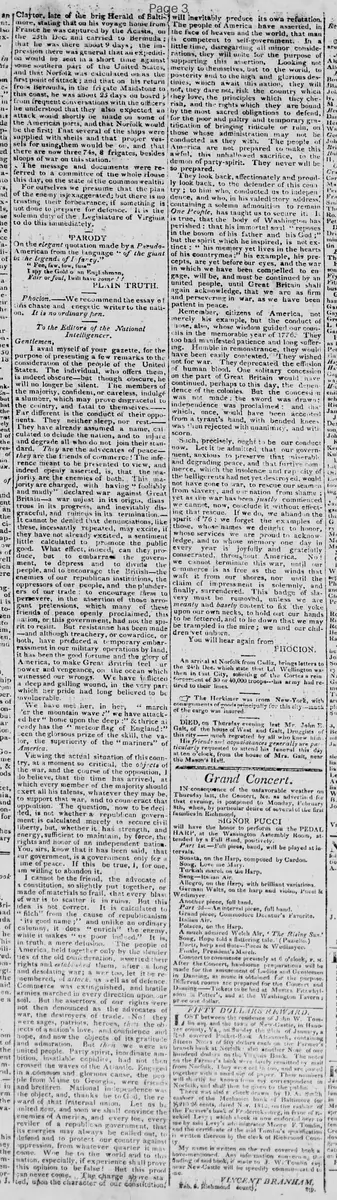
Phocion.—We recommend the essay of this chaste and energetic writer to the nation. It is no ordinary pen.
To the Editors of the National Intelligencer.
Gentlemen,
I avail myself of your gazette, for the purpose of presenting a few remarks to the consideration of the people of the United States. The individual who offers them, is indeed obscure—but though obscure, he will no longer be silent. The members of the majority, confident, or careless, indulge a slumber, which may prove disgraceful to the country, and fatal to themselves.----
Far different is the conduct of their opponents. They neither sleep, nor rest.— They have already assumed a name, calculated to delude the nation, and to injure and degrade all who do not join their standard. They are the advocates of peace— they are the friends of commerce! The inference meant to be presented to view, and indeed openly asserted, is, that, the majority are the enemies of both. This majority are charged, with having "foolishly and madly" declared war against Great Britain—a war unjust in its origin, disastrous in its progress, and inevitably disgraceful, and ruinous in its termination.—
It cannot be denied that denunciations, like these, incessantly repeated, may excite, if they have not already excited, a sentiment little calculated to promote the public good. What effect, indeed, can they produce, but to embarrass the government, to depress and to divide the people, and to encourage the British—the enemies of our republican institutions, the oppressors of our people, and the plunderers of our trade: to encourage them to persevere, in the assertion of those arrogant pretensions, which many of these friends of peace openly proclaimed, this nation, or this government, had not the spirit to resist. But resistance has been made—and although treachery, or cowardice, or both, have produced a temporary embarrassment in our military operations by land, it has been the good fortune and the glory of America, to make Great Britain feel our power and vengeance, on the ocean which witnessed our wrongs. We have inflicted a deep and galling wound, in the very part which her pride had long believed to be invulnerable.
We have met her, in her, "march o'er the mountain wave:" we have attacked her "home upon the deep:" & thrice already has the "meteor flag of England:" been the glorious prize of the skill, the valor, the superiority of the "mariners" of America.
Viewing the actual situation of this country, at a moment so critical, the objects of the war, and the Course of the opposition, I do believe, that the time has arrived, at which every member of the majority should exert all his talents, whatever they may be, to support that war, and to counteract that opposition. The question now to be decided, is not whether a republican government is calculated merely to secure civil liberty, but, whether it has strength, and energy, sufficient to maintain, by force, the rights and honor of an independent nation.
You, sirs, know that it has been said, that our government, is a government only for a time of peace. If this be true, I, for one, am willing to abandon it.
I cannot be the friend, the advocate of a constitution, so slightly put together, or made of materials so frail, that every blast of war is to scatter it in ruins. But this idea is not correct, It is calculated to "filch" from the cause of republicanism its good name; and unlike an ordinary calumny, it does "enrich" the enemy, while it makes "us poor indeed." It is, in truth, a mere delusion. The people of America, held together only by the slender ties of the old confederation, asserted their rights and established them, after a long and desolating war; a war too, let it be remembered, of attack, as well as of defence. Commerce was extinguished, and hostile armies marched in every direction upon our soil. But the assertors of our rights were not then denounced as the advocates of war, the destroyers of trade. No! they were sages, patriots, heroes, then the objects of a nation's love, and confidence and hope, and now the objects of its gratitude and admiration. But then we were an united people. Party spirit, inordinate ambition, insatiable cupidity, had not then crossed the waves of the Atlantic. Engaged in a common and glorious cause, the people from Maine to Georgia, were friends and brethren. National Independence was the object, and, thanks be to God, the reward of that fraternal union. Let us be united now, and soon we shall convince the enemies of America, and every foe, every reviler of a republican government, that its energies may always be called out, to defend and to protect our country against oppression, from whatever quarter it may come. Woe be to the world and to this nation, especially, if experience shall prove this opinion to be false! But this proof can never come. The charge above stated, upon the character of our constitution.
will inevitably produce its own refutation.
The people of America have asserted, in the face of heaven and the world, that man is competent to self-government. In a little time, disregarding all minor considerations, they will unite for the purpose of supporting this assertion, Looking not merely to themselves, but to the world, to posterity and to the high and glorious destinies; which await this nation, they will not, they dare not, risk the country which they love, the principles which they cherish, and the rights which they are bound by the most sacred obligations to defend, for the poor and paltry and temporary gratification of bringing ridicule or ruin, on those whose administration may not be conducted as they wish. The people of America are not prepared to make this awful, this unhallowed sacrifice, to the demon of party-spirit. They never will be so prepared.
They look back, affectionately and proudly look back, to the defender of this country; to him who, conducted us to independence, and who, in his valedictory address, containing a solemn admonition to remain One People, has taught us to secure it. It is true, that the body of Washington has perished: that his immortal soul "reposes in the bosom of his father and his God;" but the spirit which he inspired, is not extinct: "his memory yet lives in the hearts of his countrymen:" his example, his precepts, are yet before our eyes. and the war in which we have been compelled to engage, will be, and must be continued by an united people, until Great Britain shall again acknowledge, that we are as firm and persevering in war, as we have been patient in peace.
Remember, citizens of America, not merely his example, but the conduct of those, also, whose wisdom guided our councils in the memorable year of 1776. They too had manifested patience and long suffering. Humble in remonstrance, they would have been easily contented. They wished not for war. They deprecated the effusion of human blood. One solitary concession on the part of Great Britain would have continued, perhaps to this day, the dependence of the colonies. But the Concession was not made: the sword was drawn: independence was proclaimed: and that which, once, would have been accepted from a tyrant's hand, with bended knees was then rejected with unanimity, and with scorn.
Such, precisely, ought to be our conduct now. Let it be admitted that our government, anxious to preserve that miserable and degrading peace. and that furtive commerce, which the insolence and rapacity of the belligerents had not yet destroyed, would not have gone to war, to rescue our seamen from slavery, and our nation from shame; yet as the war has been justly commenced we cannot, now, conclude it without effecting that rescue. If we do, we abandon the spirit of '76: we forget the examples of those, whose names we delight to honor, whose services we are proud to acknowledge, and to whose memory one day in every year is joyfully and gratefully consecrated, throughout America. No! we cannot terminate this war, until our commerce is as free as the winds that waft it from our shores, nor until the claim of impressment is solemnly, and finally, surrendered. This badge of slavery must be removed, unless we are meanly and basely content to fix the yoke upon our own necks, to hold out our hands to be fettered, and to lie down that we may be trampled in the mire; we and our children yet unborn.
You will hear again from PHOCION.
What sub-type of article is it?
What themes does it cover?
What keywords are associated?
What entities or persons were involved?
Letter to Editor Details
Author
Phocion
Recipient
Editors Of The National Intelligencer
Main Argument
the war of 1812 is just and necessary to defend american rights against british impressment and trade violations; the republican government is capable of waging war effectively, and citizens must unite to support it against divisive opposition.
Notable Details