Thank you for visiting SNEWPapers!
Sign up free
Alexandria Gazette
Alexandria, Alexandria County, District Of Columbia
What is this article about?
The Joint High Commission signed a treaty in Washington for arbitrating US claims against Britain over Confederate cruisers during the Civil War, establishing neutral duties and a mixed commission for other claims from 1861-1865. It also grants reciprocal fishing liberties on coasts, resolving all differences.
Clipping
OCR Quality
Full Text
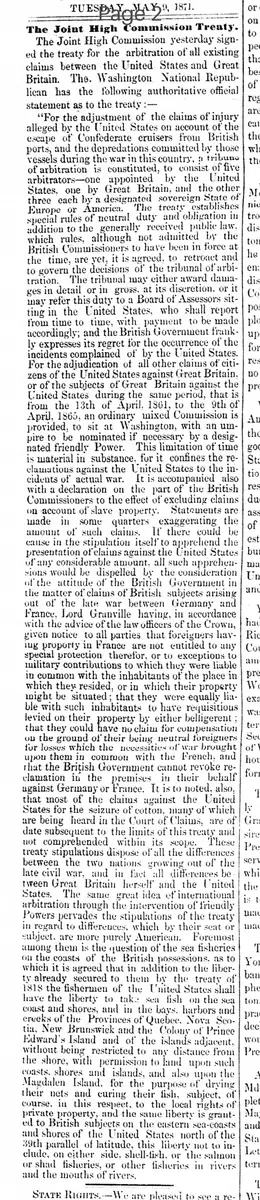
The Joint High Commission yesterday signed the treaty for the arbitration of all existing claims between the United States and Great Britain. The Washington National Republican has the following authoritative official statement as to the treaty: -
"For the adjustment of the claims of injury alleged by the United States on account of the escape of Confederate cruisers from British ports, and the depredations committed by those vessels during the war in this country, a tribunal of arbitration is constituted, to consist of five arbitrators - one appointed by the United States, one by Great Britain, and the other three each by a designated sovereign State of Europe or America. The treaty establishes special rules of neutral duty and obligation in addition to the generally received public law, which rules, although not admitted by the British Commissioners to have been in force at the time, are yet, it is agreed, to retroact and to govern the decisions of the tribunal of arbitration. The tribunal may either award damages in detail or in gross, at its discretion, or it may refer this duty to a Board of Assessors sitting in the United States, who shall report from time to time, with payment to be made accordingly; and the British Government frankly expresses its regret for the occurrence of the incidents complained of by the United States.
For the adjudication of all other claims of citizens of the United States against Great Britain or of the subjects of Great Britain against the United States during the same period, that is from the 13th of April, 1861, to the 9th of April, 1865, an ordinary mixed Commission is provided, to sit at Washington, with an umpire to be nominated if necessary by a designated friendly Power. This limitation of time is material in substance, for it confines the reclamations against the United States to the incidents of actual war. It is accompanied also with a declaration on the part of the British Commissioners to the effect of excluding claims on account of slave property. Statements are made in some quarters exaggerating the amount of such claims. If there could be cause in the stipulation itself to apprehend the presentation of claims against the United States of any considerable amount, all such apprehensions would be dispelled by the consideration of the attitude of the British Government in the matter of claims of British subjects arising out of the late war between Germany and France, Lord Granville having, in accordance with the advice of the law officers of the Crown, given notice to all parties that foreigners having property in France are not entitled to any special protection therefor, or to exceptions to military contributions to which they were liable in common with the inhabitants of the place in which they resided, or in which their property might be situated; that they were equally liable with such inhabitants to have requisitions levied on their property by either belligerent; that they could have no claim for compensation on the ground of their being neutral foreigners for losses which the necessities of war brought upon them in common with the French, and that the British Government cannot revoke reclamation in the premises in their behalf against Germany or France. It is to be noted, also, that most of the claims against the United States for the seizure of cotton, many of which are being heard in the Court of Claims, are of date subsequent to the limits of this treaty and not comprehended within its scope. These treaty stipulations dispose of all the differences between the two nations growing out of the late civil war, and in fact all differences between Great Britain herself and the United States. The same great idea of international arbitration through the intervention of friendly Powers pervades the stipulations of the treaty in regard to differences, which by their seat or subject, are more purely American. Foremost among them is the question of the sea fisheries on the coasts of the British possessions, as to which it is agreed that in addition to the liberty already secured to them by the treaty of 1818 the fishermen of the United States shall have the liberty to take sea fish on the sea coast and shores, and in the bays, harbors and creeks of the Provinces of Quebec, Nova Scotia, New Brunswick and the Colony of Prince Edward's Island and of the islands adjacent, without being restricted to any distance from the shore, with permission to land upon such coasts, shores and islands, and also upon the Magdalen Islands, for the purpose of drying their nets and curing their fish, subject, of course, in this respect, to the local rights of private property, and the same liberty is granted to British subjects on the eastern sea-coasts and shores of the United States north of the 39th parallel of latitude, this liberty not to include, on either side, shell-fish, or the salmon or shad fisheries, or other fisheries in rivers and the mouths of rivers."
What sub-type of article is it?
What keywords are associated?
What entities or persons were involved?
Where did it happen?
Foreign News Details
Primary Location
Washington
Event Date
Yesterday
Key Persons
Outcome
treaty establishes arbitration tribunal for civil war claims, mixed commission for other claims from april 13, 1861 to april 9, 1865, excluding slave property; grants reciprocal fishing liberties on coasts; resolves all differences between us and gb.
Event Details
The Joint High Commission signed a treaty arbitrating US claims against Britain for Confederate cruisers' escape and depredations, with a five-arbitrator tribunal applying retroactive neutral rules; Britain expresses regret. A mixed commission handles other claims from 1861-1865, limited to war incidents, excluding slave property claims. Additional provisions address fisheries, expanding US fishermen's liberties in British North American provinces and reciprocal rights for British in US.