Thank you for visiting SNEWPapers!
Sign up free
Gazette Of The United States
New York, New York County, New York
What is this article about?
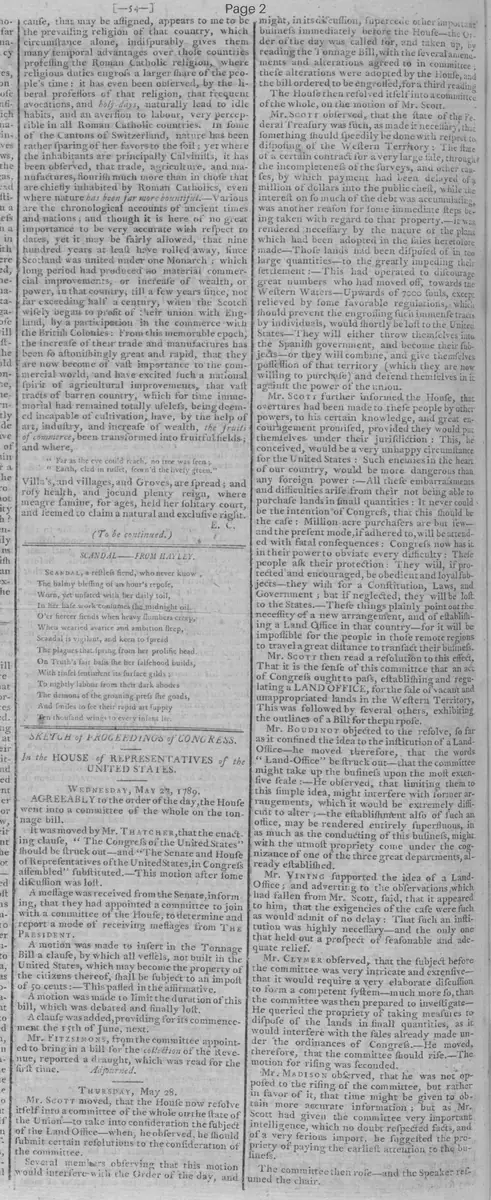
Proceedings of the U.S. House of Representatives from May 27-29, 1789, including debates and votes on the tonnage bill, discussions on establishing a land office for Western Territory sales to address settlement issues, reports on revenue collection, and administrative matters like journals and printing contracts.
Merged-components note: Continuation of the 'SKETCH Of PROCEEDINGS oF CONGRESS' report across pages 2 and 3, with seamless text flow and sequential reading order.
Clippings
1 of 2
OCR Quality
Full Text
In the HOUSE of REPRESENTATIVES of the UNITED STATES.
Wednesday, May 27, 1789.
Agreeably to the order of the day, the House went into a committee of the whole on the tonnage bill.
It was moved by Mr. Thatcher, that the enacting clause, "The Congress of the United States" should be struck out—and "The Senate and House of Representatives of the United States, in Congress assembled" substituted.—This motion after some discussion was lost.
A message was received from the Senate, informing, that they had appointed a committee to join with a committee of the House, to determine and report a mode of receiving messages from THE PRESIDENT.
A motion was made to insert in the Tonnage Bill a clause, by which all vessels, not built in the United States, which may become the property of the citizens thereof, shall be subject to an impost of 50 cents :—This passed in the affirmative.
A motion was made to limit the duration of this bill, which was debated and finally lost.
A clause was added, providing for its commencement the 15th of June, next.
Mr. Fitzsimons, from the committee appointed to bring in a bill for the collection of the Revenue, reported a draught, which was read for the first time.
Adjourned.
Thursday, May 28.
Mr. Scott moved, that the House now resolve itself into a committee of the whole on the state of the Union—to take into consideration the subject of the Land Office—when, he observed, he should submit certain resolutions to the consideration of the committee.
Several members observing that this motion would interfere—with the order of the day, and might, in its discussion, supercede other important business immediately before the House—the order of the day was called for, and taken up, by reading the Tonnage Bill, with the several amendments and alterations agreed to in committee; these alterations were adopted by the House, and the bill ordered to be engrossed, for a third reading.
The House then resolved itself into a committee of the whole, on the motion of Mr. Scott.
Mr. Scott observed, that the state of the Federal Treasury was such, as made it necessary, that something should speedily be done with respect to disposing of the Western Territory: The state of a certain contract for a very large sale, through the incompleteness of the surveys, and other causes, by which payment had been delayed of a million of dollars into the public chest, while the interest on so much of the debt was accumulating, was another reason for some immediate steps being taken with regard to that property.—it was rendered necessary by the nature of the plans which had been adopted in the sales heretofore made—Those lands had been disposed of in too large quantities—to the greatly impeding their settlement :—This had operated to discourage great numbers who had moved off, towards the Western Waters—Upwards of 7000 souls, except relieved by some favorable regulations, which should prevent the engrosing such immense tracts by individuals, would shortly be lost to the United States—They will either throw themselves into the Spanish government, and become their subjects—or they will combine, and give themselves possession of that territory (which they are now willing to purchase) and defend themselves in it against the power of the union.
Mr. Scott further informed the House, that overtures had been made to these people by other powers, to his certain knowledge, and great encouragement promised, provided they would put themselves under their jurisdiction: This, he conceived, would be a very unhappy circumstance for the United States: Such enemies in the heart of our country, would be more dangerous than any foreign power :-All these embarrassments and difficulties arise from their not being able to purchase lands in small quantities: It never could be the intention of Congress, that this should be the case: Million-acre purchasers are but few—and the present mode, if adhered to, will be attended with fatal consequences: Congress now has it in their power to obviate every difficulty: These people ask their protection: They will, if protected and encouraged, be obedient and loyal subjects—they wish for a Constitution, Laws, and Government; but if neglected, they will be lost to the States.—These things plainly point out the necessity of a new arrangement, and of establishing a Land Office in that country—for it will be impossible for the people in those remote regions to travel a great distance to transact their business.
Mr. Scott then read a resolution to this effect,
That it is the sense of this committee that an act of Congress ought to pass, establishing and regulating a LAND OFFICE, for the sale of vacant and unappropriated lands in the Western Territory,
This was followed by several others, exhibiting the outlines of a Bill for the purpose.
Mr. Boudinot objected to the resolve, so far as it confined the idea to the institution of a Land-Office—he moved, therefore, that the words "Land-Office" be struck out—that the committee might take up the business upon the most extensive scale :He observed, that limiting them to this single idea, might interfere with former arrangements, which it would be extremely difficult to alter ;—the establishment also of such an office, may be rendered entirely superfluous, in as much as the conducting of this business, might with the utmost propriety come under the cognizance of one of the three great departments, already established.
Mr. Vining supported the idea of a Land-Office; and adverting to the observations which had fallen from Mr. Scott, said, that it appeared to him, that the exigencies of the case were such as would admit of no delay: That such an institution was highly necessary—and the only one that held out a prospect of seasonable and adequate relief.
Mr. Clymer observed, that the subject before the committee was very intricate and extensive—that it would require a very elaborate discussion to form a competent system—much more so, than the committee was then prepared to investigate—He queried the propriety of taking measures to dispose of the lands in small quantities, as it would interfere with the sales already made under the ordinances of Congress.—He moved, therefore, that the committee should rise.—The motion for rising was seconded.
Mr. Madison observed, that he was not opposed to the rising of the committee, but rather in favor of it, that time might be given to obtain more accurate information; but as Mr. Scott had given the committee very important intelligence, which no doubt respected facts, and of a very serious import, he suggested the propriety of paying the earliest attention to the business.
The committee then rose—and the Speaker resumed the chair.
It was then moved, that a select committee be now appointed, to enquire into the state of the unappropriated lands in the Western Territory, and to report what steps are necessary to be taken for the sale of those lands.
This motion was opposed upon various grounds: Some considered it as an expedient to get rid of the business; others contended that it entered into the decision of a question, as to the sale of the lands, which the committee were in no measure sufficiently informed to determine--The motion after considerable discussion, was divided, and the latter clause, negatived.—A committee was then appointed agreeably to the first part, consisting of Mr. Scott, Mr. Huntington, and Mr. Sherman.
Mr. Heister introduced a resolve to the following effect, That every such member of this present Congress as is not furnished with the journals of the late Congress, upon application to the keeper of the records, be furnished with a complete set of such journals.
This resolve was adopted unanimously.
Mr. Seney then moved, that the report of the joint committee upon the subject of news-papers and printing, which has lain several days on the table, should be taken up.
This report being read, the first part which provides for supplying every member of Congress with "one news-paper" at the public expense; was objected to—a variety of observations were made, and the clause finally rejected—the latter part respecting the public printing, and giving power to the Clerk of the House, and Secretary of the Senate, to form the necessary contract. was adopted, and then the House adjourned.
FRIDAY, MAY 29.
The engrossed bill, imposing a duty on tonnage, was read the third time—and passed.
Mr. Partridge, from the committee appointed to confer with the Senate, on a proper mode of receiving bills and messages from the President, reported— that until the public offices are established, and proper officers appointed, messages or bills may be received by either House, under cover, directed to the President of the Senate, or the Speaker of the House of Representatives.—
This report, with some amendments, was accepted.
A motion was then made, that the bill regulating the collection of the revenue, should be considered in a committee of the whole, on Monday next.—This passed in the affirmative.
Mr. White introduced an amendment of the rule of the House, respecting the appointment of committees by ballot It was proposed, that all committees should be appointed by the Speaker, except when the House should order otherwise.
This was objected to by divers members —and advocated by others :—Several modifications were proposed, as expedients to get rid of the mode of balloting, which was considered as tedious, and occasioning unnecessary loss of time; but after some spirited observations on both sides the question, Mr. White's motion, with every qualification of it, was lost by a large majority—and the rule of the House remains as it originally stood.- Adjourned until Monday next.
What sub-type of article is it?
What keywords are associated?
What entities or persons were involved?
Where did it happen?
Domestic News Details
Primary Location
United States
Event Date
May 27 29, 1789
Key Persons
Outcome
tonnage bill passed with amendments; select committee appointed to inquire into western territory lands; resolve for furnishing journals adopted; newspaper supply clause rejected, printing contract clause adopted; committee appointment rule unchanged.
Event Details
The House debated and amended the tonnage bill, adding clauses for foreign-built vessels and commencement date; received Senate message on presidential communications; reported revenue collection bill; discussed establishing a land office for Western Territory sales to facilitate small purchases and prevent loss of settlers, appointing a committee; adopted resolves for journals and printing; passed tonnage bill on third reading; accepted report on receiving presidential messages; scheduled revenue bill consideration.