Thank you for visiting SNEWPapers!
Sign up free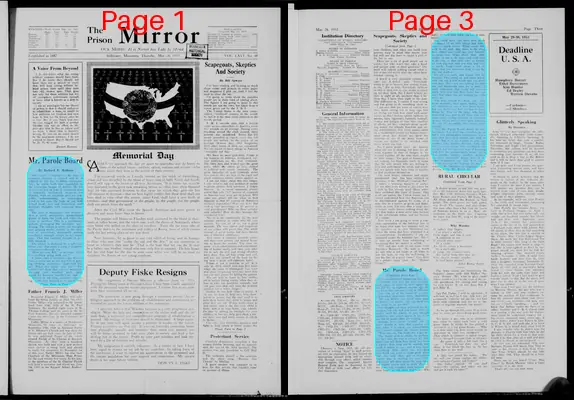
Story
May 28, 1953
The Prison Mirror
Stillwater, Washington County, Minnesota
What is this article about?
A first-person narrative from an inmate's perspective during a tense parole board interview, capturing anxiety, unspoken hopes for freedom, family longing, and uncertainty about the decision.
Merged-components note: This is a continuation of the story 'Mr. Parole Board' from page 1 to page 3.
Clippings
1 of 2
OCR Quality
98%
Excellent
Full Text
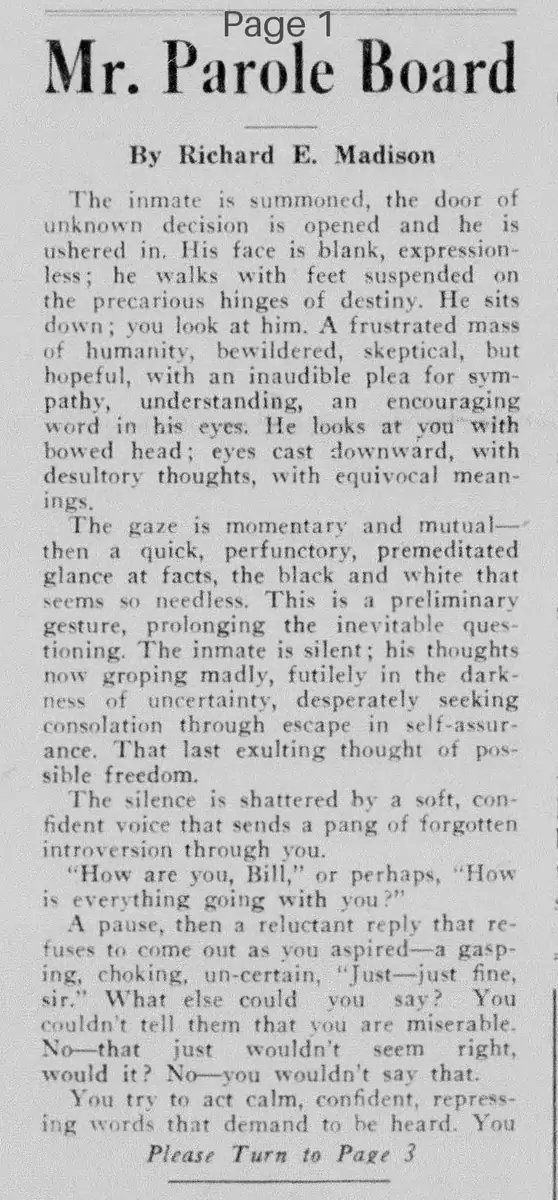
Mr. Parole Board
By Richard E. Madison
The inmate is summoned, the door of unknown decision is opened and he is ushered in. His face is blank, expressionless; he walks with feet suspended on the precarious hinges of destiny. He sits down; you look at him. A frustrated mass of humanity, bewildered, skeptical, but hopeful, with an inaudible plea for sympathy, understanding, an encouraging word in his eyes. He looks at you with bowed head: eyes cast downward, with desultory thoughts, with equivocal meanings.
The gaze is momentary and mutual then a quick, perfunctory, premeditated glance at facts, the black and white that seems so needless. This is a preliminary gesture, prolonging the inevitable questioning. The inmate is silent: his thoughts now groping madly, futilely in the darkness of uncertainty, desperately seeking consolation through escape in self-assurance. That last exulting thought of possible freedom.
The silence is shattered by a soft, confident voice that sends a pang of forgotten introversion through you.
"How are you, Bill," or perhaps, "How is everything going with you?"
A pause, then a reluctant reply that refuses to come out as you aspired—a gasping, choking, uncertain, "Just—just fine, sir." What else could you say? You couldn't tell them that you are miserable. No—that just wouldn't seem right, would it? No—you wouldn't say that. You try to act calm, confident, repressing words that demand to be heard. You
Please Turn to Page 3
Mr. Parole Board
Continued from Page 1
feel so uncomfortable imagining their look of austerity. You feel like you are being tried again, to start all over again like you did five or eighteen months ago, but you know this outcome could be different.
You look up at the sound of a voice; a somewhat imperious voice, imperative. "Do you believe you could make good on parole," or maybe, "do you think you are ready to be paroled?"
You thought you were prepared for this question, but you find you aren't and you quickly send the wheels of your thought machinery into action again. It has to be yes, but be quick—they are waiting.
Strange, how you've waited for so many months to hear that question and then when it is asked, you inadvertently find yourself without the correct answer.
"Yes, yes, sir, I'm ready for a parole."
The words seem so empty, so needless; but isn't that the way it always is? Why didn't you tell them how much you want a parole; how long you've waited; how much it means to you; and it does mean everything. Why didn't you tell them how much you want to make good, about that job and that girl or wonderful mother that is waiting for you? Why didn't you tell them about the long sleepless nights you've had to think about it, the times you wouldn't sleep because you were lonely or just plain homesick? Why didn't you tell them what you felt in your heart?
You could have told them how much you missed all the little things that didn't mean so much before. What about that walk in the park, that drive to the drug store, where you could buy your favorite ice-cream cone. What about that little brother or son in the back yard with mud on his face, or that little sister or daughter with pig tails that you miss and love so much. Yeah—what about a lot of things, that you just can't seem to say the way you want to?
It's all over now, that frantic bid for freedom. They stand up and shake hands with you, say a few words that you don't even hear. No—you are looking for that last and hundredth time for a smile, a small indication that could tell you so much. You look into their faces, but you don't find what you are looking for; you never do.
You turn around to walk out. You pause mentally, once again finding yourself wanting to say a few more words. But you don't: you feel it's best to leave things be. You, as the many who have preceded you, and as all those who will ensue, leave feeling dejected, as uncertain of your future as you were upon entering.
We are all pessimists after being interviewed.
You, Mr. Parole Board, decide his fate, his future. You don't have much to go on but a few meaningless expressions, a few facts that have died months ago, with no value. But it is all routine to you, just another vote, another decision. Sure, you feel you are being fair, un-biased and certain, but you have no way of knowing and you are unconsciously aware of it.
Yes—another inmate, another decision, one more potentially happy man or another despondent one. Yes, it is ended. It's all over but the waiting, the tears or ecstasy, the bitterness or forgetting—how do you know, Mr. Parole Board?
By Richard E. Madison
The inmate is summoned, the door of unknown decision is opened and he is ushered in. His face is blank, expressionless; he walks with feet suspended on the precarious hinges of destiny. He sits down; you look at him. A frustrated mass of humanity, bewildered, skeptical, but hopeful, with an inaudible plea for sympathy, understanding, an encouraging word in his eyes. He looks at you with bowed head: eyes cast downward, with desultory thoughts, with equivocal meanings.
The gaze is momentary and mutual then a quick, perfunctory, premeditated glance at facts, the black and white that seems so needless. This is a preliminary gesture, prolonging the inevitable questioning. The inmate is silent: his thoughts now groping madly, futilely in the darkness of uncertainty, desperately seeking consolation through escape in self-assurance. That last exulting thought of possible freedom.
The silence is shattered by a soft, confident voice that sends a pang of forgotten introversion through you.
"How are you, Bill," or perhaps, "How is everything going with you?"
A pause, then a reluctant reply that refuses to come out as you aspired—a gasping, choking, uncertain, "Just—just fine, sir." What else could you say? You couldn't tell them that you are miserable. No—that just wouldn't seem right, would it? No—you wouldn't say that. You try to act calm, confident, repressing words that demand to be heard. You
Please Turn to Page 3
Mr. Parole Board
Continued from Page 1
feel so uncomfortable imagining their look of austerity. You feel like you are being tried again, to start all over again like you did five or eighteen months ago, but you know this outcome could be different.
You look up at the sound of a voice; a somewhat imperious voice, imperative. "Do you believe you could make good on parole," or maybe, "do you think you are ready to be paroled?"
You thought you were prepared for this question, but you find you aren't and you quickly send the wheels of your thought machinery into action again. It has to be yes, but be quick—they are waiting.
Strange, how you've waited for so many months to hear that question and then when it is asked, you inadvertently find yourself without the correct answer.
"Yes, yes, sir, I'm ready for a parole."
The words seem so empty, so needless; but isn't that the way it always is? Why didn't you tell them how much you want a parole; how long you've waited; how much it means to you; and it does mean everything. Why didn't you tell them how much you want to make good, about that job and that girl or wonderful mother that is waiting for you? Why didn't you tell them about the long sleepless nights you've had to think about it, the times you wouldn't sleep because you were lonely or just plain homesick? Why didn't you tell them what you felt in your heart?
You could have told them how much you missed all the little things that didn't mean so much before. What about that walk in the park, that drive to the drug store, where you could buy your favorite ice-cream cone. What about that little brother or son in the back yard with mud on his face, or that little sister or daughter with pig tails that you miss and love so much. Yeah—what about a lot of things, that you just can't seem to say the way you want to?
It's all over now, that frantic bid for freedom. They stand up and shake hands with you, say a few words that you don't even hear. No—you are looking for that last and hundredth time for a smile, a small indication that could tell you so much. You look into their faces, but you don't find what you are looking for; you never do.
You turn around to walk out. You pause mentally, once again finding yourself wanting to say a few more words. But you don't: you feel it's best to leave things be. You, as the many who have preceded you, and as all those who will ensue, leave feeling dejected, as uncertain of your future as you were upon entering.
We are all pessimists after being interviewed.
You, Mr. Parole Board, decide his fate, his future. You don't have much to go on but a few meaningless expressions, a few facts that have died months ago, with no value. But it is all routine to you, just another vote, another decision. Sure, you feel you are being fair, un-biased and certain, but you have no way of knowing and you are unconsciously aware of it.
Yes—another inmate, another decision, one more potentially happy man or another despondent one. Yes, it is ended. It's all over but the waiting, the tears or ecstasy, the bitterness or forgetting—how do you know, Mr. Parole Board?
What sub-type of article is it?
Biography
What themes does it cover?
Misfortune
Justice
Family
What keywords are associated?
Parole Hearing
Inmate Anxiety
Prison Experience
Family Longing
Justice System
What entities or persons were involved?
Bill
Mr. Parole Board
Where did it happen?
Parole Board Room
Story Details
Key Persons
Bill
Mr. Parole Board
Location
Parole Board Room
Story Details
An inmate endures a parole interview marked by anxiety, unspoken longing for family and freedom, and uncertainty, addressing the parole board's detached decision-making.